

Description
Overview
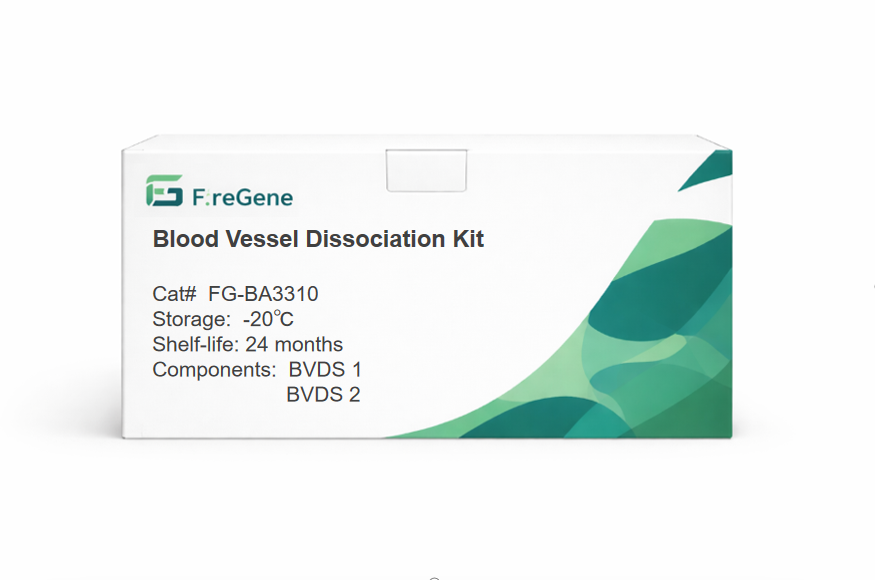
FireGene Blood Vessel Dissociation Kit is specifically developed for the efficient enzymatic dissociation of vascular tissues into high-viability single-cell suspensions. This advanced kit is ideal for applications in single-cell sequencing, vascular biology, and drug discovery.
Background Information
-
Driven by Clinical and Scientific Research Needs:
- Understanding cellular heterogeneity in vascular tissues is vital for investigating vascular diseases such as atherosclerosis and vasculitis.
- Conventional methods often damage delicate vascular cells or fail to isolate distinct populations.
- This kit enables:
- Identification of endothelial cells, smooth muscle cells, fibroblasts, and immune infiltrates.
- Discovery of biomarkers and gene targets associated with vascular inflammation and remodeling.
- Advancement of clinical research and therapeutic development in cardiovascular pathology.
-
Background of Technological Development:
- Designed to improve upon the low efficiency and high cell damage rates of traditional techniques.
- Integrates:
- Carefully selected enzymatic blends for vascular matrix degradation.
- Optimized parameters for enzyme concentration, temperature, and incubation duration.
- Workflow that ensures enhanced cell viability, higher recovery rates, and consistent performance across experiments.
Detection Principle
- Utilizes a multi-enzyme digestion protocol suited to the unique composition of blood vessel tissue.
- Process:
- Tissue is finely sectioned to facilitate penetration.
- Enzymes are applied sequentially under controlled temperature and timing.
- Matrix components and cellular junctions are enzymatically degraded.
- Results in:
- A clean, high-quality single-cell suspension ready for scRNA-seq, FACS, or downstream analysis.
Specifications
| Applications | Single-cell sequencing, cell culture or other cell-related detections |
| Compatible Sample Types | Blood vessel tissue |
| Supported Instruments | Water bath, horizontal centrifuge, cell counter |
| Storage | -20 °C |
| Shelf-life | 24 months |
Kit Components
10 Reactions
| Component | 10 Reactions/Kit |
| BVDS1 (Blood vessel dissociation solution 1) | 2 × 1.1 mL |
| BVDS1 (Blood vessel dissociation solution 2) | 4 × 1.35 mL |
50 Reactions
| Component | 50 Reactions/Kit |
| BVDS1 (Blood vessel dissociation solution 1) | 10 × 1.1 mL |
| BVDS1 (Blood vessel dissociation solution 2) |
20 × 1.35 mL |
1. Q: Is this kit suitable for vascular tissue of all mammals? Are there differences in dissociation effects on arteries, veins, and capillaries? Can it be used for vascular tumor tissue (e.g., angiosarcoma)?
A: The kit is suitable for normal vascular tissue (including arteries and veins) of mammals such as humans and mice, but it is not recommended for capillaries or vascular tumor tissue for the time being. Capillaries have extremely thin walls (only 1-2 cell layers), which are prone to rupture during dissociation, making it difficult to obtain intact single cells. The cell structure and extracellular matrix of vascular tumor tissue are significantly different from those of normal blood vessels, and the enzymatic hydrolysis parameters do not match, which may lead to incomplete dissociation or low cell viability. There are slight differences in the dissociation effects on arteries and veins: due to the thicker wall and rich elastic fibers of arteries, the incubation time of Dissociation Solution 2 needs to be 20-30 minutes longer than that of veins, and the specific duration should be adjusted through quality inspection.
2. Q: The kit is labeled "10 rxns". What are the respective dosages of Vascular Tissue Dissociation Solution 1 and Dissociation Solution 2 per experiment? If only 100mg of vascular tissue is processed in a single experiment, can the reagent dosage be reduced proportionally?
A: For each experiment (200mg of tissue), 210μL of Vascular Tissue Dissociation Solution 1 and 530μL of Vascular Tissue Dissociation Solution 2 are required. If 100mg of tissue (1/2 of the standard dosage) is processed, the reagent dosage can be reduced proportionally: Dissociation Solution 1 is reduced to 105μL (matched with 1395μL of RPMI 1640 medium), and Dissociation Solution 2 is reduced to 265μL (matched with 1235μL of RPMI 1640 medium). It should be noted that the reagent volume must ensure pipetting accuracy (single pipetting volume is not less than 50μL). If the tissue volume is less than 50mg, it is not recommended to further reduce the dosage, so as to avoid pipetting errors caused by too small volume, which will destroy the proportional balance between enzymes and tissues and affect the dissociation effect.
3. Q: Both Step 3 and the incubation of Dissociation Solution 2 require a "37°C water bath or hybridization oven". Besides "manual shaking" and "automatic rotation speed", what other precautions are there for the operation of the two devices? Which one is more suitable for vascular tissue dissociation?
A: Additional precautions: ① The water bath needs to check the water level regularly (ensure that the centrifuge tube is immersed more than 1/2 of the water surface to avoid uneven local temperature); ② The hybridization oven needs to be preheated 10 minutes in advance to ensure that the temperature inside the cavity is stable before putting in the sample. In terms of effect, the hybridization oven is more suitable for vascular tissue dissociation: vascular tissue (especially arteries) has a relatively tough texture, and manual shaking is prone to "local excessive enzymatic hydrolysis and local undigestion"; the automatic rotation speed of 20-30 rpm of the hybridization oven can make the dissociation solution evenly wrap the tissue, avoid the accumulation of fiber components, and the single-cell yield is 15%-20% higher than that of the water bath. If a water bath is used, it is necessary to shake it strictly once every 3 minutes for 10 seconds each time to ensure that no tissue sinks to the bottom.
4. Q: Step 7 mentions "quality inspection at regular intervals". What are the quality inspection intervals and judgment criteria for vascular tissue dissociation? If low cell viability is found during quality inspection but there are still undigested vascular debris, how to deal with it?
A: Quality inspection interval: In the first 1 hour of incubation with Dissociation Solution 2, quality inspection is conducted once every 20 minutes; after 1 hour, quality inspection is conducted once every 30 minutes. Quality inspection operation: Take 10μL of suspension, stain with trypan blue, and observe under a microscope to check the number and viability. The elastic fibers and collagen fibers in vascular tissue will adsorb enzymes, and continuous incubation will cause the enzymes to act excessively on cells rather than debris; the residual debris can be removed by filtration through a 70μm cell sieve, and complete dissociation is not required to avoid further decline in cell viability.
5. Q: Steps 8-10 require filtration with a 70μm cell sieve and rinsing the centrifuge tube 3 times to collect a total of 12mL of filtrate. What impact will omitting one rinsing step have on the experimental results? Can a 40μm cell sieve replace the 70μm one?
A: Omitting one rinsing step will result in the loss of about 1/3 of the residual cells, reducing the final cell yield by 25%-30%. Cells after vascular dissociation (such as endothelial cells and smooth muscle cells) are easily adsorbed on the inner wall of the centrifuge tube, and 3 rinsing steps are the key to ensuring full cell recovery. A 40μm cell sieve cannot replace the 70μm one: the pore size of the 40μm sieve is too small, which will retain some single cells derived from blood vessels (for example, the diameter of endothelial cells is about 8-12μm, which can pass through, but the sieve is easily blocked by fiber debris, leading to difficult filtration and even cell extrusion to reduce viability); the 70μm sieve can not only filter debris but also ensure that single cells pass through smoothly, which is the best choice.
6. Q: The instruction manual mentions that "DMEM medium can replace RPMI 1640 medium". After replacement, is it necessary to adjust the reagent dosage or incubation time? Is there any difference in the impact of the two media on the viability of vascular cells?
A: There is no need to adjust the reagent dosage or incubation time after replacement. Both DMEM and RPMI 1640 are common basic media for mammalian cells. Although there are differences in glucose and amino acid content, both can provide a suitable osmotic pressure (280-320mOsm/kg) and pH (7.2-7.4) for vascular tissue dissociation, and have no impact on the enzymatic hydrolysis efficiency. The impact on cell viability is minimal: you can choose freely according to the laboratory inventory without deliberate replacement.
7. Q: If there are many red blood cells in the cell suspension after dissociation and BA3311 Red Blood Cell Lysis Buffer is needed to remove them, at which step should this operation be performed? What should be noted during lysis to avoid damaging vascular cells?
A: The operation should be performed after Step 13 and before Step 14: after completing two washing steps in Step 13 and discarding the supernatant, add 1mL of BA3311 Red Blood Cell Lysis Buffer, incubate in an ice bath for 5 minutes (instead of room temperature to reduce toxicity to vascular cells), discard the supernatant, then resuspend with 5mL of PBS containing 5% FBS (add an additional washing step), and then proceed to Step 14. Precautions: ① The lysis time should not exceed 8 minutes, and the ice bath can slow down the damage of the lysis buffer to vascular cells (especially endothelial cells); ② If there are too many red blood cells, lysis can be repeated once, but PBS washing is required again to avoid residual lysis buffer affecting subsequent experiments (such as cell capture efficiency in single-cell sequencing).
8. Q: The kit needs to be stored at -20°C. If the ice pack melts during transportation and the reagent is placed at 4°C for 2 hours, can it still be used? What impact does repeated freezing and thawing have on the dissociation solution?
A: It can be used continuously if placed at 4°C for 2 hours, but it must be immediately returned to -20°C and fully mixed before subsequent use. The enzymes (such as collagenase and elastase) in the dissociation solution lose ≤10% of their activity when placed at 4°C for a short time (≤2 hours), which does not affect the dissociation effect. Repeated freezing and thawing will lead to a significant decrease in enzyme activity: each freeze-thaw cycle reduces enzyme activity by 12%-18%; after more than 3 freeze-thaw cycles, the activity is less than 50%, which cannot effectively decompose the fiber components of vascular tissue, resulting in a large number of tissue blocks after dissociation. It is recommended that after receiving the kit, aliquot Dissociation Solution 1 (2×1.1mL) into 110μL/tube and Dissociation Solution 2 (4×1.35mL) into 270μL/tube, seal them and store at -20°C. Take 2 tubes of Dissociation Solution 1 and 2 tubes of Dissociation Solution 2 (corresponding to 1 dose) for each experiment to avoid repeated freezing and thawing.
9. Q: In Step 6, the incubation time of Dissociation Solution 2 is "30 minutes - 3 hours". How to set the initial incubation time for different types of vascular tissue (such as mouse aorta and human vein)?
A: Recommendations for initial incubation time: ① Mouse aorta (thick-walled artery): incubate for 1 hour first, then adjust through quality inspection; ② Mouse vein (thin-walled vein): incubate for 30 minutes first, then adjust through quality inspection; ③ Human aorta (thicker, richer in fiber components): incubate for 1.5 hours first, then adjust through quality inspection; ④ Human vein: incubate for 45 minutes first, then adjust through quality inspection. Core principle: the thicker the vessel wall and the more fiber components, the longer the initial incubation time, but dynamic adjustment is required through quality inspection. If the viability is ≥75% and there is little debris after 1 hour, the incubation can be stopped in advance; if the viability is low, even if there is much debris, the incubation must be terminated to avoid excessive digestion.
10. Q: After quality control in Step 15, it is required to "carry out subsequent experiments immediately". If subsequent experiments cannot be carried out immediately, can the prepared vascular cell suspension be stored for a short time? What are the restrictions on storage conditions and time?
A: Short-term storage is possible. The storage condition is sealed storage in a 4°C refrigerator for no more than 1.5 hours, and repeated shaking should be avoided. During storage, the cell concentration should be adjusted to 1×10⁶-1×10⁷ cells/mL with PBS containing 5% FBS, and placed in a low-adhesion centrifuge tube. After 1.5 hours, the viability of vascular cells (especially endothelial cells) will decrease significantly (decreasing by 10%-12% per hour), and cell aggregation is prone to occur; if stored for more than 3 hours, the cell viability may be lower than 50%, which cannot be used for single-cell sequencing or cell culture. Before use, re-quality inspection is required, and only cells with viability ≥65% can be used. In addition, gently pipette 5-8 times to disperse slightly aggregated cells.
Files Download Links