

Description
Overview
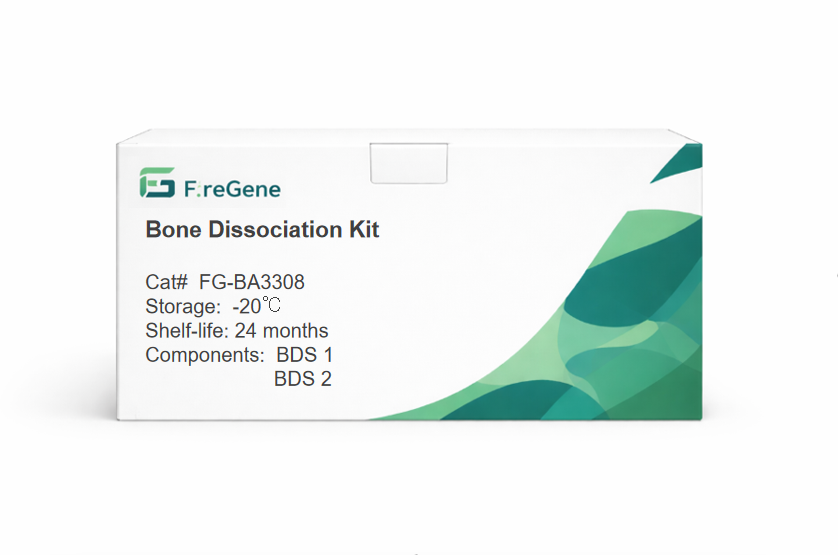
The FireGene Bone Dissociation Kit is a powerful enzymatic solution designed to generate high-quality single-cell suspensions from bone tissue. It is ideal for applications in bone disease research, regenerative medicine, and stem cell studies, offering consistent and viable cell isolation.
Background Information
-
Driven by Clinical and Scientific Research Needs:
-
Bone tissue research is essential for studying diseases like osteoporosis and bone tumors.
-
Single-cell level analysis allows for better understanding of cellular heterogeneity in bone tissue.
-
Conventional tissue sectioning methods are insufficient for detailed cellular exploration.
-
In regenerative medicine, isolating viable bone cells (e.g., mesenchymal stem cells) is critical for tissue engineering.
-
High-quality single-cell suspensions support cell culture, differentiation, and downstream analysis.
-
-
Background of Technological Development:
-
Traditional dissociation methods often lead to cell damage and poor efficiency.
-
This kit leverages advanced enzymatic techniques with:
-
Precisely selected enzymes tailored to bone matrix breakdown.
-
Optimized enzyme concentrations and reaction conditions.
-
Improved dissociation efficiency and enhanced cell viability for experimental reproducibility.
-
-
Detection Principle
-
Uses a two-step enzymatic digestion method tailored to the density and complexity of bone tissue.
-
Process:
-
Bone tissue is cut into small pieces.
-
Two enzyme mixtures are added successively under controlled conditions.
-
Enzymes break down the extracellular matrix and intercellular junctions.
-
-
The result:
-
Clean, viable single-cell suspensions suitable for flow cytometry, scRNA-seq, and cell culture.
-
Specifications
| Applications | Single-cell sequencing, cell culture or other cell-related detections |
| Compatible Sample Types | Bone tissue, including cartilage and bone |
| Supported Instruments | Water bath, horizontal centrifuge, cell counter |
| Storage | -20 °C |
| Shelf-life | 24 months |
Kit Components
10 reactions/kit
| Component | Pack Size |
|---|---|
| BDS1 (Bone Dissociation Solution 1) | 2 × 1.1 mL |
| BDS2 (Bone Dissociation Solution 2) | 2 × 1.4 mL |
50 reactions/kit
| Component | Pack Size |
|---|---|
| BDS1 (Bone Dissociation Solution 1) | 10 × 1.1 mL |
| BDS2 (Bone Dissociation Solution 2) | 10 × 1.4 mL |
Product Q&A
1. Q: Is this kit suitable for all types of bone tissue? Do the operation steps need to be adjusted for the dissociation of cartilage and hard bone?
A: The kit is suitable for cartilage and hard bone tissue of mammals such as humans and mice. However, since hard bone has a higher degree of mineralization, two points should be noted during dissociation: first, the chopping step needs to be more thorough (chop into small pieces of 1mm³ or less as much as possible) to ensure the dissociation solution fully contacts the tissue; second, the incubation time of Dissociation Solution 2 can be appropriately extended (8-14 hours recommended for hard bone, 6-10 hours for cartilage), and specific adjustments should be made based on quality inspection results. No other operation steps need to be changed; only the chopping degree and incubation time are optimized to adapt to different types of bone tissue.
2. Q: The kit is labeled "10 tests". What are the respective dosages of Bone Tissue Dissociation Solution 1 and Dissociation Solution 2 per experiment? If only 100mg of bone tissue needs to be processed in a single experiment, can the reagent dosage be reduced proportionally?
A: For each experiment (200mg of tissue), 210μL of Bone Tissue Dissociation Solution 1 and 280μL of Bone Tissue Dissociation Solution 2 are required. If processing 100mg of tissue (1/2 of the standard dosage), the reagent dosage can be reduced proportionally: Dissociation Solution 1 reduced to 105μL (mixed with 1395μL of RPMI 1640 medium), and Dissociation Solution 2 reduced to 140μL (mixed with 1360μL of RPMI 1640 medium). Note: The reagent volume must ensure pipetting accuracy (it is recommended that a single pipetting volume is not less than 50μL). If the tissue amount is less than 50mg, it is not recommended to further reduce the dosage proportionally, to avoid pipetting errors caused by too small reagent volume and thus affecting the dissociation effect.
3. Q: Both Step 3 and the incubation of Dissociation Solution 2 mention "37°C water bath or hybridization oven". What are the differences in operation and effect between the two devices? Which one is more suitable for bone tissue dissociation?
A: The core difference lies in the mixing method: a water bath requires manual shaking of the centrifuge tube every 3-5 minutes to ensure the tissue contacts the dissociation solution; a hybridization oven can be set to 20-30 rpm for automatic mixing, reducing manual operation errors. In terms of effect, the hybridization oven is more suitable for bone tissue dissociation. Bone tissue has a hard texture, and manual shaking is prone to uneven local contact, leading to incomplete dissociation; automatic mixing allows the dissociation solution to continuously wrap the tissue, which can significantly improve the single-cell yield especially during the long-term incubation (6-14 hours) of Dissociation Solution 2. If a water bath is used, the 3-5 minute shaking frequency must be strictly followed to avoid omissions.
4. Q: Step 7 mentions "quality inspection at regular intervals". What are the quality inspection intervals and judgment criteria for bone tissue dissociation? If cell viability is low but the tissue is not fully dissociated during quality inspection, how to handle it?
A: Recommended quality inspection intervals: in the first 4 hours of Dissociation Solution 2 incubation, conduct quality inspection once every 1 hour; after 4 hours, conduct it once every 2 hours. Quality inspection operation: take 10μL of the suspension, stain with trypan blue, and observe under a microscope. The core judgment criteria are cell viability ≥70% and tissue clump proportion ≤10%. If cell viability is low (<60%) but there are still tissue clumps, digestion must be stopped immediately. In bone tissue dissociation, the damage to cell viability caused by excessive enzymolysis is irreversible; continued incubation will lead to a further decrease in viability. Residual tissue clumps can be removed by filtration in subsequent steps, and complete dissociation is not necessary.
5. Q: Steps 8-10 require filtration with a 70μm cell sieve and rinsing the centrifuge tube 3 times, collecting a total of 12mL of filtrate. What impact will omitting one rinsing step have on the experimental results? Can a 100μm cell sieve replace the 70μm one?A: Omitting one rinsing step will result in the loss of approximately 1/3 of residual cells, reducing the final cell yield by 25%-30%. Cells are prone to adhering to the inner wall of the centrifuge tube after bone tissue dissociation, so 3 rinsing steps are the key to ensuring full cell recovery. A 100μm cell sieve cannot replace the 70μm one: the pore size of the 100μm sieve is too large to effectively filter fine debris (such as mineralized particles and fiber residues) remaining in bone tissue. These impurities will interfere with subsequent cell counting and even block single-cell sequencing chips, affecting experimental results.
6. Q: The instruction manual states that "DMEM medium can replace RPMI 1640 medium". After replacement, is it necessary to adjust the reagent dosage or incubation time? Do the two media have an impact on the cell viability of bone tissue dissociation?
A: No adjustment to reagent dosage or incubation time is needed after replacement. Both DMEM and RPMI 1640 are common basal media for mammalian cells. Although they differ in amino acid and vitamin content, both can provide a suitable osmotic pressure and pH environment for bone tissue dissociation, with no impact on dissociation efficiency. The impact on cell viability is minimal: experimental data shows that the difference in cell viability after dissociating mouse femur tissue with the two media is ≤4%. The medium can be selected based on the existing inventory in the laboratory, with no need for deliberate replacement.
7. Q: If there are many red blood cells in the cell suspension after dissociation and FG-BA3311 Red Blood Cell Lysis Buffer is required for removal, at which step should this operation be performed? What precautions should be taken during lysis?
A: The operation should be performed after Step 13 and before Step 14: after completing the two washing steps in Step 13 and discarding the supernatant, add 1mL of FG-BA3311 Red Blood Cell Lysis Buffer, incubate at room temperature for 5 minutes, centrifuge at 300×g for 5 minutes at 4°C, discard the supernatant, and resuspend the pellet with 5mL of PBS containing 5% FBS (adding an extra washing step) before proceeding to Step 14. Precautions: The lysis time should not be too long, otherwise it will damage bone tissue-derived cells (such as osteoblasts and osteoclasts); if there are too many red blood cells, lysis can be repeated once, but an additional washing step is required to avoid residual lysis buffer affecting subsequent experiments.
8. Q: The kit needs to be stored at -20°C. If the ice pack melts during transportation and the reagent is left at 4°C for 3 hours, can it still be used? What are the impacts of repeated freezing and thawing?
A: The reagent can still be used if left at 4°C for 1 hour, but it should be immediately returned to -20°C and fully mixed before subsequent use. The enzyme in the dissociation solution loses ≤10% of its activity when placed at 4°C for a short time (≤1 hour), which does not affect the dissociation effect. Repeated freezing and thawing will lead to a significant decrease in enzyme activity: each freeze-thaw cycle reduces enzyme activity by 12%-18%; after more than 3 cycles, the activity is less than 50%, making it unable to effectively decompose the extracellular matrix of bone tissue and resulting in incomplete dissociation. It is recommended that after receiving the kit, aliquot Dissociation Solution 1 and Dissociation Solution 2 into single-use volumes (e.g., 210μL/tube for Dissociation Solution 1, 280μL/tube for Dissociation Solution 2), seal them, store at -20°C, and take one tube per experiment to avoid repeated freezing and thawing.
9. Q: During bone tissue dissociation, if obvious tissue clumps are still found in the pellet after centrifugation in Step 4, is it necessary to add Dissociation Solution 1 again for re-digestion? Will it affect the subsequent incubation effect of Dissociation Solution 2?
A: There is no need to add Dissociation Solution 1 again for re-digestion. The purpose of centrifugation in Step 4 is to remove Dissociation Solution 1 and residual impurities. If there are tissue clumps at this time, after adding Dissociation Solution 2 in Step 6, the dissociation of tissue clumps can be promoted by extending the incubation time (e.g., extending from 8 hours to 10 hours for hard bone) or increasing the mixing frequency during incubation (the rotation speed of the hybridization oven can be slightly adjusted to 30 rpm). Re-adding Dissociation Solution 1 will lead to excessive enzyme concentration, which, when combined with Dissociation Solution 2 in subsequent steps, is likely to cause over-digestion of cells and a significant decrease in viability, thereby adversely affecting the experimental results.
Files Download Links