
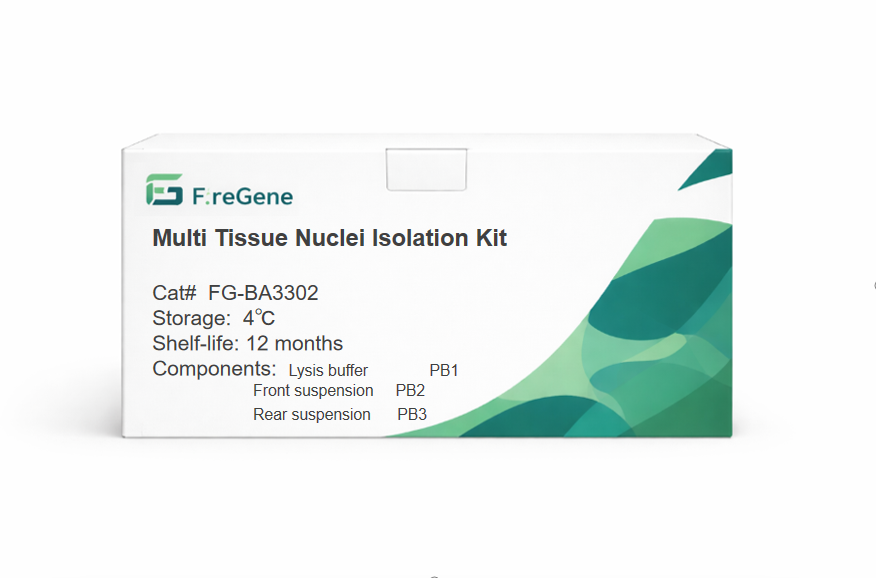

Description
Overview
FireGene’s Multi Tissue Nuclei Isolation Kit is designed for isolating high-quality nuclei from various animal tissues, enabling efficient single-cell sequencing and chromatin accessibility analysis.
Background Information
-
Ideal for gene expression and regulatory mechanism research.
-
Preserves cellular integrity by avoiding harsh dissociation.
-
Prevents loss of rare or fragile cell types during processing.
-
Facilitates freezing and reanalysis of biobanked samples without compromising quality.
-
Enhances reproducibility and efficiency across multiple tissue types.
-
Compatible with Single Cell ATAC, Multiome ATAC + Gene Expression, and Gene Expression assays.
Detection Principle
-
Begins with lysis of cells to break the membrane while retaining nuclear structure.
-
Uses density gradient centrifugation to separate nuclei by density.
-
Yields purified, intact nuclei ready for downstream applications.
Specifications
| Applications | Single-cell nuclei sequencing |
| Compatible Sample Types | Animal tissue |
| Supported Instruments | Water bath, horizontal centrifuge, cell counter |
| Storage | 4 °C |
| Shelf-life | 12 months |
Kit Components
10 reactions
| Component | 10 Reactions/Kit |
| Lysis buffer | 10 mL |
| Front suspension | 15 mL |
| Rear suspension | 50 mL |
| PB1 | 3 mL |
| PB2 | 6 mL |
| PB3 | 6 mL |
50 reactions
| Component | 50 Reactions/Kit |
| Lysis buffer | 5*10 mL |
| Front suspension | 5*15 mL |
| Rear suspension | 5*50 mL |
| PB1 | 5*3 mL |
| PB2 | 5*6 mL |
| PB3 | 5*6 mL |
Product FAQ
1. Q: Is this kit only suitable for fresh animal tissues? Can it be used for human-derived tissues or frozen tissues?
A: It is not only suitable for fresh animal tissues, but also can be used for cell suspensions of humans or other mammals, as well as frozen tissues. Whether for fresh samples or frozen samples, they must be processed in accordance with the steps in the instruction manual before subsequent operations such as grinding and lysis are carried out to ensure the effect of nucleus extraction.
2. Q: When adding BSA to the lysis buffer, pre-suspension and post-suspension in the kit, the required final concentrations are different. How to specifically calculate the amount of BSA to add?
A: The amount to add should be calculated based on the actual volume of reagents used. For example, if 10 mL of lysis buffer is used and the required final concentration of BSA is 1%, and the concentration of the original BSA solution is 10%, then the volume of BSA to add = (10 mL × 1%) ÷ 10% = 1 mL; if 15 mL of pre-suspension is used, the required final concentration of BSA is 1.5%, and the concentration of the original BSA solution is 10%, then the volume to add = (15 mL × 1.5%) ÷ 10% = 2.25 mL. It should be noted that the reagents should be prepared immediately before use according to the volume required for the sample to ensure accurate concentration (use the original BSA solution directly; otherwise, the density will be affected).
3. Q: For nucleus RNA-related experiments, there are clear standards for adding RNase inhibitors. Is it necessary to add them for non-RNA-related experiments? What are the impacts if it is not added as required?
A: It is not necessary to add RNase inhibitors for non-RNA-related experiments. If RNase inhibitors are not added or the added amount is insufficient in RNA-related experiments, the RNA in the sample will be degraded by RNase, making it impossible to obtain valid data in subsequent RNA-related experiments such as single-nucleus transcriptome sequencing, which directly affects the accuracy of experimental results. For non-RNA-related experiments, since RNA detection is not involved, not adding RNase inhibitors will not affect nucleus extraction and subsequent experiments (such as single-cell ATAC sequencing).
4. Q: The operation steps mention that after grinding, the sample should be left to stand for 2-3 minutes and no more than 3 minutes. What problems will occur if the standing time is too short or too long?
A: If the standing time is too short, the separation between cell debris and nuclei in the tissue homogenate will be insufficient. During subsequent filtration, the nuclei are likely to be wrapped by impurities, affecting purity. If the standing time is too long, some nuclei may experience decreased nuclear membrane stability and even rupture due to being in the lysis buffer environment for a long time, reducing the nucleus yield. Therefore, the standing time must be strictly controlled within 2-3 minutes.
5. Q: The centrifugation step has strict requirements on the type and parameters of the centrifuge. What consequences will there be if a vertical centrifuge is used instead of a horizontal centrifuge, or if the acceleration and deceleration are not set as required?
A: A horizontal centrifuge must be used. A vertical centrifuge cannot make the sample stratify evenly during centrifugation, leading to incomplete separation between nuclei and impurities and affecting extraction purity. If the acceleration and deceleration are not set to the medium level as required, excessively fast acceleration at the initial stage of centrifugation or excessively fast deceleration at the later stage will generate a large centrifugal force impact, which may damage the nuclear structure and cause nuclear rupture. At the same time, it will also affect the solution stratification effect, making it difficult to accurately collect the nuclear layer.
6. Q: Step 7 and Step 11 mention the use of 5 mL and 15 mL centrifuge tubes respectively. Can centrifuge tubes of other specifications be used as substitutes? What problems may occur after substitution?
A: Substitution is not recommended. In Step 7, 600 μL of mixed solution is transferred to a 5 mL centrifuge tube. This specification of centrifuge tube can provide sufficient space for the subsequent addition of PB2, PB3 and solution stratification, and is easy to operate. If a smaller specification (such as 2 mL) is used, the solution is prone to overflow and stratification will be unclear. In Step 11, a 15 mL centrifuge tube is used to collect the filtrate, which can hold a large amount of filtrate. If a 5 mL centrifuge tube is used, multiple transfers may be required, increasing the risk of contamination and being unfavorable for subsequent centrifugation operations.
7. Q: The self-prepared materials include 40 μm and 10 μm cell sieves. What are the different application scenarios of these two sieves? Can only one of them be used?
A: The 40 μm cell sieve is used for the initial filtration of the ground sample, mainly to remove large tissue debris and ensure the preliminary purification of nuclei in the filtrate. The 10 μm cell sieve is used during quality control: if there are debris larger than nuclei observed under bright field and the amount of nuclei is sufficient, it is used to further remove impurities and improve purity. It is not allowed to use only one of them. If only the 40 μm sieve is used, small impurities may remain and affect subsequent experiments; if only the 10 μm sieve is used, large tissue debris is likely to block the sieve during initial filtration, resulting in difficult filtration and reduced experimental efficiency.
8. Q: The kit should be stored at 4°C in the dark. Will short-term storage (e.g., 1-2 hours) at room temperature affect the reagent performance and experimental results?
A: Short-term storage at room temperature for 1-2 hours usually will not seriously affect the reagent performance, but direct sunlight should be avoided. If the room temperature is relatively high (e.g., exceeding 25°C), long-term storage may lead to decreased stability of some reagent components. For example, the activity of surfactants in the lysis buffer may decrease, affecting the effect of cell membrane disruption; the components in the pre-suspension and post-suspension may undergo slight changes, affecting nucleus preservation. Therefore, after taking out the reagents, they should be used as soon as possible, and the unused ones should be put back into the 4°C refrigerator in time.
9. Q: In Step 14, the volume of post-suspension is selected to resuspend the precipitate according to the required nucleus concentration. How to determine whether the required concentration is appropriate? How to adjust if the concentration is too high or too low?
A: The appropriate concentration should be determined according to the requirements of subsequent experiments. For example, single-nucleus transcriptome sequencing usually requires a nucleus concentration of 1000-5000 cells/μL. The concentration can be determined by counting with a cell counter. If the concentration is too high, an appropriate amount of post-suspension can be added for dilution. After each addition, the solution should be fully mixed and recounted until the target concentration is reached. If the concentration is too low, the suspension can be centrifuged at 300×g at 4°C for 5 minutes, part of the supernatant can be discarded, and then a small amount of post-suspension can be used to resuspend the precipitate to increase the concentration.
10. Q: If reagents or samples are accidentally contaminated during the experiment, what remedial measures are available? If remediation is not possible, is it necessary to repurchase the kit?
A: If there is obvious contamination inside the samples or reagents (such as turbidity, peculiar smell), there are no effective remedial measures, and the contaminated samples and reagents must be discarded. If the contaminated reagent is a key component of the kit and cannot be replaced, it is necessary to repurchase the kit to avoid the impact of contamination on experimental results and the failure of the experiment.
Files Download Links