

Description
Overview
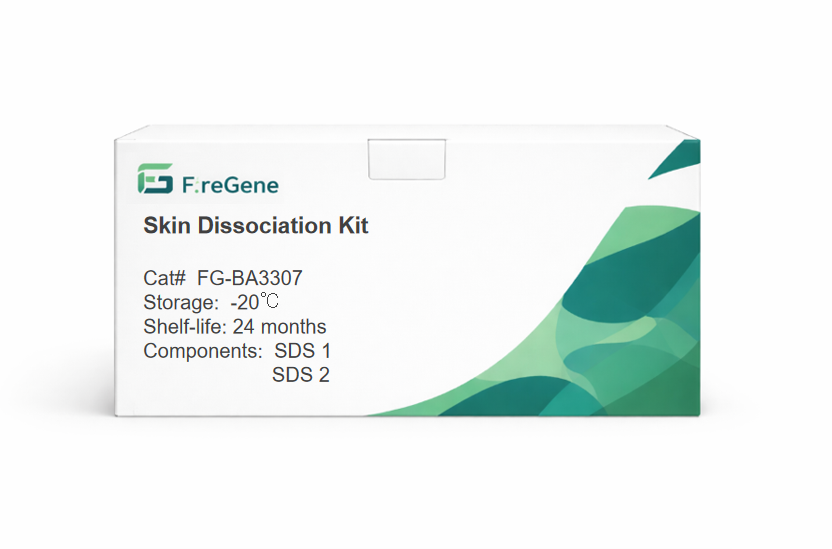
FireGene Skin Dissociation Kit is specifically designed for the efficient enzymatic dissociation of skin tissue into high-viability single-cell suspensions. Ideal for single-cell RNA sequencing, flow cytometry, and regenerative studies, this kit is optimized for sensitive skin-derived cells such as keratinocytes, fibroblasts, and immune populations.
Background Information
-
Driven by Clinical and Scientific Research Needs:
-
Skin single-cell sequencing is essential to dissect complex cell populations and intercellular signaling.
-
Traditional mechanical or chemical methods often fail to preserve cellular diversity and viability.
-
This kit enables:
-
Identification of keratinocytes, fibroblasts, Langerhans cells, and dermal immune cells.
-
In-depth research into skin disorders like psoriasis, atopic dermatitis, and skin cancer.
-
Discovery of biomarkers and therapeutic targets for dermatological diseases.
-
Analysis of gene expression profiles associated with skin aging, wound healing, and hair follicle regeneration.
-
-
-
Background of Technological Development:
-
Developed to address the inefficiencies and cell-damaging effects of conventional dissociation methods.
-
Integrates:
-
Advanced enzyme cocktails tailored for complex skin matrix digestion.
-
Precisely calibrated reaction times and temperatures.
-
Carefully balanced enzymatic ratios based on extracellular matrix biology.
-
-
Results in higher cell recovery rates, improved cell viability, and batch-to-batch consistency.
-
Detection Principle
-
Employs a synergistic enzymatic digestion protocol:
-
Skin samples are finely minced for better enzymatic penetration.
-
A sequence of multiple enzymes is added for progressive matrix breakdown.
-
Reactions are conducted under optimized temperature and timing conditions.
-
-
Process Outcome:
-
Enzymes gradually disrupt extracellular matrix components and intercellular connections.
-
Yields a high-quality single-cell suspension, ideal for downstream analysis such as scRNA-seq, immunophenotyping, or culture assays.
-
Specifications
| Applications | Single-cell sequencing, cell culture or other cell-related detections |
| Compatible Sample Types | Skin tissue |
| Supported Instruments | Water bath, horizontal centrifuge, cell counter |
| Storage | -20 °C |
| Shelf-life | 24 months |
Kit Components
10 reactions/kit
| Component | Pack Size |
|---|---|
| SDS1 (Skin Dissociation Solution 1) | 2 × 1.1 mL |
| SDS1 (Skin Dissociation Solution 2) | 2 × 1.4 mL |
50 reactions/kit
| Component | Pack Size |
|---|---|
| SDS1 (Skin Dissociation Solution 1) | 10 × 1.1 mL |
| SDS1 (Skin Dissociation Solution 2) | 10 × 1.4 mL |
Product Q&A
1. Q: Is this kit suitable for skin tissue of all mammals? Are there any requirements for the state of skin tissue (e.g., fresh, frozen)? Can it be used for skin tumor tissue?
A: The kit is suitable for normal skin tissue of common mammals such as humans and mice, but it is not recommended for direct use with skin tumor tissue. The cell density and extracellular matrix composition of tumor tissue are significantly different from those of normal skin, so it is necessary to contact the manufacturer to confirm whether enzyme digestion parameters need to be adjusted. Meanwhile, the kit only supports the dissociation of fresh skin tissue. Frozen tissue will have damaged cell structures due to ice crystal formation, resulting in extremely low cell viability after dissociation. If frozen tissue must be used, it should first be processed through a dedicated freeze-thaw recovery protocol before attempting dissociation.
2. Q: The kit is labeled "10 reactions". What are the respective dosages of Skin Tissue Dissociation Solution 1 and Dissociation Solution 2 per experiment? If only 50mg of tissue needs to be processed in a single experiment, can the reagent dosage be reduced proportionally?
A: For each experiment (200mg of tissue), 210μL of Skin Tissue Dissociation Solution 1 and 280μL of Skin Tissue Dissociation Solution 2 are required. If processing 50mg of tissue (1/4 of the standard dosage), the reagent dosage can be reduced proportionally (52.5μL of Dissociation Solution 1 + 697.5μL of RPMI 1640 medium, 70μL of Dissociation Solution 2 + 680μL of RPMI 1640 medium). However, note that when the reagent volume is too small, pipetting errors will increase. It is recommended to adjust the volume to at least 100μL (e.g., halve the dosage for 100mg of tissue). If 50mg of tissue must be processed, a high-precision pipette should be used to ensure the accuracy of the reagent ratio.
3. Q: In Step 6, mouse skin requires 0.5 hours of digestion, human skin requires overnight digestion, and the digestion time for other mammals ranges from "1 to several hours". How to specifically determine the digestion endpoint? What are the impacts of insufficient or excessive digestion time?
A: The digestion endpoint must be determined through "regular quality inspection": take 10μL of the suspension every 30 minutes, stain with trypan blue, and observe under a microscope. Digestion can be stopped if the cell viability is ≥70% and the proportion of tissue clumps is ≤10%. Insufficient digestion will result in incomplete tissue dissociation, low single-cell yield, and a large amount of residual tissue debris during subsequent filtration. Excessive digestion will cause over-enzyme hydrolysis of cells, leading to damaged cell membranes and viability dropping below 60%, making the cells unsuitable for single-cell sequencing or cell culture. For example, when processing rat skin, it is recommended to first digest for 0.5 hours, then adjust based on quality inspection results (extend by 15 minutes if viability is high, stop immediately if viability is low).
4. Q: Both Step 3 and Step 6 mention "37°C water bath or hybridization oven". Is the only operational difference between the two devices "manual shaking" and "automatic rotation speed"? Which device is better for dissociation results?
A: The core differences include not only the mixing method but also temperature stability: the temperature control accuracy of the hybridization oven (±0.5°C) is higher than that of the water bath (±1°C). Additionally, the automatic rotation speed (20-30 rpm) ensures uniform contact between tissue and dissociation solution, avoiding uneven local digestion. The water bath requires manual shaking; inconsistent force or frequency may lead to over-digestion of some tissues and under-digestion of others. For selection: if processing a large number of samples (≥5) or pursuing experimental reproducibility, the hybridization oven is better. If processing a small number of samples (1-2) and no hybridization oven is available, manual operation with a water bath is acceptable, but it is necessary to shake once every 4 minutes for 10 seconds each time.
5. Q: Steps 8-10 require filtration with a 70μm cell sieve and rinsing the centrifuge tube 3 times, collecting a total of 12mL of filtrate. What impact will omitting one rinsing step have on the experimental results? Can a 40μm cell sieve replace the 70μm one?A: Omitting one rinsing step will result in the loss of approximately 1/3 of residual cells, reducing the final cell yield by 20%-30%. Especially after overnight digestion of human skin, cells are prone to adhering to the tube wall, so 3 rinsing steps are mandatory. A 40μm cell sieve cannot replace the 70μm one: the diameter of single cells after skin dissociation is approximately 10-15μm, and the 70μm sieve can filter tissue debris without retaining cells. The 40μm sieve has a too-small pore size, which is easily clogged by cell clumps or fibrous impurities, leading to filtration difficulties and potential cell damage due to extrusion, reducing viability.
6. Q: Steps 12-13 require washing the pellet twice with PBS containing 5% FBS. What is the function of FBS? Can it be replaced with PBS without FBS or serum substitutes?
A: The core function of FBS is to neutralize the activity of residual dissociation solution, preventing enzymes from continuing to damage cells, and to provide nutrients for cells to maintain viability. It cannot be replaced with PBS without FBS; otherwise, residual enzymes will continue to damage cell membranes, reducing cell viability by more than 30% after washing. Serum substitutes (e.g., BSA) can only provide nutrients but cannot neutralize enzyme activity, so they are not recommended as substitutes. If serum-free experiments are required (e.g., certain cell sorting scenarios), an "enzyme inhibitor" (contact the manufacturer for a compatible model) must be added after washing; otherwise, cell viability cannot be guaranteed.
7. Q: The instruction manual states that "DMEM medium can replace RPMI 1640 medium". After replacement, is it necessary to adjust the reagent dosage or digestion time? Does the choice of the two media affect cell viability?
A: No adjustment to reagent dosage or digestion time is needed after replacement. Both DMEM and RPMI 1640 are common basal media for mammalian cells. Although they differ in amino acid and vitamin content, both can provide a suitable osmotic pressure and pH environment for skin tissue dissociation, with no impact on dissociation efficiency. The impact on cell viability is minimal: experimental data shows that the difference in cell viability after dissociating mouse skin with the two media is ≤5%. The medium can be selected based on the existing inventory in the laboratory, with no need for deliberate replacement.
8. Q: If there are many red blood cells in the cell suspension after dissociation and FG-BA3311 Red Blood Cell Lysis Buffer is required for removal, at which step should this operation be performed? What precautions should be taken during lysis?
A: The operation should be performed after Step 13 and before Step 14: after completing the two washing steps in Step 13 and discarding the supernatant, add 1mL of FG-BA3311 Red Blood Cell Lysis Buffer, incubate at room temperature for 5 minutes, centrifuge at 300×g for 5 minutes at 4°C, discard the supernatant, and resuspend the pellet with 5mL of PBS containing 5% FBS (equivalent to an additional washing step) before proceeding to Step 14. Precautions: The lysis time should not exceed 8 minutes, otherwise skin cells will be damaged. If there are excessive red blood cells (e.g., skin samples containing a large number of capillaries), lysis can be repeated once, but an additional washing step is required to avoid residual lysis buffer.
9. Q: The kit needs to be stored at -20°C. If the ice pack melts during transportation and the reagent is left at 4°C for 2 hours, can it still be used? What are the impacts of repeated freezing and thawing?
A: The reagent can still be used after being left at 4°C for 2 hours, but it should be immediately returned to -20°C, and fully mixed before subsequent use. Repeated freezing and thawing will reduce the enzyme activity in the dissociation solution: each freeze-thaw cycle reduces enzyme activity by 10%-15%; after more than 3 cycles, the activity will be less than 50%, making it unable to effectively dissociate tissue. It is recommended that after receiving the kit, immediately aliquot Dissociation Solution 1 and Dissociation Solution 2 into single-use volumes (e.g., 210μL/tube for Dissociation Solution 1, 280μL/tube for Dissociation Solution 2), seal them, store at -20°C, and take one tube per experiment to avoid repeated freezing and thawing.
10. Q: After quality control in Step 15, it is required to "carry out subsequent experiments immediately". If subsequent experiments cannot be conducted immediately, can the prepared cell suspension be stored for a short period? What are the restrictions on storage conditions and time?
A: Short-term storage is possible under the conditions of sealed storage in a 4°C refrigerator for no more than 2 hours, with repeated shaking avoided. During storage, the cell concentration should be adjusted to 1×10⁶-1×10⁷ cells/mL using PBS containing 5% FBS, and the suspension should be placed in a low-adhesion centrifuge tube. After 2 hours, cell viability will decrease significantly (10%-15% per hour), and new cell debris will be generated. If stored for more than 4 hours, the cells will basically lose viability and cannot be used for downstream experiments. Before use, re-quality inspection is required, and only cells with viability ≥65% can be used.
Files Download Links