
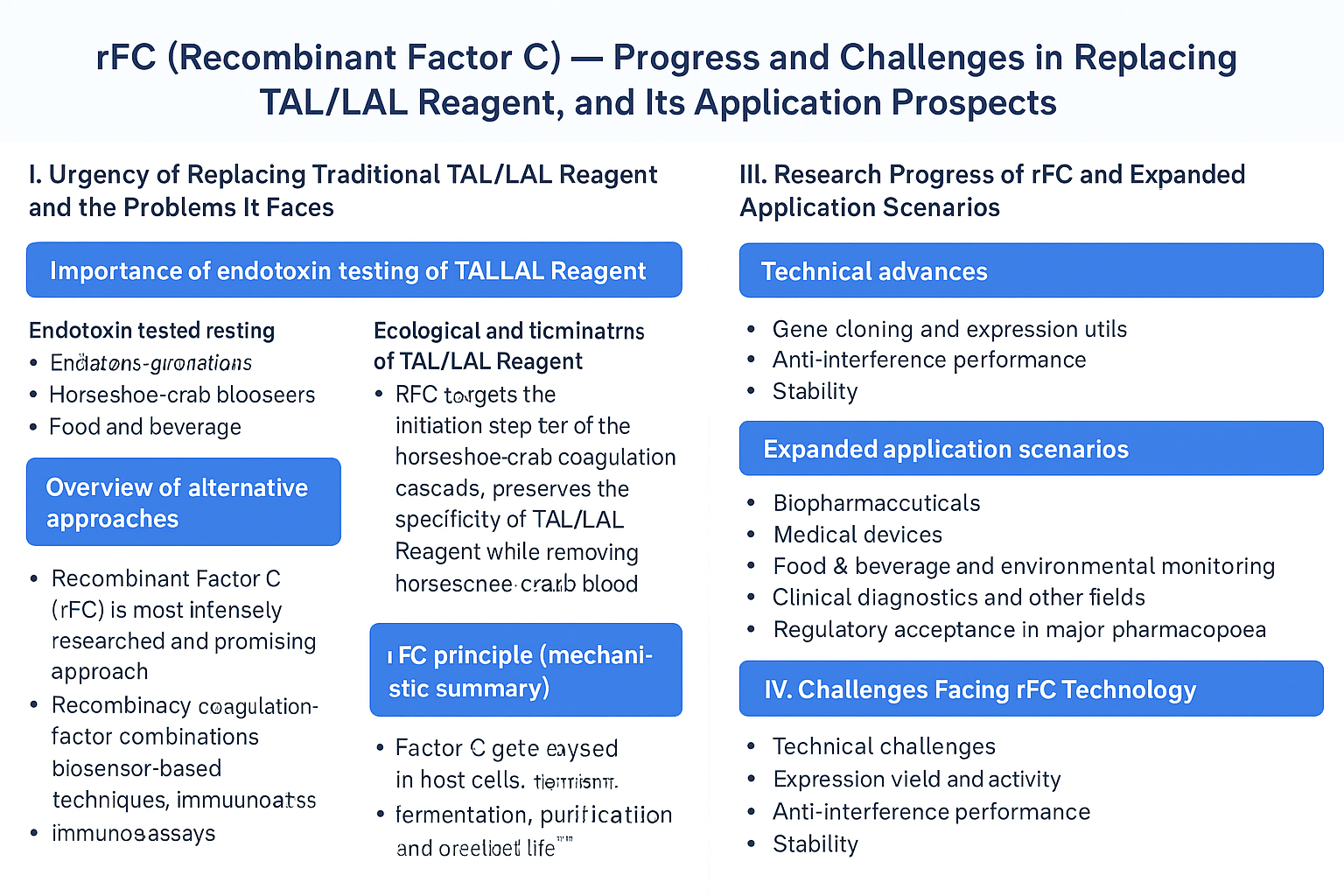
I. Urgency of Replacing Traditional TAL/LAL Reagent and the Problems It Faces
1. Importance of endotoxin testing
Endotoxin testing is a critical control to ensure safety across pharmaceuticals, medical devices, food and beverage, and other fields. For decades, TAL/LAL Reagent–based methods have been the classic approach worldwide: the test relies on a specific coagulation cascade in horseshoe-crab (Limulus) blood lysate that aggregates in the presence of bacterial endotoxin, and results are determined by observing coagulation.
2. Ecological and technical limitations of TAL/LAL Reagent
However, with industry growth and rising awareness of ecological protection, the shortcomings of TAL/LAL Reagent have become increasingly obvious, making the development of alternatives imperative.
○ Ecological concerns. Horseshoe crabs are among Earth’s oldest arthropods, and their blue blood (due to copper-containing hemocyanin) is the only raw material for TAL/LAL Reagent. Tens of thousands of horseshoe crabs are harvested annually for bleeding. Although most are returned to the sea, an estimated 10–30% may die from stress, wound infection, or related causes. Habitat loss and marine pollution have further threatened populations; several species are listed in conservation watchlists, increasing ecological pressure.
○ Technical limitations. TAL/LAL Reagent methods are vulnerable to interference (for example, from β-glucans), causing false positives; they typically require 1–4 hours, making rapid testing difficult; reagent stability is sensitive to storage conditions; and batch-to-batch variability can affect accuracy. Moreover, emerging fields such as biopharmaceuticals and cell therapies demand higher specificity, sensitivity, and regulatory compliance—requirements that traditional TAL/LAL Reagent methods increasingly struggle to meet.
3. Conclusion: the dual imperative
Therefore, developing environmentally friendly, efficient, and accurate replacements for TAL/LAL Reagent is both an ecological imperative and a necessity for advancing industry quality standards.
II. Current Status of TAL/LAL Reagent Alternatives Research: rFC at the Core
1. Overview of alternative approaches
Among various alternatives under study—such as recombinant coagulation-factor combinations, biosensor-based techniques, and immunoassays—recombinant Factor C (rFC) has emerged as the most intensely researched and promising approach. Other methods each have drawbacks: recombinant factor combinations can be technically complex and costly; biosensors may need improved stability and detection ranges; immunoassays have yet to reach the sensitivity required for endotoxin testing.
2. Why rFC stands out
rFC specifically targets the initiation step of the horseshoe-crab coagulation cascade (Factor C), preserving the high specificity of TAL/LAL Reagent while removing dependence on natural horseshoe-crab blood. This gives rFC significant environmental and technical advantages and positions it as a leading solution for TAL/LAL Reagent replacement.
3. rFC principle (mechanistic summary)
Factor C is the key protein in the horseshoe-crab coagulation cascade: when endotoxin binds to Factor C, it activates Factor C’s serine protease activity and triggers downstream coagulation. rFC uses genetic engineering to express the Factor C gene in host cells (e.g., E. coli, Pichia pastoris), followed by fermentation and purification to yield recombinant Factor C protein. The recombinant protein retains the endotoxin-binding site and enzymatic activity of the native protein; in vitro, endotoxin binding activates the rFC, and activation is detected by fluorescent or colorimetric signals to quantify endotoxin.
4. Key advantages of rFC
○ No dependence on natural horseshoe-crab blood—protects horseshoe-crab populations.
○ Higher specificity—reacts primarily with endotoxin, reducing β-glucan–induced false positives.
○ Faster detection—optimized rFC assays can return results within 15–30 minutes.
○ Better batch consistency—recombinant production enables tighter process control and reduced inter-batch variability.
III. Research Progress of rFC and Expanded Application Scenarios
A. Technical advances
1. Gene cloning and expression optimization
Researchers have cloned Factor C genes from different horseshoe-crab species (e.g., Limulus polyphemus, Asian species) and applied codon optimization to improve expression in host cells. Multiple expression systems are in use:
○ E. coli: fast growth and low cost, but recombinant proteins can form inclusion bodies and may show reduced activity.
○ Pichia pastoris (yeast): enables secreted, correctly folded proteins with higher activity—currently a mainstream choice.
○ Insect-cell systems: provide post-translational modifications closer to native proteins and suit scenarios requiring very high activity.
2. Assay system optimization
Improvements to buffer composition, ion concentrations, and reaction temperatures have enhanced rFC assay sensitivity and stability. Detection limits have been pushed to 0.001 EU/mL, far surpassing many traditional TAL/LAL Reagent assays. Lyophilized (freeze-dried) rFC reagents have also been developed to extend shelf life and broaden usability across different storage and transport conditions.
B. Expanded application scenarios
1. Biopharmaceuticals
rFC is being used for endotoxin testing in monoclonal antibodies, vaccines, and recombinant protein therapeutics. Its high specificity and sensitivity help ensure product safety, and several international pharmaceutical companies have integrated rFC methods into quality-control systems.
2. Medical devices
rFC enables rapid endotoxin screening for implantable devices and single-use disposables, helping detect residual endotoxin in manufacturing and preventing inflammation-related adverse events.
3. Food & beverage and environmental monitoring
rFC can be applied to drinking water, juices, dairy products, and industrial/medical wastewater testing to safeguard public health and support environmental monitoring programs.
4. Clinical diagnostics and other fields
There is potential for clinical applications—e.g., blood endotoxin measurement to assist in diagnosing sepsis or septic shock—and for agricultural and aquaculture monitoring (e.g., testing feed or culture water to prevent endotoxin-associated disease in livestock).
5. Regulatory acceptance
Notably, rFC methods have gained recognition in major pharmacopeias: the United States Pharmacopeia (USP), European Pharmacopoeia (EP), and Japanese Pharmacopoeia (JP) include rFC procedures, and the Chinese Pharmacopoeia added rFC-related standards in its 2020 edition—an important step toward international regulatory acceptance.
IV. Challenges Facing rFC Technology
Despite clear advantages, rFC faces challenges in commercialization and broad adoption. The main obstacles fall into three categories: technical optimization, cost control, and market/regulatory acceptance.
1. Technical challenges
○ Expression yield and activity. Although Pichia pastoris–produced rFC has reached industrial-scale yields, there remains room to improve fermentation and purification to increase protein recovery and lower production costs.
○ Anti-interference performance. While rFC has better resistance to β-glucan interference than TAL/LAL Reagent, complex sample matrices (high protein or polysaccharide content) may still interfere. Improved sample-preparation methods or optimized reaction systems are needed to reduce matrix effects.
○ Stability. Long-term stability under extreme temperatures/humidity is an issue—advances in packaging, lyophilization, and formulation are required.
2. Cost issues
○ rFC development requires substantial R&D investment (gene cloning, expression-system development, assay optimization), and initial product prices may be higher than mature TAL/LAL Reagent products. This price gap can slow uptake, especially among smaller organizations with limited budgets.
3. Market and regulatory barriers
○ User inertia. TAL/LAL Reagent has been used for decades; many users are familiar with its workflows and result interpretation. Widespread rFC adoption requires extensive validation data and user training.
○ Standards and guidelines. Although major pharmacopeias now include rFC, regional or field-specific standards are still evolving; some sectors or regions may lack harmonized guidelines, making adoption uneven.
V. Prospects and Future Directions for rFC
Despite current challenges, rFC’s outlook is promising. Continued technical improvement and growing demand will support broader adoption and industry transformation.
1. Technical innovation
○ Protein engineering. Site-directed mutagenesis and structural modifications of rFC could raise binding affinity and enzymatic activity, lowering detection limits further.
○ Integration with emerging technologies. Combining rFC with microfluidics and nanotechnology can produce miniaturized, automated, high-throughput devices that deliver results in minutes.
○ Improved sample handling. New pre-treatment techniques (e.g., nanofiltration, immunoaffinity chromatography) will reduce matrix interference and broaden sample compatibility.
2. Application expansion
○ rFC could expand from pharmaceuticals and medical devices into clinical point-of-care testing (POCT), environmental surveillance, agricultural monitoring, and more—enabling rapid on-site testing and broader public-health applications.
3. Industrial scaling and cost reduction
○ As manufacturing scales and processes optimize, the per-unit cost of rFC reagents should decline, improving market competitiveness. A mature rFC industry could spawn a complete ecosystem, from gene-cloning services and expression platforms to reagent production and detection instrument manufacturing.
4. Policy and regulation
○ Increasing global emphasis on ecological protection may prompt policies limiting reliance on horseshoe-crab–derived reagents, indirectly accelerating rFC adoption. Simultaneously, standardized validation frameworks and regulatory guidance will facilitate acceptance across industries.
VI. Conclusion
Developing TAL/LAL Reagent alternatives is both an ecological necessity and an industry imperative. rFC stands out as a leading alternative: it protects horseshoe-crab populations, offers improved specificity and sensitivity, shortens testing time, and delivers better lot-to-lot consistency. Although challenges remain in process optimization, cost, and market acceptance, ongoing research and industrial innovation are steadily overcoming these obstacles.
In the future, rFC technology is poised to replace traditional TAL/LAL Reagent in many applications, supporting an industry transition toward more efficient, accurate, and environmentally responsible endotoxin testing—ultimately enhancing drug and device safety, protecting ecosystems, and strengthening public-health monitoring.


