
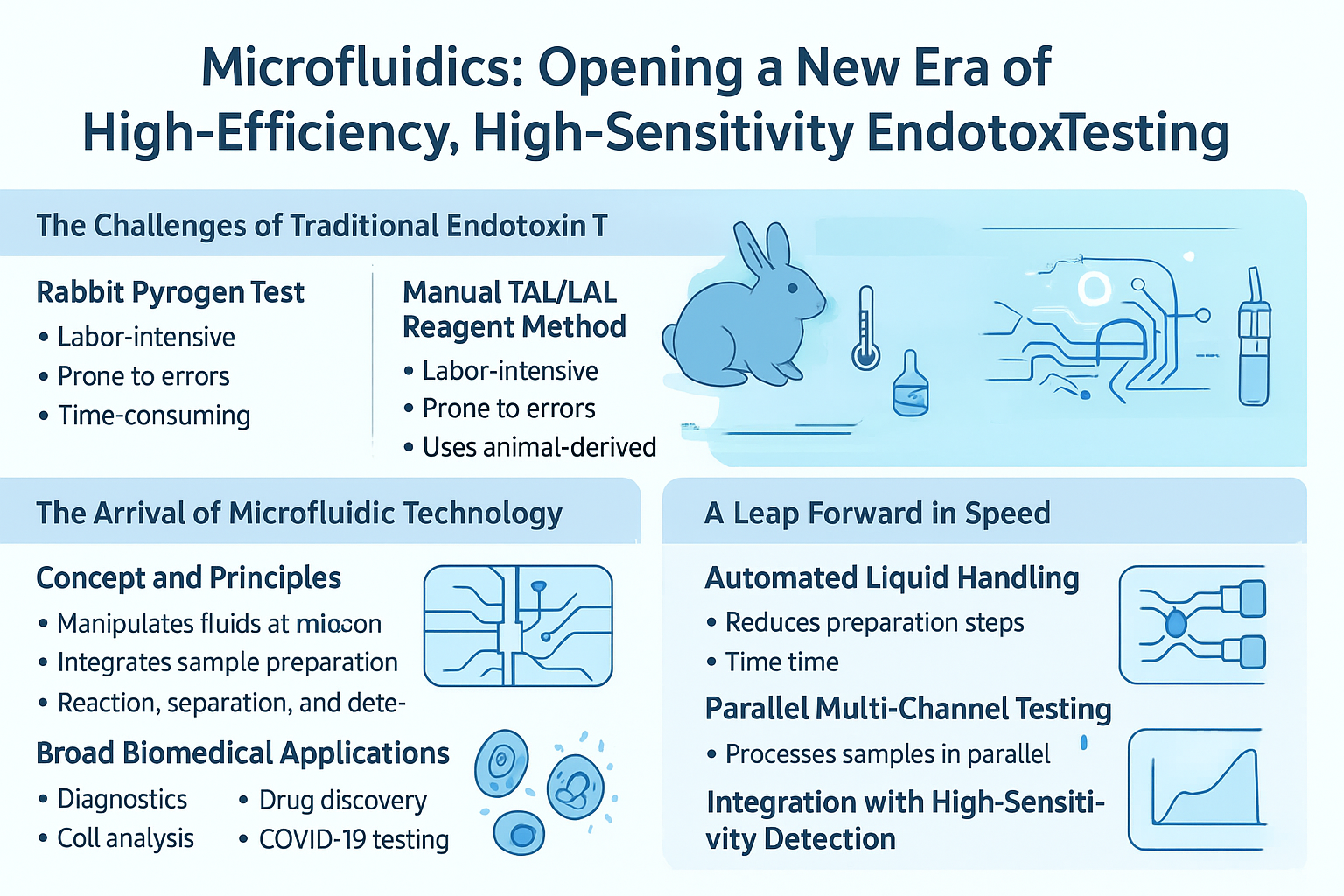
I. The Challenges of Traditional Endotoxin Testing
1. Rabbit Pyrogen Test
The rabbit pyrogen test, a classical in vivo method, involves selecting healthy adult rabbits of similar weight, acclimating them before the test to stabilize body temperature, and measuring baseline temperatures multiple times. After preparation, the test sample is injected (commonly via the ear vein), and the rabbit’s temperature is recorded periodically.
However, this method suffers from several problems:
● Individual rabbits respond differently to pyrogens, affecting result accuracy.
● The procedure is complex and labor-intensive, requiring experienced operators and careful observation.
● The full process — from animal preparation to final readout — takes a long time.
● Use of live animals raises ethical and animal-welfare concerns.
2. Manual TAL/LAL Reagent Method
The manual TAL/LAL Reagent method relies on the specific coagulation reaction between horseshoe-crab (Limulus) lysate and bacterial endotoxin. The operator mixes TAL/LAL Reagent with test samples and controls, incubates at the specified temperature, and judges endotoxin presence by gel formation.
Although this method can be sensitive, it has major limitations:
● Difficulty detecting ultra-low endotoxin concentrations.
● Operator variability due to manual pipetting and handling.
● Batch-to-batch differences in reagent quality affecting reproducibility.
● Heavy reliance on horseshoe crabs, impacting ecological balance.
II. The Arrival of Microfluidic Technology
1. Concept and Principles
Microfluidics manipulates fluids at the microscale through micron-sized channels fabricated on chips. It integrates sample preparation, reaction, separation, and detection, achieving miniaturization, automation, and high precision.
Key physical principles include:
● Laminar flow dominance (smooth, non-turbulent flow).
● Enhanced diffusion for rapid molecular transport.
● Surface effects due to high surface-to-volume ratio, influencing wetting and adsorption behavior.
2. Broad Biomedical Applications
Microfluidics has proven transformative in multiple fields:
● Diagnostics: Rapid detection of disease biomarkers in small samples.
● Drug discovery: Simulated microenvironments for high-throughput compound screening.
● Cell analysis: Real-time monitoring of growth and differentiation.
● COVID-19 testing: Integrated nucleic acid amplification chips increased speed and throughput.
Given these advantages, researchers have begun applying microfluidics to endotoxin testing, seeking to overcome traditional limitations such as reagent waste, manual errors, and long testing cycles.
III. A Leap Forward in Speed
1. Automated Liquid Handling
Microfluidic chips excel at automated liquid control. In centrifugal microfluidic systems (lab-on-a-disc), spinning the chip drives fluid movement along designed microchannels, automating distribution and mixing.
● Manual TAL/LAL workflows often require 100+ pipetting steps, taking over 1 hour.
● Microfluidic systems can reduce this to <30 operations and cut preparation time to ~9 minutes.
→ Result: Higher throughput, reduced error, and improved reproducibility.
2. Parallel Multi-Channel Testing
Microfluidic chips can host multiple independent reaction chambers on one chip.
● Traditional tests process samples serially.
● Microfluidic chips enable parallel processing — tens or hundreds of reactions simultaneously.
→ This boosts testing efficiency dramatically, especially in large-scale screening.
IV. Significant Gains in Sensitivity
1. Precise Reagent and Sample Mixing
Microfluidic channels, with micron-level dimensions, enable precise fluid control and efficient mixing using chaotic or serpentine micro-mixers.
This ensures uniform reactions and reduces human error.
In contrast, manual TAL/LAL mixing often suffers from inconsistent pipetting and uneven reagent distribution.
2. Integration with High-Sensitivity Detection
When coupled with fluorescent or electrochemical detection, microfluidic systems can reach extremely low detection limits.
● Example: Fluorescently labeled antibodies form immune complexes with endotoxin; fluorescence intensity reflects concentration.
● The microfluidic environment stabilizes signals and minimizes noise.
→ Detection limits can improve from 0.1 EU/mL (traditional) to 0.01 EU/mL (microfluidic).
This ultra-sensitivity is vital for pharmaceutical and medical device quality control.
V. Use Cases and Proven Outcomes
1. Pharmaceutical Industry
A large drug manufacturer adopted microfluidic endotoxin testing for injectable antibiotics.
● Traditional workflows: labor-intensive, inconsistent, time-consuming.
● Microfluidic replacement: simplified testing, faster completion, higher repeatability.
→ Tests that once took hours are now done in minutes, cutting costs and boosting safety.
2. Medical Device Testing
A syringe manufacturer implemented microfluidic endotoxin assays to meet mass-production QC needs.
● Automation and parallelization improved speed.
● High sensitivity enabled early contamination detection.
→ Result: Enhanced process control and product reliability.
VI. Challenges and Current Limitations
Despite great promise, microfluidic endotoxin testing faces several hurdles:
1. Manufacturing Cost
Microfabrication requires specialized equipment and expertise.
Single-use chip designs increase cost, though 3D printing and injection molding are helping reduce this barrier.
2. Standardization
Lack of unified protocols and evaluation criteria makes cross-lab comparison difficult.
Establishing standards will be key for widespread acceptance.
3. Regulatory Compatibility
Current regulatory frameworks are built around traditional assays.
Microfluidic methods must demonstrate equivalence or superiority through validation studies to gain official recognition.
VII. Future Prospects
Looking ahead, microfluidic endotoxin testing will become smaller, smarter, and more connected.
Integration with AI and IoT technologies will enable:
● On-site rapid testing
● Real-time monitoring
● Predictive quality control
Such advances promise comprehensive, high-speed, and high-sensitivity monitoring for both pharmaceutical and medical device industries.
VIII. Conclusion
Microfluidic technology represents a revolutionary advancement in endotoxin testing —
faster, more sensitive, more reproducible, and more resource-efficient.
By combining automation, parallelization, and precision detection, microfluidic platforms pave the way for safer products and more efficient quality assurance workflows in the years to come.


