
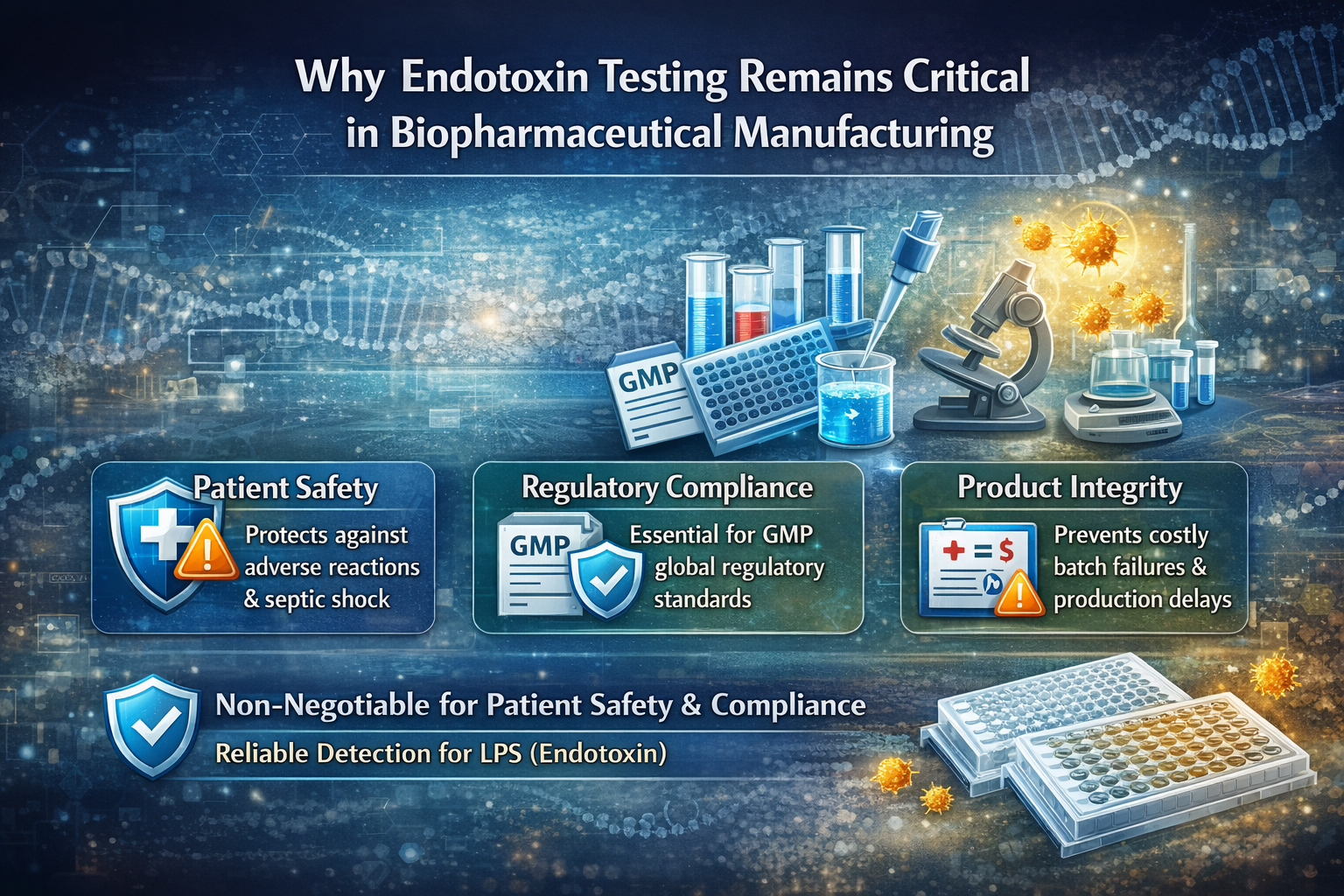
In today’s biopharmaceutical landscape, product safety is not optional — it is a fundamental requirement. Among the many risks facing manufacturers of biologics, vaccines, and injectable therapies, bacterial endotoxins represent one of the most serious and least visible threats. Even at extremely low levels, endotoxins can cause fever, inflammation, septic shock, and potentially life-threatening reactions in patients.
For this reason, endotoxin testing remains a cornerstone of quality control in biopharmaceutical manufacturing and a non-negotiable element of global regulatory compliance.
I. What Are Bacterial Endotoxins?
Bacterial endotoxins are lipopolysaccharides (LPS) found in the outer membrane of Gram-negative bacteria. Unlike viable microorganisms, endotoxins can remain biologically active even after sterilization processes such as autoclaving or filtration.
Their heat stability and structural persistence make endotoxins particularly difficult to eliminate. They may be introduced at multiple points during manufacturing, including purified water systems, raw materials, processing equipment, and container closures — often without any visible contamination or turbidity.
This invisible nature is what makes endotoxins especially dangerous and reinforces the need for sensitive, reliable detection methods.
II. The Role of TAL/LAL Reagent in Safety Testing
To detect endotoxins at trace levels, biopharmaceutical manufacturers rely on assays based on TAL/LAL Reagents. These reagents react specifically with bacterial endotoxins, producing measurable responses that enable accurate and sensitive quantification.
TAL/LAL Reagent-based endotoxin testing is widely used for:
-
Raw material qualification
-
In-process control
-
Final product release testing
Importantly, TAL/LAL methods are recognized and accepted by major regulatory authorities, including the U.S. FDA, European Medicines Agency (EMA), and global pharmacopoeias, making them a trusted standard across the industry.
III. Why Endotoxin Testing Is Non-Negotiable
Endotoxin testing is essential for multiple critical reasons:
1. Patient Safety
Endotoxins can trigger severe pyrogenic responses even at picogram concentrations. Robust endotoxin testing protects patients from adverse and potentially fatal reactions.
2. Regulatory Compliance
Global pharmacopoeias mandate bacterial endotoxin testing as part of Good Manufacturing Practice (GMP). Failure to comply can result in batch rejection, warning letters, or product recalls.
3. Product Integrity and Business Continuity
Undetected endotoxin contamination can invalidate entire production batches, leading to costly delays, supply disruptions, and reputational damage.
Together, these factors make endotoxin testing a critical safeguard for both patients and manufacturers.
IV. FireGene’s Commitment to Reliable Endotoxin Testing
At FireGene, we understand that reliable endotoxin testing is fundamental to biopharmaceutical quality systems. Our portfolio of high-performance TAL/LAL Reagents is designed to deliver consistency, sensitivity, and reproducibility across a wide range of applications.
Whether you are qualifying new suppliers, validating manufacturing processes, or performing routine release testing, FireGene supports your endotoxin control strategy with dependable reagents and technical expertise — helping you generate data you can trust.
V. Conclusion
Endotoxin testing is far more than a regulatory checkbox. It is a life-sustaining safety measure that underpins the integrity of modern biopharmaceutical manufacturing.
By implementing robust endotoxin testing programs and leveraging trusted TAL/LAL Reagents, manufacturers can minimize risk, protect patients, and maintain compliance with global regulatory standards — today and in the future.


