
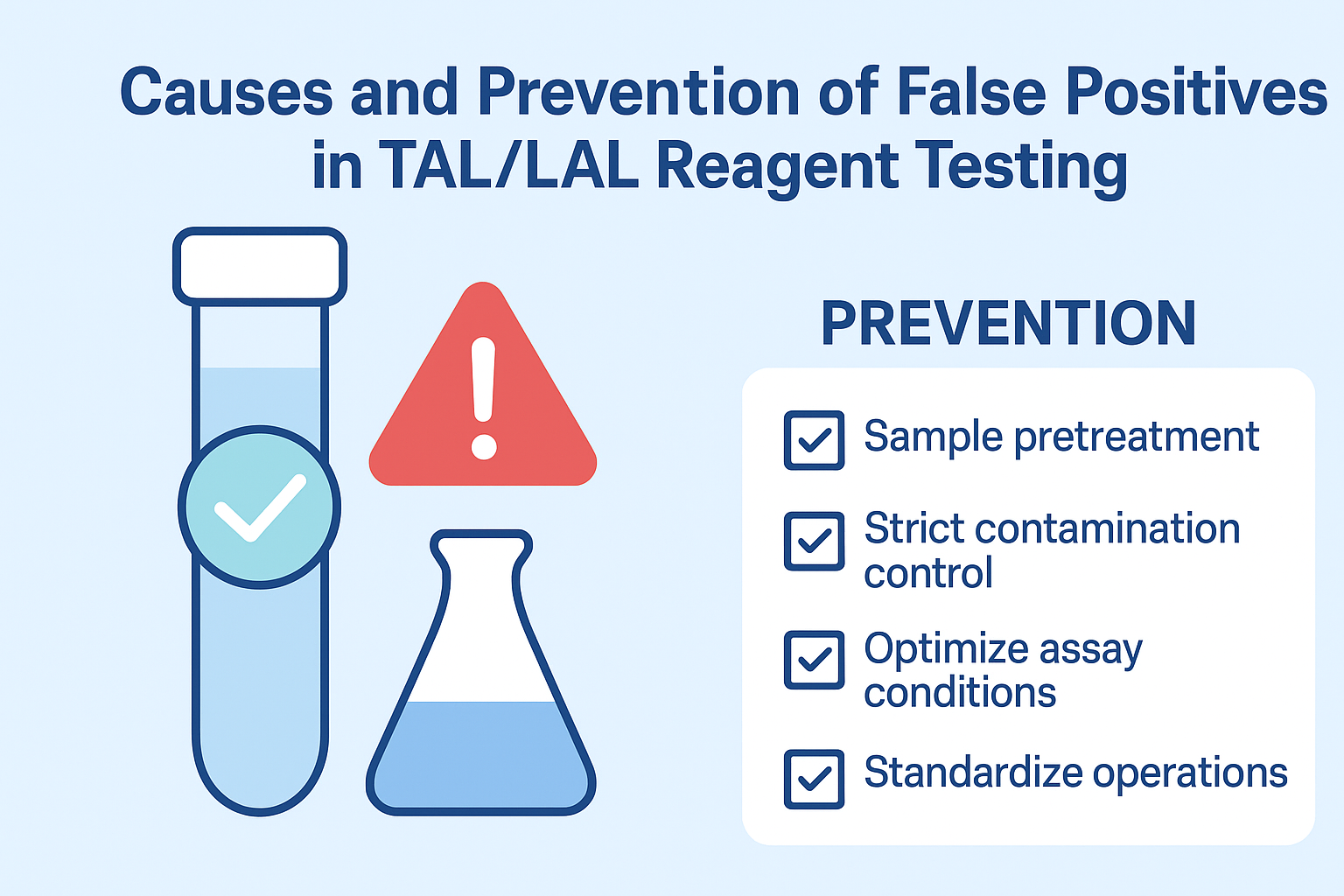
TAL/LAL Reagent assays—valued for high sensitivity and strong specificity—are the core tools for endotoxin testing in pharmaceuticals, medical devices, and biological products. Test results directly affect product quality assessment and market access. However, false positives (i.e., positive assay signals when no endotoxin is present) do occur. False positives can cause compliant products to be misclassified, increase production costs, and lengthen R&D timelines. This article systematically analyzes the main causes of false positives and, based on industry practice, proposes targeted prevention measures to support accurate testing.
I. Core Causes of False Positives
A false positive happens when the enzymatic cascade of a TAL/LAL Reagent is activated by non-endotoxin substances or when exogenous contamination or procedural issues are introduced. The main causes can be grouped into four categories.
I.i Non-endotoxin activators in the sample matrix
These substances can mimic endotoxin or otherwise non-specifically trigger Factor C (or downstream cascade components).
1. Polysaccharides and glucans — Natural polysaccharides from plant extracts, fungal products (e.g., starch, β-glucans) and microbial cell-wall fragments may resemble lipopolysaccharide (LPS) structures and activate Factor C. Such interference is common in traditional herbal injections and fungal polysaccharide products.
2. Nucleic acids and proteins — Residual bacterial DNA/RNA fragments or high concentrations of proteins (serum proteins, recombinant proteins) can alter the enzymatic environment or bind assay components, amplifying the signal; this is particularly common in biologics and blood-derived product testing.
3. Surfactants and chemical additives — Residual nonionic surfactants (e.g., Tween 80, Triton X-100), anionic surfactants (e.g., SDS), preservatives and antioxidants can change interfacial tension or reaction kinetics and accelerate enzymatic activation, causing overestimation.
4. Metal ions and chelators — Excess divalent cations (Ca²⁺, Mg²⁺) may non-specifically promote clotting activation; imbalanced chelators (EDTA, sodium citrate) can destabilize the reaction milieu and produce unintended activation.
I.ii Exogenous endotoxin contamination
Undetected introduction of environmental endotoxin during sampling or testing is a commonly overlooked cause of false positives; contamination routes are often subtle.
1. Contaminated labware — Labware that has not been properly depyrogenated (250°C dry-heat for 30 minutes) or that has only received conventional sterilization may retain endotoxin (glassware, pipettes, tubes). Reused glassware in particular can adsorb endotoxin that is difficult to remove.
2. Reagent and consumable contamination — Poorly stored endotoxin-free water, buffers, or opened reagents can become contaminated. Single-use consumables (tips, plates) manufactured or handled without endotoxin control may carry endotoxin.
3. Environmental and operator contamination — Aerosols, skin secretions, or respiratory droplets from personnel, and work in non-sterile environments, can introduce endotoxin—especially if gloves, masks, or clean benches are not used.
I.iii Test conditions and reagent compatibility issues
Incorrect assay environment or suboptimal reagent status can reduce specificity and lead to false positives.
1. pH and osmolarity imbalance — TAL/LAL Reagent performs optimally at pH ~6.0–8.0. Strongly acidic (pH < 6.0) or alkaline (pH > 8.0) samples, or very high/low osmolarity, can alter enzyme conformation and cause non-specific activation.
2. Degraded or contaminated reagents — Improper storage (outside recommended 2–8°C), expired reagents, or reconstituted reagents left standing too long (e.g., gel reagents not used immediately after reconstitution) reduce specificity. Reconstituting with non-endotoxin water also introduces risk.
3. Inappropriate method selection — Different TAL/LAL formats (gel-clot, kinetic chromogenic/turbidimetric) have varying anti-interference capacities. For example, the gel-clot format is more sensitive to polysaccharide interference; using it for complex matrices without mitigation increases false-positive risk.
I.iv Non-standardized operation and human error
Operator mistakes or inconsistent workflows often cause false positives during sample handling and reaction steps.
1. Improper dilution or mixing — Using non-endotoxin containers for dilution, insufficient dilution (so interferent concentration remains high), or inadequate mixing can create local microenvironments that trigger non-specific reactions.
2. Incorrect incubation conditions — Deviations from 37 ± 1°C, overly long incubation (e.g., > 90 minutes), or inconsistent timing can increase non-specific enzyme activity and cause false signals.
3. Result interpretation errors — In gel-clot tests, misreading weak gels as positive (not following the “invert tube—no gel detachment” rule) or failing to subtract blank signals in chromogenic assays leads to incorrect positive calls.
II. Core Prevention Measures
The guiding principle is: remove interfering substances, block contamination routes, optimize assay conditions, and standardize operations. Practical measures are summarized below.
II.i Sample pretreatment — remove matrix interference
1. Targeted removal by interference type
○ Polysaccharide interference: add β-glucanase (final 5–10 U/mL) and incubate at ~37°C for ~1 hour.
○ High-protein interference: digest with Proteinase K (final 10–50 μg/mL) at ~37°C for ~30 minutes, then inactivate by heating.
○ Surfactant interference: apply dialysis or dilution to reduce surfactant concentration.
2. Optimized dilution
Dilute samples with endotoxin-free water or buffer within the Maximum Valid Dilution (MVD) to lower interferent concentrations while preserving assay sensitivity (e.g., 1:10–1:100 for some herbal injections).
3. Adjust reaction environment
Bring sample pH to ~6.0–8.0 using endotoxin-free HCl/NaOH or Tris-HCl buffer; correct osmolarity with endotoxin-free saline if necessary.
II.ii Strict contamination control — block exogenous endotoxin
1. Depyrogenate labware
Use dry-heat depyrogenation (250°C, 30 minutes) for reusable glassware or use certified single-use endotoxin-free disposables. Glassware should be cleaned (dilute sulfuric acid rinse, distilled endotoxin-free water) before depyrogenation.
2. Manage reagents and consumables
Store endotoxin-free water and buffers sealed in sterile conditions; aliquot and consume within recommended windows. Verify supplier quality for single-use consumables and inspect packaging integrity. Use reconstituted TAL/LAL Reagent within manufacturer-specified time limits (e.g., gel reagents used immediately; chromogenic reagents within recommended timeframe).
3. Optimize environment and operator practice
Perform assays in a clean bench or controlled environment. Disinfect surfaces with 70–75% ethanol. Operators must wear sterile gloves, masks, and appropriate protective clothing; avoid open-bench handling that could introduce aerosols.
II.iii Optimize the assay system — improve specificity
1. Select appropriate reagents
For complex matrices, consider recombinant Factor C (rFC) reagents, which offer greater resistance to glucan and polysaccharide interference and are endotoxin-specific. For routine matrices, choose the TAL/LAL format (gel-clot, kinetic chromogenic/turbidimetric) appropriate to the sample and interference profile.
2. Follow storage and reconstitution guidance
Store reagents at recommended temperatures, avoid repeat freeze–thaw cycles, and reconstitute using manufacturer-specified endotoxin-free water; mix gently to avoid damaging active components.
3. Control reaction parameters
Maintain incubation at 37 ± 1°C and adhere to recommended incubation times (e.g., gel-clot 60 ± 2 minutes; chromogenic/turbidimetric within manufacturer’s specified window). Always include blank, negative, and positive controls to detect non-specific activation.
II.iv Standardize operations — reduce human error
1. Establish SOPs
Document and enforce SOPs for sample handling, dilution, reagent addition order (e.g., add sample before reagent), mixing (vortex 30 seconds), incubation timing, and result readout.
2. Train personnel
Ensure operators understand TAL/LAL Reagent principles, common interferents, and depyrogenation techniques; conduct periodic competency assessments.
3. Maintain quality control
Include positive controls (known endotoxin concentration), negative controls (endotoxin-free water), and sample blanks in each batch. Recalibrate instruments (plate readers, incubators) routinely.
III. Verification and Troubleshooting of Suspected False Positives
When a positive result is obtained, use a structured validation workflow to determine whether it is a true or false positive.
1. Repeat the test
Use fresh reagents and consumables; if the repeat is negative, the original result may have been due to contamination or operator error.
2. Interference recovery test
Spike the sample matrix with a known endotoxin concentration (λm, e.g., midpoint of the standard curve) and prepare an unspiked control. Calculate percent recovery:
R=Measured value of sample positive control−Measured value of sample negative controlλm×100%R = \frac{\text{Measured value of sample positive control} - \text{Measured value of sample negative control}}{\lambda_m} \times 100\%R=λmMeasured value of sample positive control−Measured value of sample negative control×100%
If R = 50%–200%, interference is considered acceptably removed and the original positive is likely true. If R is outside this range and the sample negative control is positive, the original positive is likely false.
3. Dilution verification
Test serial dilutions (e.g., 1:10, 1:100, 1:1000). If the signal disappears with dilution and shows linearity consistent with dilution factors, the original positive was likely caused by an interfering substance.
4. Additional source tracing
If contamination is suspected, test reagents, water, consumables and labware individually to identify the source.
IV. Conclusion
False positives in TAL/LAL Reagent testing result from the combined effects of interferent activation and exogenous contamination, and are closely related to assay format and operational practice. Prevention requires a multi-layered approach: sample pretreatment, strict contamination control, assay optimization, and standardized operations. Recombinant Factor C reagents offer clear anti-interference benefits for complex matrices, while strict depyrogenation and well-enforced SOPs are essential to block environmental contamination.
By implementing a closed loop of testing → verification → troubleshooting, laboratories can significantly reduce false positives and improve the reliability of endotoxin testing. As detection technologies evolve, reagents with stronger anti-interference properties and new pretreatment techniques will further enhance the precision and robustness of endotoxin assays.


