
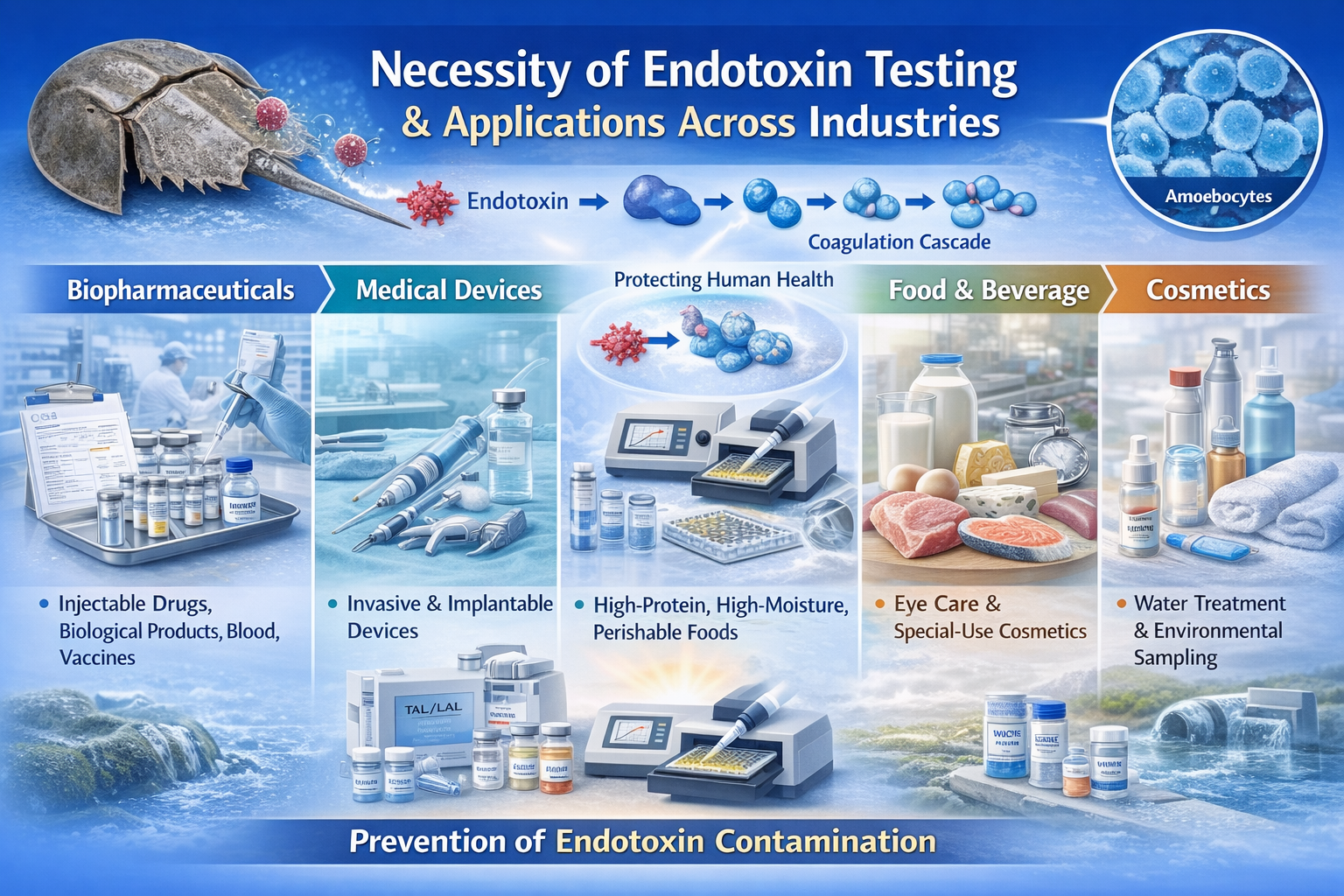
Endotoxins are lipopolysaccharide (LPS) components of the cell wall of Gram-negative bacteria. As toxic substances released upon bacterial death, endotoxins exhibit extremely strong biological activity. Even trace amounts can trigger severe pathological reactions in humans, including fever, chills, shock, and even multiple organ failure, posing a serious threat to human health and life.
Endotoxins are widely present in natural environments, raw materials, production processes, and medical devices. Moreover, they are highly resistant to high temperatures and chemical disinfectants, meaning that conventional sterilization methods cannot reliably eliminate them. As a result, establishing accurate and efficient endotoxin testing systems has become a critical step in ensuring product safety and preventing health risks.
Endotoxin testing is not only a core indicator of product biosafety, but also an essential technical foundation for regulating industrial production and safeguarding public health. Its necessity is evident across multiple industries, where it has developed distinct application scenarios and regulatory requirements.
I. Core Necessity of Endotoxin Testing
I. A Critical Barrier for Protecting Human Health
Endotoxins are characterized by low-dose, high-risk toxicity. Once they enter the human body through injectable drugs, invasive medical devices, or contaminated food, they can rapidly trigger immune stress responses. For example, endotoxin contamination in injectable pharmaceuticals may cause pyrogenic reactions, and in severe cases, lead to septic shock. Medical devices implanted or introduced into the body may carry endotoxins that increase postoperative infection risks, impair wound healing, and even endanger lives.
Endotoxin testing enables the early identification of potential contamination and blocks endotoxin exposure at the source. It therefore represents a fundamental line of defense for ensuring the safe use of medical, pharmaceutical, and food products.
II. An Important Basis for Standardizing Manufacturing Quality
Endotoxin contamination is closely linked to raw material quality, production environments, and process control. By implementing routine endotoxin testing, manufacturers can promptly identify weaknesses in their production systems, such as contaminated raw materials, insufficient equipment cleaning, or excessive microbial levels in production areas.
Test results also serve as a critical basis for batch release and product qualification decisions. In this way, endotoxin testing compels manufacturers to fulfill their quality responsibilities, prevents non-compliant products from entering the market, and helps maintain orderly industry operations.
III. A Mandatory Requirement for Regulatory Compliance
In many countries and regions, endotoxin testing has been incorporated into regulatory and pharmacopoeial standards. Clear requirements have been established regarding test methods, endotoxin limits, and acceptance criteria. For instance, the United States Pharmacopeia (USP) and the European Pharmacopoeia (EP) impose strict endotoxin limits on injectable drugs, medical devices, and biological products, requiring manufacturers to demonstrate compliance using validated testing methods.
Conducting endotoxin testing is therefore essential for market access, regulatory compliance, and risk avoidance, as well as a fundamental prerequisite for participation in international markets.
IV. Technical Support for Public Health Risk Prevention
In public health emergencies and food or drug safety incidents, endotoxin testing can rapidly help identify contamination sources and provide scientific evidence for risk control. In the food industry, certain food poisoning incidents caused by microbial contamination are associated with excessive endotoxin levels, and rapid testing can help isolate contaminated products before the situation escalates.
In healthcare settings, endotoxin monitoring of medical devices and clinical environments plays an important role in infection control, reducing the risk of cross-contamination and protecting both patients and healthcare workers.
II. Application of Endotoxin Testing Across Industries
I. Biopharmaceutical Industry: A Core Quality Control Element
The biopharmaceutical industry represents the most extensive and stringent application area for endotoxin testing, covering injectable drugs, biological products, vaccines, and blood products.
Injectable pharmaceuticals, such as antibiotics, vitamins, and intravenous infusions, enter the bloodstream directly and are therefore subject to extremely strict endotoxin limits, commonly requiring endotoxin levels below 0.5 EU per milliliter. Biological products, including recombinant protein drugs, monoclonal antibodies, and cell therapy products, involve complex manufacturing processes in which endotoxin contamination may be introduced through raw materials, cell culture environments, or production equipment.
As a result, endotoxin testing must be conducted throughout the entire production process, from raw material inspection to in-process controls and final product release. In vaccine manufacturing, excessive endotoxin levels may cause adverse reactions such as fever or allergic responses in recipients. Consequently, every stage—from strain cultivation to final filling—must be strictly monitored using TAL/LAL Reagent testing to ensure vaccine safety.
II. Medical Device Industry: Safety Assurance for Invasive Products
In the medical device industry, endotoxin testing primarily focuses on invasive and implantable products that come into direct contact with blood or tissues. Examples include syringes, infusion sets, catheters, artificial joints, and heart valves.
If such products are exposed during manufacturing to environments or materials contaminated with Gram-negative bacteria, endotoxins may adhere to their surfaces. Once introduced into the body, these endotoxins can provoke inflammatory responses or infections. Accordingly, regulatory standards require endotoxin testing prior to product release, and in some cases, post-sterilization endotoxin residue testing to confirm biocompatibility.
In hospital settings, repeated-use medical instruments such as surgical tools and endoscopes are also subject to endotoxin testing after cleaning and disinfection, serving as an important measure for preventing healthcare-associated infections.
III. Food and Beverage Industry: Supplementary Screening for Food Safety
In the food and beverage industry, endotoxin testing is mainly used to assess safety risks associated with microbial contamination, particularly in high-protein, high-moisture, and perishable products. Dairy products, meat products, seafood, and beverages are especially susceptible to Gram-negative bacterial growth under poor storage or inadequate hygiene conditions, leading to elevated endotoxin levels.
Consumption of such contaminated foods may result in gastrointestinal symptoms such as nausea, vomiting, and diarrhea, and in severe cases, systemic toxic reactions. Endotoxin testing has therefore become a supplementary tool for microbial safety assessment, helping to evaluate contamination levels and product freshness.
Additionally, endotoxin testing can be applied to raw materials such as drinking water and food additives, ensuring source quality. In the functional food and dietary supplement sectors, where products often claim specific health benefits, higher hygiene standards are required, and endotoxin testing is increasingly incorporated into quality control systems.
IV. Cosmetics Industry: Control of Eye Products and Special-Use Cosmetics
In the cosmetics industry, endotoxin testing is mainly applied to eye-area products and certain special-use cosmetics, such as eye drops, eye creams, contact lens care solutions, and products designed for skin conditions like acne or pigmentation.
The ocular mucosa is highly sensitive, and exposure to endotoxins may cause conjunctivitis, keratitis, or even vision damage. Special-use cosmetics that are applied to compromised skin or used over long periods may also pose risks if endotoxin levels are excessive, potentially leading to allergic reactions, redness, swelling, or infections.
Although endotoxin testing is not yet universally mandated in the cosmetics industry to the same extent as in biopharmaceuticals, increasing consumer awareness of safety has prompted many manufacturers to incorporate endotoxin testing into their quality control systems, particularly for eye-care products, often referencing relevant standards to define acceptable limits.
V. Environmental Monitoring and Water Treatment: Auxiliary Indicators of Pollution
In environmental monitoring and water treatment, endotoxin testing is used as an auxiliary indicator for assessing microbial contamination in water bodies, including industrial wastewater, domestic sewage, and drinking water sources.
Gram-negative bacteria are common contaminants in water environments, and endotoxins released after bacterial death may persist even after conventional disinfection. Excessive endotoxin levels in drinking water pose potential health risks, while high endotoxin concentrations in industrial effluents may damage aquatic ecosystems.
Endotoxin testing can therefore be used to evaluate the effectiveness of water treatment processes, such as disinfection efficiency, and to support the protection of drinking water safety and environmental quality. In pharmaceutical and food manufacturing facilities, endotoxin testing of production environments, including air, surfaces, and equipment, also provides valuable data for hygiene control.
III. Industry Trends and Future Outlook
With increasing attention to product safety and continuous improvement of regulatory standards, the scope of endotoxin testing is steadily expanding, accompanied by ongoing technological advancements. Traditional rabbit pyrogen tests are being progressively replaced by more sensitive and efficient TAL/LAL Reagent testing methods, including Gel-Clot, Turbidimetric, and Chromogenic assays. In some industries, automated and high-throughput testing technologies are being explored to meet the demands of large-scale sample analysis.
At the same time, the application of endotoxin testing is extending beyond traditional biopharmaceutical and medical device sectors into food, cosmetics, and environmental monitoring, with increasingly refined and application-specific requirements.
Looking ahead, endotoxin testing will continue to evolve toward greater precision, efficiency, and intelligence. More industries are expected to integrate endotoxin testing into routine quality management systems, establishing comprehensive, end-to-end risk control frameworks. On the technical front, the development of new reagents, such as recombinant alternatives to TAL/LAL Reagent, along with rapid detection instruments, will further enhance testing accuracy, efficiency, and cost-effectiveness.
As global regulatory standards become more harmonized, endotoxin testing will play an increasingly important role in cross-industry and cross-regional quality recognition, providing robust technical support for global public health protection and sustainable industrial development.


