
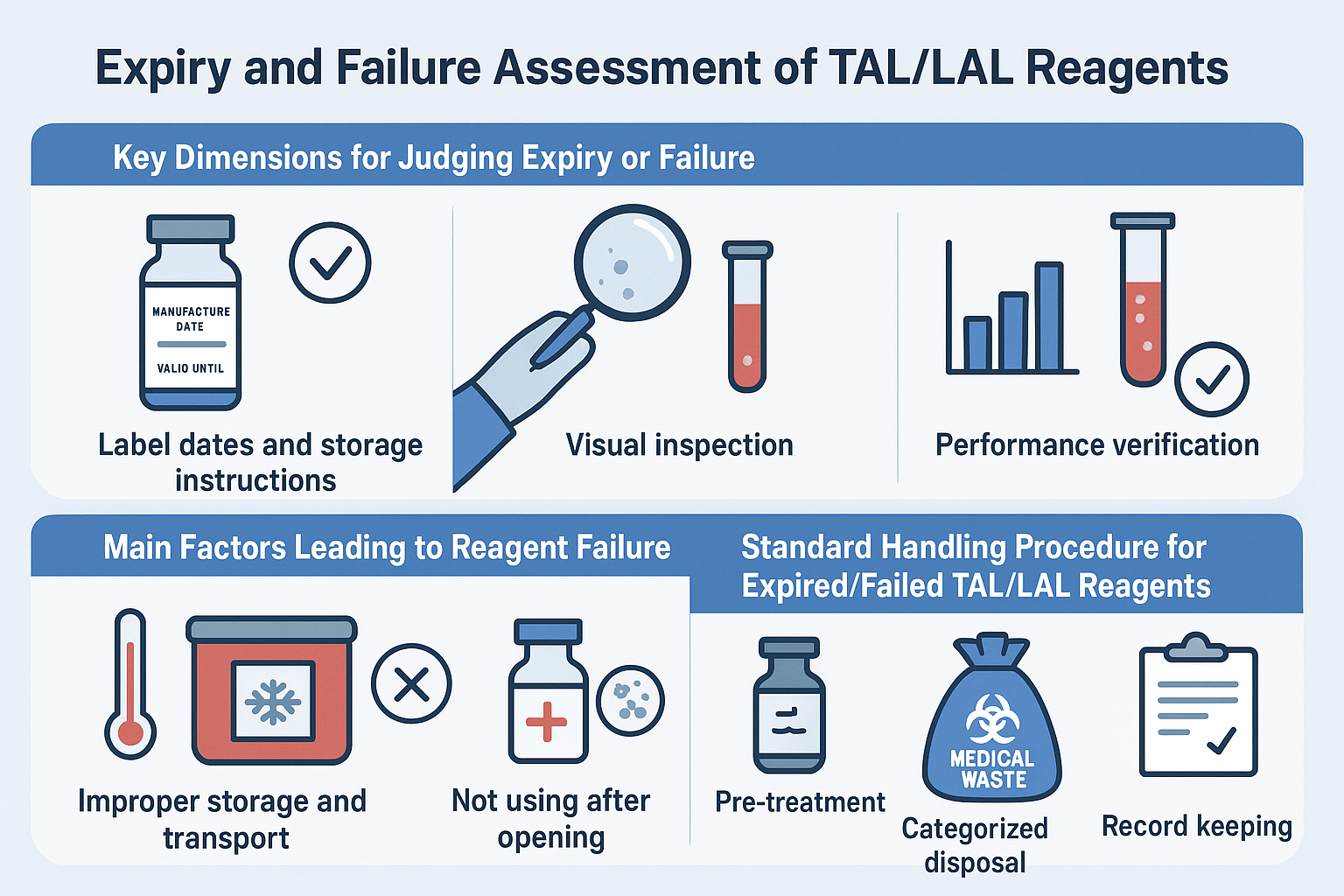
TAL/LAL Reagents are the core consumables for endotoxin testing; their activity and specificity directly determine the reliability of test results. Storage conditions, transport environment, and time after opening can all affect reagent performance—so that even within the printed shelf life, a reagent may fail prematurely. Using expired or degraded reagents can cause false positives, false negatives, or quantitative bias, with serious consequences for product quality evaluation. This article systematically describes how to judge TAL/LAL reagent expiry/failure, the main contributing factors, and standardized handling procedures for laboratories.
I. Key Dimensions for Judging Expiry or Failure
Decisions about whether a TAL/LAL reagent has expired or failed should be based on three complementary checks: label information, visual inspection, and performance verification. Relying on any single indicator may lead to misjudgment.
I.i Basic check — label dates and storage instructions
● Shelf-life assessment: Check the reagent packaging or vial label for “manufacture date,” “valid until,” or stated shelf life (for example, “24 months,” “18 months”). If the current date is past the “valid until” date, or the elapsed time since opening exceeds the manufacturer’s limit (e.g., “use within 4 weeks after opening”), classify the reagent as expired and do not use it.
● Storage-condition compliance: Typical TAL/LAL storage is 2–8°C, protected from light and sealed; some recombinant reagents require −20°C. Even within the printed shelf life, reagents can lose activity if any of the following occur during storage/transport:
○ repeated freeze–thaw cycles (for frozen reagents);
○ temperature excursions outside the specified range (e.g., summer heat exposure during transport);
○ poor sealing (exposure to humid air or contaminants);
○ direct strong light exposure (which can damage enzyme components).
I.ii Visual check — appearance and reconstitution behavior
Visual inspection offers a quick preliminary screen; standards differ by reagent format.
● Lyophilized (freeze-dried) reagents:
○ Normal: uniform powder, consistent pale/white color, no caking or discoloration; vial interior free of water droplets or foreign material.
○ Failure signs: severe caking, abnormal color (yellowing, greying), turbidity or precipitate after reconstitution, flocculation, or unusually slow dissolution (e.g., more than ~5 minutes to fully dissolve).
● Liquid reagents:
○ Normal: clear, transparent solution with uniform color (usually colorless or pale yellow).
○ Failure signs: turbidity, suspended particles or sediments, darker color (deep yellow to brown), bubbles, or off-odors.
I.iii Performance verification — the gold standard
Appearance and label checks are preliminary. Performance verification is required to confirm whether a reagent still meets detection capability. Common tests include sensitivity, specificity, and repeatability validations.
● Sensitivity test:
○ Procedure: Reconstitute according to the instructions, prepare a series of endotoxin standard concentrations (for example 0.5λ, 1λ, 2λ where λ is the reagent’s claimed sensitivity), and include negative control (endotoxin-free water) and positive control (1λ endotoxin). Run the assay per normal procedure and read results.
○ Decision rule: If the 1λ standard is positive, 0.5λ is negative, and the negative control is negative, the reagent sensitivity is acceptable. If 1λ is negative (false negative) or 0.5λ is positive (false positive), sensitivity is abnormal and the reagent is considered failed.
● Specificity test:
○ Procedure: Use samples known to be endotoxin-free but containing common interferents (e.g., glucans, proteins). Run the sample and include a positive endotoxin control and a sample blank.
○ Decision rule: If the sample blank is positive (no endotoxin but shows positive) or the endotoxin positive control fails, specificity has declined and the reagent is not reliable.
● Repeatability test:
○ Procedure: Run at least three replicates of the same concentration (e.g., 1λ). Calculate the coefficient of variation (CV).
○ Decision rule: If CV exceeds 10% for gel-clot assays or 15% for chromogenic assays, reagent stability/repeatability is inadequate and the reagent is considered failed.
II. Main Factors Leading to Reagent Failure
Understanding failure causes helps laboratories prevent premature loss of reagent function. Major contributors are:
1. Improper storage and transport: Temperature excursions, repeated freeze–thaw, and inadequate sealing are primary causes—enzyme components (e.g., Factor C, pro-clotting factors) are sensitive to environmental change and can denature.
2. Not using after opening: Once reconstituted, reagents (especially freeze-dried ones) expose active components to air and degrade with time. Many reagents must be used within 24 hours after reconstitution (follow the manufacturer’s instructions).
3. Contamination during preparation/use: Reconstituting with non-endotoxin water, microbial contamination introduced during handling, or environmental endotoxin can disable reagent specificity.
4. Manufacturing quality issues: Rarely, a reagent lot may have production defects (insufficient active component, incorrect excipient ratio) and fail earlier than expected.
III. Standard Handling Procedure for Expired/Failed TAL/LAL Reagents
Expired or failed TAL/LAL reagents are treated as regulated medical waste. Follow relevant medical-waste regulations and laboratory safety rules to avoid environmental or biosafety hazards. A typical compliant workflow includes:
III.i Pre-treatment — reduce biohazard risk
● Inactivation:
○ Liquid reagents: Autoclave at 121°C, 30 minutes (steam sterilization) or heat at 60°C for 1 hour to inactivate biological activity and any contaminating microbes.
○ Lyophilized reagents: Reconstitute with endotoxin-free water, then apply the same inactivation procedure.
● Sealed packaging: Place in dedicated medical-waste bags and clearly label (e.g., “Expired TAL/LAL Reagent — Inactivated — Medical Waste”).
III.ii Categorized disposal — follow regulated channels
● On-site temporary storage: Store sealed waste in a locked, ventilated, and labeled medical-waste cabinet away from food or reagent storage; do not exceed allowable temporary storage time (commonly 48 hours; follow local regulations).
● Professional collection: Engage a licensed medical-waste disposal company to collect and process the waste. Complete and retain transfer documentation (waste transfer forms) specifying waste name, quantity, and treatment method.
● Prohibited actions: Do not dispose of expired reagents down drains, mix with general trash, or discard casually—such improper disposal risks environmental contamination.
III.iii Record keeping — ensure traceability
● Maintain an Expired Reagent Disposal Log recording reagent name, specification, batch number, manufacture date, expiry date, reason for failure, disposal date, treatment method, and the qualified disposal company and transfer form number.
● Keep records for a recommended retention period (e.g., at least 3 years) to support audits and regulatory inspections.
IV. Laboratory Prevention Recommendations — Reduce Reagent Failure Risk
Implementing robust reagent lifecycle management reduces waste and testing risk.
1. Smart purchasing and inventory management: Order based on expected consumption to avoid overstock. Use first-in, first-out (FIFO) inventory practice, prioritize use of near-expiry lots, and conduct regular stock counts to remove expired items promptly.
2. Correct storage and transport: Strictly follow manufacturer storage instructions; maintain calibrated refrigeration/freezer units and validate temperature logs. During transport, use insulated containers with cold packs and minimize transit time to limit temperature fluctuations.
3. Operator training and handling rules: Train staff on reconstitution procedures using endotoxin-free water and sterile tools; label opened vials with the opening date and use within specified time; reseal and refrigerate unused portions where permitted.
4. Routine performance checks: For near-expiry lots, randomly sample 1–2 batches per month for sensitivity verification to detect early failure and prevent use of compromised reagent.
V. Conclusion
Judging TAL/LAL reagent expiry or failure should follow a stepwise approach: label check → visual inspection → performance verification, with performance testing being the decisive criterion. Laboratories must manage the full reagent lifecycle—procurement, storage, use, verification, and compliant disposal—to maintain test accuracy and environmental safety.
Keep a complete reagent management and disposal log to reduce compliance risk and optimize procurement. Newer, stabilized TAL/LAL reagent formulations with extended shelf life (some manufacturers report stability up to 36 months) can also help laboratories reduce expiry-related losses and operational risk.


