
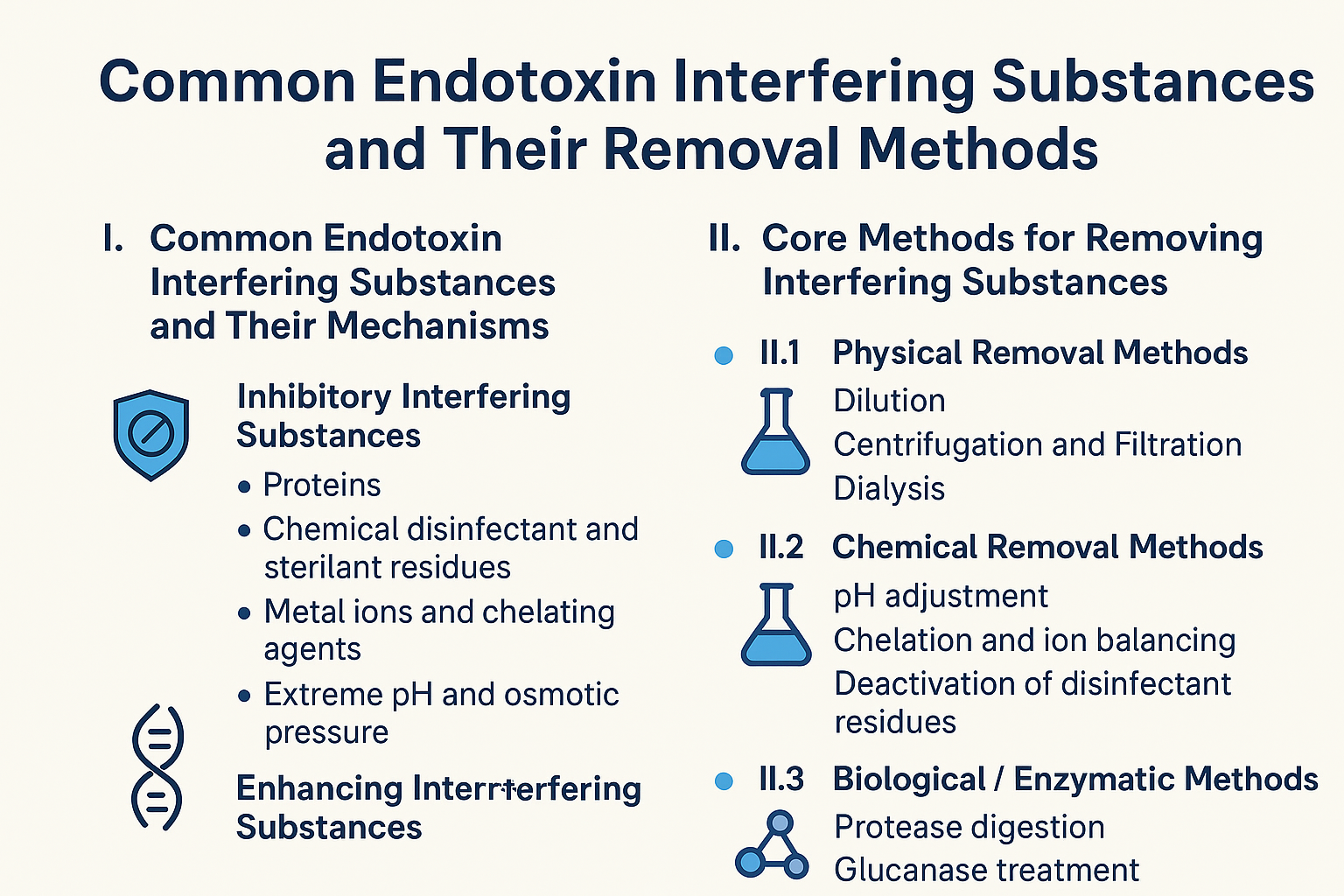
Accurate endotoxin detection—especially when using TAL/LAL Reagent—is essential in the quality control of pharmaceuticals, medical devices, and biological products. Interfering substances commonly present in sample matrices may suppress or enhance the specific reaction between endotoxin and TAL/LAL Reagent, leading to false negatives, false positives, or significant deviations in quantitative results.
This article systematically summarizes common types of endotoxin interfering substances, their mechanisms of interference, and practical strategies for removing them, providing a reference for improving detection accuracy.
I. Common Endotoxin Interfering Substances and Their Mechanisms
I.1 Inhibitory Interfering Substances
These substances suppress the enzymatic cascade of TAL/LAL Reagent, reducing detection sensitivity and causing false-negative results.
(1) Proteins
High concentrations of proteins (e.g., serum proteins, recombinant proteins, antibodies) may adsorb endotoxins or competitively bind to bioactive components of TAL/LAL Reagent (such as C-factor and coagulase precursor), inhibiting the enzymatic reaction. This is common in biologics and tissue-extraction samples from medical devices.
(2) Chemical Disinfectant and Sterilant Residues
Residual ethanol, isopropanol, hydrogen peroxide, or preservatives (e.g., benzalkonium chloride) can disrupt the biological activity of TAL/LAL Reagent. Even trace amounts may fully inhibit gel formation or chromogenic reactions.
(3) Metal Ions and Chelating Agents
Excess heavy metals (lead, copper, mercury) can denature key enzymes in TAL/LAL Reagent, while chelators such as EDTA or sodium citrate remove essential divalent cations (Ca²⁺, Mg²⁺), blocking the enzymatic cascade.
(4) Extreme pH and Osmotic Pressure
TAL/LAL Reagent functions optimally at pH 6.0–8.0. Strongly acidic or alkaline matrices and high/low osmolarity solutions (high salts, concentrated sucrose solutions) can denature the enzymes and compromise reactivity.
I.2 Enhancing Interfering Substances
These substances non-specifically activate the TAL/LAL Reagent reaction system, leading to inflated endotoxin results or false positives.
(1) Polysaccharides and Glucans
Certain natural polysaccharides (starch, glucans, plant extracts) and fungal cell-wall residues may mimic endotoxin structure and activate the C-factor, triggering false coagulation reactions.
(2) Surfactants
Nonionic surfactants (Tween 80, Triton X-100) and anionic surfactants (SDS) affect reaction interface tension and accelerate enzyme kinetics, resulting in artificially elevated endotoxin readings.
(3) Nucleic Acids
Residual bacterial DNA/RNA fragments—especially from Gram-negative bacteria—may indirectly increase reaction signal intensity and interfere with quantitative accuracy.
II. Core Methods for Removing Interfering Substances
Removal strategies must eliminate or neutralize interfering substances without compromising endotoxin activity or TAL/LAL Reagent performance. The choice depends on interference type and sample characteristics.
II.1 Physical Removal Methods
(1) Dilution
The simplest and most widely used approach. Diluting samples with endotoxin-free water or buffer reduces interfering substance concentration below tolerance limits (while staying within the Maximum Valid Dilution, MVD).
Examples:
• High-protein biologics: 1:10–1:100 dilution
• Medical-device extracts: post-extraction dilution to reduce ionic interference
(2) Centrifugation and Filtration
Centrifuge at 10,000–15,000 rpm for 10–15 minutes to remove insoluble particles.
Filter through a 0.22 μm endotoxin-free membrane to eliminate particulate matter that may adsorb endotoxin and to avoid external contamination.
(3) Dialysis
Ideal for removing small-molecule interferents (e.g., metal ions, chelators, disinfectant residues).
Dialyze samples against endotoxin-free buffer (e.g., Tris-HCl) for 2–4 hours.
Endotoxins (large LPS molecules) remain retained, while small inhibitors diffuse away.
II.2 Chemical Removal Methods
(1) pH Adjustment
Adjust sample pH to 6.0–8.0 using endotoxin-free 0.1M HCl or 0.1M NaOH.
Stabilize with buffer afterward.
pH must be validated to ensure no rebound during reaction.
(2) Chelation and Ion Balancing
• Add endotoxin-free EDTA (0.01–0.05M) to complex heavy metals.
• Add citrate buffer to stabilize excess cations and maintain ionic strength.
(3) Deactivation of Disinfectant Residues
• Ethanol: evaporate under ventilation
• Hydrogen peroxide: add catalase (100–200 U/mL) to degrade it
• Dilute all disinfectants to <0.1% (v/v) with endotoxin-free water
II.3 Biological / Enzymatic Methods
(1) Protease Digestion
Add protease K or trypsin (10–50 μg/mL) and incubate at 37°C for 30–60 min to degrade protein interferents.
Then heat at 60°C for 10 minutes to inactivate the protease before TAL/LAL Reagent testing.
(2) Glucanase Treatment
Add β-glucanase (5–10 U/mL) and incubate at 37°C for 1 hour to eliminate glucan-mediated false activation.
Useful for plant extracts and fungal-derived bioproducts.
II.4 Specialized Interference Inhibitors
Commercially available TAL/LAL Reagent interference inhibitors bind specific interfering substances via ligands (e.g., protein-binding resins, ion-exchange materials) or modify reaction conditions to shield interference.
Must follow manufacturer’s instructions to avoid over-inhibition.
III. Key Steps for Validating Interference Removal
To confirm the effectiveness of interference removal:
1. Prepare a sample positive control containing known endotoxin concentration (λm) and a sample negative control.
2. Prepare TAL/LAL Reagent positive and negative controls.
3. Conduct the assay following standard procedures.
4. Calculate endotoxin recovery:
R = [(Sample PC – Sample NC) / λm] × 100%
5. If R = 50%–200%, interference is considered adequately removed.
6. If not, adjust removal strategy and revalidate.
IV. Practical Considerations
● All materials contacting the sample must be heat-depyrogenated at 250°C for 30 minutes.
● Start with gentle methods (dilution, dialysis) to avoid damaging endotoxin activity.
● Different TAL/LAL Reagent types (gel-clot vs. kinetic chromogenic) vary in interference tolerance—select accordingly.
● Establish standardized interference-removal procedures for similar sample categories to ensure consistent results.
Conclusion
Effective endotoxin interference removal requires identifying the interference type and applying targeted strategies that balance “removing the interferent” and “preserving endotoxin and reagent activity.”
Dilution and pH adjustment solve most routine issues, while complex samples may require protease digestion or specialized inhibitors.
Through proper interference testing and validation, false-negative and false-positive results can be minimized, ensuring reliable quality control. As TAL/LAL Reagent technologies advance, improved anti-interference formulations will further enhance accuracy and ease of detection.
FireGene Endotoxin Testing
Ready to run your endotoxin assay?
FireGene offers a complete endotoxin testing toolkit — from TAL reagents and CSE standards to pyrogen-free consumables and LAL reagent water. All products are aligned with USP <85>, EP 2.6.14, and JP 4.01.


