
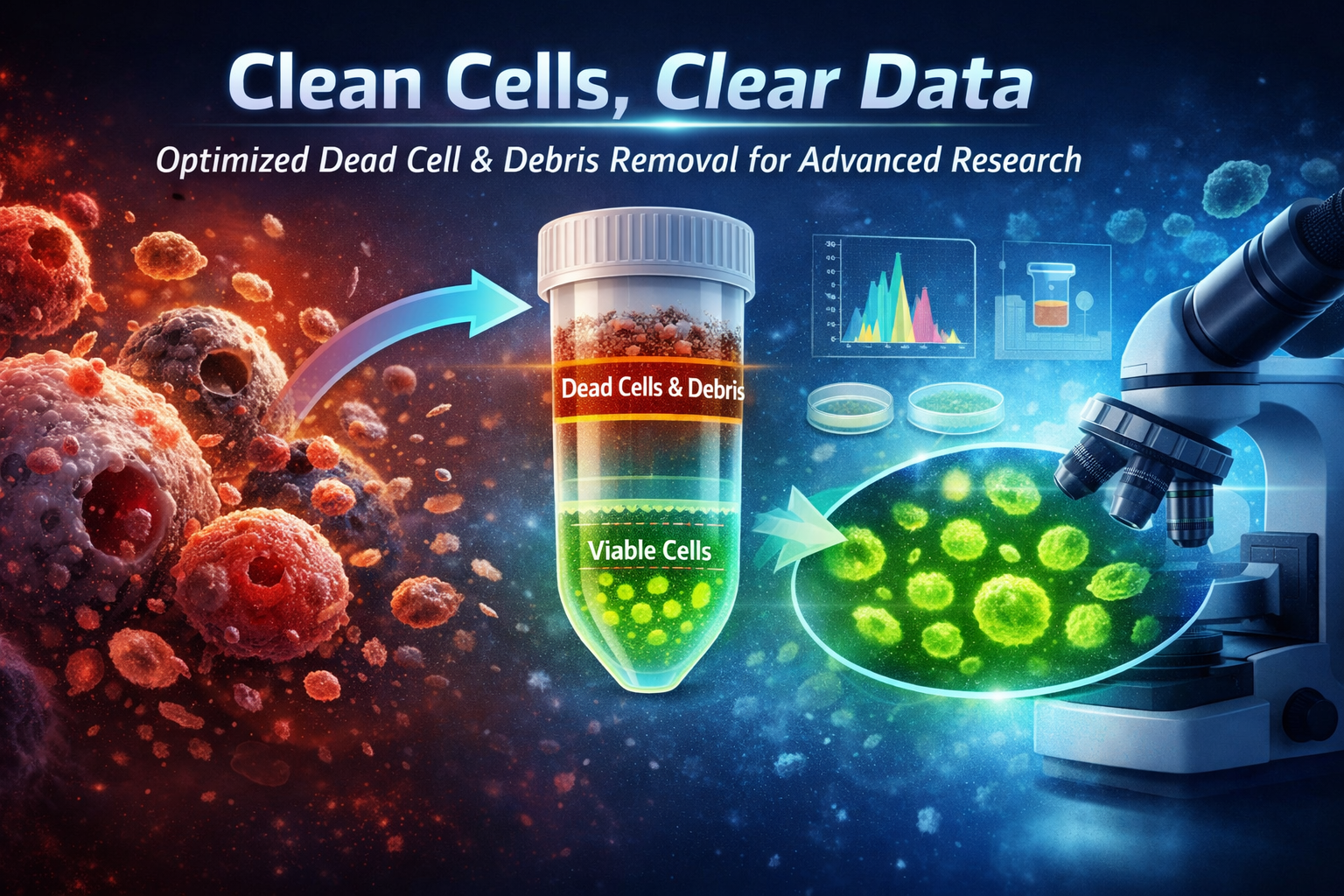
The Hidden Bottleneck in Modern Research: Sample Quality
In today’s fast-evolving landscape of biological research, technologies such as single-cell RNA sequencing (scRNA-seq), flow cytometry, and primary cell culture have transformed how scientists explore cellular complexity. Yet, despite advances in instrumentation and computational analysis, one fundamental issue continues to limit experimental success: poor sample quality.
Following tissue dissociation or cell harvesting, researchers often encounter heterogeneous suspensions filled with dead cells, membrane fragments, and other impurities. These contaminants are not just minor inconveniences—they are major obstacles that compromise experimental reproducibility and data integrity.
Low viability samples can lead to:
Reduced sequencing depth and gene detection sensitivity
Increased background noise in cytometry assays
Impaired cell growth in downstream cultures
As a result, even the most sophisticated research workflows can fail at the very first step: sample preparation. Addressing this challenge requires not just better techniques, but a reliable and standardized method for removing unwanted cellular debris.
Why Dead Cells and Debris Matter More Than You Think
Dead cells and impurities are far from inert. They actively interfere with experimental systems in multiple ways, making them a critical concern in any cell-based research workflow.
One of the most significant issues arises in sequencing applications. Dead cells release degraded RNA and intracellular enzymes into the surrounding environment. This leads to contamination of viable cell populations and ultimately results in lower-quality transcriptomic data. Researchers often observe reduced median gene counts and increased variability across samples—clear indicators of compromised data quality.
In flow cytometry and fluorescence-activated cell sorting (FACS), debris and apoptotic bodies can produce non-specific signals. These artifacts complicate gating strategies and increase the likelihood of false-positive results. Similarly, cell aggregates formed by debris can disrupt sorting accuracy and reduce overall efficiency.
From a methodological perspective, these issues highlight a key principle:
The accuracy of downstream analysis is only as good as the quality of the input sample.
Therefore, implementing an effective cell preparation method to eliminate dead cells and impurities is not optional—it is essential for achieving reliable and reproducible research outcomes.
A Smarter Approach: The FireGene Removal Kit
To address these persistent challenges, the FireGene Dead Cell Debris & Impurities Removal Kit offers an innovative and efficient solution tailored for modern research workflows.
Designed with both performance and usability in mind, this kit provides a streamlined method for purifying cell suspensions while preserving the integrity of viable cells. Unlike traditional approaches that may require complex instrumentation or extended processing times, FireGene delivers a balance of simplicity, speed, and reproducibility.
 Key Advantages
1. Efficient Removal of Dead Cells and Impurities
The kit effectively separates unwanted debris, apoptotic cells, and contaminants, resulting in a cleaner and more homogeneous cell population.
2. Gentle Processing for Maximum Viability
Optimized conditions ensure minimal stress on live cells, preserving cell function and improving downstream compatibility.
3. Broad Workflow Compatibility
Whether applied to single-cell sequencing, cytometry, or cell culture, the kit integrates seamlessly into existing research protocols.
4. Reproducible Results Across Experiments
A standardized approach reduces variability, enabling consistent performance across different samples and studies.
By combining these features, the FireGene kit represents a next-generation sample purification solution—one that aligns with the increasing demands for precision and reproducibility in life science research.
Optimized Protocol: Simple, Fast, and Reliable
One of the defining strengths of the FireGene kit is its user-friendly and highly efficient protocol, designed to fit effortlessly into standard laboratory workflows.
Typical Workflow Overview
Step 1: Prepare Cell Suspension
Obtain a single-cell suspension from tissue dissociation or cultured cells. Ensure proper filtration to remove large aggregates.
Step 2: Add Removal Reagent
Introduce the optimized reagent to the sample. The formulation selectively interacts with dead cells and debris.
Step 3: Incubation and Separation
Following a brief incubation, perform centrifugation or separation according to the protocol. During this step, impurities are effectively segregated from viable cells.
Step 4: Collect Purified Cells
Carefully collect the enriched population of live cells for downstream applications.
Protocol Highlights
Time-efficient: Minimal hands-on time, ideal for high-throughput research
Easy to implement: No specialized equipment required
Scalable: Suitable for both small-scale experiments and larger studies
Consistent performance: Reduces variability across operators and experiments
This optimized protocol and method ensures that researchers can achieve high-quality results without adding complexity to their workflows.
Empowering Advanced Research Applications
High-quality cell preparation is the foundation of successful experimental outcomes. By removing dead cells and impurities, the FireGene kit enables researchers to unlock the full potential of their downstream applications.
1. Single-Cell Sequencing (scRNA-seq & snRNA-seq)
Clean cell suspensions lead to:
Higher cell capture efficiency
Increased gene detection sensitivity
Reduced ambient RNA contamination
This directly translates into more accurate and biologically meaningful datasets, enhancing the power of single-cell analysis.
2. Flow Cytometry and Cell Sorting (FACS)
Improved sample purity results in:
Clearer population separation
Reduced background noise
More precise gating strategies
Researchers can achieve higher confidence in their data, especially in complex or rare cell population studies.
3. Primary Cell Culture and Organoids
Removing dead cells minimizes toxic byproducts and supports:
Better cell viability
Enhanced growth and proliferation
More stable culture conditions
This is particularly valuable for sensitive systems such as stem cells and organoids.
4. Broad Research Applications Across Life Sciences
From immunology and oncology to neuroscience and regenerative medicine, the FireGene kit supports a wide range of research applications where sample quality is critical.
From Sample to Discovery: Transforming Research Outcomes
In the era of precision biology, the demand for high-quality, reproducible data has never been greater. While advanced technologies continue to push the boundaries of discovery, the importance of robust sample preparation methods remains unchanged.
The FireGene Dead Cell Debris & Impurities Removal Kit addresses this need by providing a reliable, efficient, and easy-to-use solution for improving cell sample quality. By integrating this optimized workflow and protocol into your research, you can:
Enhance data accuracy
Increase experimental reproducibility
Maximize the value of your biological samples
Ultimately, better samples lead to better science.
Conclusion
In modern life science research, sample quality is a decisive factor that directly impacts data accuracy and experimental success. The FireGene Dead Cell Debris & Impurities Removal Kit provides a reliable, efficient, and user-friendly solution to eliminate dead cells and contaminants from complex cell suspensions. By integrating this optimized method and streamlined protocol into your workflow, researchers can significantly improve cell viability, reduce background noise, and enhance reproducibility across applications such as single-cell sequencing, flow cytometry, and cell culture. Ultimately, cleaner samples lead to clearer insights, enabling scientists to generate high-quality data and accelerate meaningful discoveries with greater confidence and consistency.
FireGene, light your research with passion, innovation and prefession.
FireGene Single-Cell Sample Prep
Looking for validated dissociation kits?
FireGene's tissue dissociation kits are optimized for specific organ types — brain, tumor, liver, GI, reproductive, and more. Validated for 10x Genomics Chromium and BD Rhapsody workflows.


