

Description
Product Introduction
This product is suitable for the isolation and preparation of protoplast suspensions from higher plants. It employs enzymes to gently, rapidly, and effectively break down the cell wall, releasing protoplasts and thereby generating a single-protoplast suspension. The prepared single-protoplast suspension can be utilized for single-cell sequencing, tissue culture, protoplast fusion, or other cell-related research.
Specifications
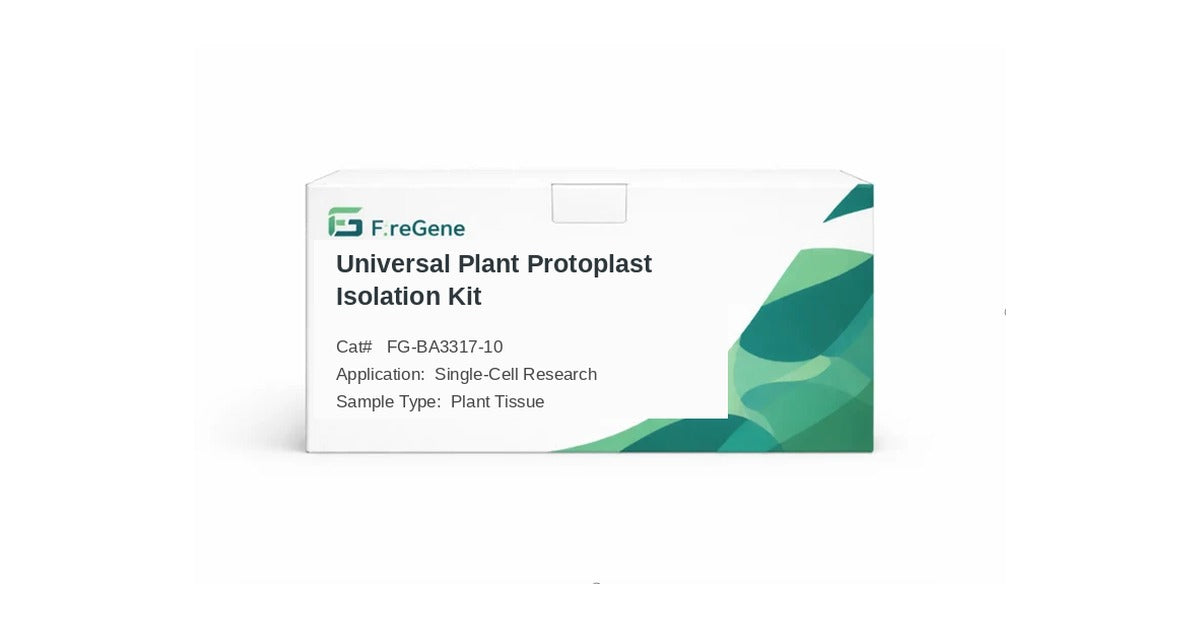
| Product Name | Universal Plant Protoplast Isolation Kit |
| Catalog No. | FG-BA3317 |
| Package Size | 10 reactions/kit, 50 reactions/kit |
| Sample Type | Fresh, tender tissue from higher plants (~200–300 mg per reaction) |
| Key Applications | Single-cell sequencing, tissue culture, protoplast fusion, and other cell-related research |
| Product Format | Sterile |
Product Components
| Component | Catalog Number | FG-BA3317 (10 rxns) |
|---|---|---|
| Enzyme A | FG-BA3317-A | 50 mL |
| Buffer B | FG-BA3317-B | 80 mL |
| PPS (Protoplast Purification Solution) | FG-BA3317-C | 25 mL |
| Buffer C | FG-BA3317-G | 10 mL |
Storage
- Enzyme A: Store at -20°C, with a shelf life of two years.
- Buffer B, PPS (Protoplast Purification Solution), and Buffer C: Store at 4°C, protected from light, with a shelf life of one year.
Precautions
- Be sure to use a horizontal centrifuge and set the appropriate parameters to avoid affecting the experimental results due to improper operation.
- This product is sterile. Please wear a lab coat and disposable gloves, and follow aseptic techniques to prevent microbial contamination.
- Ensure that reagents are thoroughly mixed before use.
- During the operation, keep samples in a dark or dimly lit environment as much as possible — the container can be wrapped with tin foil.
- When aspirating protoplasts, use wide-bore pipette tips and aspirate gently.
Reagent and Instrument Requirements
Instruments: Orbital shaker (horizontal type), surgical scalpel, horizontal centrifuge.
Reagents: 15% mannitol solution, BSA.
Consumables: Low-adsorption pipette tips, 30 mL conical flasks, 15 mL centrifuge tubes, 70 µm cell strainers.
Protocol Overview
Preparation Work:
- Set the orbital shaker (horizontal type) and horizontal centrifuge to 25°C or room temperature, and prepare a 15% mannitol solution.
- Add BSA to Buffer B and Buffer C to achieve a final concentration of 0.2%.
- Collect approximately 200–300 mg of fresh, tender tissue.
Procedure:
- Immerse the clean, contamination-free sample in 15% mannitol solution and cut into the finest possible shreds with a surgical blade, taking care not to crush it. Immerse the shreds in 15% mannitol solution and protect from light for 8 minutes.
- Add 5 mL of Enzyme A to a clean, dry 30 mL conical flask. Transfer the sample shreds into the flask using forceps.
- Wrap the flask with tin foil for a dark environment. Place on an orbital shaker at 45 r/min, 25°C or room temperature.
- Enzymatic digestion should last 3–5 hours. Every 30 minutes to 1 hour, take a 10 µL sample and observe under a microscope. Terminate digestion once a significant number of free protoplasts are observed.
- Add at least an equal volume (5 mL) of Buffer B and mix thoroughly. Manually rotate and shake the flask vigorously for 1 minute without splashing.
- Filter through a 70 µm cell strainer and collect the filtrate in a new 15 mL centrifuge tube.
- Centrifuge at 25°C, 130 × g for 5 minutes, then discard the supernatant.
- Resuspend the pellet in 500 µL of Buffer B, gently pipette to mix, and take 10 µL for microscopic observation. If viability and purity meet requirements, proceed to Step 13; if not, continue with Steps 9–12.
- Add PPS (Protoplast Purification Solution) in a 1:1 ratio (approximately 500 µL) and gently pipette to mix. Do not vortex.
- Take 2 mL of PPS in a new 15 mL centrifuge tube. Gently layer the protoplast-containing liquid (approximately 1 mL) on top of the PPS using a pipette tip, without disturbing the lower layer.
- Centrifuge at 25°C, 200 × g for 15 minutes with centered acceleration/deceleration. The solution separates into two layers, with high-purity protoplasts located between them. Remove approximately 800 µL of the debris-containing liquid above the protoplast layer, taking care not to aspirate the protoplasts.
- Gently aspirate approximately 400 µL of the protoplast-rich liquid and add at least 5 times the volume (approximately 2 mL) of Buffer B.
- Centrifuge at 25°C, 150 × g for 5 minutes, then discard the supernatant. Gently resuspend the pellet in an appropriate volume of Buffer C, depending on pellet amount and desired concentration.
- Perform quality control on the cell suspension using a microscope and cell counter, and record the results.
- Proceed immediately to subsequent experiments after quality control.
Note: Handle the centrifuge tube gently throughout to ensure distinct layering and prevent mixing between solution layers.
Frequently Asked Questions
What is this kit used for?
The kit isolates and prepares protoplast suspensions from higher plants by enzymatically breaking down the cell wall to release protoplasts, generating a single-protoplast suspension for downstream research.
What downstream applications is the protoplast suspension suitable for?
The prepared single-protoplast suspension can be used for single-cell sequencing, tissue culture, protoplast fusion, or other cell-related research.
How much starting plant tissue do I need?
We recommend collecting approximately 200–300 mg of fresh, tender tissue per reaction.
How long does enzymatic digestion take?
Digestion typically takes 3–5 hours. Check a 10 µL sample under a microscope every 30 minutes to 1 hour, and terminate digestion once a significant number of free protoplasts are observed.
What equipment and reagents do I need beyond the kit?
You'll need an orbital shaker (horizontal type), a surgical scalpel, and a horizontal centrifuge, along with 15% mannitol solution and BSA. Consumables include low-adsorption pipette tips, 30 mL conical flasks, 15 mL centrifuge tubes, and 70 µm cell strainers.
Why do samples need to be kept in the dark during the procedure?
Protoplasts are light-sensitive during isolation. Keep samples in a dark or dimly lit environment as much as possible — wrapping the container in tin foil works well during enzymatic digestion.
What is PPS (Protoplast Purification Solution) used for?
PPS is used in a density-gradient centrifugation step to separate high-purity protoplasts from cell debris and dead cells. The protoplast-containing liquid is layered on top of PPS and centrifuged, after which high-purity protoplasts collect between the two layers.
How should the kit components be stored?
Enzyme A should be stored at -20°C with a two-year shelf life. Buffer B, PPS, and Buffer C should be stored at 4°C, protected from light, with a one-year shelf life.
Is this kit sterile?
Yes, this product is sterile. Wear a lab coat and disposable gloves, and follow aseptic technique throughout to prevent microbial contamination.
What centrifuge settings are important for this protocol?
A horizontal centrifuge is required throughout, with specific g-force and time settings at each step (e.g., 130 × g for 5 min, 200 × g for 15 min with centered acceleration/deceleration, and 150 × g for 5 min). Improper centrifuge parameters can affect protoplast yield and purity.
Files Download Links