
Introduction: High Standards Shouldn’t Mean High Costs
Endotoxin control is the process of detecting, removing, and verifying endotoxin levels in biological samples to ensure experimental accuracy and safety.
Endotoxin contamination is a critical concern in protein research, cell culture, and biopharmaceutical workflows. Even low levels can disrupt experiments, reduce reproducibility, and delay progress.
To avoid these risks, many labs rely on endotoxin detection and removal solutions—but often at a high cost.
The good news?
Reliable endotoxin control doesn’t have to break your budget.
With the right workflow, you can achieve accurate endotoxin detection (LAL assay) and efficient endotoxin removal (resin-based methods)—while significantly reducing overall cost.
The Real Problem: Inefficient Workflows Waste Money
Many labs unknowingly overspend on endotoxin control due to:
Repeating experiments caused by undetected contamination
Using endotoxin removal methods without prior quantification
Choosing expensive systems that exceed actual needs
Key insight: The biggest cost is not the reagent—it’s failed experiments and lost time.
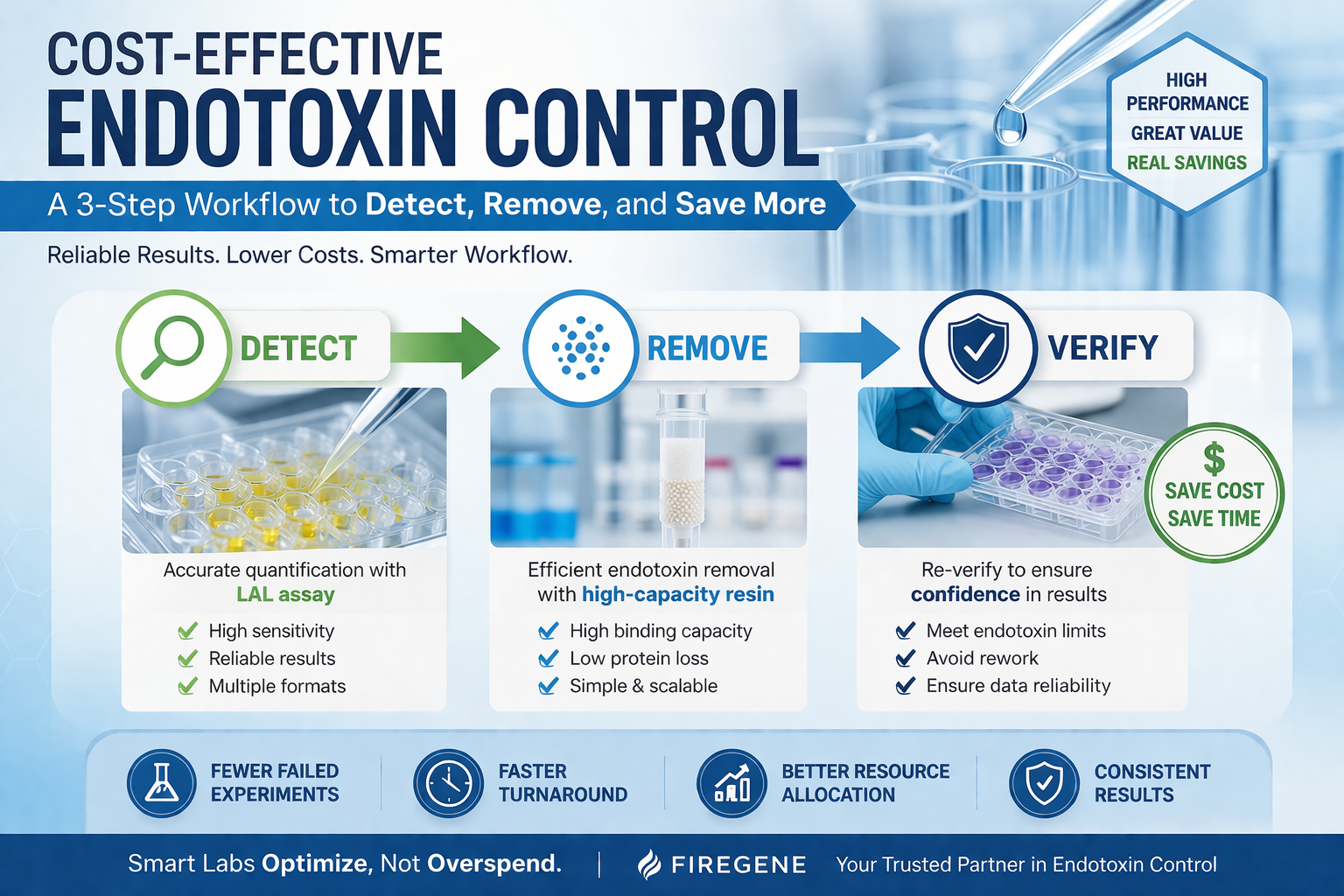
A Smarter, More Cost-Effective Workflow
Instead of treating endotoxin control as isolated steps, a smarter approach is to build a cost-efficient workflow:
Detect → Remove → Verify
This closed-loop strategy helps you:
Avoid unnecessary reagent usage
Maximize endotoxin removal efficiency
Reduce trial-and-error cycles
Ensure consistent results
Step 1 – Accurate Endotoxin Detection with LAL Assay
Endotoxin detection is the foundation of the entire process.
The LAL assay (Limulus Amebocyte Lysate assay) remains the gold standard for endotoxin detection due to its:
High sensitivity (down to low EU/mL levels)
Reliable and quantitative results
Broad compatibility with protein and biological samples
However, not all LAL assay kits are priced equally.
What to look for in a cost-effective LAL assay:
Consistent performance across batches
Flexible formats (gel clot, chromogenic, turbidimetric)
Competitive pricing without unnecessary brand premiums
The goal is simple:
Pay for accuracy—not for brand markup.
Step 2 – Efficient Endotoxin Removal Using Resin
Once endotoxin levels are confirmed, removal becomes the priority.
Among available methods, endotoxin removal resins provide the best balance between:
High performance
Sample safety
Cost efficiency
Why endotoxin removal resins are cost-effective:
High binding capacity → fewer purification cycles
Minimal protein loss → higher recovery yield
Simple workflow → reduced labor and time
Comparison of common endotoxin removal methods:
Method Hidden Cost
Ultrafiltration Low efficiency → repeated runs
Phase separation Time-consuming and variable
Proprietary systems High consumable cost
A well-designed endotoxin removal resin saves both time and total experimental cost.
Step 3 – Verification Using LAL Assay
Skipping verification is one of the most expensive mistakes in endotoxin control.
Without re-testing:
Downstream experiments may fail
Additional purification cycles may be required
Data reliability is compromised
A quick LAL re-test ensures:
Endotoxin levels meet required thresholds
Your purification process is successful
No hidden contamination risks remain
FireGene Advantage: High Value Without Compromise
FireGene provides a cost-effective endotoxin control solution by integrating detection and removal into a streamlined workflow.
 Why choose FireGene?
Affordable LAL assay kits with high sensitivity and reproducibility
High-capacity endotoxin removal resins with low protein loss
Designed for real lab workflows—not overengineered systems
Competitive pricing for both routine and large-scale applications
In short:
Reliable performance at a fraction of the typical cost.
Applications of Endotoxin Control Workflow
This workflow is widely used in:
Recombinant protein purification
Antibody development
Cell-based assays
Vaccine and mRNA research
Real Impact: Where You Save the Most
A cost-effective endotoxin strategy improves both performance and efficiency.
You save on:
Fewer failed experiments
Reduced sample loss
Lower reagent consumption
Less hands-on time
You gain:
Consistent and reproducible results
Faster project turnaround
Better lab resource allocation
Conclusion: Optimize Performance While Reducing Cost
Endotoxin control is essential—but overspending is not.
By combining:
Accurate endotoxin detection (LAL assay)
Efficient endotoxin removal (resin)
Reliable verification
you can build a workflow that is both scientifically robust and economically efficient.
Call to Action
Looking for a more cost-effective way to manage endotoxins?
Explore FireGene LAL assay kits and endotoxin removal resins
Request samples or technical support
Optimize your endotoxin control workflow today
FireGene, light your research with passion, innovation, and profession.
FireGene Endotoxin Testing
Ready to run your endotoxin assay?
FireGene offers a complete endotoxin testing toolkit — from TAL reagents and CSE standards to pyrogen-free consumables and LAL reagent water. All products are aligned with USP <85>, EP 2.6.14, and JP 4.01.


