
Introduction
Primary cell culture provides an experimental system that more closely reflects the biological characteristics of native tissues than many continuously passaged cell lines. However, primary cells are often more sensitive to enzymatic digestion, mechanical dissociation, environmental stress, and changes in culture conditions. As a result, the initial culture stage, commonly referred to as P0, may contain variable amounts of dead cells, cellular debris, tissue fragments, extracellular matrix residues, and other impurities.
These contaminants can negatively affect the quality of the culture before cells are passaged into P1.
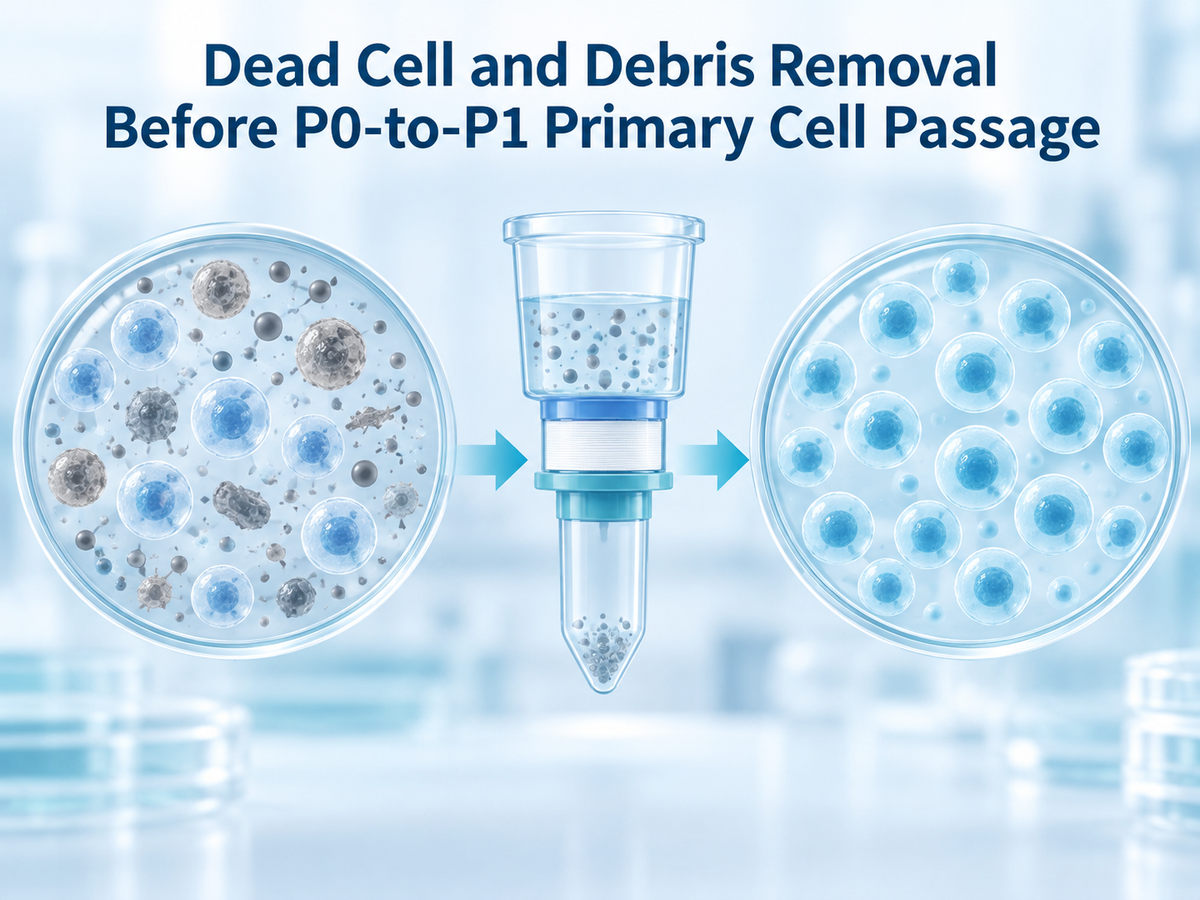
For laboratories working with primary cells, removing dead cells and debris before the first passage can therefore be an important sample-preparation step. A Dead Cell Debris and Impurities Removal Kit can be used to clean P0-derived cell suspensions before healthy cells are reseeded for P1 culture.
The purpose is not to distinguish P0 cells from P1 cells. Instead, the objective is to improve the quality of the viable cell population before the next culture stage.
Why P0 Primary Cultures Often Contain Dead Cells and Debris
The P0 stage begins after cells are isolated from fresh tissue and placed into primary culture. This process can expose cells to substantial physical and biochemical stress.
A typical primary-cell workflow may involve:
Tissue Collection → Tissue Dissociation → Filtration → Cell Seeding → P0 Culture → Passaging → P1 Culture
During these steps, some cells may be damaged or lost.
Several factors can contribute to poor sample quality.
Enzymatic Digestion
Primary tissues are commonly treated with enzymes to break down extracellular matrix components and release individual cells.
Excessive digestion may damage cell membranes, surface proteins, or cell-cell interactions. Sensitive cell populations can therefore lose viability during or after dissociation.
Mechanical Stress
Pipetting, trituration, filtration, centrifugation, and repeated resuspension can generate additional stress.
While these steps are often necessary to produce a single-cell suspension, excessive mechanical manipulation can increase cell damage and debris formation.
Tissue-Derived Contaminants
Fresh tissues may contain:
extracellular matrix fragments;
connective tissue remnants;
lipid material;
blood-derived components;
damaged cells;
apoptotic cells;
necrotic material; and
incompletely dissociated tissue particles.
These materials may remain in the P0 culture or appear again when adherent cells are detached for passaging.
Culture-Associated Cell Death
Some primary cells do not adapt well to in vitro conditions.
Cell death may occur because of:
changes in nutrient availability;
inappropriate substrate attachment;
serum or growth-factor conditions;
cell-density effects;
dissociation-induced stress;
oxidative stress; or
loss of tissue-specific cell interactions.
Consequently, a P0 culture may contain both healthy cells and a substantial amount of unwanted material by the time the first passage is performed.
Why Remove Dead Cells Before P1 Passage?
When P0 cells are harvested for passaging, dead cells and debris may be transferred together with viable cells into the P1 culture.
This can create several experimental problems.
Reduced Effective Seeding Quality
Cell counting may overestimate the amount of useful cellular material when dead cells and debris are present.
A sample containing one million total particles does not necessarily contain one million viable cells.
Removing unwanted material can provide a more representative viable cell population for reseeding.
Increased Background Material
Dead cells release intracellular components, nucleic acids, proteins, membrane fragments, and other cellular material.
These components can increase sample complexity and may interfere with downstream observations.
Poorer Culture Appearance
A culture containing extensive debris may appear cloudy, heterogeneous, or difficult to evaluate microscopically.
Cleaner cell suspensions generally make morphology, attachment, spreading, and proliferation easier to assess.
Potential Interference with Downstream Experiments
If P1 cells will later be used for flow cytometry, cell sorting, transcriptomic analysis, imaging, or molecular assays, poor starting quality at the first passage may influence subsequent experimental consistency.
For this reason, dead-cell and debris removal can be particularly useful when P0 viability is lower than expected.
How a Dead Cell Debris and Impurities Removal Kit Fits into the Workflow
A typical workflow can be represented as:
P0 Primary Culture → Cell Detachment → Single-Cell Suspension → Dead Cell / Debris / Impurity Removal → Viable Cell Recovery → P1 Reseeding
The cleanup step is performed after the P0 cells have been harvested and converted into a cell suspension.
The purified viable fraction is then collected and reseeded under the appropriate culture conditions.
This approach may help researchers obtain a cleaner population of cells before establishing the P1 culture.
Importantly, the kit does not biologically convert P0 cells into P1 cells.
The passage designation changes because the recovered cells are reseeded and expanded in a new culture cycle. The removal kit is simply used as a purification step before that reseeding process.
Suitable Primary Cell Applications
Dead cell and debris removal may be useful for many types of primary-cell preparations, particularly when the original tissue is difficult to dissociate or naturally produces substantial debris.
Examples may include cells derived from:
brain tissue;
spinal cord;
tumor tissue;
lung;
liver;
gastrointestinal tissue;
heart;
kidney;
skin;
adipose tissue; and
other solid tissues.
Neural tissues can be especially challenging because dissociation may generate large amounts of myelin-associated material and fragile cellular debris.
Tumor tissues may also produce heterogeneous suspensions containing necrotic cells, stromal material, extracellular matrix fragments, and variable cell populations.
In these cases, a cleanup step before P1 culture can be particularly valuable.
Potential Advantages for P1 Culture Preparation
Improved Viable Cell Proportion
Removing dead cells can increase the relative percentage of viable cells in the final suspension.
This does not necessarily increase the absolute number of viable cells, but it improves the composition of the sample.
Cleaner Cell Suspension
Reduction of cellular fragments and tissue-derived impurities can make the suspension more uniform and easier to handle.

Better Cell Counting
A cleaner preparation may improve the accuracy of manual or automated cell counting because fewer non-cellular particles are present.
More Consistent Reseeding
When the viable-cell fraction is better defined, researchers can seed P1 cultures at a more consistent cell density.
This can be important because many primary cells are highly sensitive to plating density.
Improved Downstream Sample Quality
If P1 cultures are later used for:
flow cytometry;
fluorescence-activated cell sorting;
single-cell RNA sequencing;
immunostaining;
gene-expression analysis;
protein analysis; or
primary-cell functional assays,
starting with a cleaner population can help reduce unnecessary background and improve sample consistency.
Important Considerations Before Using a Cleanup Step
Although dead-cell removal can improve sample quality, it should not automatically be applied to every primary-cell culture.
One important consideration is cell recovery.
Any additional purification step may lead to some loss of viable cells. This is particularly relevant when the starting sample contains a limited number of cells.
Researchers should therefore consider the balance between:
Purity → Viability → Recovery
If a P0 culture already contains high viability and little debris, additional purification may provide limited benefit.
In contrast, cleanup may be more valuable when:
viability is visibly poor;
many floating dead cells are present;
large amounts of debris remain after dissociation;
accurate cell counting is difficult;
the sample will be used for sensitive downstream assays; or
reseeding quality is inconsistent.
The compatibility of the removal method with the target cell type should also be evaluated.
Some primary cells are particularly sensitive to centrifugation, incubation time, temperature changes, or repeated handling.
Assessing the Cell Population After Cleanup
After dead-cell and debris removal, several parameters can be evaluated before P1 reseeding.
Cell Viability
Trypan blue staining, automated viability analyzers, or fluorescent live/dead assays can be used to assess viability.
Cell Concentration
The recovered viable cells should be counted to determine an appropriate P1 seeding density.
Cell Morphology
After reseeding, researchers can monitor attachment, spreading, morphology, and early proliferation.
Recovery Rate
Comparing the number of viable cells before and after purification helps determine whether the procedure provides an acceptable balance between sample quality and cell recovery.
For sensitive primary-cell experiments, these quality-control steps can help optimize the workflow for a specific tissue or cell type.
P0-to-P1 Cleanup in Primary Cell Research
A practical workflow may therefore look like:
Primary Tissue
↓
Tissue Dissociation
↓
Initial Cell Isolation
↓
P0 Primary Culture
↓
Cell Harvesting
↓
Dead Cell, Debris, and Impurity Removal
↓
Viable Cell Collection
↓
Cell Counting and Viability Assessment
↓
P1 Reseeding
↓
Downstream Primary Cell Research
This workflow is particularly useful when P0 cultures contain substantial nonviable material that would otherwise be carried into the next passage.
Conclusion
Removing dead cells, cellular debris, and tissue-derived impurities before the first passage can be a useful strategy for improving the quality of primary-cell cultures.
A Dead Cell Debris and Impurities Removal Kit can be incorporated between P0 harvesting and P1 reseeding to enrich the viable cell fraction, reduce unwanted particulate material, improve cell counting, and provide a cleaner starting population for continued culture.
The key objective is not to distinguish P0 cells from P1 cells, but to optimize the cell suspension before the cells are reseeded into P1.
For primary-cell workflows involving difficult tissues, low initial viability, extensive debris, or sensitive downstream applications, this purification step may provide an effective way to improve sample consistency and culture quality.
FAQ
Can a Dead Cell Debris and Impurities Removal Kit be used before P1 culture?
Yes. It can be used after P0 primary cells are harvested and converted into a cell suspension. The cleanup step removes dead cells, cellular debris, and other unwanted material before viable cells are reseeded to establish the P1 culture.
Does the kit separate P0 cells from P1 cells?
No. P0 and P1 describe passage stages rather than distinct biological cell populations. The kit does not differentiate cells according to passage number. Instead, it improves the quality of the cell suspension before reseeding.
When is dead-cell removal most useful?
It is particularly useful when P0 cultures contain substantial numbers of dead cells, floating debris, tissue-derived contaminants, or poorly dissociated material. It may also be helpful when accurate cell counting or high-quality downstream analysis is required.
Can dead-cell removal improve cell viability?
The process can increase the relative proportion of viable cells by removing nonviable cells. However, it does not revive damaged cells or increase the absolute number of live cells. Some viable-cell loss may also occur during purification.
What downstream applications can benefit from cleaner P1 cultures?
Cleaner P1 preparations may be beneficial for flow cytometry, FACS, single-cell RNA sequencing, immunostaining, gene-expression analysis, protein analysis, primary-cell culture, and other cell-based assays.
Is dead-cell removal necessary for every P0-to-P1 passage?
No. If the P0 culture already has high viability and minimal debris, an additional purification step may not be necessary. The decision should depend on sample quality, cell type, recovery requirements, and downstream applications.
Which primary tissues may benefit from this workflow?
This approach may be useful for primary cells isolated from brain, spinal cord, tumor, lung, liver, heart, kidney, gastrointestinal tissue, skin, adipose tissue, and other solid tissues that can generate substantial debris during isolation and culture.
What should be checked after purification?
Researchers should evaluate cell viability, cell concentration, recovery rate, morphology, attachment, and early proliferation before or after P1 reseeding. These parameters help determine whether the purification step is suitable for a specific primary-cell system.


