
Introduction
Bacterial endotoxin contamination is a significant concern in pharmaceutical manufacturing, biotechnology, and laboratory quality control. Endotoxins, which are associated with the outer membranes of Gram-negative bacteria, can induce inflammatory and pyrogenic responses even when viable microorganisms are no longer present. Therefore, controlling endotoxin contamination requires strategies that extend beyond conventional microbial sterilization.
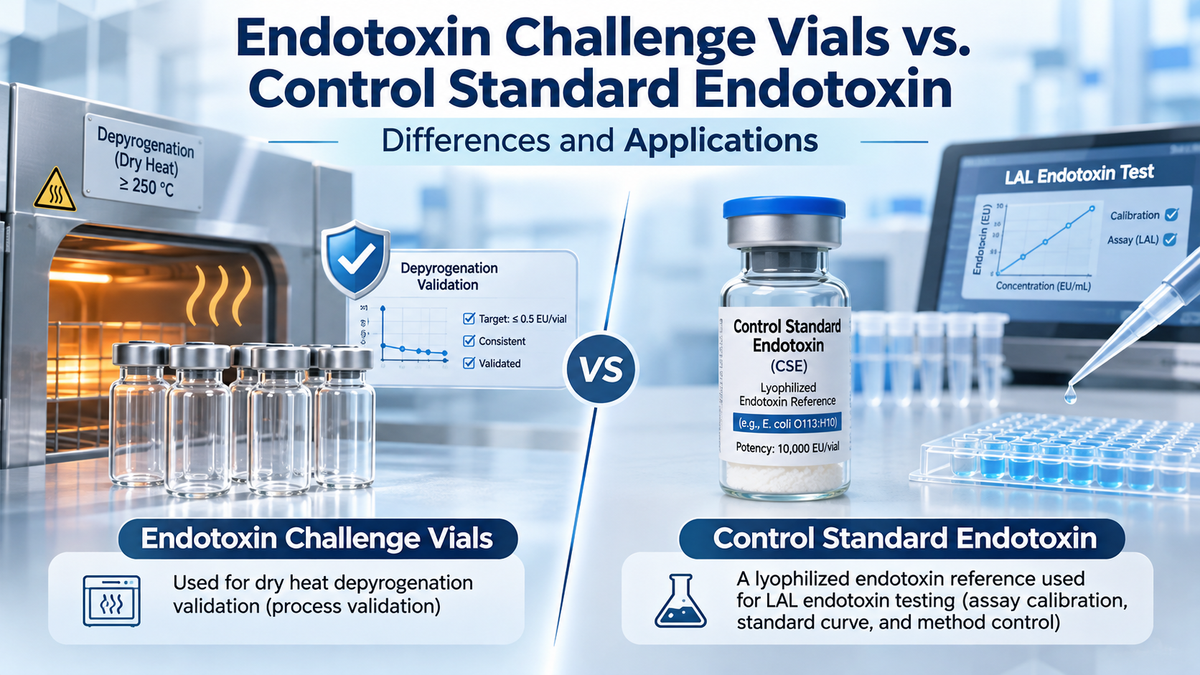
Two important materials used in endotoxin-related quality control are Endotoxin Challenge Vials (ECVs) and Control Standard Endotoxin (CSE). Although both involve characterized bacterial endotoxin preparations, they serve distinct functions in pharmaceutical testing and manufacturing validation.
Endotoxin Challenge Vials are primarily used to evaluate the effectiveness of depyrogenation processes, particularly dry heat treatment of pharmaceutical glass containers. In contrast, Control Standard Endotoxin is commonly used as a calibrated endotoxin preparation in bacterial endotoxin testing, including Limulus Amebocyte Lysate (LAL) assays.
Understanding the differences between ECVs and CSE is essential for selecting suitable testing materials, establishing reliable validation procedures, and maintaining effective endotoxin control programs.
1. What Are Endotoxin Challenge Vials (ECVs)?
Endotoxin Challenge Vials are prepared endotoxin indicators designed to assess the effectiveness of depyrogenation processes. They contain a characterized endotoxin challenge, typically deposited and dried onto the internal surface of a glass vial.
These indicators are introduced into a depyrogenation process to determine whether the selected operating conditions provide sufficient reduction in measurable endotoxin activity.
1.1 Composition and Characteristics
A typical ECV consists of a glass vial containing a defined endotoxin challenge derived from a bacterial lipopolysaccharide (LPS) preparation.
Depending on the manufacturer, ECVs may be supplied with documentation describing the nominal endotoxin challenge, batch identification, storage requirements, and recommended recovery procedures.
Important characteristics include:
Defined endotoxin challenge: A characterized amount of endotoxin activity, usually expressed in endotoxin units (EU).
Suitable carrier: A glass vial or another carrier compatible with the intended depyrogenation process.
Batch traceability: Product identification and supporting quality documentation.
Recovery characteristics: Information supporting the measurement of endotoxin recovered from untreated indicators.
Application-specific handling: Instructions for storage, processing, extraction, and analytical testing.
The specified challenge level should be suitable for the intended validation study and capable of supporting meaningful measurement of endotoxin reduction.
1.2 How Endotoxin Challenge Vials Work
ECVs function by providing a measurable endotoxin challenge before and after exposure to a depyrogenation cycle.
During validation, selected ECVs are placed at predetermined locations within a dry heat oven or depyrogenation tunnel. These locations are generally identified through heat distribution studies, equipment qualification, and worst-case operating assessments.
After processing, residual endotoxin is recovered from the treated indicators and measured using a qualified bacterial endotoxin assay.
The measured activity is compared with endotoxin recovered from unprocessed positive control indicators.
This comparison provides evidence of the process's ability to reduce detectable endotoxin activity under the evaluated conditions.
2. What Is Control Standard Endotoxin (CSE)?
Control Standard Endotoxin is a characterized bacterial endotoxin preparation used primarily as a reference material for analytical endotoxin testing.
CSE is commonly supplied as a lyophilized preparation containing purified LPS derived from Gram-negative bacteria, frequently Escherichia coli.
Unlike ECVs, which are prepared as physical challenge indicators, CSE is generally reconstituted and diluted to prepare endotoxin standards or analytical controls.
2.1 Standardization of CSE
CSE is standardized against a recognized Reference Standard Endotoxin (RSE), which provides the reference framework for assigning endotoxin activity.
The assigned potency of a CSE preparation is generally expressed in EU and may be associated with a specific endotoxin assay reagent system.
Consequently, laboratories should consult the product's Certificate of Analysis (CoA) and applicable reagent documentation before preparing working standards.
Accurate reconstitution and dilution are essential because errors in standard preparation can affect assay calibration, control recovery, and the interpretation of test results.
2.2 Major Applications of CSE
Control Standard Endotoxin supports several analytical activities:
LAL assay calibration: CSE is used to prepare standards for quantitative endotoxin testing methods, including chromogenic and turbidimetric LAL assays.
Gel-clot sensitivity verification: Known endotoxin concentrations are used to confirm the labeled sensitivity of gel-clot LAL reagents.
Positive product controls: CSE can be added to test samples to determine whether sample components inhibit or enhance endotoxin detection.
Analytical method qualification: Known endotoxin concentrations support evaluations of assay performance and suitability.
Recovery studies: CSE can help investigate the recovery of purified endotoxin from selected laboratory materials and sample matrices.
These applications make CSE an important material in pharmaceutical microbiology and quality control laboratories.
3. Endotoxin Challenge Vials vs. Control Standard Endotoxin: Main Differences
Although ECVs and CSE may contain related purified endotoxin materials, they differ in physical format, intended application, preparation, and the results they are designed to generate.
|
Comparison |
Endotoxin Challenge Vials (ECVs) |
Control Standard Endotoxin (CSE) |
|
Primary purpose |
Depyrogenation process validation |
Endotoxin assay standardization and controls |
|
Product format |
Prepared endotoxin challenge indicator |
Usually lyophilized endotoxin preparation |
|
Common application |
Dry heat ovens and depyrogenation tunnels |
LAL assays and endotoxin recovery studies |
|
Preparation |
Generally supplied with endotoxin on a suitable carrier |
Requires reconstitution and dilution |
|
Measurement objective |
Endotoxin reduction following processing |
Endotoxin activity and analytical performance |
|
Typical result |
Logarithmic reduction in recoverable endotoxin |
Calibration response or control recovery |
|
Main users |
Process validation and manufacturing QC teams |
Analytical QC and microbiology laboratories |
|
Key consideration |
Challenge consistency and recoverability |
Assigned potency and reagent compatibility |
The fundamental difference is their role in the testing process.
ECVs challenge the effectiveness of a depyrogenation process, while CSE supports the measurement and analytical control of bacterial endotoxin.
These materials are therefore complementary rather than direct substitutes.
4. Applications of ECVs in Dry Heat Depyrogenation Validation
Dry heat depyrogenation is commonly used in pharmaceutical manufacturing to reduce endotoxin contamination on heat-resistant materials, especially glass containers intended for sterile products.
Because endotoxins can remain biologically active after microorganisms have been inactivated, manufacturers need evidence that a process is capable of achieving the required endotoxin reduction.
4.1 Depyrogenation Oven Validation
Batch depyrogenation ovens are used to process heat-resistant equipment and containers under controlled temperature and exposure conditions.
ECVs may be distributed throughout the oven load to evaluate endotoxin reduction at locations representing challenging heat exposure.
Validation activities typically consider the loading pattern, equipment temperature distribution, heat penetration, operating cycle, and indicator placement.
The resulting data help determine whether the process provides reproducible endotoxin reduction under the defined conditions.
4.2 Depyrogenation Tunnel Qualification
Continuous depyrogenation tunnels are frequently integrated into pharmaceutical container preparation and aseptic filling operations.
In these systems, glass containers move through heating and cooling zones under controlled operating conditions.
ECVs can be used during qualification to investigate whether the process achieves the intended endotoxin reduction across representative operating configurations.
Relevant parameters may include conveyor speed, container size, loading density, temperature distribution, and exposure conditions.
4.3 Understanding 3-Log Endotoxin Reduction
A commonly applied benchmark for dry heat depyrogenation validation of pharmaceutical glass containers is a reduction of at least three logarithmic units.
A 3-log reduction corresponds to a 1,000-fold decrease in measured endotoxin activity, equivalent to 99.9% reduction.
The calculation is expressed as:
Log Reduction = log₁₀ (Initial Recovered Endotoxin / Residual Recovered Endotoxin)
For example, consider a validation study in which untreated control indicators provide an initial recovered activity of 10,000 EU per vial.
If the treated indicators contain 10 EU per vial following depyrogenation, the calculated reduction is:
log₁₀ (10,000 / 10) = 3.0
This represents a 3-log reduction.
Importantly, the calculation should use appropriately measured and qualified recovery results. The nominal labeled endotoxin challenge should not automatically be treated as equivalent to experimentally recovered endotoxin activity.
The acceptance criteria for a specific process should also reflect applicable regulatory expectations, product requirements, and the approved validation protocol.
5. Applications of CSE in Bacterial Endotoxin Testing
While ECVs are primarily used to evaluate depyrogenation processes, CSE plays a central role in analytical endotoxin measurement.
5.1 Preparation of Endotoxin Standards
In quantitative LAL testing, CSE is used to prepare known endotoxin concentrations across an established analytical range.
These standards provide the basis for relating assay response to endotoxin activity in unknown samples.
For chromogenic assays, endotoxin activity is determined through a color-producing enzymatic reaction.
In turbidimetric assays, endotoxin activity is evaluated through changes in turbidity associated with the LAL reaction.
The reliability of these measurements depends on suitable calibration standards, reagent performance, and appropriate analytical controls.
5.2 Positive Product Control Testing
Pharmaceutical formulations and complex laboratory samples may contain substances that interfere with endotoxin detection.
Such interference can produce artificially low or high assay responses.
To investigate this possibility, a known amount of endotoxin is added to the test sample to prepare a positive product control.
The measured recovery is compared with the expected endotoxin activity to evaluate potential inhibition or enhancement.
CSE provides a characterized endotoxin source for this purpose.
5.3 Endotoxin Recovery Studies
CSE is also useful for evaluating the recovery of purified endotoxin from laboratory materials and sample matrices.
Recovery can be influenced by factors such as pH, ionic strength, protein interactions, container adsorption, dilution conditions, and sample handling.
These studies may support analytical method development and troubleshooting.
However, purified CSE does not necessarily behave identically to naturally occurring endotoxin contamination in every pharmaceutical formulation. Therefore, conclusions from CSE recovery studies should be interpreted within the limits of the experimental model.
6. Can Control Standard Endotoxin Replace Endotoxin Challenge Vials?
Although CSE can be used to prepare endotoxin challenge materials, it should not automatically be considered a substitute for a qualified commercial ECV.
A laboratory may prepare its own endotoxin indicators by applying a characterized endotoxin solution to suitable carriers and drying the preparation under controlled conditions.
However, the resulting indicators must be evaluated to ensure that they are appropriate for their intended validation application.
Several factors require attention.
6.1 Endotoxin Loading Consistency
Each indicator should contain a sufficiently consistent endotoxin challenge to support meaningful comparison among samples.
Variability during preparation can complicate interpretation of depyrogenation results.
6.2 Baseline Endotoxin Recovery
The recovery procedure should be capable of extracting an appropriate and reproducible amount of endotoxin from untreated indicators.
Poor or inconsistent baseline recovery may reduce confidence in calculated log reductions.
6.3 Carrier Compatibility
The physical characteristics of the carrier can influence endotoxin deposition, heat exposure, and recovery.
Therefore, the selected carrier should be suitable for the process being investigated.
6.4 Method Qualification and Documentation
The preparation method, endotoxin source, challenge activity, storage conditions, recovery procedure, and acceptance criteria should be adequately documented.
Commercial ECVs can simplify indicator preparation by supplying a characterized challenge material. Nevertheless, laboratories remain responsible for confirming suitability under their specific testing and validation conditions.
7. How ECVs and CSE Complement Each Other
ECVs and CSE can contribute to different stages of an integrated pharmaceutical endotoxin control program.
For example, during dry heat depyrogenation validation, ECVs are positioned within the equipment to challenge process effectiveness.
After processing, endotoxin is extracted from treated and untreated indicators and measured using an appropriately qualified assay.
CSE may be used to prepare analytical standards and assay controls, helping verify that the measurement procedure performs as intended.
The resulting endotoxin measurements are then used to calculate reduction factors and evaluate the process against predetermined acceptance criteria.
This arrangement provides two complementary forms of information:
Process performance: ECVs help demonstrate the capacity of the depyrogenation cycle to reduce recoverable endotoxin activity.
Analytical reliability: CSE supports the calibration and control procedures used to measure endotoxin activity.
Together, these materials contribute to a more comprehensive assessment of endotoxin control.
8. How to Select the Appropriate Endotoxin Material
Selecting between ECVs and CSE begins with identifying the primary objective of the laboratory procedure.
For depyrogenation process qualification, a characterized endotoxin indicator is generally the appropriate choice.
For routine endotoxin analysis, assay calibration, reagent sensitivity verification, or positive product control testing, CSE is typically more suitable.
When evaluating commercial ECVs, laboratories should review the specified challenge activity, carrier characteristics, storage requirements, recoverability, and available quality documentation.
For CSE, important considerations include assigned potency, reference standard traceability, reagent compatibility, reconstitution instructions, and stability after preparation.
In both cases, the material should be selected according to the intended application rather than solely on the basis of its nominal endotoxin content.
9. FireGene Solutions for Endotoxin Testing and Depyrogenation Studies
FireGene provides laboratory materials for endotoxin-related testing and process evaluation, including Endotoxin Challenge Vials and Control Standard Endotoxin.
FireGene Endotoxin Challenge Vials
FireGene ECVs are intended to support dry heat depyrogenation studies by providing a prepared endotoxin challenge that can be evaluated before and after processing.
Potential applications include pharmaceutical glass container depyrogenation, equipment qualification studies, and process validation.
FireGene Control Standard Endotoxin
FireGene CSE is intended for analytical endotoxin testing applications, including the preparation of endotoxin standards, assay controls, and selected recovery studies.
Researchers and quality control professionals should review the applicable product specifications, batch-specific CoA, and instructions for use when selecting either material.
10. Conclusion
Endotoxin Challenge Vials and Control Standard Endotoxin are both important materials in pharmaceutical endotoxin control, but their functions are fundamentally different.
ECVs are designed primarily to evaluate the effectiveness of depyrogenation processes by providing a characterized endotoxin challenge. They are particularly useful in dry heat depyrogenation validation and equipment qualification.
CSE, on the other hand, is a calibrated endotoxin preparation used primarily in bacterial endotoxin testing. It supports assay calibration, positive product controls, reagent performance evaluation, and analytical recovery studies.
Although CSE may be used to prepare customized endotoxin indicators, such materials require suitable preparation, characterization, and qualification before use in validation studies.
Understanding the distinction between ECVs and CSE enables laboratories to select appropriate materials, improve analytical reliability, and develop more effective endotoxin control strategies.
For pharmaceutical manufacturers, biotechnology laboratories, and quality control professionals, using each material for its intended purpose is an important element of dependable depyrogenation validation and bacterial endotoxin testing.
Frequently Asked Questions
Are Endotoxin Challenge Vials and Control Standard Endotoxin interchangeable?
No. ECVs are primarily designed for depyrogenation process validation, while CSE is used mainly for analytical endotoxin testing and assay controls. CSE can be used to prepare challenge indicators, but additional qualification is necessary.
Why are ECVs used in dry heat depyrogenation validation?
ECVs provide a characterized endotoxin challenge that allows laboratories to assess the reduction in recoverable endotoxin activity following a defined heat treatment process.
Can CSE be used in an LAL assay?
Yes. CSE is widely used to prepare endotoxin standards and positive controls for compatible LAL methods, including gel-clot, chromogenic, and turbidimetric assays.
What is the difference between RSE and CSE?
Reference Standard Endotoxin (RSE) is the recognized primary reference material used for endotoxin standardization. Control Standard Endotoxin (CSE) is a secondary standard calibrated against RSE for routine analytical applications.
What does a 3-log endotoxin reduction mean?
A 3-log reduction represents a 1,000-fold decrease in measured endotoxin activity, corresponding to a 99.9% reduction. It is a commonly established benchmark for pharmaceutical dry heat depyrogenation validation of glass containers, subject to the applicable process requirements and validation criteria.


