
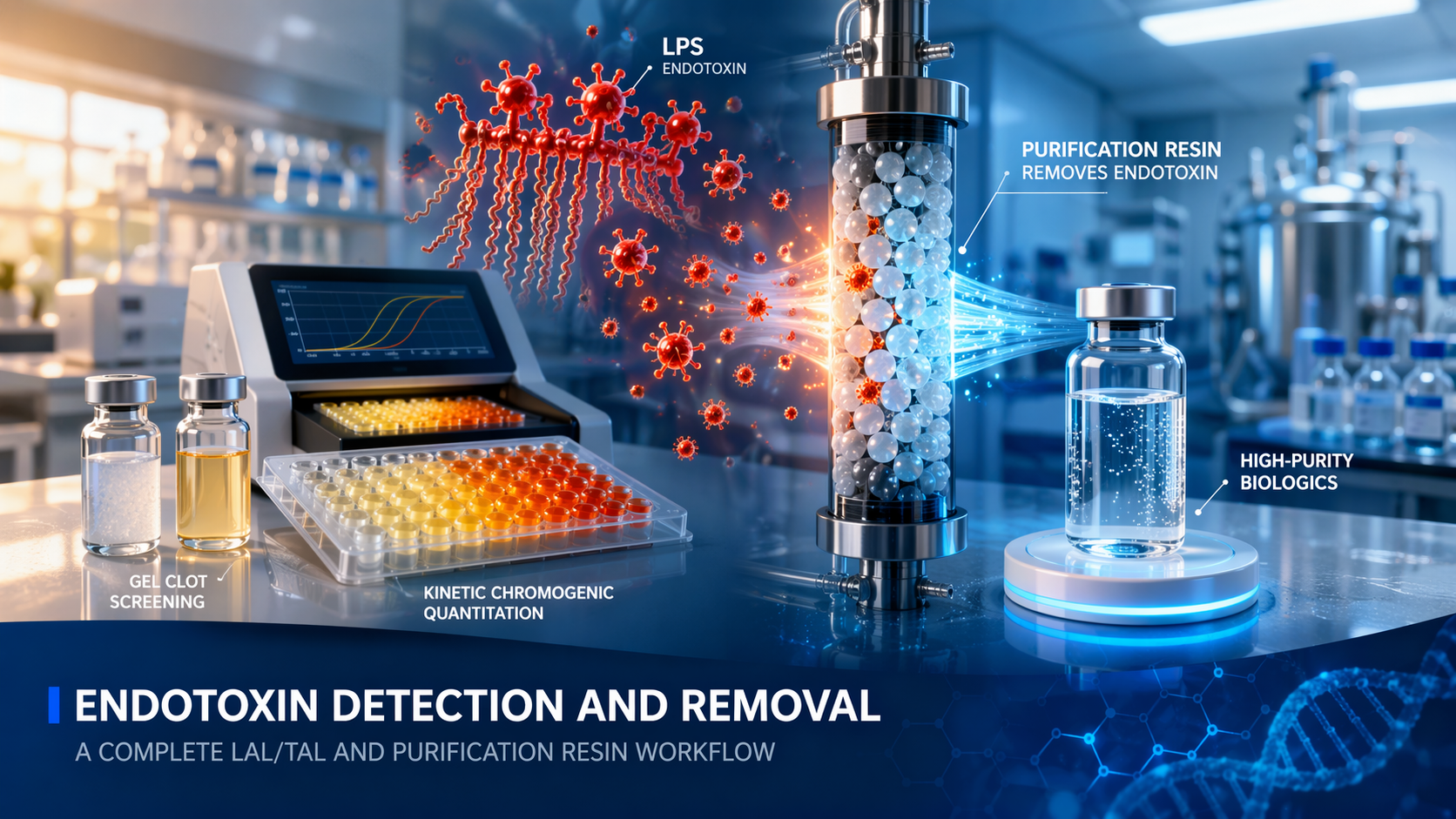
Abstract:Endotoxin contamination is a major concern in biological research and biopharmaceutical manufacturing, as it can compromise product safety, affect cellular responses, and reduce experimental reproducibility. This article introduces an integrated endotoxin control workflow combining sensitive detection and efficient removal strategies. The Limulus Amebocyte Lysate (LAL/TAL) system, including Gel Clot and Kinetic Chromogenic assays, provides both qualitative screening and quantitative measurement of endotoxin levels. In parallel, high-efficiency purification resins enable effective adsorption and removal of lipopolysaccharides from proteins and biological samples. Together, these technologies form a complete solution for endotoxin monitoring, clearance, and quality assurance in research and GMP environments.
Key words:Endotoxin detection;LAL/TAL assay;Gel Clot method;Kinetic Chromogenic assay;Endotoxin removal resin
What Are Endotoxins and Why Strict Control Is Essential?
Endotoxins are lipopolysaccharides (LPS) located in the outer membrane of Gram-negative bacteria. When these bacteria grow, die, or lyse, endotoxins are released into the surrounding environment, where they can easily contaminate biological materials, laboratory reagents, and biopharmaceutical products. Even in extremely low concentrations, endotoxins can trigger strong biological responses, making them one of the most critical quality concerns in life science research and pharmaceutical manufacturing.
The primary issue with endotoxins lies in their potent immunostimulatory activity. Once introduced into a biological system, they are recognized by immune cells through the TLR4 signaling pathway, leading to the activation of innate immune responses. This can result in the release of pro-inflammatory cytokines, fever-like reactions, and in severe cases, toxic shock-like effects. Because of this, endotoxin contamination is strictly regulated in injectable drugs, vaccines, and cell-based therapeutics.
In laboratory research, endotoxins can significantly distort experimental outcomes. They may reduce cell viability, alter gene expression profiles, and induce nonspecific immune activation in cell culture systems. In recombinant protein and antibody production, even trace endotoxin levels can compromise functional assays and downstream biological interpretations.
Common application areas where endotoxin control is essential include recombinant protein purification, monoclonal antibody development, vaccine production, and advanced cell therapy products such as CAR-T cells. In all of these fields, maintaining endotoxin levels below pharmacopeia-defined limits is a fundamental requirement for both safety and reproducibility.
As biotechnological applications continue to advance toward higher sensitivity and clinical relevance, the demand for rigorous endotoxin control is increasing. This makes reliable detection and efficient removal strategies indispensable components of any modern bioprocess workflow.
Endotoxin Detection Methods: The LAL/TAL Assay System
Accurate endotoxin detection is a fundamental requirement in biopharmaceutical production and life science research. Among the available methods, the Limulus Amebocyte Lysate (LAL) and Tachypleus Amebocyte Lysate (TAL) assays remain the global gold standard for endotoxin testing due to their high sensitivity, specificity, and regulatory acceptance in pharmacopeias such as USP, EP, and ChP.
The LAL/TAL assay is based on a unique enzymatic cascade derived from the blood cells of horseshoe crabs. When endotoxin (LPS) is present, it activates Factor C in the lysate, initiating a سلسلة of reactions that ultimately lead to either clot formation, color development, or turbidity change depending on the assay format. This biological amplification mechanism allows detection of endotoxin at extremely low concentrations, often down to 0.01 EU/mL or lower.
One of the simplest formats is the Gel Clot method, a qualitative assay that indicates the presence or absence of endotoxin through visible gel formation. It is widely used for routine screening, raw material testing, and batch release decisions due to its robustness and minimal equipment requirements. The FireGene Gel Clot Endotoxin Test Assay (LAL/TAL Assay) provides a reliable and cost-effective solution for this purpose, enabling rapid pass/fail evaluation in quality control workflows.
For applications requiring higher precision, the kinetic chromogenic method offers a quantitative approach. This assay measures the rate of color development produced by enzymatic cleavage of a synthetic substrate in response to endotoxin activity. By generating a standard curve, researchers can accurately determine endotoxin concentration in EU/mL. The FireGene Kinetic Chromogenic Endotoxin Test Kit (LAL/TAL Assay) is designed for high-sensitivity quantification and is well-suited for both research and GMP-compliant environments, especially when paired with microplate reader systems for automation and high-throughput testing.
Together, these two complementary methods provide a flexible and reliable detection framework, allowing users to choose between rapid screening and precise quantification depending on experimental or production requirements.
Why Detection Alone Is Not Enough: Sources and Challenges of Endotoxin Contamination
Although endotoxin detection is essential for quality control, testing alone cannot solve the underlying problem of contamination. In real-world bioprocessing and laboratory workflows, endotoxins are persistent and can be introduced at multiple stages, making them difficult to fully eliminate without a dedicated removal strategy.
One of the most common sources of endotoxin contamination is the bacterial expression system, particularly Escherichia coli. During cell growth and harvest, bacterial lysis releases large amounts of lipopolysaccharides (LPS) into the lysate, which can strongly associate with target proteins. In addition, purification steps themselves may introduce endotoxins through chromatography resins, filtration units, and even buffer preparation systems if water quality is not strictly controlled.
Laboratory consumables such as plastic tubes, pipette tips, and glassware can also contribute to low-level endotoxin contamination, especially if they are not certified pyrogen-free. Because endotoxins are highly stable amphipathic molecules, they are resistant to standard sterilization methods and can persist on surfaces even after autoclaving.
The removal of endotoxins presents additional challenges due to their unique physicochemical properties. The lipid A component of LPS is highly hydrophobic, allowing endotoxins to form aggregates and bind strongly to proteins and other biomolecules. This interaction can reduce protein recovery during purification and make separation difficult without affecting product integrity.
Traditional removal approaches such as Triton X-114 phase separation, high-salt washes, or ultrafiltration can provide partial improvement but often suffer from limitations including protein loss, incomplete removal efficiency, or incompatibility with scale-up and GMP workflows.
Because of these challenges, a simple “test-and-adjust” strategy is no longer sufficient for modern biologics production. Instead, effective endotoxin control requires a systematic workflow that combines sensitive detection with robust and scalable removal technologies, ensuring both product safety and experimental reproducibility.
High-Efficiency Endotoxin Removal: The Role of Purification Resin
To overcome the limitations of traditional endotoxin reduction methods, modern bioprocessing increasingly relies on advanced chromatographic and adsorption-based technologies. Among these, endotoxin removal purification resins have become one of the most efficient and scalable solutions for achieving low endotoxin levels without compromising product quality.
Endotoxin removal strategies generally rely on exploiting the physicochemical properties of lipopolysaccharides (LPS), particularly their strong negative charge and hydrophobic lipid A region. Based on these characteristics, several mechanisms can be used for separation, including affinity interactions, ion exchange, and mixed-mode adsorption. Each approach offers different advantages depending on the complexity of the sample and the sensitivity requirements of the final application.
Affinity-based systems, such as polymyxin-like binding interactions, are widely used due to their relatively high specificity toward endotoxins. Ion exchange resins, especially anion exchangers, can also effectively capture LPS by exploiting its overall negative charge. However, these methods may sometimes interact with target proteins, requiring careful optimization of buffer conditions and loading parameters. Mixed-mode resins, which combine ionic and hydrophobic interactions, offer improved flexibility and often achieve higher overall clearance efficiency across a broader range of biomolecules.
 In this context, the FireGene High-Efficiency Endotoxin Removal Purification Resin provides a robust solution for both laboratory and industrial applications. Designed for efficient endotoxin adsorption, this resin enables effective reduction of LPS levels while maintaining high recovery of target proteins. Its performance makes it suitable for a wide range of biomolecules, including recombinant proteins, antibodies, and enzymes.
Importantly, this type of resin is not limited to small-scale research use. It can be integrated into scalable purification workflows as a polishing step following affinity or ion-exchange chromatography, making it highly valuable in GMP-compliant biomanufacturing processes. By incorporating a dedicated endotoxin removal step, researchers can significantly reduce batch variability and improve downstream assay reliability.
Overall, high-efficiency purification resins represent a critical advancement in endotoxin control, bridging the gap between detection and final product safety.
Integrated Workflow: A Complete Endotoxin Control Strategy
Effective endotoxin control in modern bioprocessing is no longer achieved through a single step or isolated technique. Instead, it requires a systematic, closed-loop workflow that integrates sensitive detection, efficient removal, and final validation. This combined strategy ensures both product safety and experimental reproducibility across research and industrial applications.
The workflow typically begins with rapid screening using a qualitative assay. The Gel Clot method provides a straightforward and reliable way to determine whether endotoxins are present in raw materials, buffers, or intermediate samples. Its simplicity and robustness make it an ideal first-line checkpoint in routine quality control processes.
Once initial screening confirms the presence of endotoxins or when precise quantification is required, a more advanced analytical method is applied. The kinetic chromogenic assay enables accurate measurement of endotoxin concentration in EU/mL by monitoring enzyme-driven color development over time. This quantitative data is essential for establishing baseline contamination levels and evaluating process performance.
After quantification, samples undergo targeted purification using an endotoxin removal step. High-efficiency purification resins play a central role here, selectively adsorbing lipopolysaccharides while preserving the structural and functional integrity of the target biomolecule. This step is especially important for sensitive applications such as recombinant protein production, monoclonal antibody development, and vaccine antigen purification.
Finally, a validation step is performed to confirm the effectiveness of the removal process. Re-testing with LAL/TAL-based assays ensures that endotoxin levels have been reduced to acceptable thresholds defined by regulatory or experimental requirements. This final verification is critical for GMP compliance and for ensuring consistency across production batches.
By combining detection and removal into a unified workflow, researchers and manufacturers can achieve a higher level of control over product quality. This integrated approach minimizes the risk of contamination-related failures, improves downstream experimental reliability, and supports the production of safe, high-purity biologics suitable for both research and clinical applications.
Conclusion
Endotoxin control is a critical step in ensuring the safety, reliability, and reproducibility of modern biological research and biopharmaceutical production. From sensitive detection using LAL/TAL-based assays to efficient removal through advanced purification resins, each stage plays a vital role in maintaining product quality. FireGene’s Gel Clot and Kinetic Chromogenic Endotoxin Test Kits provide flexible solutions for both rapid screening and precise quantification, while the High-Efficiency Endotoxin Removal Purification Resin enables effective LPS clearance during purification workflows. Together, these tools form an integrated endotoxin management system that supports robust GMP compliance and high-quality biologics development.
FireGene, light your research with passion, innovation, and profession.
FireGene Endotoxin Testing
Ready to run your endotoxin assay?
FireGene offers a complete endotoxin testing toolkit — from TAL reagents and CSE standards to pyrogen-free consumables and LAL reagent water. All products are aligned with USP <85>, EP 2.6.14, and JP 4.01.


