
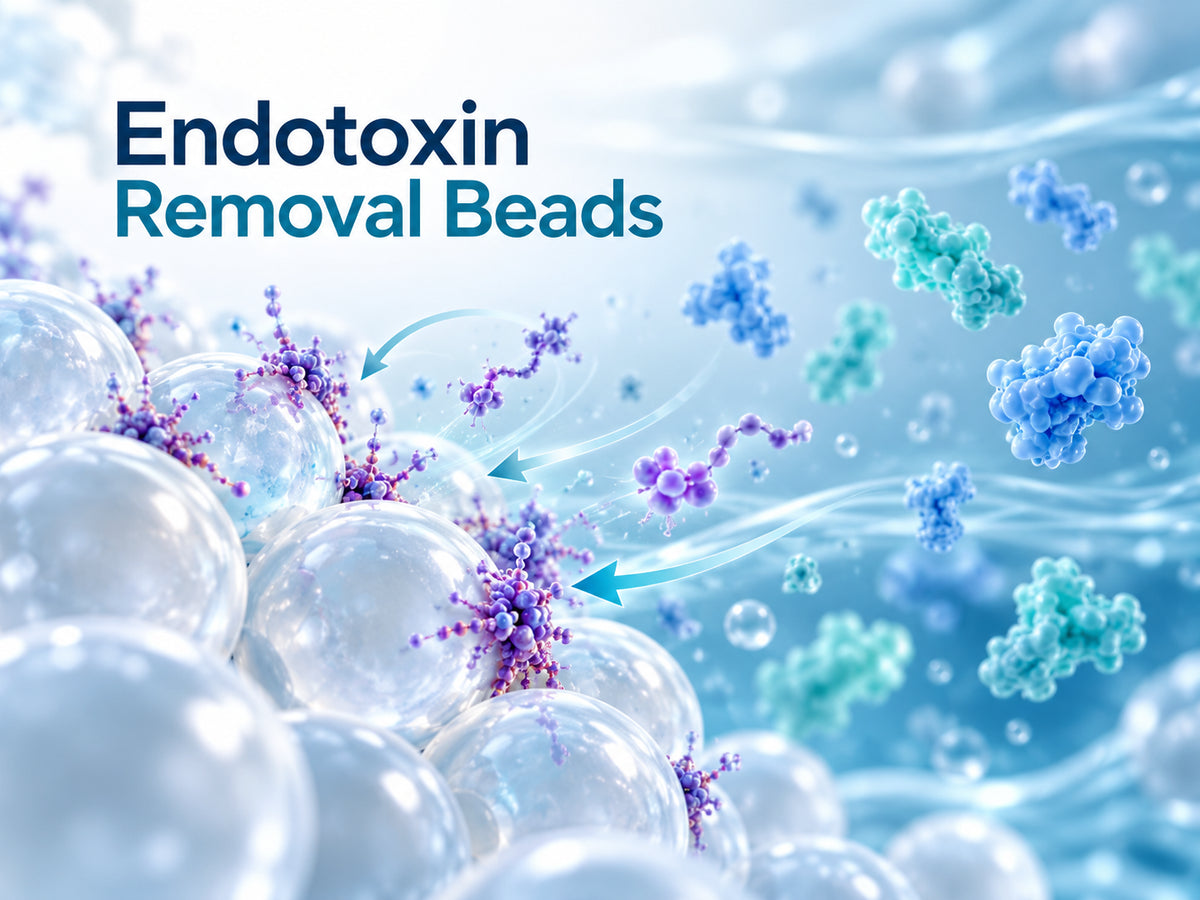
Bacterial endotoxin contamination is a common challenge in protein purification, peptide research, antibody production, and other biological sample preparation workflows. Even low concentrations of endotoxins can interfere with cell-based assays and compromise experimental reproducibility. Endotoxin Removal Beads provide an affinity-based approach for reducing lipopolysaccharide (LPS) contamination in biological samples. These beads are prepared by immobilizing modified Polymyxin B onto a 4% agarose matrix, enabling selective interaction with bacterial endotoxins. Under optimized conditions, the beads can reduce endotoxin concentrations to approximately 0.1 EU/mL while supporting high recovery of target biomolecules. This article explores their working mechanism, product advantages, research applications, and practical considerations for efficient endotoxin removal.
1. Why Is Endotoxin Removal Important in Biological Research?
Endotoxins are components of the outer membrane of Gram-negative bacteria, primarily consisting of lipopolysaccharides (LPS). Their molecular structures generally contain three major regions: lipid A, a core oligosaccharide, and an O-antigen polysaccharide.
Lipid A is primarily responsible for the immunostimulatory activity associated with bacterial endotoxins.
During recombinant protein expression, bacterial fermentation, purification, and sample processing, endotoxins may contaminate biological preparations.
Even after bacterial cells are removed or inactivated, endotoxins may remain in solution because they are relatively stable and can associate with proteins or other biomolecules.
1.1 Endotoxin Contamination in Recombinant Proteins
Recombinant proteins produced using Gram-negative bacterial expression systems, particularly Escherichia coli, are susceptible to endotoxin contamination.
During cell disruption and protein extraction, LPS molecules released from bacterial membranes may enter the protein-containing solution.
Conventional purification procedures, including affinity chromatography and size-exclusion chromatography, do not necessarily eliminate endotoxins completely.
Consequently, additional endotoxin removal steps may be required before conducting downstream experiments.
1.2 Impact on Cell-Based Experiments
Endotoxins can activate innate immune signaling pathways through the TLR4–MD-2 receptor complex.
This interaction may stimulate inflammatory signaling, including NF-κB activation and the production of cytokines such as TNF-α and IL-6.
Uncontrolled endotoxin contamination may therefore:
Trigger unwanted inflammatory responses in cell cultures.
Alter gene expression and cellular signaling.
Interfere with immunological experiments.
Affect the interpretation of protein bioactivity.
Reduce experimental consistency and reproducibility.
For these reasons, effective endotoxin removal is particularly important when preparing samples for endotoxin-sensitive biological assays.
2. What Are Endotoxin Removal Beads?
Endotoxin Removal Beads are affinity-based purification materials designed to selectively capture and remove bacterial endotoxins from biological samples.
The beads consist of modified Polymyxin B immobilized onto 4% agarose microspheres.
Polymyxin B is a cationic cyclic polypeptide antibiotic with a strong affinity for the lipid A region of many bacterial lipopolysaccharides.
By immobilizing Polymyxin B onto a solid agarose support, the purification material can interact with endotoxins while allowing many target biomolecules to remain in the surrounding solution.
Following the adsorption process, the beads can be separated from the sample, thereby reducing endotoxin contamination.
2.1 Product Composition and Features
|
Parameter |
Description |
|
Product Name |
Endotoxin Removal Beads |
|
Affinity Ligand |
Modified Polymyxin B |
|
Support Matrix |
4% Agarose Beads |
|
Separation Principle |
Affinity Adsorption |
|
Target Contaminant |
Bacterial Endotoxin (LPS) |
|
Applicable Samples |
Proteins, Peptides, Antibodies, Polysaccharides |
|
Endotoxin Reduction |
Down to approximately 0.1 EU/mL under suitable conditions |
|
Sample Recovery |
Designed to support high recovery of target biomolecules |
|
Main Applications |
Protein Purification, Biological Sample Preparation, LPS Removal |
The agarose matrix provides a hydrated, porous support for immobilized Polymyxin B, while the affinity ligand enables selective interactions with endotoxin molecules.
Actual purification efficiency depends on the sample composition, initial endotoxin concentration, processing conditions, and endotoxin binding capacity.
3. How Do Polymyxin B Agarose Beads Remove Endotoxins?
The endotoxin removal mechanism is based on molecular affinity between immobilized Polymyxin B and bacterial lipopolysaccharides.
3.1 Recognition of the Lipid A Region
Lipid A contains negatively charged phosphate groups and hydrophobic fatty acyl chains.
Polymyxin B possesses positively charged amino groups and hydrophobic structural regions that can interact with lipid A.
These interactions involve two major mechanisms.
Electrostatic interactions: Positively charged groups in Polymyxin B interact with negatively charged phosphate groups in lipid A.
Hydrophobic interactions: Hydrophobic regions of Polymyxin B associate with the fatty acyl chains of lipid A.
Together, these molecular interactions promote adsorption of endotoxins onto the immobilized ligand.
3.2 Endotoxin Capture on Agarose Beads
When an endotoxin-containing sample contacts the beads, accessible LPS molecules may bind to Polymyxin B molecules immobilized on the agarose surface.
The solid support retains the bound endotoxins during bead separation.
The treated sample can then be collected with a reduced endotoxin concentration.
This approach provides an alternative to purification techniques that depend primarily on differences in molecular size or charge.
3.3 Preservation of Target Biomolecules
Because Polymyxin B exhibits preferential affinity toward many endotoxin structures, affinity adsorption can reduce endotoxin contamination while preserving a substantial proportion of the target protein or peptide.
However, sample recovery is not universally guaranteed.
Some biomolecules may interact directly with the beads or form complexes with endotoxins, potentially causing losses during purification.
Appropriate optimization is therefore important for balancing endotoxin reduction and target recovery.
4. Key Advantages of Endotoxin Removal Beads
4.1 Effective Endotoxin Reduction
One of the primary advantages of Endotoxin Removal Beads is their ability to reduce bacterial endotoxin contamination through targeted affinity adsorption.
Under suitable experimental conditions, the product can achieve residual endotoxin levels as low as approximately 0.1 EU/mL.
This performance makes the beads potentially useful for preparing biological samples requiring reduced endotoxin contamination.
However, the final endotoxin concentration must be verified experimentally, since different sample matrices may produce different removal efficiencies.
4.2 High Sample Recovery
Maintaining protein or peptide recovery is an essential consideration during biological purification.
Aggressive endotoxin removal procedures may cause protein aggregation, denaturation, or sample loss.
Polymyxin B-based affinity adsorption provides a potentially gentler approach that can be adapted to sensitive biological samples.
By optimizing sample contact conditions and bead quantity, researchers can seek to minimize nonspecific binding and maintain target biomolecule recovery.
4.3 Broad Compatibility with Biological Samples
Endotoxin Removal Beads can be evaluated for several categories of biological samples, including:
Recombinant proteins
Purified antibodies
Synthetic and recombinant peptides
Biological polysaccharides
Enzyme preparations
Other endotoxin-sensitive research materials
Their applicability to different sample types makes them useful candidates for laboratory-scale purification workflows.
Compatibility and recovery should nevertheless be established for each sample formulation.
4.4 Convenient Integration into Purification Workflows
Affinity-based endotoxin removal can often be incorporated as an additional processing step after primary biomolecule purification.
This allows researchers to evaluate endotoxin removal without necessarily redesigning the entire protein purification process.
The specific processing format, contact time, and separation conditions should follow the product manufacturer's validated instructions.
5. Applications of Endotoxin Removal Beads in Biomedical Research
5.1 Recombinant Protein Purification
Recombinant proteins expressed in bacterial systems frequently require additional endotoxin control before downstream biological characterization.
Endotoxin Removal Beads can be used as a polishing step following conventional protein purification.
Relevant research applications include cytokine studies, recombinant antigen preparation, enzyme characterization, and protein–cell interaction experiments.
Reducing endotoxin contamination helps researchers distinguish the biological properties of a purified protein from unintended LPS-induced responses.
5.2 Antibody Preparation and Immunological Research
Antibodies used in immunological assays may require controlled endotoxin levels, particularly when they are introduced into sensitive cell-based systems.
Endotoxin contamination may interfere with studies involving macrophages, dendritic cells, or other immune-responsive populations.
Affinity-based endotoxin removal can support antibody sample preparation before functional experiments, provided that antibody recovery, aggregation, and binding activity are adequately evaluated.
5.3 Peptide Research
Peptides are widely used to investigate molecular signaling, receptor interactions, antimicrobial activity, and immunological regulation.
Although chemically synthesized peptides may have limited intrinsic endotoxin contamination, endotoxins can still be introduced through biological raw materials, processing equipment, water, or subsequent handling.
Endotoxin Removal Beads may help reduce contamination in compatible peptide preparations.
Researchers should verify that treatment does not significantly affect peptide concentration, integrity, or biological activity.
5.4 Polysaccharide and Biopolymer Research
Biological polysaccharides obtained from microbial or other natural sources may contain bacterial endotoxins.
Such contamination can complicate the interpretation of experiments investigating polysaccharide-mediated immune responses.
Endotoxin removal is therefore valuable when researchers need to distinguish the intrinsic biological activity of a polysaccharide from the immunostimulatory activity of residual LPS.
Since certain polysaccharides may associate with endotoxins or interact with purification materials, method suitability should be evaluated individually.
5.5 Cell Culture and Functional Assays
Many cell-based experiments require careful control of unintended inflammatory stimuli.
Endotoxin Removal Beads can support preparation of lower-endotoxin proteins, peptides, and other reagents before their introduction into experimental cell cultures.
Potential applications include inflammatory signaling studies, cytokine assays, receptor activation experiments, and investigations of cellular responses to purified biomolecules.
6. General Workflow for Using Endotoxin Removal Beads
The following workflow illustrates the general principles of affinity-based endotoxin removal. It is not a substitute for the manufacturer's product-specific protocol.
Step 1: Sample Assessment
Determine the initial endotoxin concentration of the biological sample using a suitable analytical method, such as a validated LAL or recombinant Factor C assay.
Record the sample volume, protein concentration, buffer composition, and relevant quality attributes.
Step 2: Bead Preparation
Prepare and equilibrate the Endotoxin Removal Beads according to the manufacturer's instructions.
Use suitable low-endotoxin consumables and buffers to minimize additional contamination.
Step 3: Sample Contact
Combine the sample with the prepared beads under the recommended conditions.
During this stage, accessible endotoxin molecules interact with immobilized Polymyxin B.
Contact conditions and bead loading should be selected according to the product instructions and sample characteristics.
Step 4: Bead Separation
Separate the beads from the processed sample using the manufacturer's specified separation method.
The collected fraction contains the target biomolecules along with any residual unbound endotoxin.
Step 5: Quality Control
Measure residual endotoxin concentration and evaluate target biomolecule recovery.
Depending on the application, additional assessments may include protein integrity, aggregation, enzymatic activity, and ligand leaching.
7. Factors Affecting Endotoxin Removal Efficiency
Although Polymyxin B-based affinity adsorption is a well-established endotoxin removal approach, its effectiveness depends on multiple variables.
7.1 Initial Endotoxin Concentration
Samples with high endotoxin loads may require greater binding capacity or additional purification steps.
The amount of beads required should be determined from the sample's endotoxin burden and the product's validated adsorption capacity.
7.2 Sample pH and Ionic Strength
Electrostatic interactions contribute to Polymyxin B–endotoxin binding.
Consequently, changes in pH and ionic strength may alter adsorption performance or affect protein stability.
Researchers should use buffer conditions compatible with both the target biomolecule and the affinity matrix.
7.3 Protein–Endotoxin Interactions
Certain proteins form strong associations with endotoxins, which may reduce the accessibility of LPS molecules to the immobilized ligand.
In some cases, protein–endotoxin complexes may bind to the beads and reduce sample recovery.
These interactions should be considered when optimizing the purification process.
7.4 Detergents and Other Additives
Detergents, chaotropic agents, and other sample additives can influence endotoxin aggregation, protein interactions, and affinity adsorption.
Their effects depend on the concentration, chemical identity, and sample matrix.
Any buffer modification should therefore be tested for compatibility with the target biomolecule and endotoxin removal procedure.
8. How to Evaluate Endotoxin Removal Performance
Successful purification requires more than a reduction in endotoxin concentration.
Researchers should assess both endotoxin clearance and recovery of the desired biomolecule.
Two useful performance indicators are:
Endotoxin Removal Efficiency (%)
Removal Efficiency = [(Initial Endotoxin Amount − Final Endotoxin Amount) / Initial Endotoxin Amount] × 100
Sample Recovery (%)
Sample Recovery = (Recovered Target Amount / Initial Target Amount) × 100
These calculations should account for changes in sample volume during processing.
For example, reducing endotoxin concentration from 10 EU/mL to 0.1 EU/mL represents a 99% concentration reduction when the sample volume remains unchanged.
This is an illustrative calculation rather than a guaranteed product result.
Analytical methods must also be validated for sample-specific interference, and results below an assay's quantification limit should be reported appropriately.
Importantly, reaching 0.1 EU/mL does not automatically establish that a sample meets requirements for every downstream application.
9. Frequently Asked Questions About Endotoxin Removal Beads
Q1. What are Endotoxin Removal Beads used for?
Endotoxin Removal Beads are used to reduce bacterial lipopolysaccharide contamination in compatible biological samples, including proteins, peptides, antibodies, and polysaccharides.
Q2. How does Polymyxin B remove endotoxins?
Polymyxin B interacts with the lipid A region of bacterial endotoxins through electrostatic and hydrophobic interactions. When immobilized on agarose beads, it functions as an affinity ligand for endotoxin adsorption.
Q3. Can Endotoxin Removal Beads reduce endotoxin levels to 0.1 EU/mL?
Under appropriate experimental conditions, the product may reduce residual endotoxin levels to approximately 0.1 EU/mL. Actual performance depends on the sample composition, initial contamination, adsorption capacity, and processing conditions.
Q4. Will endotoxin removal affect protein activity?
Affinity adsorption can provide relatively mild purification conditions, but certain proteins may bind nonspecifically to the matrix or be lost through protein–endotoxin interactions. Protein recovery and biological activity should be assessed after treatment.
Q5. Can Endotoxin Removal Beads be used for antibody purification?
Yes, they may be suitable for removing endotoxins from antibody-containing solutions. However, antibody recovery, structural integrity, aggregation, and functional activity should be evaluated for the specific antibody preparation.
10. Conclusion
Endotoxin contamination remains an important consideration in biological sample preparation, particularly for recombinant proteins, antibodies, peptides, and polysaccharides used in endotoxin-sensitive research.
Endotoxin Removal Beads provide an affinity-based approach that combines modified Polymyxin B with a 4% agarose support to selectively capture bacterial lipopolysaccharides.
Their ability to achieve low residual endotoxin concentrations under suitable conditions, while supporting high sample recovery, makes them a useful purification option for research laboratories.
By integrating appropriate endotoxin removal procedures with reliable analytical testing and sample recovery assessments, researchers can improve the consistency and interpretability of downstream biological experiments.
For laboratories seeking an affinity-based solution for endotoxin reduction, Polymyxin B Agarose Beads represent a practical approach for compatible protein, peptide, antibody, and polysaccharide preparations.
Explore Endotoxin Removal Beads for research-grade biological sample purification and contact our technical team for product specifications, compatibility information, and ordering inquiries.


