
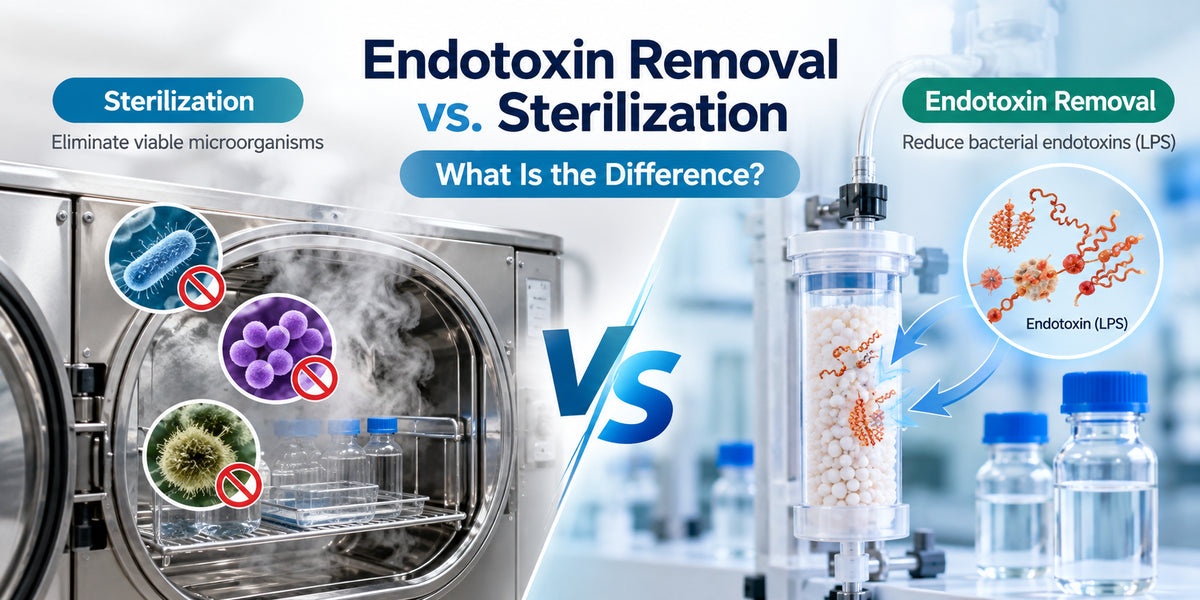
Endotoxin removal and sterilization are essential contamination-control processes in biotechnology, pharmaceutical manufacturing, and laboratory research. Although both contribute to sample quality and safety, they address fundamentally different risks. Sterilization eliminates viable microorganisms, whereas endotoxin removal reduces bacterial lipopolysaccharides (LPS), which may remain biologically active after bacteria have been destroyed. Consequently, a sterile sample is not necessarily free from endotoxin contamination. This article explores the differences between sterilization and endotoxin removal, explains why conventional sterilization methods may not eliminate endotoxins, and discusses the applications of high-efficiency endotoxin removal purification resin in biological research and protein purification.
1. What Is Sterilization?
Sterilization is a process designed to eliminate or destroy all viable microorganisms, including bacteria, fungi, and bacterial spores.
It is widely used in pharmaceutical manufacturing, medical device processing, microbiology, and biological research.
Common sterilization methods include:
Steam sterilization: Uses saturated steam under pressure to inactivate microorganisms.
Dry heat sterilization: Uses elevated temperatures to destroy microorganisms on heat-resistant materials.
Sterile filtration: Removes microorganisms from compatible liquid formulations using validated sterilizing-grade filters.
Radiation sterilization: Uses ionizing radiation to inactivate microorganisms in suitable products.
Ethylene oxide sterilization: Used for certain heat-sensitive medical devices.
However, sterilization primarily addresses microbial viability rather than chemical contaminants.
A successfully sterilized sample may still contain bacterial endotoxins.
This limitation is especially important for recombinant proteins, pharmaceutical preparations, and cell culture reagents.
2. What Is Endotoxin Removal?
Endotoxin removal is the process of reducing bacterial endotoxin contamination in biological samples, laboratory reagents, and pharmaceutical materials.
Endotoxins are primarily lipopolysaccharides (LPS) found in the outer membranes of Gram-negative bacteria, including Escherichia coli and Pseudomonas aeruginosa.
LPS contains three major structural components: lipid A, core oligosaccharide, and O-antigen polysaccharide.
Lipid A is primarily responsible for endotoxin-associated inflammatory activity.
Unlike living bacteria, endotoxins do not require microbial viability to produce biological effects.
When Gram-negative bacteria are destroyed, endotoxin-containing fragments may remain in the surrounding solution.
These contaminants can activate innate immune responses through the TLR4–MD-2 signaling complex, promoting inflammatory cytokine production.
Common endotoxin removal approaches include affinity chromatography, specialized purification resins, selected membrane-based techniques, and other sample-specific purification methods.
For heat-sensitive biological materials, high-efficiency endotoxin removal purification resin can offer a practical alternative to harsh chemical or thermal treatments.
3. Key Differences Between Endotoxin Removal and Sterilization
Although both methods support contamination control, their targets and operating principles differ.
|
Parameter |
Sterilization |
Endotoxin Removal |
|
Primary objective |
Eliminate viable microorganisms |
Reduce bacterial endotoxins |
|
Main target |
Bacteria, fungi, and spores |
Lipopolysaccharides |
|
Common methods |
Autoclaving, dry heat, sterile filtration |
Affinity resins, chromatography, selected filtration methods |
|
Effect on bacteria |
Eliminates viable microorganisms |
Does not necessarily eliminate microorganisms |
|
Effect on endotoxins |
Not reliably effective |
Specifically reduces endotoxin contamination |
|
Verification |
Sterility testing or validated sterility assurance |
Bacterial endotoxin testing |
|
Applications |
Medical devices, equipment, pharmaceutical products |
Recombinant proteins, peptides, biologics |
The fundamental difference is that sterilization controls viable microorganisms, while endotoxin removal targets bacterial endotoxins.
Therefore, neither process automatically replaces the other.
4. Why Doesn't Sterilization Always Remove Endotoxins?
4.1 Endotoxins Are Relatively Heat-Stable
Conventional sterilization methods can effectively destroy microorganisms under validated conditions.
However, bacterial endotoxins are relatively resistant to heat.
For example, standard autoclaving conditions may eliminate viable bacteria without achieving sufficient endotoxin reduction.
Consequently, successful steam sterilization does not guarantee that a sample meets endotoxin specifications.
4.2 Bacterial Destruction Does Not Eliminate LPS
When Gram-negative bacteria are killed or disrupted, their cellular components may remain.
LPS released from bacterial outer membranes can persist in the surrounding environment.
This is particularly relevant during recombinant protein production using E. coli, where cell disruption can release both target proteins and endotoxins.
4.3 Sterile Filtration Cannot Reliably Remove Dissolved Endotoxins
Sterilizing-grade membrane filters, commonly rated at 0.22 µm, are designed to retain microorganisms.
However, endotoxin molecules and certain aggregates may pass through these filters.
Therefore, sterile filtration alone cannot establish that a protein solution is sufficiently low in endotoxins.
5. What Is the Difference Between Sterilization and Depyrogenation?
Depyrogenation refers to the removal or destruction of pyrogenic substances.
Pyrogens are substances capable of inducing fever or inflammatory responses. Bacterial endotoxins represent an important category of pyrogens, but not all pyrogens are endotoxins.
In pharmaceutical manufacturing, depyrogenation often focuses on reducing bacterial endotoxins.
Dry Heat Depyrogenation
Validated high-temperature dry heat processes are commonly used to reduce endotoxins on heat-resistant pharmaceutical materials, particularly glass vials.
These processes generally require conditions different from conventional sterilization cycles.
Endotoxin Removal for Biological Samples
High-temperature depyrogenation is unsuitable for many proteins, peptides, and temperature-sensitive biological preparations.
For these materials, specialized endotoxin removal purification resins may provide a gentler approach.
Why Is Endotoxin Removal Important in Biological Research?
6.1 Recombinant Protein Purification
Recombinant proteins expressed in E. coli may contain residual endotoxins after extraction and purification.
These contaminants can interfere with downstream experiments, even when the protein preparation has been sterile-filtered.
Dedicated endotoxin removal steps can reduce LPS contamination while aiming to preserve protein recovery and biological activity.
6.2 Cell Culture and Immunology Research
Endotoxin contamination can significantly influence immune-sensitive cells, including macrophages, monocytes, and dendritic cells.
LPS may activate inflammatory signaling pathways and stimulate cytokine release, including TNF-α and IL-6.
These responses can produce misleading experimental results if researchers mistakenly attribute endotoxin-induced activity to the tested protein or compound.
Reducing endotoxin contamination helps improve experimental reliability and reproducibility.
6.3 Pharmaceutical Manufacturing
Sterility and endotoxin control are distinct quality requirements for many pharmaceutical products.
Injectable formulations and biological therapeutics may require both microbial control and compliance with applicable endotoxin limits.
A product that satisfies sterility requirements may still contain unacceptable endotoxin concentrations.
7. How Does High-Efficiency Endotoxin Removal Purification Resin Work?
High-efficiency endotoxin removal purification resin is designed to capture bacterial endotoxins from compatible aqueous samples.
Depending on the resin chemistry, endotoxin binding may involve electrostatic interactions, hydrophobic interactions, or immobilized affinity ligands.
During purification, endotoxins interact with the resin while the desired sample components are recovered.
Key Benefits
Effective endotoxin reduction: Helps decrease residual LPS contamination.
Mild purification conditions: May be suitable for temperature-sensitive proteins.
Protein recovery: Can help preserve target proteins when the resin and operating conditions are appropriately selected.
Flexible applications: May support recombinant protein, enzyme, antibody, and peptide purification.
Improved experimental reliability: Helps minimize endotoxin-associated interference in biological assays.
However, performance depends on sample composition, resin chemistry, binding capacity, and operating conditions.
Endotoxin removal resin does not inherently sterilize a sample and should not be considered a replacement for validated microbial control procedures.
8. How Can Endotoxin Removal Efficiency Be Verified?
Endotoxin concentrations can be measured before and after purification using appropriate bacterial endotoxin assays.
Common methods include the Limulus amebocyte lysate (LAL) assay and recombinant Factor C (rFC) assays.
Endotoxin removal efficiency can be calculated as:

Where Ci represents the initial endotoxin concentration and Cf represents the final concentration.
For example, reducing endotoxin concentration from 1,000 EU/mL to 1 EU/mL corresponds to 99.9% removal, assuming comparable sample volumes.
Appropriate assay controls are necessary to evaluate potential interference from sample components.
9. Frequently Asked Questions (FAQs)
Q1. Can a sterile sample still contain endotoxins?
Yes. Sterilization eliminates viable microorganisms but does not necessarily remove bacterial endotoxins. Therefore, sterile samples may still contain biologically active LPS.
Q2. Does autoclaving eliminate endotoxins?
Conventional autoclaving does not reliably eliminate endotoxins. Validated depyrogenation or specialized endotoxin removal methods may be required.
Q3. Can a 0.22 µm filter remove endotoxins?
Conventional 0.22 µm sterilizing-grade filters do not reliably remove dissolved endotoxins. Dedicated endotoxin removal methods may be necessary.
Q4. Can endotoxin removal resin be used for recombinant proteins?
Yes. Compatible purification resins can reduce endotoxin contamination in recombinant protein preparations, particularly those produced using Gram-negative bacterial expression systems.
Q5. Is endotoxin removal the same as depyrogenation?
Not exactly. Endotoxin removal specifically targets bacterial endotoxins, whereas depyrogenation refers more broadly to reducing or destroying pyrogenic substances.
10. Conclusion
Sterilization and endotoxin removal address different contamination risks and serve complementary roles in laboratory research and pharmaceutical manufacturing.
Sterilization eliminates viable microorganisms, while endotoxin removal reduces bacterial endotoxin contamination that may persist after sterilization.
Because endotoxins can remain biologically active even after bacteria are destroyed, sterile samples are not necessarily suitable for endotoxin-sensitive applications.
For recombinant proteins, peptides, and other biological preparations, high-efficiency endotoxin removal purification resin provides a potential solution for reducing LPS contamination under compatible conditions.
Combining appropriate sterilization, endotoxin removal, and analytical testing helps improve sample quality, experimental reproducibility, and downstream research reliability.


