
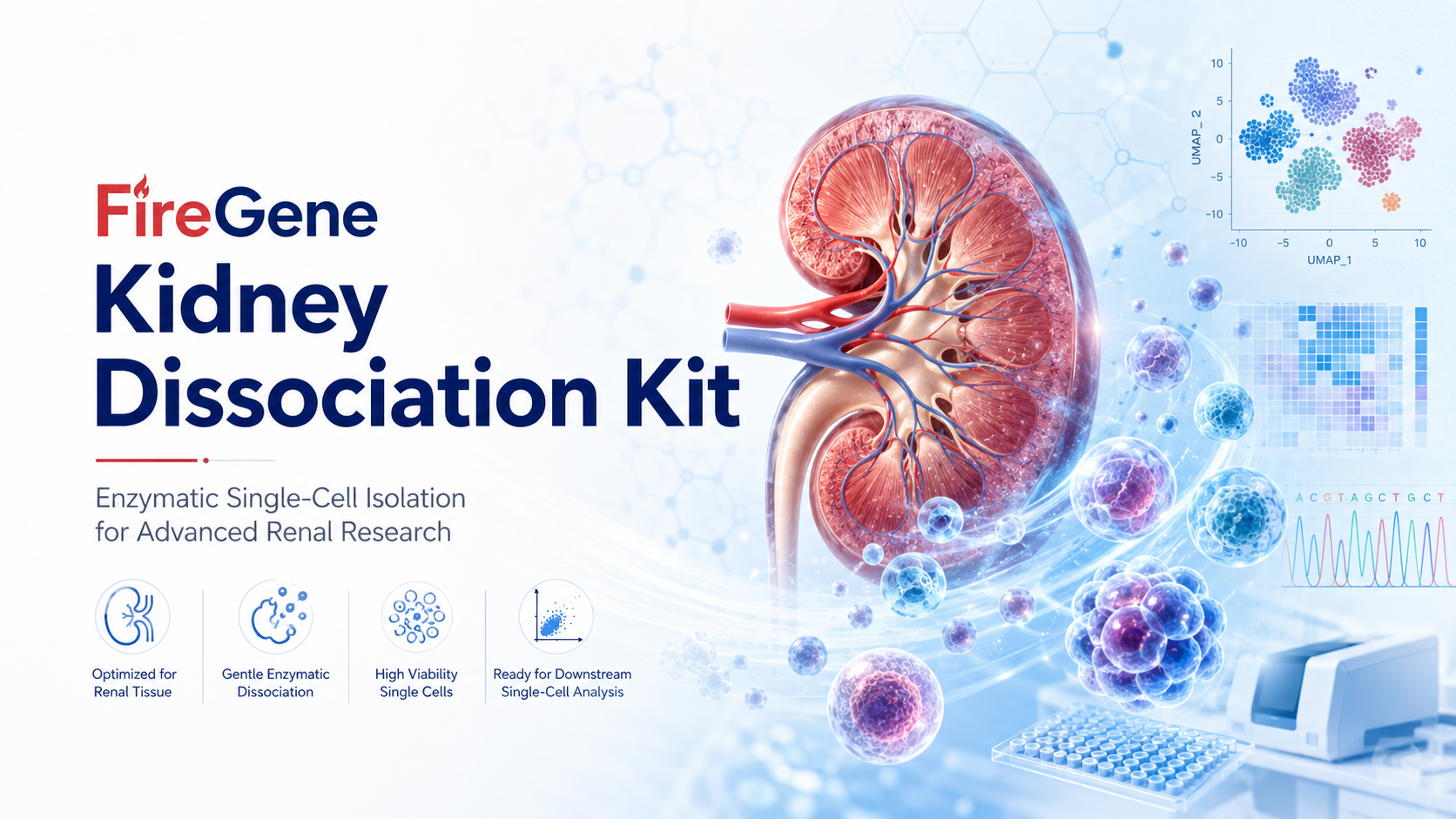
Single-cell analysis has transformed the way researchers study complex tissues, and kidney research is one of the fields benefiting most from this shift. The kidney is not a uniform organ. It contains highly organized compartments, including glomeruli, proximal and distal tubules, collecting ducts, vascular networks, interstitial cells, resident immune cells, and infiltrating inflammatory populations. To understand how these diverse cell types behave in health and disease, researchers need reliable methods for converting intact kidney tissue into high-quality single-cell suspensions.
The FireGene Kidney Dissociation Kit is designed for enzymatic single-cell isolation from kidney tissue, supporting workflows that require viable, dissociated renal cells for downstream analysis. By using an optimized enzymatic approach, the kit helps researchers process kidney samples efficiently while reducing excessive mechanical stress that may damage sensitive cell populations.
For laboratories working in renal biology, nephrology, fibrosis, inflammation, oncology, toxicology, and single-cell sequencing, a dependable kidney tissue dissociation reagent system can improve sample consistency and experimental reliability.
Why Kidney Tissue Dissociation Matters
Kidney tissue is structurally complex. Its dense extracellular matrix, tubular architecture, vascular components, and specialized filtration structures make it more difficult to dissociate than many softer tissues. Poor dissociation can lead to low cell yield, reduced viability, excessive debris, clumping, or biased recovery of certain cell types.
In many renal research workflows, the quality of the starting cell suspension directly affects the quality of the final data. For example, single-cell RNA sequencing requires intact, viable cells with preserved RNA quality. Flow cytometry and FACS require cells that remain sufficiently viable and retain important surface markers. Primary cell culture depends on gentle but effective processing that minimizes cellular stress.
The FireGene Kidney Dissociation Kit is intended to support this critical first step. Its enzymatic dissociation workflow helps release kidney-derived cells from tissue architecture, producing suspensions that can be filtered, washed, counted, and prepared for downstream applications.
Enzymatic Single-Cell Isolation from Kidney Tissue
Traditional mechanical dissociation methods may be insufficient for kidney samples because they can leave tissue fragments incompletely processed or cause unnecessary cellular damage. Enzymatic dissociation provides a more controlled approach by digesting extracellular matrix components and loosening cell-cell interactions.
The FireGene Kidney Dissociation Kit uses an enzymatic strategy to help break down renal tissue structure and release individual cells. This approach is especially useful when researchers need to preserve a broad range of renal cell populations, including epithelial cells, stromal cells, endothelial cells, and immune cells.
A well-designed dissociation workflow can help researchers achieve several important goals:
1. Improve recovery of kidney-derived cells
2. Maintain cell viability for sensitive downstream assays
3. Reduce mechanical damage during tissue disruption
4. Generate more uniform single-cell suspensions
5. Support reproducible preparation across samples
Because kidney disease research often compares healthy and diseased tissue, consistency in tissue processing is essential. Variation introduced during dissociation can affect cell recovery, gene expression profiles, and immune cell representation. An optimized kit helps reduce unwanted technical variability.
Applications in Renal Biology and Nephrology
The FireGene Kidney Dissociation Kit is suitable for a wide range of kidney research applications. In basic renal biology, researchers may use dissociated kidney cells to study nephron development, epithelial cell function, renal vascular biology, or interstitial cell behavior. In disease-focused studies, the kit can support investigation of acute kidney injury, chronic kidney disease, diabetic nephropathy, ischemia-reperfusion injury, renal fibrosis, and inflammatory kidney disorders.
Kidney disease often involves multiple cell types interacting within a changing tissue microenvironment. Tubular epithelial cells may undergo stress responses. Fibroblasts and myofibroblast-like cells may contribute to matrix remodeling. Endothelial cells may reflect vascular injury. Immune cells may infiltrate the tissue and promote inflammation. Single-cell isolation allows these populations to be examined separately, helping researchers identify cell-type-specific changes that may be hidden in bulk tissue analysis.
For nephrology researchers, the ability to prepare viable single-cell suspensions from kidney tissue can support deeper insight into disease mechanisms and therapeutic targets.
Supporting Single-Cell RNA Sequencing Workflows
Single-cell RNA sequencing has become a powerful tool for mapping kidney cell heterogeneity. It allows researchers to identify known and novel cell populations, analyze gene expression at single-cell resolution, and examine how renal cell states change during disease progression.
However, scRNA-seq data quality depends heavily on sample preparation. Damaged cells, dead cells, debris, and aggregates can reduce sequencing efficiency and compromise data interpretation. Overly harsh dissociation may also alter gene expression patterns or selectively reduce sensitive cell populations.
The FireGene Kidney Dissociation Kit is designed to support preparation of kidney single-cell suspensions suitable for single-cell transcriptomics workflows. By enabling controlled enzymatic tissue digestion, the kit can help researchers obtain dissociated renal cells for downstream processing, including cell counting, viability assessment, filtration, enrichment, and library preparation.
For studies involving renal fibrosis, inflammation, drug response, or disease modeling, high-quality single-cell suspensions can help produce more accurate and biologically meaningful datasets.
Flow Cytometry and FACS Sample Preparation
Flow cytometry and fluorescence-activated cell sorting are widely used in kidney research to quantify, characterize, and isolate specific cell populations. Researchers may analyze immune infiltration, endothelial cell markers, epithelial cell injury markers, or stromal cell activation.
To perform these assays effectively, cells must be released from tissue while preserving marker detectability and maintaining sufficient viability. Clumped or damaged samples can clog instruments, reduce sorting efficiency, and distort population analysis.
The FireGene Kidney Dissociation Kit supports the preparation of single-cell suspensions for flow cytometry and FACS workflows. After enzymatic digestion, samples can be filtered and processed according to the needs of the assay. Researchers can then stain cells with antibodies or other markers to study renal immune responses, inflammatory cell recruitment, fibrosis-associated cell populations, or tumor microenvironment composition.
Kidney Inflammation and Immune Profiling
Inflammation plays an important role in many kidney diseases, including acute kidney injury, chronic kidney disease, autoimmune nephritis, transplant rejection, and diabetic kidney disease. Immune cells such as macrophages, monocytes, neutrophils, T cells, B cells, dendritic cells, and natural killer cells may participate in tissue injury or repair.
Studying these populations requires reliable tissue dissociation. If immune cells are not efficiently released, researchers may underestimate their abundance or miss important inflammatory subtypes. Conversely, harsh processing can reduce viability or alter cellular phenotypes.
The FireGene Kidney Dissociation Kit can be used in kidney immune profiling workflows where researchers need to isolate renal immune cells from tissue samples. This makes it useful for inflammation and immunology research, especially when combined with flow cytometry, FACS, cytokine analysis, or single-cell sequencing.
Renal Fibrosis and Extracellular Matrix Research
Renal fibrosis is a common pathological feature of progressive kidney disease. It involves excessive extracellular matrix deposition, fibroblast activation, epithelial injury, inflammatory signaling, and tissue remodeling. Because fibrotic kidney tissue can be denser and more difficult to process, enzymatic dissociation is especially important.
The FireGene Kidney Dissociation Kit helps digest kidney tissue structures and supports release of cells from extracellular matrix-rich environments. This can help researchers analyze fibroblast-like populations, immune cells, epithelial cells, endothelial cells, and other contributors to fibrotic remodeling.
For fibrosis studies, single-cell isolation enables researchers to examine which cell populations are expanding, which signaling pathways are activated, and how tissue remodeling changes over time. These insights may support the discovery of new biomarkers or therapeutic targets.
Renal Cancer and Tumor Microenvironment Studies
Kidney cancer research increasingly focuses on the tumor microenvironment, including tumor cells, stromal cells, endothelial cells, and immune infiltrates. Dissociation of renal tumor tissue or adjacent kidney tissue can help researchers examine cell composition, immune suppression, angiogenesis, and treatment response.
The FireGene Kidney Dissociation Kit may be used in workflows involving renal tumor microenvironment analysis, where viable single-cell suspensions are required for flow cytometry, FACS, single-cell RNA sequencing, or functional studies. Controlled enzymatic dissociation helps release cells from complex tissue architecture and supports downstream analysis of heterogeneous cell populations.
Advantages of an Optimized Kidney Dissociation Kit
Using a tissue-specific dissociation reagent system can improve workflow efficiency and reduce the need for extensive protocol optimization. The FireGene Kidney Dissociation Kit offers several practical advantages for researchers working with kidney samples:
· Supports enzymatic single-cell isolation from renal tissue
· Helps prepare viable cell suspensions for downstream assays
· Reduces reliance on harsh mechanical disruption
· Supports analysis of epithelial, endothelial, stromal, and immune cell populations
· Compatible with flow cytometry, FACS, scRNA-seq, and primary cell workflows
· Useful for renal disease, fibrosis, inflammation, oncology, and toxicology research
By improving the tissue processing step, researchers can increase confidence in downstream data quality and reproducibility.
Conclusion
Reliable kidney tissue dissociation is essential for modern renal research. Whether the goal is to study kidney injury, chronic kidney disease, fibrosis, immune infiltration, renal cancer, or single-cell transcriptomics, the preparation of a high-quality single-cell suspension is a foundational step.
The FireGene Kidney Dissociation Kit provides an enzymatic solution for single-cell isolation from kidney tissue, helping researchers process complex renal samples for flow cytometry, FACS, single-cell RNA sequencing, primary cell preparation, and related applications. With its focus on controlled enzymatic digestion and downstream compatibility, the kit supports advanced studies in nephrology, renal biology, inflammation, fibrosis, oncology, and drug discovery.
For laboratories seeking a reliable kidney dissociation workflow, FireGene Kidney Dissociation Kit offers a practical approach to preparing kidney-derived single-cell suspensions for high-quality cellular and molecular analysis.
FireGene, light your research with passion, innovation, and profession.
FireGene Single-Cell Sample Prep
Looking for validated dissociation kits?
FireGene's tissue dissociation kits are optimized for specific organ types — brain, tumor, liver, GI, reproductive, and more. Validated for 10x Genomics Chromium and BD Rhapsody workflows.


