
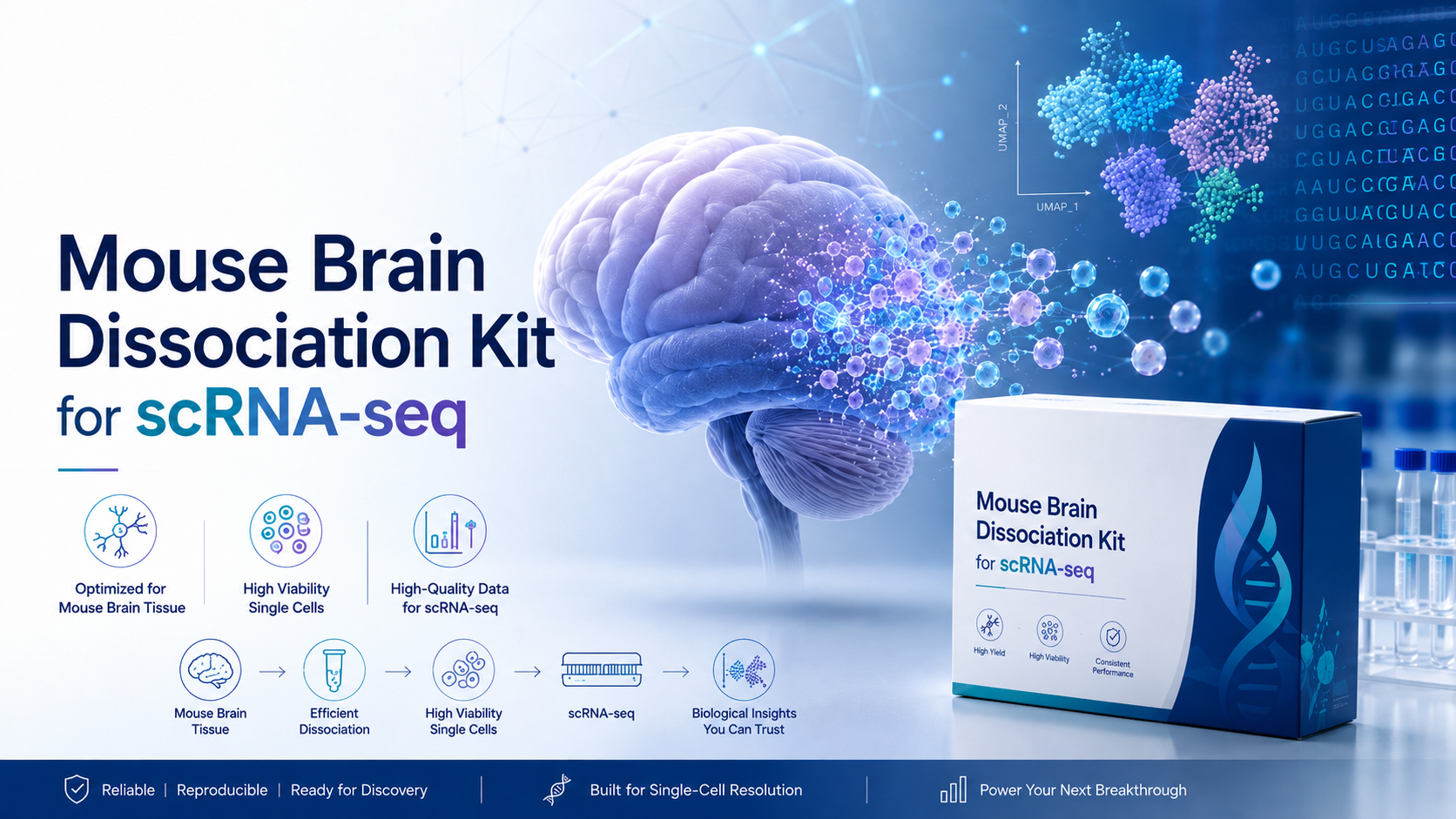
Single-cell RNA sequencing has transformed neuroscience by allowing researchers to examine the brain at cellular resolution. Instead of analyzing bulk tissue as an average of many mixed cell types, scRNA-seq enables the identification of distinct neuronal, glial, vascular, immune, and progenitor cell populations. This is especially important in mouse brain research, where complex cellular diversity, regional specialization, and disease-associated changes can be difficult to capture using conventional molecular biology methods.
However, the quality of single-cell sequencing data depends heavily on the quality of the starting cell suspension. Brain tissue is delicate, heterogeneous, and structurally complex. Neurons have fragile processes, glial cells can respond rapidly to mechanical or enzymatic stress, and certain cell populations may be lost or underrepresented if dissociation conditions are too harsh. For this reason, a reliable tissue dissociation workflow is essential before downstream single-cell RNA sequencing.
The FireGene Mouse Brain Dissociation Kit for scRNA-seq is designed to support the preparation of high-quality single-cell suspensions from mouse brain tissue. By combining tissue-specific enzymatic dissociation with a workflow suitable for single-cell applications, this kit helps researchers generate viable cells for transcriptomic profiling, cell-type discovery, neurobiology studies, and disease model analysis.
Why Mouse Brain Dissociation Matters for scRNA-seq
Mouse models are widely used in neuroscience because they allow researchers to study brain development, behavior, neurodegeneration, neuroinflammation, aging, injury, and genetic disease mechanisms in a controlled experimental system. The mouse brain contains many specialized cell types, including excitatory neurons, inhibitory neurons, astrocytes, oligodendrocytes, oligodendrocyte precursor cells, microglia, endothelial cells, pericytes, ependymal cells, and infiltrating immune cells.
For scRNA-seq, these cell populations must be released from tissue while preserving RNA quality and cellular integrity. Poor dissociation can lead to several problems, including low cell viability, excessive debris, clumped cells, biased recovery of certain cell types, and stress-induced transcriptional artifacts. These issues can reduce sequencing efficiency and complicate bioinformatic interpretation.
A dedicated mouse brain dissociation kit helps standardize this critical step. Instead of relying on inconsistent manual protocols, researchers can use a prepared reagent system optimized for brain tissue processing. This improves reproducibility between samples, experiments, and operators, which is particularly important when comparing control and disease groups.
Product Overview
The FireGene Mouse Brain Dissociation Kit for scRNA-seq is a tissue dissociation solution developed for converting mouse brain samples into single-cell suspensions suitable for downstream sequencing workflows. It is intended for researchers working with fresh mouse brain tissue, specific brain regions, or disease model samples that require careful preparation before single-cell analysis.
The kit supports applications such as single-cell transcriptomics, cell population profiling, FACS-based cell enrichment, flow cytometry, and other cell-based assays that require intact single cells. Its main value lies in helping researchers prepare cleaner and more consistent single-cell suspensions from a tissue type that is known to be technically challenging.
Key Features of the FireGene Mouse Brain Dissociation Kit
The FireGene Mouse Brain Dissociation Kit for scRNA-seq is designed around the needs of single-cell neuroscience workflows. Its key features include:
Tissue-specific dissociation for mouse brain samples
Brain tissue requires a different dissociation strategy from softer tissues, immune tissues, or tumor samples. This kit is intended specifically for mouse brain dissociation, helping researchers process neural tissue more appropriately.
Compatibility with scRNA-seq workflows
Single-cell sequencing requires viable, intact cells with preserved RNA profiles. The kit is suitable for preparing samples before single-cell RNA sequencing and related downstream analysis.
Support for diverse brain cell populations
Mouse brain contains multiple cell types with different structural and biochemical properties. A reliable dissociation method helps improve recovery of mixed neural and non-neural cell populations.
Improved workflow consistency
Standardized dissociation reagents can reduce variability caused by homemade enzyme mixes or inconsistent tissue handling. This is valuable for studies involving multiple animals, treatment groups, time points, or brain regions.
Useful for neuroscience and disease model research
The kit can be applied to studies involving brain development, aging, neurodegenerative disease, neuroinflammation, traumatic brain injury, ischemia, epilepsy, psychiatric disease models, and other areas of neurological research.
Applications in Neuroscience Research
The FireGene Mouse Brain Dissociation Kit for scRNA-seq can be used in a broad range of research areas where single-cell resolution is important.
In brain development studies, scRNA-seq can help identify progenitor populations, differentiation trajectories, and region-specific transcriptional programs. Proper dissociation is essential to capture fragile or transitional cell states.
In neurodegeneration research, mouse models of Alzheimer’s disease, Parkinson’s disease, amyotrophic lateral sclerosis, Huntington’s disease, and other disorders often involve subtle changes in neurons, astrocytes, microglia, and oligodendrocytes. A high-quality single-cell suspension enables researchers to investigate disease-associated cell states more accurately.
In neuroinflammation studies, microglia, astrocytes, endothelial cells, and infiltrating immune cells may all contribute to disease progression. scRNA-seq can reveal inflammatory signatures and immune-cell heterogeneity that would be obscured in bulk analysis.
In aging research, single-cell profiling can identify age-associated transcriptional changes across multiple brain cell populations. Reliable dissociation is important because aged tissue may be more sensitive to processing conditions.
In brain injury and repair models, single-cell sequencing can help characterize acute and chronic responses after trauma, ischemia, demyelination, or other forms of damage. Cell recovery and viability are especially important in these models because injured tissue may contain debris, dying cells, and activated immune populations.
Advantages for Single-Cell RNA Sequencing Preparation
The dissociation step is one of the most important pre-analytical variables in scRNA-seq. Even the most advanced sequencing platform cannot compensate for poor sample quality. A well-prepared single-cell suspension can improve downstream results by reducing doublets, minimizing debris, improving cell capture, and supporting more accurate clustering and cell-type annotation.
Using a dedicated kit such as the FireGene Mouse Brain Dissociation Kit can help researchers streamline sample preparation and reduce protocol optimization time. This is particularly helpful for laboratories that need to process multiple samples in parallel or establish a reproducible workflow for ongoing studies.
For scRNA-seq, sample preparation should aim to balance dissociation efficiency with cell preservation. Over-digestion may damage cells and alter gene expression, while under-digestion may leave tissue fragments and cell clumps. A brain-focused dissociation kit helps researchers work within a more controlled preparation framework.
Recommended Workflow Considerations
For best results, researchers should handle mouse brain tissue carefully before and during dissociation. Fresh tissue should typically be processed promptly to preserve cell viability and RNA integrity. Gentle mechanical handling can help reduce cell damage, while proper filtration can remove undissociated tissue fragments and large debris.
After dissociation, the single-cell suspension should be evaluated before sequencing. Common quality control steps include cell counting, viability assessment, debris evaluation, and doublet reduction. Depending on the study design, researchers may also perform red blood cell removal, myelin debris reduction, or fluorescence-activated cell sorting.
Because different brain regions may vary in cell composition and tissue structure, researchers may need to adjust sample input, incubation conditions, or downstream cleanup steps according to their experimental goals. Consistency across samples is especially important when comparing biological conditions.
Who Can Benefit from This Kit?
The FireGene Mouse Brain Dissociation Kit for scRNA-seq is suitable for neuroscience laboratories, genomics cores, pharmaceutical research teams, biotechnology companies, and academic groups working with mouse brain samples. It may be particularly useful for researchers who need to establish a reproducible dissociation workflow for single-cell sequencing projects.
Researchers studying neurological diseases, neuroimmune interactions, developmental biology, cell atlas construction, drug response, or gene function can benefit from a standardized tissue dissociation approach. By improving the starting sample preparation process, the kit helps support more reliable downstream data generation.
Conclusion
The FireGene Mouse Brain Dissociation Kit for scRNA-seq provides a practical solution for preparing mouse brain tissue for single-cell analysis. As scRNA-seq continues to reshape neuroscience research, high-quality sample preparation remains essential for generating meaningful and reproducible data. Brain tissue presents unique challenges due to its cellular complexity, structural organization, and sensitivity to processing stress. A dedicated dissociation kit helps address these challenges by supporting the generation of viable single-cell suspensions suitable for transcriptomic profiling.
For researchers investigating brain development, neurodegeneration, neuroinflammation, aging, injury, or disease models, the FireGene Mouse Brain Dissociation Kit for scRNA-seq offers a useful starting point for reliable single-cell sample preparation. By helping preserve cell quality and workflow consistency, this kit supports deeper insight into the cellular and molecular architecture of the mouse brain.
FireGene, light your research with passion, innovation, and profession.
FireGene Single-Cell Sample Prep
Looking for validated dissociation kits?
FireGene's tissue dissociation kits are optimized for specific organ types — brain, tumor, liver, GI, reproductive, and more. Validated for 10x Genomics Chromium and BD Rhapsody workflows.


