
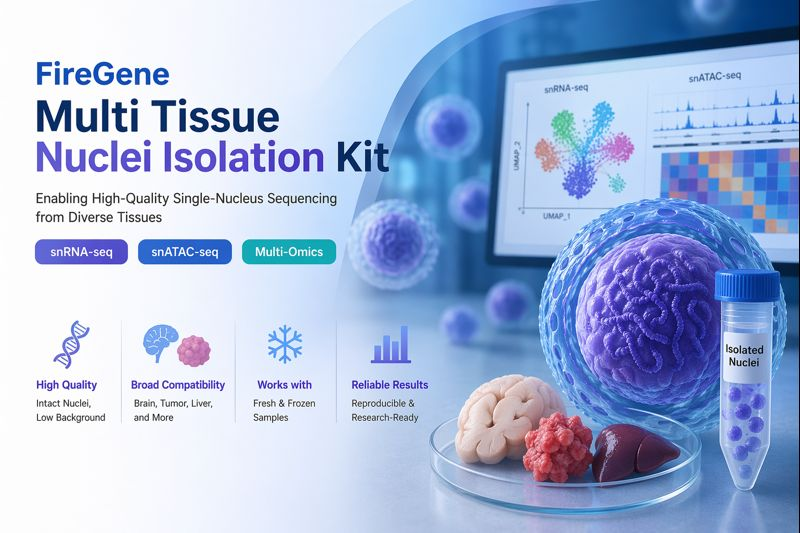
Abstract:The FireGene Multi Tissue Nuclei Isolation Kit is designed to efficiently extract high-quality nuclei from a wide range of fresh and frozen tissues for single-cell and multi-omics sequencing applications. By utilizing a gentle lysis and optimized purification system, the kit preserves nuclear integrity while minimizing cellular debris and transcriptional artifacts. It is particularly suitable for difficult-to-dissociate tissues such as brain, tumors, and fibrotic organs. The isolated nuclei are compatible with snRNA-seq, snATAC-seq, and multiome workflows, enabling robust downstream analysis. This standardized approach improves reproducibility, reduces bias, and expands access to archived clinical samples for advanced genomic research.
Keywords:Nuclei isolation;Single-cell sequencing;snRNA-seq;Multi-omics;Tissue dissociation
Introduction: Why Nuclei Isolation Matters in Single-Cell Sequencing
Single-cell sequencing technologies have transformed our ability to study cellular heterogeneity, enabling researchers to dissect complex tissues at unprecedented resolution. However, traditional workflows rely heavily on enzymatic tissue dissociation to generate viable single-cell suspensions—a process that can introduce significant limitations. Harsh dissociation conditions may damage fragile cell types, alter gene expression profiles, or lead to the selective loss of specific populations, ultimately biasing downstream data.
To overcome these challenges, nuclei-based approaches such as single-nucleus RNA sequencing (snRNA-seq) and single-nucleus ATAC sequencing (snATAC-seq) have gained increasing attention. By isolating nuclei instead of intact cells, these methods bypass the need for complete cell preservation and are particularly advantageous for difficult-to-dissociate tissues, including brain, fibrotic tumors, and archived or frozen samples. Nuclei isolation also reduces stress-induced transcriptional artifacts, providing a more accurate snapshot of the in vivo state.
As the demand for robust and versatile sample preparation grows, optimized nuclei isolation solutions have become essential. The FireGene Multi Tissue Nuclei Isolation Kit is designed to address these needs by enabling efficient and gentle extraction of high-quality nuclei from a wide range of tissue types. By supporting reliable downstream applications such as snRNA-seq and multi-omics analyses, it offers researchers a powerful tool to unlock deeper biological insights while minimizing technical bias.
What Is the FireGene Multi Tissue Nuclei Isolation Kit?
The FireGene Multi Tissue Nuclei Isolation Kit is a specialized sample preparation solution designed to efficiently extract intact nuclei from a wide variety of biological tissues for single-cell and multi-omics sequencing applications. Unlike conventional dissociation methods that aim to isolate whole, viable cells, this kit focuses on selectively lysing cell membranes while preserving the structural integrity of nuclei, making it particularly suitable for challenging or sensitive samples.
Engineered for broad compatibility, the kit supports nuclei isolation from diverse tissue types, including brain, tumor, liver, and other complex or fibrotic tissues. It is also well-suited for frozen or archived specimens, where cell viability is often compromised and traditional workflows may fail. This flexibility makes it an ideal choice for both basic research and translational studies that rely on heterogeneous or limited clinical samples.
At its core, the kit utilizes an optimized buffer system and gentle processing conditions to minimize mechanical stress and reduce contamination from cellular debris. The result is a clean, high-quality nuclei suspension that can be directly used in downstream platforms such as single-nucleus RNA sequencing (snRNA-seq), single-nucleus ATAC sequencing (snATAC-seq), and multiome assays.
By providing a standardized and reproducible approach to nuclei isolation, the FireGene Multi Tissue Nuclei Isolation Kit helps researchers improve data consistency, reduce sample bias, and streamline workflows across a wide range of single-cell sequencing applications.
How It Works: Workflow and Mechanism
The FireGene Multi Tissue Nuclei Isolation Kit is built around a streamlined workflow that prioritizes both efficiency and preservation of nuclear integrity. The process begins with gentle tissue homogenization, where samples are mechanically disrupted under controlled conditions to release cellular contents without damaging nuclei. This step is carefully optimized to accommodate a wide range of tissue types while minimizing shear stress. Following homogenization, a selective lysis buffer is applied to disrupt cell membranes while leaving nuclear membranes intact. This targeted approach ensures that nuclei are released cleanly, reducing the risk of fragmentation or loss. The lysate is then subjected to purification steps, typically involving filtration and density-based separation, to remove cellular debris, cytoplasmic contaminants, and aggregates.
An important aspect of the workflow is its ability to maintain a low level of ambient RNA and background noise, which is critical for improving sequencing accuracy. The final output is a highly purified nuclei suspension with consistent quality, suitable for precise counting and downstream processing.
Overall, the protocol is designed to be both time-efficient and reproducible, enabling researchers to generate reliable results across different sample types and experimental conditions. By combining gentle processing with effective purification, the kit ensures optimal performance in single-nucleus sequencing applications.
Key Advantages Over Traditional Dissociation Methods
One of the main advantages of the FireGene Multi Tissue Nuclei Isolation Kit is its ability to overcome the inherent limitations of traditional enzymatic tissue dissociation. Conventional cell dissociation workflows often require harsh enzymatic digestion and prolonged incubation times, which can compromise cell viability and distort transcriptional profiles. In contrast, nuclei isolation avoids the need to maintain intact, living cells, significantly reducing stress-induced artifacts and improving data fidelity.
Another major benefit is its compatibility with a wide range of sample types, including difficult-to-dissociate tissues such as brain, fibrotic organs, and solid tumors. These tissues often yield poor-quality single-cell suspensions when processed using standard methods, resulting in the loss of rare or fragile cell populations. The nuclei-based approach helps preserve a more representative snapshot of the original tissue composition.
The kit also offers a critical advantage in working with frozen or archived samples. Since nuclei remain relatively stable even when cellular membranes are disrupted by freezing, researchers can still obtain high-quality sequencing input from biobanked materials—greatly expanding the scope of retrospective and clinical studies.
In addition, the streamlined and standardized workflow improves reproducibility across experiments and operators. This consistency is particularly important in large-scale studies where batch effects can significantly impact downstream analysis. Overall, the kit enhances both data quality and experimental flexibility in modern single-cell and single-nucleus sequencing applications.
Applications in Research and Translational Studies
The FireGene Multi Tissue Nuclei Isolation Kit supports a wide range of applications in both basic research and translational biomedical studies, particularly those relying on high-quality single-nucleus data. One of its most prominent uses is in tumor biology, where it enables detailed profiling of the tumor microenvironment. By isolating nuclei from solid tumor tissues, researchers can better capture the diversity of malignant cells, immune infiltrates, and stromal populations, even in samples that are difficult to dissociate using conventional methods.
In neuroscience, the kit is widely applicable for brain tissue analysis, where intact cell isolation is challenging due to the fragility of neuronal networks. Nuclei-based approaches allow researchers to investigate gene expression and chromatin accessibility across different neuronal and glial populations, supporting studies on neurodevelopment, neurodegeneration, and psychiatric disorders.
The kit is also highly valuable in the analysis of frozen or archived clinical samples, enabling retrospective studies that were previously limited by poor cell viability. This expands opportunities in biomarker discovery, disease progression tracking, and cohort-based clinical research.
Beyond transcriptomics, the isolated nuclei are compatible with multi-omics platforms such as single-nucleus ATAC sequencing and joint RNA–chromatin accessibility assays. This makes the kit an important tool for epigenetic studies, drug response profiling, and precision medicine research, where understanding regulatory mechanisms is essential for identifying therapeutic targets and disease mechanisms.
Conclusion
As single-cell and single-nucleus sequencing technologies continue to evolve, the quality of sample preparation has become a decisive factor in determining the reliability and depth of biological insights. In this context, nuclei isolation has emerged as a practical and often essential alternative to traditional whole-cell dissociation, especially when working with complex, fragile, or archived tissues.
The FireGene Multi Tissue Nuclei Isolation Kit addresses these challenges by providing a streamlined and reproducible method for isolating high-quality nuclei across a broad range of tissue types. Its ability to preserve nuclear integrity while minimizing processing-induced bias makes it particularly valuable for applications such as single-nucleus RNA sequencing (snRNA-seq), single-nucleus ATAC sequencing (snATAC-seq), and integrated multi-omics workflows.
By enabling consistent nuclei recovery from both fresh and frozen samples, the kit expands the possibilities of experimental design and helps researchers unlock data from previously inaccessible specimens. This not only improves the robustness of single-cell datasets but also supports more accurate interpretations of cellular heterogeneity, disease mechanisms, and therapeutic responses.
In summary, the FireGene Multi Tissue Nuclei Isolation Kit serves as a critical enabling technology in modern genomics research. Its role in improving data quality, reducing experimental bias, and broadening sample compatibility makes it a valuable tool for laboratories focused on single-cell and multi-omics innovation.
FireGene, light your research with passion, innovation, and profession.
FireGene Single-Cell Sample Prep
Looking for validated dissociation kits?
FireGene's tissue dissociation kits are optimized for specific organ types — brain, tumor, liver, GI, reproductive, and more. Validated for 10x Genomics Chromium and BD Rhapsody workflows.


