
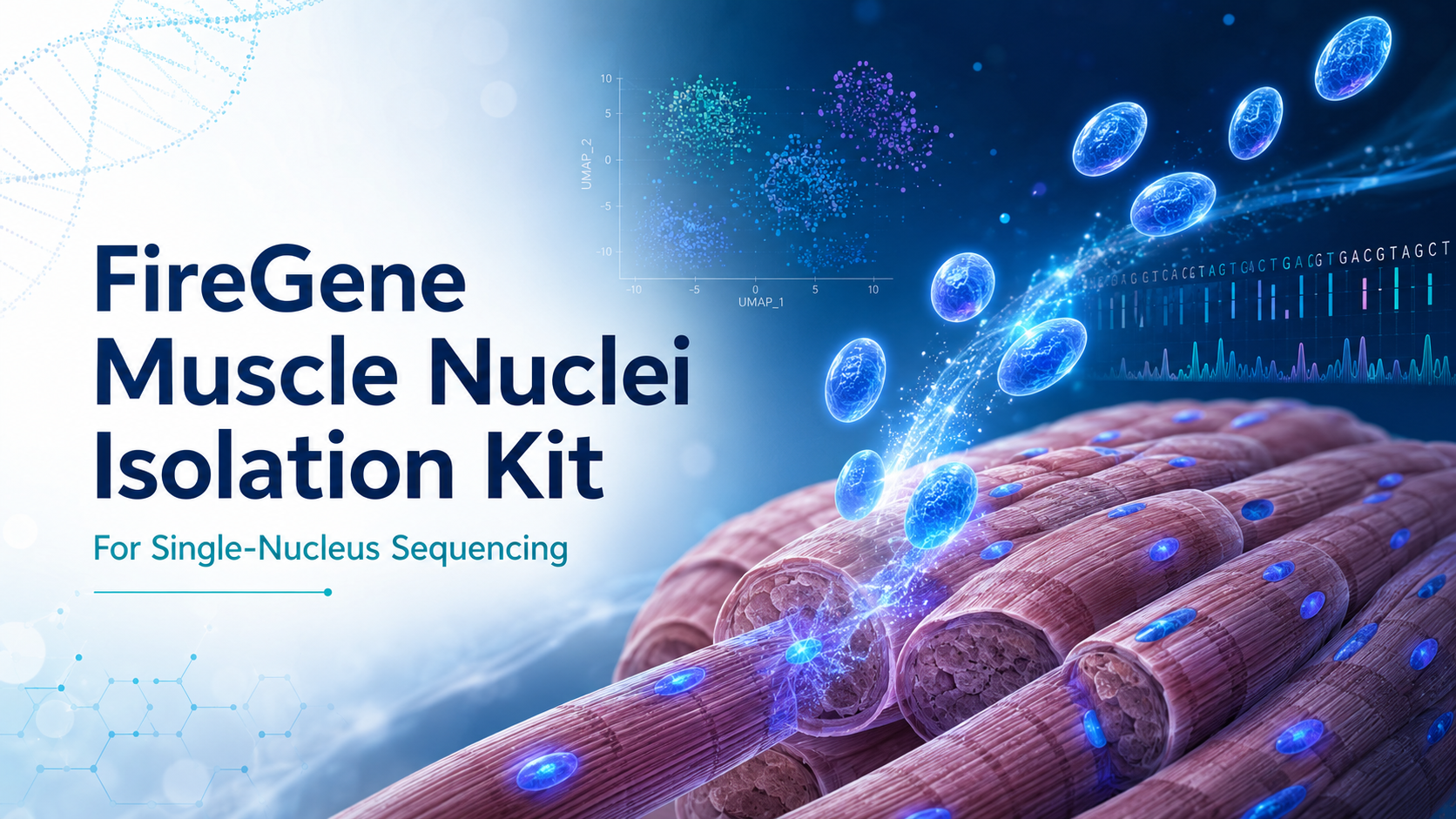
Muscle tissue is one of the most biologically dynamic yet technically challenging sample types in modern sequencing research. From skeletal muscle regeneration and neuromuscular disease to aging, exercise physiology, metabolic dysfunction, and regenerative medicine, muscle studies increasingly require high-resolution molecular profiling. However, traditional single-cell workflows can be difficult to apply to muscle samples because muscle fibers are large, elongated, multinucleated, and structurally dense. These features often make it hard to obtain intact, viable single-cell suspensions suitable for high-throughput sequencing.
This is where single-nucleus sequencing has become especially valuable. Instead of isolating whole cells, researchers isolate nuclei and analyze nuclear RNA, chromatin accessibility, or other nuclear features. The FireGene Muscle Nuclei Isolation Kit for Single-Nucleus Sequencing is designed for this exact purpose: preparing clean single-nucleus suspensions from fresh or frozen mammalian muscle tissue for downstream sequencing and nuclear analysis workflows. FireGene lists the kit as suitable for nuclei extraction from fresh and frozen muscle samples, with applications including single-nucleus RNA sequencing, single-nucleus ATAC sequencing, nuclear transcriptome analysis, chromatin accessibility studies, and cell-type composition analysis.
Why Muscle Tissue Is Difficult for Single-Cell Sequencing
Single-cell RNA sequencing has transformed tissue biology by allowing researchers to profile gene expression at cellular resolution. Yet not every tissue is equally compatible with single-cell dissociation. Muscle presents several major obstacles.
First, muscle fibers are much larger than most individual cells analyzed in droplet-based single-cell systems. Mature myofibers are multinucleated syncytial structures, meaning many nuclei share the same cytoplasmic space. This makes it difficult to represent muscle biology accurately using whole-cell dissociation alone.
Second, enzymatic and mechanical dissociation can damage fragile cells, alter transcriptional states, or selectively lose certain cell populations. This is especially problematic when the goal is to compare disease versus healthy tissue, young versus aged muscle, or treated versus untreated samples. Literature on skeletal muscle snRNA-seq has noted that single-nucleus RNA sequencing can help profile myonuclei from multinucleated myofibers while reducing dissociation-induced transcriptional artifacts.
Third, many valuable muscle samples are archived or frozen. Clinical biopsies, biobanked specimens, and rare disease samples are often not available as fresh tissue. Because nuclei can often be recovered from frozen samples more reliably than intact viable cells, single-nucleus sequencing expands the usability of precious stored muscle material.
What Is the FireGene Muscle Nuclei Isolation Kit?
The FireGene Muscle Nuclei Isolation Kit is a sample preparation kit developed to isolate nuclei from muscle tissue for single-nucleus sequencing and related molecular assays. According to FireGene’s product information, the kit supports fresh and frozen muscle tissue, is intended for human or mammalian muscle samples, and uses a workflow involving tissue grinding, lysis, filtration, centrifugation, density-layer separation, and nuclei resuspension. The listed catalog number is FG-BA3315, with a kit size of 10 reactions and recommended starting material of approximately 200 mg tissue.
The kit is positioned for research areas such as skeletal muscle biology, muscle development, regeneration, neuromuscular disease research, aging-related muscle studies, metabolic disease models, exercise physiology, translational biomedical research, and single-cell or single-nucleus multiomics.
For researchers working with complex muscle samples, a dedicated muscle nuclei isolation workflow can reduce the burden of protocol optimization. Instead of adapting a general nuclei extraction method to fibrous tissue, researchers can use a workflow designed specifically for muscle structure and downstream sequencing compatibility.
Key Applications in Muscle Research
1. Single-Nucleus RNA Sequencing
Single-nucleus RNA sequencing, or snRNA-seq, allows researchers to study gene expression from individual nuclei. In muscle tissue, this approach is particularly useful because it can capture nuclear populations from myofibers as well as resident cell types such as satellite cells, fibro-adipogenic progenitors, endothelial cells, immune cells, smooth muscle cells, and other stromal populations.
For disease research, snRNA-seq can help reveal changes in cell-type composition, inflammatory signatures, regenerative states, fibrosis-associated pathways, mitochondrial stress responses, and muscle-specific transcriptional programs. It is also useful for comparing normal and pathological tissue when intact cell dissociation is impractical.
2. Single-Nucleus ATAC Sequencing
The kit is also described as compatible with single-nucleus ATAC sequencing, or snATAC-seq, which profiles chromatin accessibility at single-nucleus resolution. This is important for understanding gene regulation, enhancer activity, transcription factor networks, and epigenetic remodeling in muscle development, injury response, aging, and disease.
In muscle biology, gene expression alone may not fully explain why cells adopt certain states. Chromatin accessibility can provide another layer of information, helping researchers identify regulatory mechanisms behind muscle differentiation, regeneration, metabolic adaptation, or degeneration.
3. Frozen Muscle Sample Analysis
A major advantage of single-nucleus workflows is the ability to work with frozen tissue. Published work has shown that frozen human skeletal muscle can be analyzed by snRNA-seq and that this approach is useful for studying banked samples, including those with pathological changes.
For translational and clinical research, this is highly valuable. Many studies depend on archived biopsies collected over time, and re-collecting fresh tissue may be impossible. A nuclei isolation kit that supports frozen muscle samples can help researchers unlock information from existing sample collections.
4. Muscle Disease and Regeneration Studies
Muscle diseases often involve complex interactions between myofibers, immune cells, connective tissue, vasculature, and stem/progenitor populations. Single-nucleus sequencing allows researchers to examine these systems at higher resolution. It can be applied to research involving muscular dystrophy, sarcopenia, cachexia, metabolic muscle dysfunction, injury repair, inflammatory myopathies, fibrosis, and neuromuscular disorders.
By preparing high-quality nuclei suspensions, researchers can improve downstream data quality and reduce sample preparation variability, which is essential when comparing subtle disease-associated molecular changes.
Why Nuclei Quality Matters
In single-nucleus sequencing, the quality of the nuclei suspension directly affects the quality of the final dataset. Poor nuclei preparation can lead to debris contamination, clumping, damaged nuclear membranes, low recovery, high background RNA, or clogging in microfluidic systems. These issues may reduce sequencing efficiency and compromise cell-type identification.
A good nuclei suspension should be clean, evenly dispersed, intact, and compatible with downstream counting and loading requirements. FireGene describes the kit workflow as including filtration, centrifugation, and density-layer separation, which are commonly used steps to remove tissue debris and enrich usable nuclei.
Researchers using droplet-based systems, such as 10x Genomics Chromium workflows, must pay close attention to nuclei concentration, suspension cleanliness, and aggregation. 10x Genomics’ own support materials emphasize best practices such as lysis, washing, debris removal, counting, and concentrating nuclei before use in single-cell RNA sequencing protocols.
Advantages of Using a Muscle-Specific Nuclei Isolation Kit
A muscle-focused nuclei isolation kit offers several practical benefits:
Reduced protocol development time. Muscle nuclei isolation often requires careful optimization of tissue disruption, lysis conditions, filtration, and cleanup. A kit designed for muscle tissue can help streamline the workflow.
Compatibility with fresh and frozen samples. FireGene states that the kit supports both fresh and frozen muscle tissue, increasing flexibility for different experimental designs.
Support for multiomics workflows. Because the resulting nuclei may be used for snRNA-seq, snATAC-seq, nuclear transcriptome analysis, and chromatin accessibility studies, the kit can support multiple research directions from a similar sample preparation strategy.
Improved access to difficult cell populations. Single-nucleus methods are especially useful in muscle because they allow analysis of myonuclei from large multinucleated fibers, a population that can be underrepresented or inaccessible in standard single-cell workflows.
Better use of archived materials. Frozen muscle biopsies and stored experimental samples can become more accessible for high-resolution sequencing studies.
Research Areas That Can Benefit
The FireGene Muscle Nuclei Isolation Kit may be useful across a wide range of research fields, including:
Skeletal muscle development, muscle stem cell biology, exercise adaptation, aging-related muscle decline, metabolic disease models, neuromuscular disease research, muscle injury and repair, regenerative medicine, drug response studies, and translational biomarker discovery.
In each of these areas, researchers need reliable sample preparation to generate meaningful sequencing data. Since sequencing platforms are sensitive to sample input quality, nuclei isolation is not just a preliminary step; it is a critical determinant of experiment success.
Conclusion
The FireGene Muscle Nuclei Isolation Kit for Single-Nucleus Sequencing addresses a central challenge in muscle research: how to prepare high-quality nuclei from a dense, fibrous, multinucleated tissue type that is often difficult to process by standard single-cell methods. By supporting fresh and frozen mammalian muscle tissue and enabling applications such as snRNA-seq and snATAC-seq, the kit provides a practical sample preparation option for researchers studying muscle biology, disease mechanisms, tissue heterogeneity, regeneration, aging, metabolism, and gene regulation.
As single-nucleus sequencing continues to expand in biomedical research, reliable nuclei isolation from challenging tissues such as muscle will remain essential. For laboratories working with muscle samples, especially frozen or clinically valuable specimens, a dedicated muscle nuclei isolation workflow can help improve reproducibility, preserve sample value, and support high-quality downstream sequencing analysis.
FireGene, light your research with passion, innovation, and profession.
FireGene Single-Cell Sample Prep
Looking for validated dissociation kits?
FireGene's tissue dissociation kits are optimized for specific organ types — brain, tumor, liver, GI, reproductive, and more. Validated for 10x Genomics Chromium and BD Rhapsody workflows.


