
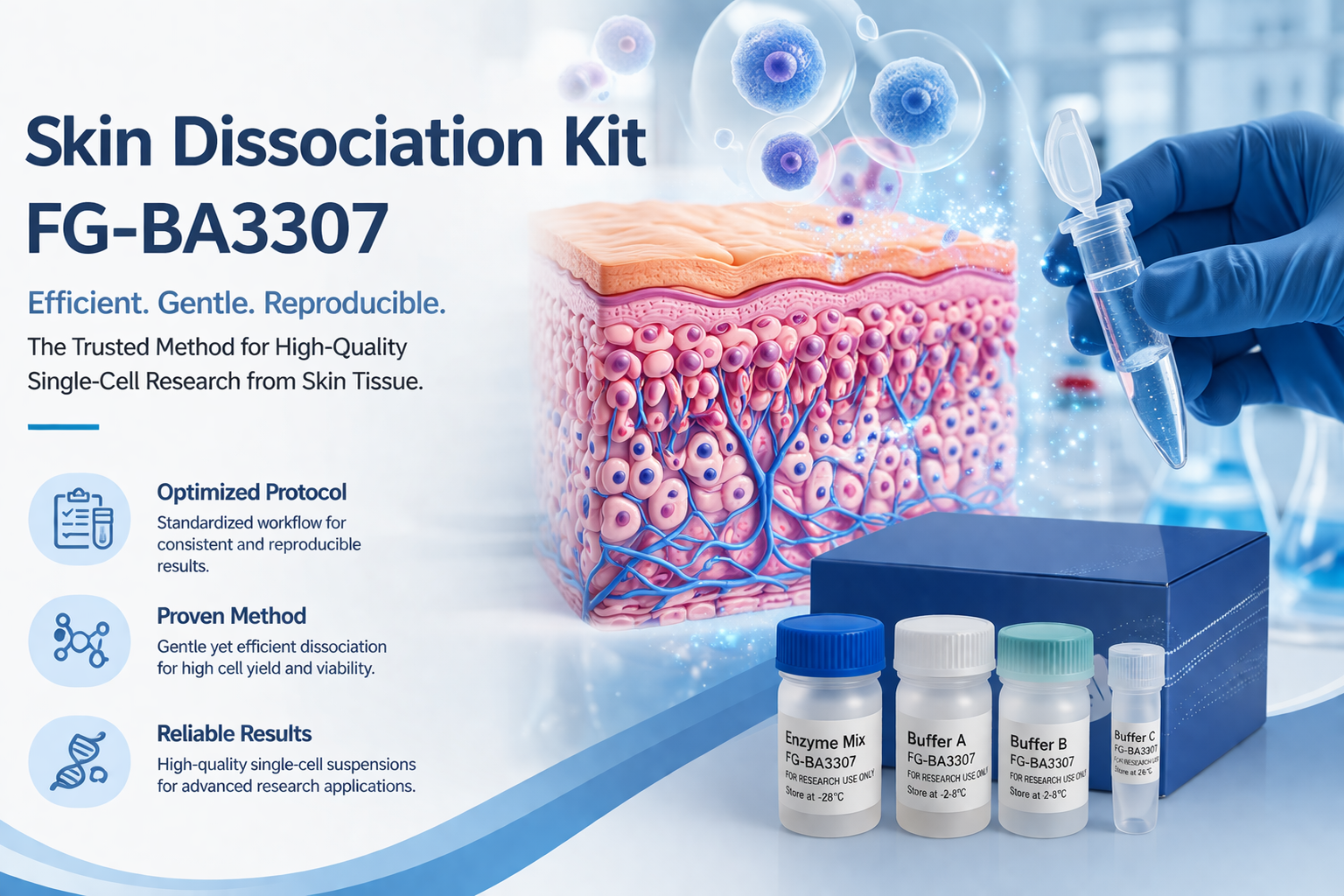
In modern life science research, high-quality single-cell suspensions are the foundation for accurate and reproducible downstream analysis. Applications such as single-cell RNA sequencing (scRNA-seq), flow cytometry, and primary cell culture all depend heavily on how well tissue samples are processed during the dissociation stage. Skin tissue, in particular, presents unique challenges due to its dense extracellular matrix, structural complexity, and diverse cell populations.
The FireGene Skin Dissociation Kit (FG-BA3307), developed by FireGene, is designed to address these challenges through an optimized combination of research-driven design, standardized protocols, and validated dissociation methods. This article explores how the kit works, its advantages, and why it is an effective solution for researchers working with skin tissue.
Why Skin Tissue Dissociation Is Challenging in Research
Skin is one of the most structurally complex tissues in the human body. It contains multiple layers (epidermis, dermis, and subcutaneous tissue), each composed of distinct cell types embedded within a dense extracellular matrix (ECM). This ECM is rich in collagen, elastin, and other structural proteins that provide mechanical strength but also make tissue dissociation difficult.
Traditional mechanical or enzymatic dissociation approaches often face several limitations:
Low cell yield
Reduced cell viability
Cell aggregation
Loss of sensitive cell populations
Poor reproducibility across experiments
These limitations can significantly affect the quality of downstream research data, especially in high-resolution applications such as single-cell sequencing.
FireGene’s Research-Oriented Design Philosophy
The FireGene Skin Dissociation Kit is built around a research-first approach, focusing on the needs of modern laboratories conducting advanced biological studies. Rather than relying on generic dissociation reagents, the kit is optimized specifically for skin tissue, ensuring that researchers can achieve consistent results across different experimental setups.
This research-oriented design supports a wide range of scientific investigations, including:
Skin development and regeneration studies
Dermatological disease research
Tumor microenvironment analysis
Immunological profiling of skin-resident cells
Stem cell and fibroblast research
By aligning with current research demands, the kit helps streamline experimental workflows while maintaining high data quality.
Standardized Protocol for Reproducibility
One of the key strengths of the FireGene Skin Dissociation Kit is its standardized protocol. Reproducibility is a critical factor in scientific research, and inconsistent tissue processing can introduce variability that affects experimental outcomes.
The kit provides a clearly defined workflow that includes:
Tissue preparation and trimming
Enzymatic digestion under controlled conditions
Gentle mechanical assistance when needed
Filtration and cell recovery steps
Preparation of a single-cell suspension
Each step is optimized to minimize variability and ensure that researchers can achieve consistent results across multiple samples and experiments.
Benefits of the standardized protocol include:
Reduced operator-dependent variation
Simplified training for new users
Improved experimental repeatability
Compatibility with standard lab equipment
This makes the kit suitable for both experienced researchers and laboratories establishing single-cell workflows for the first time.
Optimized Method for Efficient Tissue Dissociation
At the core of the FireGene Skin Dissociation Kit is its optimized enzymatic method, which is specifically designed to balance efficiency and cell preservation.
The method combines carefully selected enzymes that target key components of the skin extracellular matrix. This allows for:
Effective breakdown of collagen-rich structures
Controlled digestion without over-processing
Preservation of fragile and sensitive cell types
Reduction of mechanical stress on cells
Unlike overly aggressive dissociation methods that may damage cells, FireGene’s approach emphasizes gentle yet effective tissue processing. This ensures that the resulting single-cell suspension accurately reflects the original cellular composition of the tissue.
Key advantages of the method include:
High cell viability
Low levels of cell debris
Reduced cell clumping
Improved representation of heterogeneous cell populations
These characteristics are especially important for downstream applications where cell integrity directly impacts data quality.
Compatibility with Downstream Applications
The quality of a single-cell suspension determines how well it performs in downstream applications. The FireGene Skin Dissociation Kit is designed to produce suspensions that are compatible with a wide range of analytical techniques.
Common applications include:
1. Single-Cell RNA Sequencing (scRNA-seq)
High cell viability and minimal RNA degradation are essential for capturing accurate gene expression profiles. The kit supports the preparation of high-quality cells suitable for sequencing workflows.
2. Flow Cytometry and Cell Sorting
Clean, debris-free suspensions improve staining efficiency and reduce background noise, enabling more precise cell population analysis.
3. Primary Cell Culture
Viable and structurally intact cells are critical for establishing reliable primary cultures, particularly for functional assays and drug testing.
4. Immunological Studies
The kit helps preserve immune cell populations within the skin, supporting studies of inflammation, immune response, and tissue microenvironment interactions.
Performance Benefits for Researchers
The FireGene Skin Dissociation Kit delivers several practical advantages that enhance overall research efficiency:
High Viability: Maintains cell integrity during dissociation
Improved Yield: Efficient recovery of diverse cell populations
Consistency: Reliable results across different samples and operators
Time Efficiency: Streamlined workflow reduces preparation time
Scalability: Suitable for both small-scale experiments and larger studies
These benefits contribute to more reliable experimental outcomes and reduce the need for repeated sample processing.
Supporting High-Quality Single-Cell Research
As single-cell technologies continue to evolve, the demand for high-quality sample preparation tools is increasing. The FireGene Skin Dissociation Kit plays a crucial role in bridging the gap between complex tissue biology and advanced analytical techniques.
By integrating optimized research design, standardized protocol execution, and efficient dissociation methods, the kit enables researchers to:
Generate reproducible single-cell suspensions
Preserve biological relevance of samples
Improve data accuracy in downstream analyses
Accelerate experimental workflows
Conclusion
Preparing single-cell suspensions from skin tissue is a technically demanding process that requires a balance between efficiency and cell preservation. The FireGene Skin Dissociation Kit (FG-BA3307) provides a comprehensive solution by combining a research-driven design, a standardized protocol, and an optimized dissociation method.
Developed by FireGene, the kit is well-suited for a wide range of applications, including single-cell sequencing, flow cytometry, and primary cell culture. Its ability to deliver high viability, reproducibility, and consistent performance makes it a valuable tool for researchers working in dermatology, immunology, oncology, and regenerative medicine.
For laboratories seeking to improve their tissue dissociation workflow and achieve high-quality single-cell data, the FireGene Skin Dissociation Kit offers a reliable and efficient solution that supports modern research demands.
FireGene, light your research with passion, innovation, and profession.
FireGene Single-Cell Sample Prep
Looking for validated dissociation kits?
FireGene's tissue dissociation kits are optimized for specific organ types — brain, tumor, liver, GI, reproductive, and more. Validated for 10x Genomics Chromium and BD Rhapsody workflows.


