
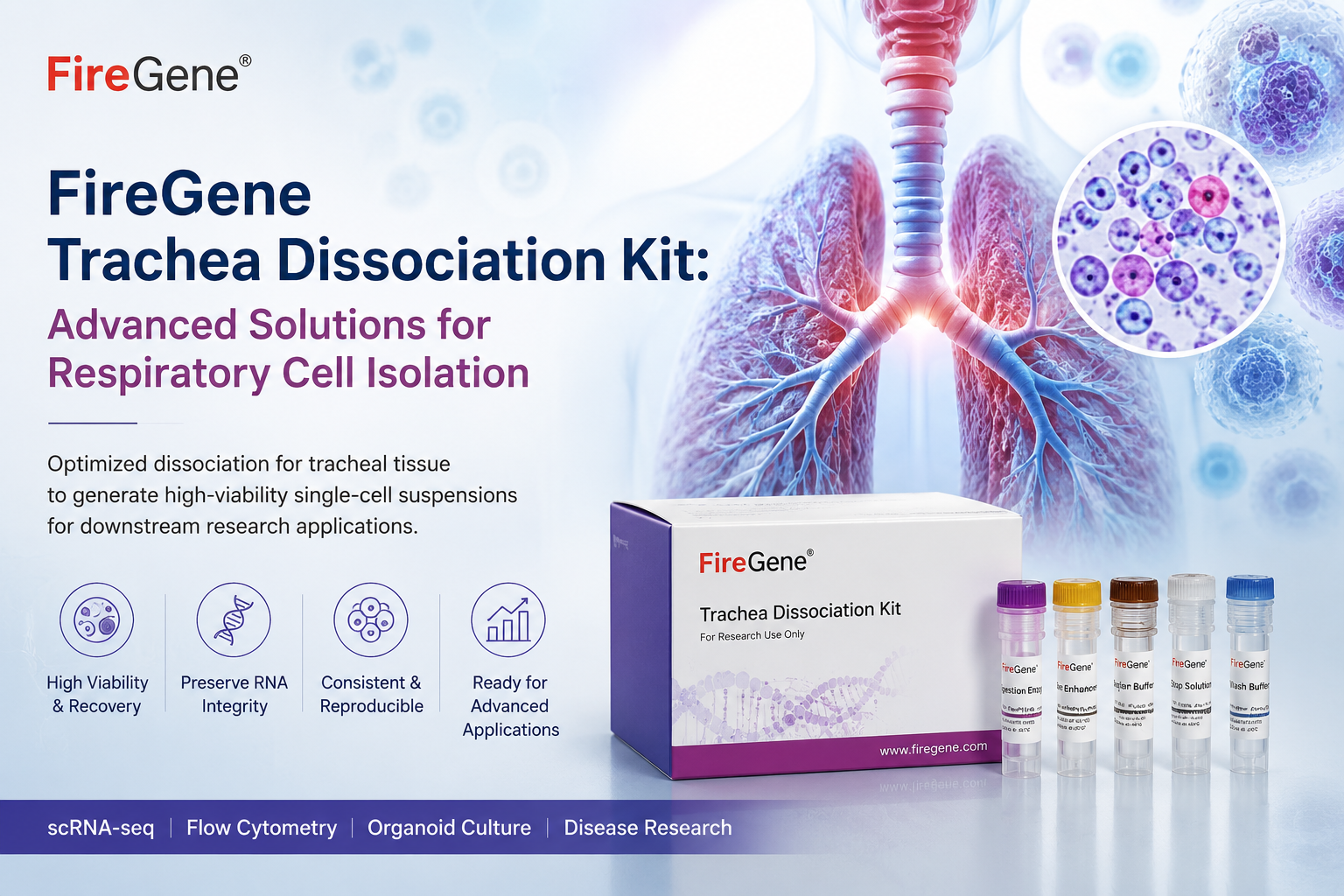
Introduction: Why High-Quality Tracheal Cell Isolation Matters
Respiratory research has rapidly advanced in recent years, driven by growing interest in airway diseases, lung regeneration, and single-cell technologies. From asthma and chronic obstructive pulmonary disease (COPD) to respiratory infections and lung cancer, understanding the cellular composition of the trachea has become increasingly important for both basic science and translational medicine. However, obtaining high-quality single-cell suspensions from tracheal tissue remains a major technical challenge.
The trachea contains a complex microenvironment composed of epithelial cells, immune cells, stromal cells, and extracellular matrix components. Traditional tissue digestion methods often rely on harsh enzymatic treatments or inconsistent manual protocols, which can damage fragile cell populations, reduce cell viability, and compromise RNA integrity. Poor-quality dissociation may ultimately affect downstream applications such as single-cell RNA sequencing (scRNA-seq), flow cytometry, organoid culture, and airway cell profiling.
Efficient respiratory cell isolation therefore plays a critical role in generating reliable and reproducible experimental data. Researchers increasingly require optimized dissociation workflows that minimize cellular stress while preserving the diversity of airway cell populations.
The FireGene Trachea Dissociation Kit is designed to address these challenges by providing a streamlined and optimized solution for respiratory tissue processing. Developed specifically for tracheal tissue dissociation, the kit helps researchers prepare high-viability single-cell suspensions suitable for advanced downstream analyses. By improving consistency and reducing sample damage, it supports more accurate investigation of respiratory biology and disease mechanisms.
Common Challenges in Tracheal Tissue Dissociation
Tracheal tissue dissociation is a critical step in respiratory research, yet it remains one of the most technically demanding parts of airway cell isolation workflows. The trachea possesses a dense and highly structured extracellular matrix that tightly connects epithelial, stromal, and immune cell populations. As a result, generating high-quality single-cell suspensions without damaging delicate cells can be difficult using conventional digestion methods.
One major challenge is achieving efficient tissue digestion while maintaining high cell viability. Overly aggressive enzymatic treatments may accelerate tissue breakdown, but they can also damage fragile respiratory epithelial cells, including basal cells and ciliated cells that are essential for airway biology studies. Excessive mechanical disruption further increases the risk of cell death and stress-induced transcriptional changes, which may negatively affect downstream analyses such as single-cell RNA sequencing (scRNA-seq).
Another common issue is cell aggregation. Incomplete digestion or excessive debris can lead to clumping, making filtration and downstream cell counting less reliable. Aggregates may also interfere with flow cytometry and microfluidic single-cell platforms, reducing data quality and experimental reproducibility.
In addition, traditional manual dissociation protocols often produce inconsistent results between experiments or operators. Variability in enzyme concentration, digestion time, and handling conditions can significantly affect cell yield and sample quality. This lack of reproducibility becomes especially problematic in large-scale respiratory studies where standardized workflows are essential.
Because of these limitations, researchers increasingly seek optimized trachea dissociation solutions that provide gentle yet efficient tissue processing while preserving cellular diversity, viability, and RNA integrity for advanced respiratory research applications.
How the FireGene Trachea Dissociation Kit Works
The FireGene Trachea Dissociation Kit is designed to simplify respiratory cell isolation by combining optimized enzymatic digestion with a streamlined tissue processing workflow. Developed specifically for tracheal tissue, the kit enables researchers to efficiently generate high-quality single-cell suspensions while minimizing cellular damage and preserving sample integrity for downstream applications.
The workflow typically begins with fresh tracheal tissue preparation. After careful dissection and mincing, tissue samples are incubated with the kit’s specialized dissociation reagents under controlled conditions. The optimized enzymatic formulation helps break down extracellular matrix components efficiently without exposing cells to excessive stress or prolonged digestion times. This balanced approach is particularly important for preserving fragile airway epithelial populations and maintaining overall cell viability.
Following enzymatic digestion, gentle mechanical dissociation is applied to further release individual cells from the tissue matrix. The resulting suspension is then filtered through cell strainers to remove undigested fragments, debris, and aggregates. Optional cleanup steps, such as red blood cell lysis or dead cell removal, can also be incorporated depending on the experimental requirements.
One of the key advantages of the FireGene Trachea Dissociation Kit is its compatibility with modern downstream research platforms. The isolated cells can be directly used for single-cell RNA sequencing (scRNA-seq), flow cytometry, organoid culture, and primary respiratory cell studies. Maintaining high RNA integrity and minimizing stress-induced artifacts are especially important for transcriptomic analyses, where sample quality directly influences data accuracy and biological interpretation.
By providing a more standardized and reproducible dissociation workflow, the FireGene kit helps researchers reduce experimental variability while improving the consistency of respiratory tissue processing. This makes it a valuable tool for both basic airway biology research and advanced translational studies.
Applications in Respiratory and Airway Research
Efficient tracheal tissue dissociation is essential for a wide range of respiratory research applications, particularly as single-cell technologies continue to transform the study of airway biology. By generating high-quality single-cell suspensions with high viability and preserved cellular diversity, the FireGene Trachea Dissociation Kit supports multiple downstream workflows used in both basic and translational research.
One of the most important applications is single-cell RNA sequencing (scRNA-seq). Researchers use scRNA-seq to analyze the complex cellular composition of the airway and identify distinct epithelial, immune, and stromal cell populations within tracheal tissue. High-quality respiratory cell isolation is critical for obtaining accurate transcriptomic profiles and minimizing stress-related artifacts that may interfere with data interpretation.
The kit is also well suited for flow cytometry and fluorescence-activated cell sorting (FACS). Reliable dissociation improves cell recovery and reduces aggregation, allowing researchers to isolate specific respiratory cell populations for functional studies, biomarker analysis, or downstream culture experiments.
In addition, tracheal single-cell suspensions are frequently used in organoid research and air-liquid interface (ALI) culture systems. These advanced in vitro models help scientists investigate airway regeneration, epithelial differentiation, host-pathogen interactions, and drug responses under physiologically relevant conditions.
The FireGene Trachea Dissociation Kit can support research in numerous respiratory disease areas, including asthma, chronic obstructive pulmonary disease (COPD), pulmonary fibrosis, respiratory viral infections, and lung cancer. As respiratory medicine increasingly relies on high-resolution cellular analysis, optimized airway tissue dissociation workflows have become essential for improving experimental reproducibility and accelerating scientific discovery.
Why Researchers Choose FireGene for Respiratory Cell Isolation
As respiratory research becomes increasingly dependent on high-resolution cellular analysis, researchers require tissue dissociation methods that deliver both efficiency and reproducibility. The FireGene Trachea Dissociation Kit is designed to meet these demands by providing an optimized workflow for preparing high-quality single-cell suspensions from tracheal tissue.
One of the primary advantages of the kit is its ability to preserve high cell viability while maintaining the integrity of sensitive airway cell populations. Traditional trachea dissociation methods often expose cells to excessive enzymatic or mechanical stress, leading to poor recovery and compromised downstream results. In contrast, the FireGene system uses carefully optimized dissociation conditions to support gentler tissue processing and more reliable respiratory cell isolation.
The kit also helps improve experimental consistency. Standardized reagents and workflow protocols reduce variability between experiments and operators, which is especially important for large-scale studies and single-cell sequencing projects. More reproducible tissue preparation can ultimately lead to higher-quality transcriptomic data, improved flow cytometry performance, and more dependable in vitro culture models.
Another important benefit is workflow efficiency. The streamlined protocol reduces processing complexity and minimizes handling time, allowing researchers to process respiratory tissue samples more quickly without sacrificing sample quality. This is particularly valuable in studies where maintaining RNA integrity and reducing cellular stress are critical.
With growing demand for advanced airway research tools, the FireGene Trachea Dissociation Kit offers a practical solution for modern respiratory biology applications. By combining optimized tissue digestion, improved reproducibility, and compatibility with downstream analytical platforms, the kit supports researchers in generating more accurate and reliable data for respiratory disease research and translational medicine.
Conclusion
High-quality respiratory cell isolation is essential for advancing modern airway and lung research. The FireGene Trachea Dissociation Kit provides researchers with a streamlined and reproducible solution for generating viable single-cell suspensions from tracheal tissue. By combining optimized enzymatic digestion with gentle processing conditions, the kit supports reliable downstream applications including scRNA-seq, flow cytometry, and organoid culture. Its ability to preserve cellular integrity and reduce experimental variability makes it a valuable tool for respiratory disease studies. As single-cell technologies continue to evolve, efficient trachea dissociation workflows will remain critical for accurate and impactful respiratory research.
FireGene, light your research with passion, innovation, and profession.
FireGene Single-Cell Sample Prep
Looking for validated dissociation kits?
FireGene's tissue dissociation kits are optimized for specific organ types — brain, tumor, liver, GI, reproductive, and more. Validated for 10x Genomics Chromium and BD Rhapsody workflows.


