
1. Introduction: Why Tumor Dissociation Matters in Modern Cancer Research
In modern cancer research, understanding tumors at the single-cell level has become essential for revealing the complexity of the tumor microenvironment (TME). Traditional bulk analysis methods often mask critical biological differences by averaging signals across millions of cells. As a result, rare but clinically important cell populations—such as cancer stem cells, infiltrating immune cells, and stromal components—can be overlooked. This limitation has driven the rapid adoption of single-cell technologies, including single-cell RNA sequencing (scRNA-seq) and high-dimensional flow cytometry.
However, the success of these advanced techniques heavily depends on one crucial upstream step: high-quality tumor tissue dissociation. Solid tumors are structurally complex and composed of tightly packed cells embedded within a dense extracellular matrix. Efficiently breaking down this structure into a viable, representative single-cell suspension is challenging, yet it is fundamental for obtaining accurate downstream data. Poor dissociation can lead to reduced cell viability, biased cell-type representation, and artificial changes in gene expression, all of which can compromise experimental outcomes.
This is where optimized dissociation solutions become indispensable. The FireGene Tumor Dissociation Kit is designed specifically to address these challenges by enabling efficient tissue breakdown while preserving cell integrity and the biological diversity of the tumor microenvironment. By supporting gentle yet effective dissociation, it helps researchers maintain the native state of tumor-derived cells, ensuring more reliable and reproducible data for downstream applications.
As cancer research continues to move toward precision oncology and single-cell resolution studies, the demand for robust and standardized tissue processing tools is increasing. High-quality tumor dissociation is no longer just a preparatory step—it is a critical determinant of experimental success. Tools like the FireGene Tumor Dissociation Kit play a key role in bridging the gap between complex solid tumor biology and actionable molecular insights, ultimately accelerating discoveries in cancer diagnostics, therapeutics, and biomarker development.
2. Challenges in Tumor Tissue Dissociation
Tumor tissue dissociation is one of the most technically demanding steps in cancer research workflows, largely due to the inherent structural and biological complexity of solid tumors. Unlike cultured cells or simpler tissues, tumors are highly heterogeneous and consist of tightly interconnected cancer cells, stromal cells, immune infiltrates, and extracellular matrix (ECM) components. This complexity makes it difficult to obtain a clean, viable, and representative single-cell suspension without introducing bias or damage.
One of the primary challenges is the dense and rigid extracellular matrix found in many tumor types. Rich in collagen, fibronectin, and other structural proteins, the ECM acts as a physical barrier that limits enzyme penetration and mechanical disruption. As a result, stronger digestion conditions are often required, which can inadvertently damage fragile cell populations or reduce overall viability.
Another major issue is the risk of altering the biological state of cells during processing. Harsh enzymatic or prolonged mechanical dissociation can induce stress responses, leading to artificial changes in gene expression. These artifacts are particularly problematic for downstream applications such as single-cell RNA sequencing, where accurate transcriptional profiling is critical.
Additionally, different cell types within the tumor respond differently to dissociation conditions. While immune cells may be relatively resilient, epithelial tumor cells or stromal fibroblasts can be more sensitive, leading to selective loss of specific populations. This introduces sampling bias and compromises the representation of the true tumor microenvironment.
Finally, conventional dissociation methods often struggle with reproducibility across different tumor types and sample conditions, making standardization difficult. These limitations highlight the need for more refined, tumor-optimized dissociation strategies that can balance efficiency, viability, and biological fidelity.
3. FireGene Tumor Dissociation Kit: Design and Mechanism
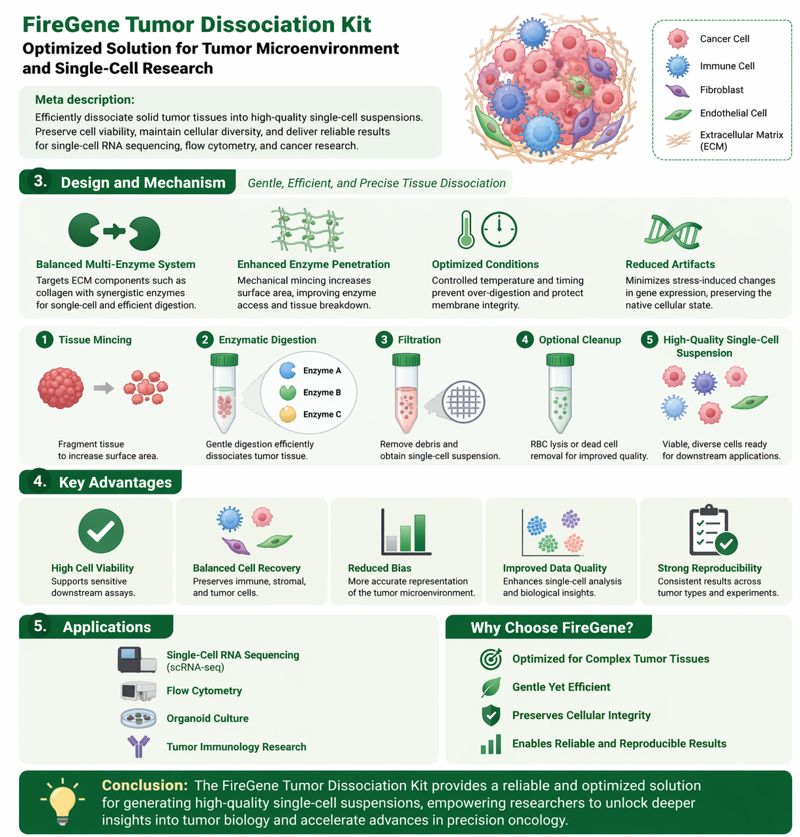
The FireGene Tumor Dissociation Kit is specifically engineered to address the unique structural and biological challenges of solid tumor tissues. Its design focuses on achieving efficient tissue breakdown while maintaining high cell viability and preserving the cellular diversity of the tumor microenvironment (TME), making it well-suited for advanced single-cell and translational research applications.
 At the core of the kit is a carefully optimized enzyme system that targets key components of the extracellular matrix (ECM), including collagen and other structural proteins that contribute to tumor rigidity. Instead of relying on overly aggressive single-enzyme digestion, the kit typically uses a balanced combination of enzymes working synergistically. This approach enables gradual and controlled tissue dissociation, reducing mechanical stress on sensitive cell populations.
The workflow generally combines mechanical mincing with enzymatic digestion in a stepwise process. Tissue samples are first fragmented to increase surface area, allowing enzymes to penetrate more effectively. Controlled incubation conditions—such as optimized temperature and timing—ensure that digestion is efficient without over-processing the sample. This balance is critical for maintaining membrane integrity and minimizing cell death.
Another important feature of the system is its focus on reducing dissociation-induced artifacts. During harsh processing, cells can activate stress pathways that alter gene expression profiles. The FireGene system is designed to minimize these effects, helping preserve a more physiologically accurate transcriptional state, which is especially important for downstream applications like single-cell RNA sequencing (scRNA-seq).
Overall, the mechanism of the kit reflects a shift from brute-force digestion to precision-oriented tissue processing. By integrating enzymatic efficiency with gentle handling principles, it provides researchers with a reliable tool for generating high-quality single-cell suspensions from even the most challenging tumor tissues.
4. Advantages in Tumor Microenvironment Research
One of the most significant strengths of the FireGene Tumor Dissociation Kit is its ability to support high-resolution analysis of the tumor microenvironment (TME) without compromising cell quality or population diversity. In modern oncology research, where understanding cell-to-cell interactions is essential, preserving the native complexity of tumor samples is critical.
A key advantage is improved cell viability after dissociation. By combining optimized enzymatic activity with controlled digestion conditions, the kit reduces excessive mechanical and chemical stress on cells. This leads to a higher recovery rate of intact, functional cells that are suitable for sensitive downstream applications such as single-cell RNA sequencing (scRNA-seq) and flow cytometry.
Equally important is the kit’s ability to preserve the diversity of cell populations within the tumor. Tumors are composed not only of malignant cells but also immune cells, fibroblasts, endothelial cells, and other stromal components. Many conventional dissociation methods disproportionately damage fragile cell types, resulting in biased datasets. In contrast, a more balanced dissociation approach helps maintain a more accurate representation of the tumor microenvironment.
This improved preservation directly translates into better data quality. Researchers benefit from more reliable insights into immune infiltration patterns, stromal interactions, and intratumoral heterogeneity. These factors are essential for advancing immuno-oncology studies, identifying therapeutic targets, and understanding mechanisms of drug resistance.
Another major benefit is reproducibility. Standardized and optimized digestion conditions reduce variability between experiments and across different tumor types, making results more consistent and comparable. This is particularly valuable in multi-center studies and high-throughput research pipelines.
Overall, the kit enhances both the biological fidelity and analytical robustness of tumor research, making it a valuable tool for precision oncology and single-cell discovery workflows.
5. Applications, Workflow, and Why Choose FireGene
The FireGene Tumor Dissociation Kit is widely used across modern cancer and immunology research workflows, particularly in studies that require high-quality single-cell suspensions. Its applications span multiple advanced platforms, including single-cell RNA sequencing (scRNA-seq), flow cytometry, organoid development, and tumor immunology profiling. By enabling efficient dissociation of solid tumors while preserving cell integrity, it supports a broad range of downstream analyses that depend on accurate cellular representation.
A typical workflow begins with mechanical mincing of freshly collected tumor tissue to increase surface area. This is followed by enzymatic digestion using the kit’s optimized enzyme mix under controlled temperature and timing conditions. After digestion, the sample is gently filtered to remove debris and aggregated material, resulting in a clean single-cell suspension. Depending on experimental requirements, additional steps such as red blood cell lysis or dead cell removal may be performed to further improve sample quality.
Compared with conventional tissue dissociation methods, FireGene’s approach offers a more balanced trade-off between digestion efficiency and cell preservation. Traditional protocols often rely on harsh enzymatic conditions or prolonged incubation times, which can reduce viability and distort cell population ratios. In contrast, the FireGene system is designed to maintain both structural integrity and biological fidelity, making it particularly suitable for sensitive applications like transcriptomic profiling.
Choosing this kit is especially valuable for researchers working in precision oncology, tumor heterogeneity studies, and immune microenvironment analysis. It provides consistent, reproducible results across different tumor types, helping to reduce experimental variability and improve data reliability.
In summary, the FireGene Tumor Dissociation Kit serves as a robust and optimized solution for transforming complex tumor tissues into high-quality single-cell suspensions, ultimately enabling deeper insights into cancer biology and therapeutic discovery.
Conclusion
Efficient tumor dissociation is a critical foundation for accurate single-cell analysis and meaningful insights into the tumor microenvironment. The FireGene Tumor Dissociation Kit addresses key challenges in processing solid tumor tissues by combining optimized enzymatic activity with gentle, controlled digestion conditions. This ensures high cell viability, improved recovery of diverse cell populations, and reduced experimental artifacts. As cancer research continues to advance toward precision medicine and single-cell resolution, reliable sample preparation becomes increasingly important. By delivering consistent, high-quality single-cell suspensions, the kit supports more accurate downstream analyses and accelerates discoveries in oncology research, biomarker identification, and therapeutic development.
FireGene, light your research with passion, innovation, and profession.
FireGene Single-Cell Sample Prep
Looking for validated dissociation kits?
FireGene's tissue dissociation kits are optimized for specific organ types — brain, tumor, liver, GI, reproductive, and more. Validated for 10x Genomics Chromium and BD Rhapsody workflows.


