
1. Introduction: Why Endotoxin Testing and Removal Must Work Together
Endotoxin contamination remains a persistent challenge in biological research and biopharmaceutical process development. Even when a protein sample appears pure by conventional analytical methods, residual bacterial endotoxins may still interfere with downstream experiments.
Endotoxins are lipopolysaccharides (LPS) associated with the outer membrane of Gram-negative bacteria. During bacterial growth, cell disruption, and recombinant protein production, LPS can enter sample preparations and remain associated with proteins or other biomolecules. Removing it can be difficult because endotoxins may form aggregates, interact with proteins, and behave differently depending on buffer composition and sample conditions.
The consequences can extend beyond sample quality. Endotoxin contamination may stimulate immune cells, alter cytokine production, affect cell viability, and introduce confounding variables into inflammation-related experiments. In biopharmaceutical research, it can also complicate the interpretation of product characterization and process-development data.
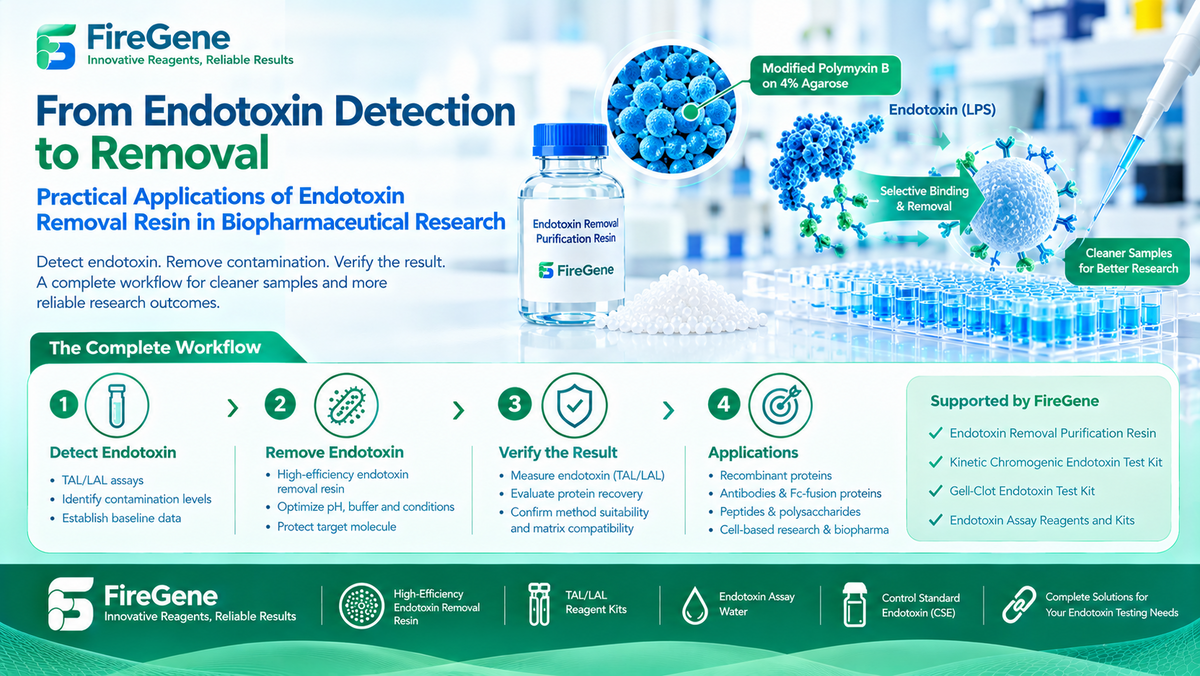
A reliable endotoxin-control strategy therefore involves three connected steps:
-
Detect: Determine the initial endotoxin level using a suitable TAL/LAL-based method.
-
Remove: Apply an appropriate purification strategy when the measured level or intended application warrants it.
-
Verify: Test the treated sample to evaluate endotoxin reduction while assessing target-molecule recovery and analytical interference.
FireGene's High-Efficiency Endotoxin Removal Purification Resin is designed to reduce endotoxin in protein-based preparations, including proteins, peptides, antibodies, and polysaccharides. It can be evaluated as a dedicated purification step when conventional purification alone does not provide the desired endotoxin control.
The critical point is that resin treatment and endotoxin testing serve different purposes. The resin supports contaminant removal; a suitable endotoxin assay helps determine whether the treatment achieved the intended result.
2. Why Endotoxin Can Remain After Protein Purification
Protein purification and endotoxin removal are related but distinct objectives.
Affinity chromatography, ion-exchange chromatography, size-exclusion chromatography, and other purification methods are selected primarily to separate the target molecule from host-cell proteins, nucleic acids, aggregates, and other impurities. Depending on the process and the physicochemical properties of the target, endotoxin may not be adequately removed by these steps.
This is particularly relevant to proteins expressed in Escherichia coli. Because E. coli is Gram-negative, bacterial cell disruption can introduce LPS into the lysate. Endotoxin may subsequently persist through several purification stages, including affinity capture and buffer exchange.
A sample can therefore meet a conventional purity specification while still containing endotoxin at a level that affects sensitive biological experiments.
Common situations in which additional endotoxin removal may be considered
Recombinant protein production: Bacterial expression systems may introduce substantial LPS contamination into crude lysates and downstream protein fractions.
Antibody and Fc-fusion protein research: A protein may require an additional polishing step after Protein A/G chromatography if endotoxin remains above the project's target level.
Cell-based assays: Endotoxin contamination can activate innate immune pathways and complicate studies involving macrophages, monocytes, cytokines, or inflammatory signaling.
Animal research preparations: Depending on the experimental design and applicable requirements, endotoxin levels may need to be controlled to reduce confounding biological effects.
Biopharmaceutical process development: Researchers may need to compare removal strategies, evaluate protein recovery, and establish reproducible operating conditions before moving to more advanced process studies.
The appropriate intervention should be determined from measured contamination, the target molecule's properties, and the requirements of the intended application—not from a general assumption that every purified protein needs the same treatment.
3. How FireGene Endotoxin Removal Purification Resin Works
FireGene's High-Efficiency Endotoxin Removal Purification Resin uses modified Polymyxin B immobilized on 4% agarose microspheres.
Polymyxin B-based ligands interact with bacterial endotoxins, enabling the resin to capture LPS under suitable operating conditions. Immobilizing the ligand on a solid support provides a practical format for treating compatible sample preparations through a purification workflow.
According to the FireGene product specifications, the resin features:
-
Matrix: 4% agarose microspheres
-
Ligand: Modified Polymyxin B
-
Bead size: 45–165 µm
-
Listed endotoxin-binding capacity: Greater than 2,000,000 EU/mL of resin matrix
-
Operating pH range: 5–10
-
Maximum pressure: 0.1 MPa (1 bar)
-
Storage: 2–8°C
-
Shelf life: 2 years
The product is supplied in 20% ethanol, and its listed volume refers to the gel matrix rather than the combined gel-and-storage-solution volume.
These specifications help researchers assess whether the resin may fit their sample preparation and purification workflow. Actual performance depends on endotoxin load, sample composition, pH, ionic strength, flow rate, contact time, and interactions between the target molecule and the resin.
The manufacturer reports endotoxin removal of up to 99% and protein recovery of up to 90%. These are product-reported performance figures, not guaranteed results for every sample. Users should establish performance with their own target molecule and operating conditions.
4. Application One: Endotoxin Removal from Recombinant Proteins
Recombinant proteins are among the most relevant applications for endotoxin-removal resin, especially when proteins are expressed in Gram-negative bacterial systems.
After cell disruption, the crude lysate contains the target protein alongside host-cell components. Downstream purification can substantially improve purity, but endotoxin may remain in the product fraction. This can become a problem when the protein is used in immune-cell experiments, functional assays, or other applications sensitive to LPS.
When should researchers consider a resin-based polishing step?
An additional endotoxin-removal step may be worth evaluating when:
-
Endotoxin testing identifies residual contamination after the main purification steps.
-
Cell-based experiments show unexpected inflammatory responses.
-
Different batches produce inconsistent biological results despite comparable protein purity.
-
The sample must meet a predefined endotoxin target for a specific research protocol.
-
Further reduction is needed without excessively compromising protein recovery.
A practical approach is to quantify the starting endotoxin level, establish the desired endpoint, and then evaluate resin treatment using a small pilot sample.
The pilot should assess at least three outcomes: residual endotoxin concentration, recovered protein amount, and retained protein functionality where relevant. A treatment that reduces endotoxin but causes substantial protein loss or changes biological activity may not be the best solution.
For researchers seeking quantitative before-and-after measurements, FireGene's Kinetic Chromogenic Endotoxin Test Kit can be evaluated as part of an appropriate endotoxin-testing workflow, subject to sample-specific method suitability.
5. Application Two: Antibodies and Fc-Fusion Proteins
Antibodies and Fc-fusion proteins are widely used in immunology, target validation, cell-based assays, and biopharmaceutical research. Their downstream applications can be particularly sensitive to impurities that alter immune-cell behavior.
Protein A/G chromatography is commonly used to capture antibody-containing molecules. However, successful affinity purification does not automatically demonstrate that endotoxin has been adequately removed.
When endotoxin testing identifies a problem, FireGene's resin may be evaluated as an additional polishing step after the primary antibody purification process.
Important considerations for antibody preparations
Preserve antibody recovery. Antibodies and Fc-fusion proteins may interact with purification materials in ways that depend on their structure and formulation. Measure the recovered target concentration rather than assuming all protein passes through unchanged.
Check formulation compatibility. Buffer pH, salt concentration, and excipients can influence endotoxin binding and nonspecific protein adsorption. Test conditions that are compatible with the target molecule.
Confirm functional integrity. Depending on the application, assess binding activity or another relevant functional attribute before and after treatment.
Verify endotoxin reduction independently. The appearance of the sample, its protein concentration, and its chromatography profile cannot substitute for a suitable endotoxin assay.
For example, if an antibody preparation is intended for macrophage activation studies, residual endotoxin may independently stimulate inflammatory pathways. Without appropriate endotoxin control, researchers may struggle to distinguish an antibody-related effect from an LPS-related response.
The objective is not simply to obtain a cleaner-looking sample. It is to prepare a sample whose endotoxin level, recovery, and relevant biological characteristics are adequately characterized.
6. Application Three: Peptides and Other Protein-Based Preparations
Peptides and other protein-based preparations may also require endotoxin control, depending on their production process and intended use.
A peptide sample can contain endotoxin introduced through raw materials, processing equipment, water, or upstream biological production. Conventional purification may reduce some impurities without consistently achieving the required endotoxin endpoint.
The resin's suitability depends on the specific peptide, its solubility, charge, aggregation behavior, and compatibility with the operating buffer.
How to evaluate suitability
Start by confirming that the resin is appropriate for the target material. Then compare a small untreated sample with a treated sample under controlled conditions.
Useful evaluation criteria include:
-
Endotoxin concentration before and after treatment
-
Peptide concentration and recovery
-
Solubility and aggregation behavior
-
Relevant purity or identity measurements
-
Functional performance when applicable
The same principle applies to other compatible protein-based preparations: evaluate the resin as a targeted purification step, rather than treating it as a universal solution for every biomolecule.
7. Application Four: Polysaccharides and Other Compatible Biological Samples
FireGene identifies polysaccharides among the product's intended sample categories. However, polysaccharides can vary substantially in molecular weight, charge, solubility, and structural characteristics.
These differences can influence both resin compatibility and endotoxin-removal performance. A condition that works well for one polysaccharide may not work for another.
For this reason, researchers should not assume that a removal percentage observed with a protein preparation will transfer directly to a polysaccharide sample.
A fit-for-purpose evaluation should examine:
-
Whether the target material remains soluble and stable under the proposed treatment conditions.
-
Whether the resin reduces endotoxin to the intended level.
-
Whether target-molecule recovery is acceptable.
-
Whether the final endotoxin assay is suitable for the treated matrix.
If the sample contains additional formulation components, those components should also be considered when assessing adsorption behavior and analytical interference.
For complex biological materials, a pilot study can help identify the operating conditions that balance endotoxin reduction with product recovery.
8. A Practical Workflow: Detect, Remove, and Verify
A structured workflow helps researchers evaluate the resin systematically and avoid unnecessary purification cycles.
Step 1: Measure the initial endotoxin level
Collect a representative sample and measure endotoxin using a suitable TAL/LAL-based method. The test method should be sensitive enough for the intended endpoint and appropriate for the sample matrix.
If the initial result is unexpectedly high, review sample handling, water quality, buffers, consumables, and potential contamination sources before beginning treatment.
Step 2: Define the treatment objective
Determine the target endotoxin level based on the research application or applicable product requirements.
There is no single acceptable endotoxin limit for every research sample. Requirements differ by product, route of administration, dose, experimental model, and regulatory context.
Step 3: Prepare and equilibrate the resin
Follow the current product instructions for resin preparation, regeneration, and equilibration. Use suitable endotoxin-controlled water, buffers, and consumables.
Do not load a sample directly onto resin that has not been properly prepared according to the manufacturer's instructions.
Step 4: Optimize sample-to-resin ratio and operating conditions
FireGene's product guidance indicates that a resin-to-sample volume ratio of 1:1 or 1:2 may be used as an initial experiment when the sample's endotoxin content is unknown. This should be treated as a starting point for evaluation—not a universal recommendation.
Where possible, use measured endotoxin concentration and the resin's stated binding capacity to inform the amount of resin required.
Evaluate pH, salt concentration, contact time, flow rate, and sample stability. For column operation, avoid exceeding the product's stated maximum pressure and determine a flow rate that provides sufficient contact time.
The product FAQ suggests evaluating pH adjustment toward 7–8 when endotoxin removal is low, provided that the target molecule tolerates the change. If protein recovery is poor, investigate nonspecific adsorption and assess whether a compatible change in salt concentration can improve recovery.
Step 5: Collect and characterize the treated sample
Collect the intended product fraction according to the resin format and operating protocol. Measure target-molecule recovery and inspect any relevant quality attributes.
Do not assume that a lower endotoxin result alone proves that the sample remains fit for its intended experiment.
Step 6: Verify endotoxin reduction
Measure endotoxin in the treated sample using a suitable, validated or otherwise appropriately qualified method for the intended context.
When comparing pre- and post-treatment results, use comparable units and account for changes in sample volume or concentration. Include appropriate controls and evaluate whether the sample matrix interferes with the assay.
A reduction in the measured endotoxin concentration is meaningful only when the analytical method is performing reliably in that matrix.
Step 7: Document and refine the process
Record the starting endotoxin level, resin volume, sample volume, buffer conditions, contact time or flow rate, final endotoxin result, protein recovery, and any relevant functional measurements.
This information makes it easier to troubleshoot poor performance and reproduce successful conditions in subsequent preparations.
9. Why TAL/LAL Verification Matters After Resin Treatment
Endotoxin removal and endotoxin measurement answer different questions.
The resin is intended to reduce contamination. The assay determines the endotoxin concentration detectable in the sample under the test conditions.
Without post-treatment testing, researchers cannot confidently determine whether the intended endpoint has been reached or whether an additional treatment cycle is necessary.
However, endotoxin assays can be affected by the sample matrix. Proteins, buffers, excipients, and residual process components may inhibit or enhance the analytical response.
Use appropriate controls
Positive product control (PPC): A spiked sample can help evaluate whether the matrix interferes with endotoxin recovery in the assay.
Dilution assessment: Where appropriate, evaluate suitable sample dilutions to reduce interference while maintaining the sensitivity required for the target endpoint.
Reagent and water controls: Use appropriate controls and endotoxin-controlled water and consumables to reduce the risk of introducing contamination during testing.
Consistent pre- and post-treatment testing: Use a suitable, comparable analytical approach when assessing the effect of resin treatment.
FireGene provides a range of endotoxin assay reagents and kits, including gel-clot and kinetic chromogenic formats. The appropriate choice depends on the intended use, sensitivity requirements, sample matrix, and applicable testing framework.
For regulated applications, laboratories should follow the applicable compendial requirements, regulatory guidance, and validated procedures. A research workflow should not automatically be treated as a validated manufacturing process.
10. Troubleshooting: When Endotoxin Removal or Sample Recovery Is Poor
Not every sample responds to resin treatment in the same way. When results fall short of expectations, investigate the process systematically.
Low endotoxin removal
Potential contributors include an unsuitable pH, insufficient contact time, an excessive endotoxin load relative to the resin volume, or sample conditions that reduce effective binding.
Review the starting endotoxin concentration, confirm that the resin was properly prepared, and evaluate whether the operating conditions are appropriate for the sample.
Low protein recovery
The target protein may adsorb nonspecifically to the resin or become unstable under the selected conditions. Evaluate protein concentration before and after treatment, and check whether pH, salt concentration, or other buffer components can be adjusted without compromising the target.
Unexpected endotoxin results after treatment
Consider contamination introduced during handling, buffer preparation, collection, or storage. Also evaluate analytical interference and confirm that the assay controls meet the method's acceptance criteria.
Contamination between samples
Follow the manufacturer's instructions for resin handling and reuse. FireGene's product FAQ advises against using previously used resin to remove endotoxin from different samples. Where cross-contamination could compromise results, use an appropriate fresh resin aliquot and maintain a documented handling process.
High-viscosity samples
High concentrations of glycerol can increase viscosity and negatively affect recovery. FireGene recommends no more than 5% glycerol for this resin. Confirm compatibility for other additives and sample conditions before use.
The most effective troubleshooting strategy is to change one variable at a time and measure both endotoxin reduction and target recovery.
11. Product Handling and Compatibility Considerations
Before integrating an endotoxin removal resin into a workflow, review the product specifications and current instructions.
FireGene's resin is stored at 2–8°C in 20% ethanol and has a stated shelf life of two years. The manufacturer lists compatibility with several reagents and conditions, including 20% DMSO, 20% ethanol, 20% glycerol, 1 M urea, 300 mM imidazole, 0.05% Tween 20, and 10 mM DTT. Such compatibility information should be interpreted within the product's intended operating context; it does not mean that every combination will provide equivalent removal efficiency or target recovery.
For long-term storage, use the recommended storage conditions rather than assuming that a temporary working buffer is suitable.
Most importantly, verify that the product is appropriate for the exact sample type. Although the product page lists several biological applications, its FAQ states that the resin is not suitable for removing endotoxin from nucleic acid samples such as plasmids or DNA. Researchers working with nucleic acids should confirm product suitability with FireGene and choose a method intended for their sample type.
12. Building a More Reliable Endotoxin-Control Strategy
A robust endotoxin-control strategy should not rely on a single test or purification step.
For research teams working with recombinant proteins, antibodies, peptides, and compatible polysaccharide preparations, a practical strategy is to:
-
Identify likely contamination sources during sample preparation.
-
Measure initial endotoxin levels.
-
Select a removal method compatible with the target molecule.
-
Optimize treatment conditions using small-scale studies.
-
Measure residual endotoxin with appropriate interference controls.
-
Evaluate target recovery and relevant biological functionality.
-
Document the conditions required to reproduce successful results.
This integrated approach supports more informed decisions than either endotoxin testing or removal alone.
13. Conclusion: Make Endotoxin Control a Measurable Process
Endotoxin contamination can undermine biological experiments even when conventional purification results appear satisfactory. For compatible protein-based samples, a dedicated endotoxin removal step may help reduce LPS contamination and improve the suitability of preparations for downstream research.
FireGene's High-Efficiency Endotoxin Removal Purification Resin provides a modified Polymyxin B-based approach that researchers can evaluate for recombinant proteins, antibodies, peptides, polysaccharides, and other compatible preparations.
Its effectiveness should be established for each relevant sample through appropriate optimization and verification. Endotoxin reduction, target-molecule recovery, and analytical method suitability all matter when determining whether a treatment has achieved its purpose.
The most reliable workflow is simple in principle: detect endotoxin, remove it with a suitable process, and verify the result.
Explore the FireGene High-Efficiency Endotoxin Removal Purification Resin and the FireGene Endotoxin Assay Reagents and Kits to learn more about integrating endotoxin removal and testing into your research workflow.
For research use only. Product suitability and performance should be evaluated for the intended sample and application. Follow the current product instructions and applicable regulatory or compendial requirements.
FireGene Endotoxin Testing
Ready to run your endotoxin assay?
FireGene offers a complete endotoxin testing toolkit — from TAL reagents and CSE standards to pyrogen-free consumables and LAL reagent water. All products are aligned with USP <85>, EP 2.6.14, and JP 4.01.


