
Research Background
In single-cell research, the quality of the starting sample is a critical determinant of downstream data accuracy and reliability. Even when advanced sequencing platforms or optimized analytical pipelines are used, poor sample integrity can significantly limit experimental success. This is particularly true for tissue-derived samples, which often undergo mechanical or enzymatic dissociation, introducing substantial levels of cellular stress.
As a result, samples frequently contain a mixture of viable cells, dead cells, and various forms of debris, including membrane fragments and extracellular nucleic acids. These contaminants can interfere with key analytical steps. For example, dead cells may release RNA that contributes to background noise in sequencing data, while debris can be misidentified as cells during flow cytometry, leading to false-positive signals. Such interference not only reduces data clarity but also affects reproducibility and biological interpretation. Low-quality samples often yield lower gene detection rates, inconsistent clustering, and unreliable conclusions. Therefore, minimizing impurities and enriching viable cells before analysis is not just beneficial—it is essential.
Ensuring a clean, high-quality single-cell suspension is the foundation for generating meaningful, reproducible insights in modern single-cell research.
Research Solution
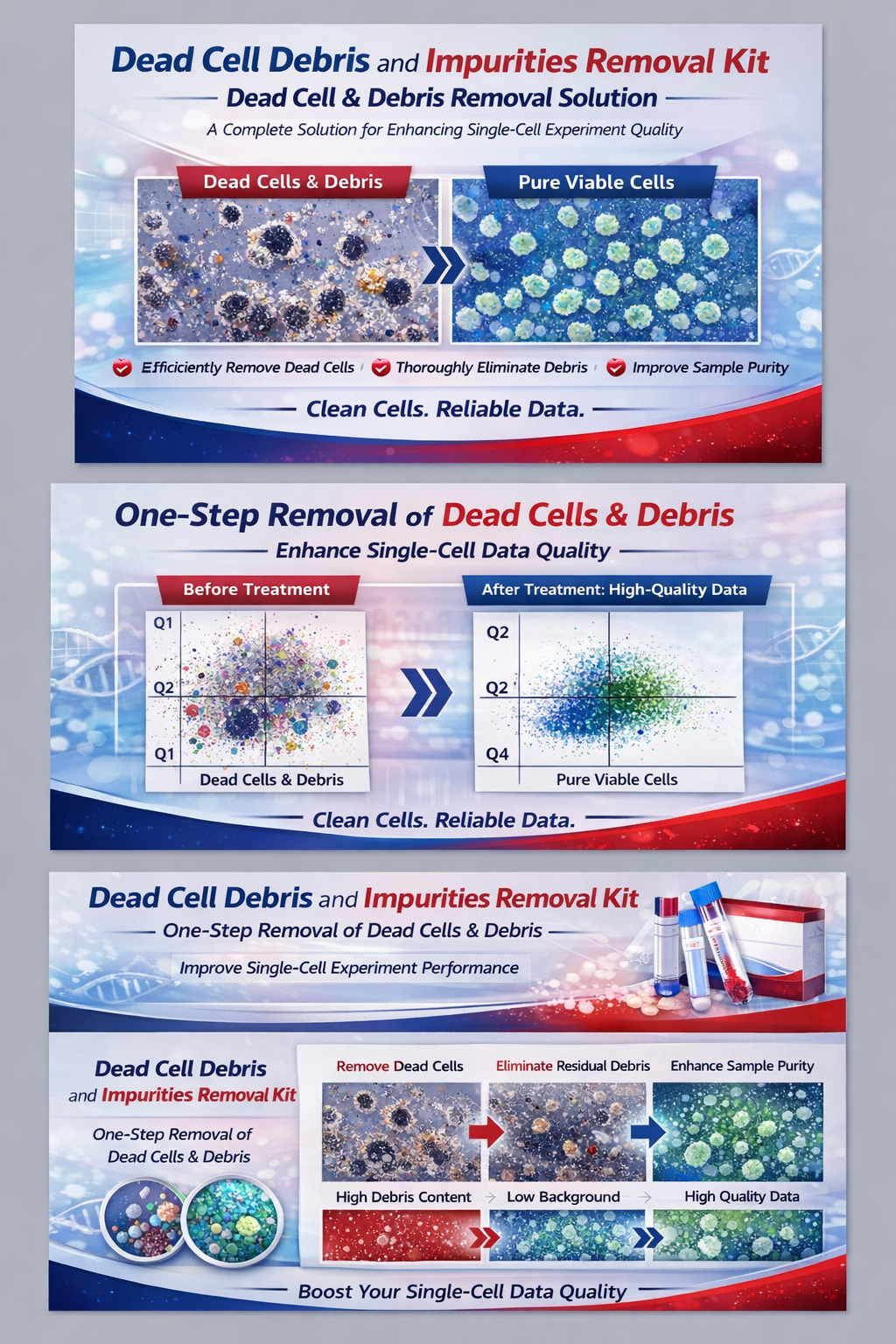
To address the challenges associated with low-quality single-cell samples, an effective purification strategy is essential. The Dead Cell Debris and Impurities Removal Kit provides a streamlined solution designed to improve sample integrity prior to downstream analysis. By specifically targeting unwanted components such as dead cells, cellular debris, and residual contaminants, the kit enables researchers to obtain cleaner and more reliable cell populations.
The core principle of this solution is to enrich viable, intact cells while minimizing sources of background noise. Dead cells are a major contributor to experimental interference, as they release intracellular contents that can distort sequencing results and reduce assay sensitivity. Similarly, debris generated during tissue dissociation can obscure true cellular signals and complicate data interpretation.
By removing these unwanted elements, the kit significantly enhances overall sample quality. This leads to improved cell viability, clearer flow cytometry profiles, and more accurate gene expression data in single-cell sequencing workflows. Importantly, the process is designed to be simple and efficient, allowing seamless integration into existing laboratory protocols without requiring specialized equipment.
Ultimately, this solution transforms compromised samples into high-quality inputs, enabling researchers to generate more consistent, reproducible, and biologically meaningful results.
Method Overview
The removal of dead cells and debris is based on exploiting the physical and biological differences between viable and non-viable components within a sample. Viable cells typically retain intact membranes, stable density, and normal morphology, while dead cells and debris exhibit compromised structures, altered density, and fragmented characteristics. These distinctions enable effective separation using optimized systems such as density-based or selective removal technologies.

During the process, dead cells, apoptotic bodies, and extracellular debris are separated from intact cells, reducing sources of background noise and contamination. Importantly, the method is designed to be gentle, minimizing additional stress or damage to viable cells and preserving their functionality for downstream applications.

By selectively enriching healthy cells and removing interfering components, this approach produces cleaner and more consistent cell populations. As a result, it significantly improves the reliability of subsequent analyses, including flow cytometry and single-cell sequencing, where sample purity is critical for accurate data generation.
Protocol
The protocol for removing dead cells and debris is designed to be simple, efficient, and easily integrated into standard laboratory workflows. The process begins with the preparation of a single-cell suspension, typically obtained after tissue dissociation. To ensure uniformity, the sample is often filtered through a cell strainer to remove aggregates and large particles.
Next, the sample is mixed with the removal reagent according to the recommended ratio. Gentle handling during this step is important to avoid introducing additional cellular stress or damage. The mixture is then subjected to a separation step, commonly involving centrifugation, which allows distinct layers to form based on cell properties.
Following separation, the fraction enriched with viable cells is carefully collected while avoiding disturbance of debris and dead cell layers. Finally, the purified cells are washed and resuspended in an appropriate buffer or medium, making them ready for downstream applications.
Applications
The Dead Cell Debris and Impurities Removal Kit is widely applicable across a range of single-cell and cell-based research workflows. It is particularly valuable in single-cell RNA sequencing (scRNA-seq), where high sample purity is essential for accurate gene expression profiling and reliable cell clustering. By removing contaminants, the kit helps improve sequencing sensitivity and data consistency.
In flow cytometry, cleaner samples result in clearer population separation and reduced background noise, enabling more precise analysis. The kit is also beneficial for primary cell culture, where eliminating dead cells can enhance cell viability and overall culture health. Additionally, it supports immunological assays by reducing interference from debris and non-specific signals.
This solution is especially useful for tissue-derived samples, which often contain high levels of debris, as well as for low-viability samples that require quality improvement before analysis.
Conclusion
High-quality single-cell data begins with high-quality sample preparation. The presence of dead cells, debris, and other impurities can significantly compromise experimental outcomes by introducing noise, reducing sensitivity, and affecting reproducibility. Implementing an effective removal strategy is therefore essential for ensuring reliable and interpretable results.
The Dead Cell Debris and Impurities Removal Kit provides a simple yet powerful solution to these challenges. By efficiently eliminating unwanted components and enriching viable cells, it enhances sample purity and overall data quality across a wide range of applications. Its ease of use and compatibility with standard workflows make it a valuable addition to any laboratory.
Ultimately, cleaner samples lead to clearer insights, enabling researchers to achieve more accurate, consistent, and meaningful scientific discoveries.
FireGene, light your research with passion, innovation, and profession.
FireGene Single-Cell Sample Prep
Looking for validated dissociation kits?
FireGene's tissue dissociation kits are optimized for specific organ types — brain, tumor, liver, GI, reproductive, and more. Validated for 10x Genomics Chromium and BD Rhapsody workflows.


