
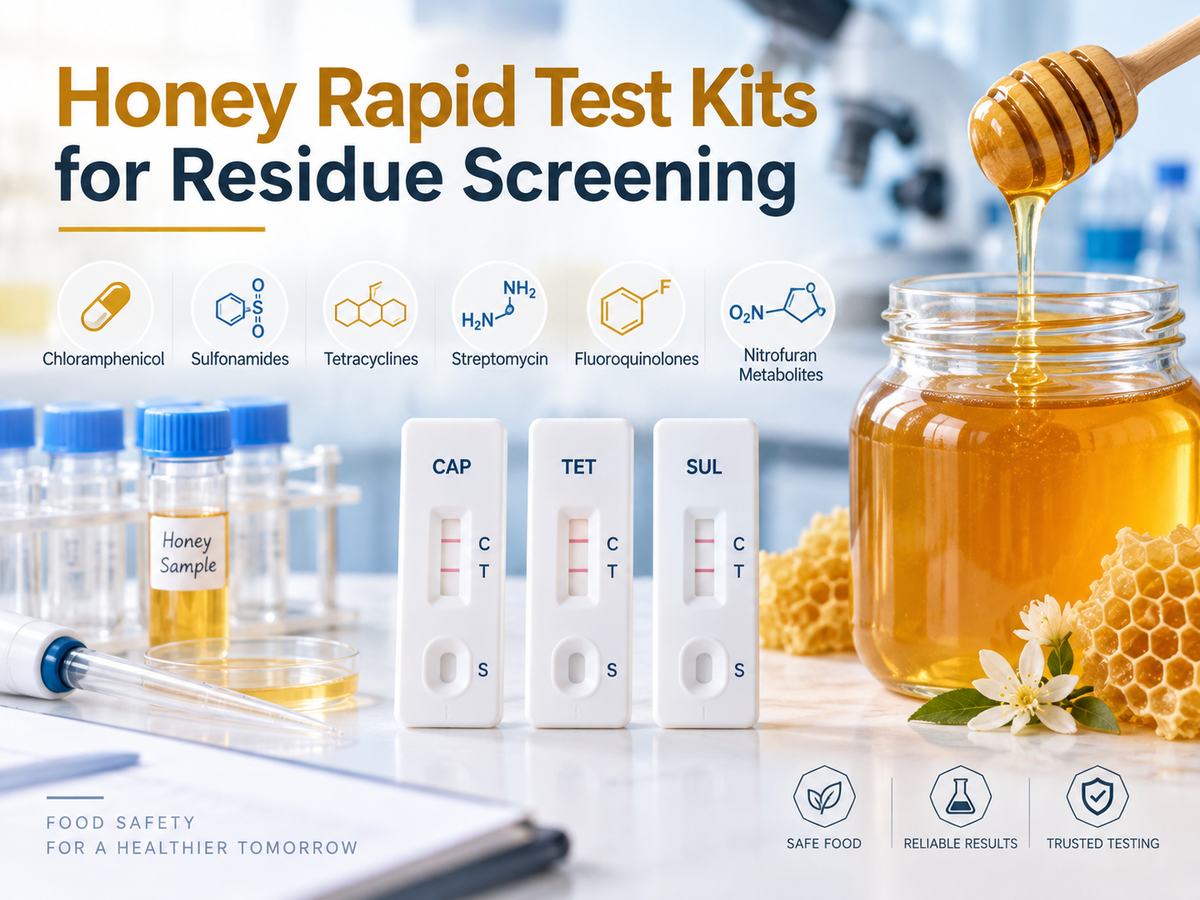
Honey is widely valued as a natural food product, but its quality can be influenced by residues introduced during apiculture, veterinary treatment, environmental exposure, or processing. For honey producers, exporters, food laboratories, and quality-control teams, rapid screening methods can provide an efficient way to identify potentially non-compliant samples before they enter downstream testing, trade, or distribution.
Among available rapid-screening technologies, colloidal gold immunochromatographic test kits are particularly useful because they are simple to operate, require limited instrumentation, and can provide results within a short testing period.
However, honey is a challenging food matrix. Its high sugar content, viscosity, acidity, pigments, proteins, and naturally occurring compounds can interfere with immunochemical detection. Therefore, rapid test devices intended for honey should be developed and validated specifically for the honey matrix rather than simply adapted from tests designed for milk, meat, urine, or other samples.
For routine honey residue screening, several analyte groups are particularly relevant: chloramphenicol, sulfonamides, tetracyclines, streptomycin, fluoroquinolones, and nitrofuran metabolites including AOZ, AMOZ, AHD, and SEM.
Why Rapid Residue Screening Is Important for Honey
Residue analysis plays an important role in honey quality assurance and international trade. Depending on the market, regulatory authority, and customer specification, laboratories may need to monitor honey for veterinary drug residues at very low concentrations.
Confirmatory techniques such as LC-MS/MS remain important because they provide high sensitivity, selectivity, and quantitative capability. However, these analytical methods require sophisticated instrumentation, trained personnel, and relatively complex sample preparation.
Rapid test kits serve a different purpose.
They can be used for:
· incoming raw honey screening;
· supplier qualification;
· apiary monitoring;
· batch release support;
· pre-export quality checks;
· routine factory quality control;
· screening before LC-MS/MS confirmation.
A well-designed rapid test therefore acts as an efficient first-line screening tool. Samples showing negative results may proceed through routine workflows, while suspicious or positive samples can be prioritized for confirmatory laboratory analysis.
1. Chloramphenicol Rapid Test Kit for Honey
Chloramphenicol rapid testing is one of the most established applications in honey residue screening.
Chloramphenicol is an antimicrobial compound that has historically received considerable attention in food-residue monitoring. Because laboratories may require detection at very low concentrations, the sensitivity and matrix compatibility of a honey-specific rapid test are particularly important.
A typical chloramphenicol colloidal gold test uses a competitive immunochromatographic principle. After appropriate honey dilution or extraction, the prepared sample is applied to the test device. The color intensity of the test line changes according to the concentration of the target analyte.
For commercial honey testing programs, important validation parameters include:
Detection sensitivity → Cut-off concentration → Specificity → Recovery → Repeatability → Matrix interference
Because different honeys may vary significantly in color, floral source, sugar composition, and acidity, matrix validation across multiple honey types is recommended.
2. Sulfonamide Rapid Test Kits for Honey
Sulfonamides represent a large family of antimicrobial compounds, making them suitable candidates for multi-residue screening.
Instead of developing a separate test strip for every individual sulfonamide, many laboratories and suppliers prefer a Sulfonamides Multi-Residue Rapid Test Kit.
Depending on the antibody used, such a test may recognize several structurally related compounds, including selected members of the sulfonamide family.
This approach can provide several advantages:
One sample preparation → One rapid test → Screening of multiple related residues
For practical quality-control programs, this may be more efficient than maintaining numerous individual test kits.
However, cross-reactivity data must be reviewed carefully. A kit described as a “sulfonamide rapid test” does not necessarily detect every sulfonamide with equal sensitivity. Suppliers should therefore provide a clear cross-reactivity profile showing which compounds are recognized and the approximate response for each analyte.
3. Tetracycline Rapid Test Kits for Honey
The tetracycline family includes several widely recognized antimicrobial compounds, such as:
· tetracycline;
· oxytetracycline;
· chlortetracycline;
· doxycycline.
For honey applications, a Tetracyclines Multi-Residue Rapid Test Kit can provide a practical screening approach.
Tetracyclines can present analytical challenges because interactions with sample components, metal ions, and pH may influence extraction and immunochemical recognition. As a result, buffer composition and sample preparation are important components of kit performance.
A honey-specific tetracycline test should therefore be evaluated not only for analytical sensitivity but also for robustness across different honey matrices.
In routine applications, rapid tetracycline testing can support screening of raw honey, processed honey, blended honey, and other honey-derived samples, provided the manufacturer has validated those matrices.
4. Streptomycin Rapid Test Kit for Honey
Streptomycin is another important target in veterinary drug residue screening.
Compared with some relatively hydrophobic compounds, aminoglycoside antibiotics such as streptomycin have different chemical characteristics and may require specifically optimized extraction and assay conditions.
A dedicated Streptomycin Rapid Test Kit for Honey can simplify routine screening by combining matrix preparation with lateral-flow immunodetection.
Potential users include:
· honey processors;
· beekeeping cooperatives;
· exporters;
· third-party testing laboratories;
· food-quality laboratories;
· purchasing and receiving departments.
For these users, rapid screening can help identify questionable batches before more expensive confirmatory testing is initiated.
5. Fluoroquinolone Multi-Residue Rapid Test Kits
Fluoroquinolones include compounds such as enrofloxacin, ciprofloxacin, sarafloxacin, and flumequine, among others.
Although individual analyte tests can be developed, a Fluoroquinolones Multi-Residue Rapid Test Kit is often more practical for broad honey screening.
The key technical issue is antibody cross-reactivity.
A useful multi-residue test should demonstrate adequate recognition of the intended fluoroquinolone panel rather than showing high sensitivity to only one compound.
For this reason, product specifications should clearly state:
· target fluoroquinolones;
· detection limits;
· relative cross-reactivity;
· cut-off concentrations;
· honey sample preparation;
· recommended interpretation time.
This information helps laboratories determine whether the test is suitable for their specific monitoring program.
6. Nitrofuran Metabolite Rapid Test Kits: AOZ, AMOZ, AHD, and SEM
Nitrofuran residue screening is more complex than many conventional antibiotic rapid tests.
The principal target metabolites are commonly identified as:
AOZ — metabolite associated with furazolidone
AMOZ — metabolite associated with furaltadone
AHD — metabolite associated with nitrofurantoin
SEM — metabolite associated with nitrofurazone
These metabolites may occur in protein-bound forms, meaning that sample preparation generally requires additional steps before immunochromatographic detection.
A simplified workflow may include:
Honey Sample → Hydrolysis → Derivatization → Extraction/Neutralization → Rapid Test Strip → Result Interpretation
Derivatization is particularly important because nitrofuran metabolites are commonly converted into derivatives that can be recognized more effectively by antibodies used in screening assays.
Therefore, AOZ, AMOZ, AHD, and SEM kits should not be evaluated in the same way as simple “dilute-and-test” rapid strips.
For honey laboratories, the quality of the sample preparation reagent system can be just as important as the lateral-flow strip itself.
Why Honey-Specific Validation Matters
One of the most important considerations when selecting a rapid test kit is whether the manufacturer has actually validated the product using honey.
Honey contains high concentrations of glucose and fructose and may vary significantly in:
· viscosity;
· pH;
· mineral content;
· color;
· floral compounds;
· protein content;
· phenolic compounds.
These characteristics can affect liquid migration, antibody binding, background coloration, and test-line development.
A scientifically designed honey test should therefore include matrix-specific sample preparation and validation.
Relevant performance parameters may include:
Limit of Detection, Cut-Off, Specificity, Cross-Reactivity, Recovery, Repeatability, False-Positive Rate, False-Negative Rate, and Agreement with Confirmatory Methods.
Rapid Screening and Confirmatory Analysis Should Work Together
Rapid tests should generally be positioned as screening tools rather than complete replacements for instrumental analysis.
A practical honey residue-control workflow can be designed as:
Honey Receipt → Rapid Screening → Negative Sample Release / Suspect Sample Segregation → LC-MS/MS Confirmation
This workflow can reduce unnecessary confirmatory testing while allowing laboratories to focus resources on samples requiring further investigation.
For international honey suppliers, such a screening strategy may also support supplier management, raw-material control, export preparation, and internal quality systems.
Building a Focused Honey Rapid Test Portfolio
For suppliers developing a dedicated Honey Antibiotic Residue Rapid Test product line, a focused portfolio may include:
Chloramphenicol Rapid Test Kit for Honey
Sulfonamides Multi-Residue Rapid Test Kit for Honey
Tetracyclines Multi-Residue Rapid Test Kit for Honey
Streptomycin Rapid Test Kit for Honey
Fluoroquinolones Multi-Residue Rapid Test Kit for Honey
AOZ Rapid Test Kit for Honey
AMOZ Rapid Test Kit for Honey
AHD Rapid Test Kit for Honey
SEM Rapid Test Kit for Honey
Together, these products cover several of the most practical categories for veterinary drug residue screening in honey.
Conclusion
Honey residue testing requires more than simply applying a general food rapid-test strip to a honey sample. Because honey is a highly concentrated and chemically complex matrix, matrix-specific extraction, dilution, antibody performance, and validation are essential.
Colloidal gold rapid test kits for chloramphenicol, sulfonamides, tetracyclines, streptomycin, fluoroquinolones, AOZ, AMOZ, AHD, and SEM can provide a convenient first-line solution for honey quality-control programs.
When combined with appropriate sample preparation and confirmatory LC-MS/MS testing, these rapid screening tools can help honey producers, laboratories, processors, and exporters establish a more efficient residue-monitoring workflow while maintaining scientifically defensible quality-control procedures.


