
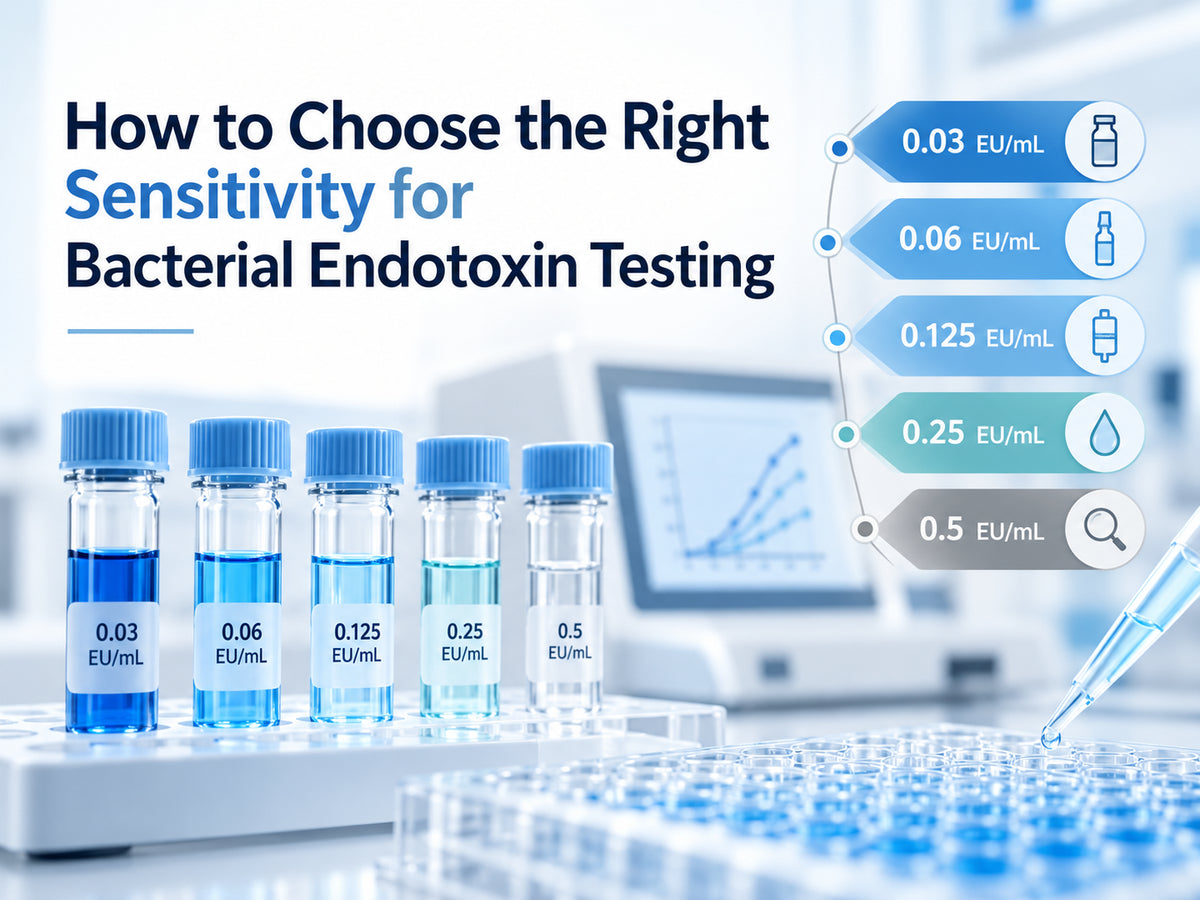
Selecting the appropriate sensitivity is essential for reliable bacterial endotoxin testing in pharmaceutical, biotechnology, and research laboratories. Gel-clot Limulus Amebocyte Lysate (LAL) and Tachypleus Amebocyte Lysate (TAL) assays are available in different sensitivity levels, commonly including 0.03, 0.06, 0.125, 0.25, and 0.5 EU/mL. However, the highest sensitivity does not necessarily provide the most appropriate testing conditions. Optimal selection depends on the endotoxin limit, sample concentration, maximum valid dilution (MVD), matrix interference, and analytical objectives. This guide explains how to interpret assay sensitivity, compare available options, calculate dilution requirements, and select suitable reagents for different laboratory applications.
1. Understanding Sensitivity in Bacterial Endotoxin Testing
Bacterial endotoxins are lipopolysaccharide components associated with the outer membranes of Gram-negative bacteria. Their presence in pharmaceutical preparations, biological materials, and medical devices is an important quality and safety concern.
The Bacterial Endotoxins Test (BET) is widely used to detect or measure endotoxin contamination. Among established detection technologies, the gel-clot method remains an important approach because of its straightforward procedure and visually interpretable results.
In gel-clot assays, endotoxins activate a proteolytic cascade in the lysate reagent, ultimately producing a gel clot under appropriate reaction conditions.
The sensitivity of a gel-clot reagent is represented by the symbol λ (lambda) and expressed in endotoxin units per milliliter (EU/mL).
Lambda represents the labeled endotoxin concentration required to produce clot formation under specified assay conditions.
For example:
A sensitivity of 0.03 EU/mL indicates a reagent intended to detect endotoxin at approximately 0.03 EU/mL.
A sensitivity of 0.125 EU/mL indicates a higher endotoxin detection threshold.
A sensitivity of 0.5 EU/mL indicates a comparatively less sensitive reagent.
The lower the numerical sensitivity value, the greater the analytical sensitivity of the reagent.
However, the correct sensitivity must be selected according to the sample-specific endotoxin acceptance criteria rather than sensitivity alone.
2. Comparing Five Common Gel-Clot Endotoxin Test Sensitivities
Gel-clot endotoxin test kits are available in several sensitivity grades to accommodate different analytical requirements.
|
Sensitivity |
Relative Sensitivity |
Potential Applications |
|
0.03 EU/mL |
Very high |
Low-limit biological materials, recombinant proteins, highly diluted samples |
|
0.06 EU/mL |
High |
Biological formulations, pharmaceutical research, protein solutions |
|
0.125 EU/mL |
Moderately high |
Medical device extracts, laboratory samples, routine testing |
|
0.25 EU/mL |
Moderate |
Water and buffer monitoring where the acceptance limit permits |
|
0.5 EU/mL |
Lower |
Preliminary screening and samples with relatively permissive endotoxin limits |
These applications are illustrative rather than universal regulatory classifications.
For example, Water for Injection testing cannot automatically be assigned to a 0.25 EU/mL reagent. The applicable water specification, sampling procedure, dilution, and validated detection method must be considered.
Likewise, biological products do not universally require 0.03 EU/mL sensitivity. A product with a relatively high permissible endotoxin concentration may be tested with a less sensitive reagent if the method meets its analytical requirements.
Therefore, reagent selection should begin with the allowable endotoxin limit.
3. Determine the Endotoxin Limit Before Selecting Sensitivity
The endotoxin limit defines the maximum acceptable endotoxin content for a particular sample or product.
Depending on the application, it may be expressed as:
EU/mL for liquid preparations
EU/mg for pharmaceutical ingredients or proteins
EU/device for medical devices
EU/unit for products expressed in biological activity units
For certain parenteral drug products, endotoxin limits are calculated using the relationship:
Endotoxin Limit = K / M
Where:
K is the applicable threshold pyrogenic dose of endotoxin.
M is the maximum recommended dose administered per kilogram of body weight within the specified period.
The appropriate value of K and the calculation of M depend on the route of administration and relevant regulatory guidance.
For research materials, the acceptable endotoxin concentration may instead be established by experimental requirements, customer specifications, or laboratory quality criteria.
A reagent must provide sufficient analytical sensitivity to determine whether the sample satisfies its established limit.
Example: Selecting Sensitivity for a Protein Solution
Consider a recombinant protein solution with an established endotoxin acceptance limit of 0.5 EU/mL.
If the sample can be tested without dilution, several reagent sensitivities may provide sufficient detection capability.
However, if the sample requires a tenfold dilution, its endotoxin concentration will also decrease tenfold.
At the original acceptance limit, the diluted sample would contain:
0.5 EU/mL ÷ 10 = 0.05 EU/mL
A reagent with a sensitivity of 0.125 EU/mL would therefore be insufficient for testing at this dilution.
A 0.03 EU/mL reagent would be an appropriate sensitivity candidate, provided that the assay is validated for the sample.
This example illustrates why sensitivity selection and sample dilution cannot be considered independently.
4. Maximum Valid Dilution: A Critical Factor in Sensitivity Selection
The Maximum Valid Dilution (MVD) is one of the most important parameters in bacterial endotoxin testing.
MVD defines the maximum permitted sample dilution at which an assay can still detect endotoxin at the established acceptance limit.
For products with endotoxin limits expressed in EU/mg or EU/unit, the general calculation is:
MVD = (Endotoxin Limit × Sample Concentration) / λ
Where:
Endotoxin Limit is the maximum allowable endotoxin content.
Sample Concentration is expressed in the corresponding units per milliliter.
λ is the labeled gel-clot reagent sensitivity in EU/mL.
For liquid samples with an endotoxin limit expressed directly in EU/mL:
MVD = Endotoxin Limit / λ
Worked Example
Suppose a liquid sample has an endotoxin limit of 0.5 EU/mL.
|
Reagent Sensitivity |
Calculated MVD |
|
0.03 EU/mL |
16.67 |
|
0.06 EU/mL |
8.33 |
|
0.125 EU/mL |
4 |
|
0.25 EU/mL |
2 |
|
0.5 EU/mL |
1 |
The results demonstrate that higher-sensitivity reagents permit greater sample dilution while retaining the ability to detect endotoxin at the specified limit.
If an eightfold dilution is required to overcome sample interference, the 0.03 and 0.06 EU/mL reagents are potential choices.
Conversely, a 0.125 EU/mL reagent would not provide sufficient detection capability at that dilution.
Importantly, MVD represents a maximum allowable dilution, not a recommended routine dilution.
Laboratories should generally use a validated dilution that minimizes interference while maintaining adequate analytical sensitivity.
5. Consider Sample Matrix Interference
Sample interference is another major factor influencing the choice of endotoxin assay sensitivity.
Some sample components can inhibit or enhance the lysate reaction, potentially causing inaccurate results.
Common sources of interference include:
Extreme sample pH
High ionic strength
Certain surfactants and detergents
Chelating agents
Protein-rich formulations
Complex pharmaceutical excipients
For example, a concentrated recombinant protein formulation may interfere with clot formation.
Diluting the sample can sometimes reduce interference. However, excessive dilution may also decrease endotoxin concentrations below the reagent's detection capability.
A more sensitive reagent can offer a wider practical dilution range, helping laboratories balance interference reduction and analytical sensitivity.

Why Inhibition and Enhancement Testing Matters
Compendial gel-clot procedures require appropriate preparatory testing to verify reagent sensitivity and assess sample interference.
An inhibition/enhancement test evaluates whether the sample matrix adversely affects the detection of an added endotoxin standard.
A positive product control is particularly important because a negative sample result alone cannot establish that the assay functioned correctly in the presence of the sample.
When interference is identified, laboratories may investigate further dilution or other validated sample preparation approaches.
The selected dilution must remain within the calculated MVD.
6. Sensitivity Selection for Different Laboratory Applications
6.1 Recombinant Proteins and Biological Materials
Recombinant proteins, antibodies, peptides, and biological research reagents may require stringent endotoxin control, especially when used in sensitive cell-based experiments.
High-sensitivity reagents such as 0.03 or 0.06 EU/mL may be useful when low endotoxin limits or substantial sample dilution are required.
Nevertheless, the appropriate choice depends on the sample's concentration, acceptance limit, and assay compatibility.
6.2 Pharmaceutical Quality Control
Pharmaceutical laboratories use endotoxin testing to support raw material assessment, in-process monitoring, and finished-product quality control.
The required sensitivity depends on the applicable product-specific endotoxin limit and validated method.
A 0.125 or 0.25 EU/mL reagent may be sufficient for some products, whereas others require substantially greater sensitivity.
Regulated release testing must follow the applicable pharmacopoeial requirements and approved analytical procedures.
6.3 Medical Device Testing
Medical device endotoxin testing frequently involves extraction or rinsing procedures.
The measured endotoxin concentration in an extract must be interpreted in relation to the extraction volume and the relevant device-specific acceptance limit.
Therefore, the most suitable reagent sensitivity cannot be determined solely from the type of device.
For example, two devices with identical acceptance limits may require different analytical sensitivities if different extraction volumes are used.
6.4 Water and Buffer Quality Control
Endotoxin testing is important for monitoring laboratory water, process water, and selected buffer solutions.
Where the established acceptance limit allows it, reagents with sensitivities of 0.125 or 0.25 EU/mL may provide adequate detection capability.
More sensitive reagents may be preferable when monitoring low endotoxin concentrations or investigating contamination trends.
6.5 Research and Preliminary Screening
For general laboratory screening, the primary objective may be to determine whether endotoxin contamination exceeds a predefined research threshold.
In such cases, 0.25 or 0.5 EU/mL reagents may be suitable if the analytical requirements permit.
These lower-sensitivity options should not be used when the acceptance limit or required dilution demands a more sensitive method.
7. Does Higher Sensitivity Always Mean Better Performance?
Not necessarily.
Although a 0.03 EU/mL reagent detects lower endotoxin concentrations than a 0.5 EU/mL reagent under specified assay conditions, higher analytical sensitivity does not automatically translate into better method suitability.
Three considerations are particularly important.
First, sensitivity must be appropriate for the acceptance limit. Detecting endotoxin concentrations far below the required threshold may provide additional information without being necessary for routine limit testing.
Second, sample compatibility remains essential. A highly sensitive reagent cannot compensate for unresolved inhibition or enhancement effects.
Third, method suitability and reproducibility must be demonstrated. The reagent sensitivity, sample preparation procedure, incubation conditions, and assay controls all contribute to reliable results.
Consequently, selecting the lowest possible detection threshold should not replace a systematic evaluation of analytical requirements.
8. A Practical Five-Step Sensitivity Selection Workflow
Laboratories can follow a structured approach when selecting a gel-clot endotoxin test kit.
Step 1: Identify the sample type.
Determine whether the material is a pharmaceutical formulation, recombinant protein, medical device extract, process water, or research reagent.
Step 2: Establish the endotoxin limit.
Identify the applicable regulatory specification, product acceptance criterion, or research-based threshold.
Step 3: Calculate the maximum valid dilution.
Evaluate the relationship between endotoxin limits, sample concentration, and candidate reagent sensitivities.
Step 4: Investigate sample interference.
Determine whether the sample can be tested directly or requires dilution or another validated preparation procedure.
Step 5: Confirm method suitability.
Perform the required sensitivity confirmation, inhibition/enhancement testing, and appropriate controls before routine implementation.
Following these steps helps ensure that the chosen sensitivity provides meaningful, reproducible results.
9. Frequently Asked Questions About Endotoxin Test Sensitivity
What is the difference between 0.03 and 0.125 EU/mL sensitivity?
A 0.03 EU/mL reagent has a lower labeled detection threshold than a 0.125 EU/mL reagent.
It may therefore allow greater sample dilution while maintaining the ability to detect endotoxin at the established acceptance limit.
Can I use a 0.5 EU/mL reagent for pharmaceutical testing?
Potentially, but only if the applicable endotoxin limit, maximum valid dilution, and validated testing procedure support its use.
The reagent sensitivity alone cannot establish regulatory suitability.
Which LAL sensitivity is best for recombinant proteins?
There is no universal requirement. Reagents with 0.03 or 0.06 EU/mL sensitivity may be appropriate for low-endotoxin protein applications, particularly when dilution is needed to reduce interference.
The final selection should be supported by sample-specific calculations and method suitability testing.
What happens if a sample is diluted beyond the MVD?
Diluting beyond the MVD may reduce endotoxin concentrations below the assay's detection threshold even when the original sample exceeds its acceptance limit.
A negative result obtained under these conditions cannot reliably demonstrate compliance with that limit.
Is the gel-clot method quantitative?
The gel-clot method can be used for limit testing and for endpoint-based semi-quantitative determination when the relevant procedure is followed.
However, it should not be interpreted as providing the same continuous numerical measurement capability as kinetic chromogenic or turbidimetric assays.
10. Conclusion
Selecting the appropriate sensitivity for bacterial endotoxin testing requires more than choosing the lowest available EU/mL value.
A scientifically justified selection considers the sample's endotoxin limit, concentration, allowable dilution, matrix interference, and intended analytical application.
High-sensitivity reagents such as 0.03 and 0.06 EU/mL are particularly valuable when low detection thresholds or greater dilution flexibility are necessary. Reagents with 0.125, 0.25, or 0.5 EU/mL sensitivity may be sufficient for applications with less stringent detection requirements.
Ultimately, the best endotoxin test sensitivity is the one that reliably detects the established endotoxin limit under validated testing conditions.
By combining sensitivity selection with MVD calculations and method suitability testing, laboratories can establish effective, scientifically defensible endotoxin testing workflows.
About FireGene Gel-Clot Endotoxin Test Kits
FireGene provides gel-clot endotoxin test kits with five sensitivity options: 0.03, 0.06, 0.125, 0.25, and 0.5 EU/mL.
These options support flexible assay selection for pharmaceutical quality control, biotechnology research, medical device testing, water monitoring, and laboratory applications.
Researchers can select an appropriate sensitivity based on their sample properties, endotoxin acceptance criteria, and validated dilution requirements.
Not sure which sensitivity to choose? Contact the FireGene technical support team with your sample type, endotoxin limit, and intended dilution factor for assistance with reagent selection.


