
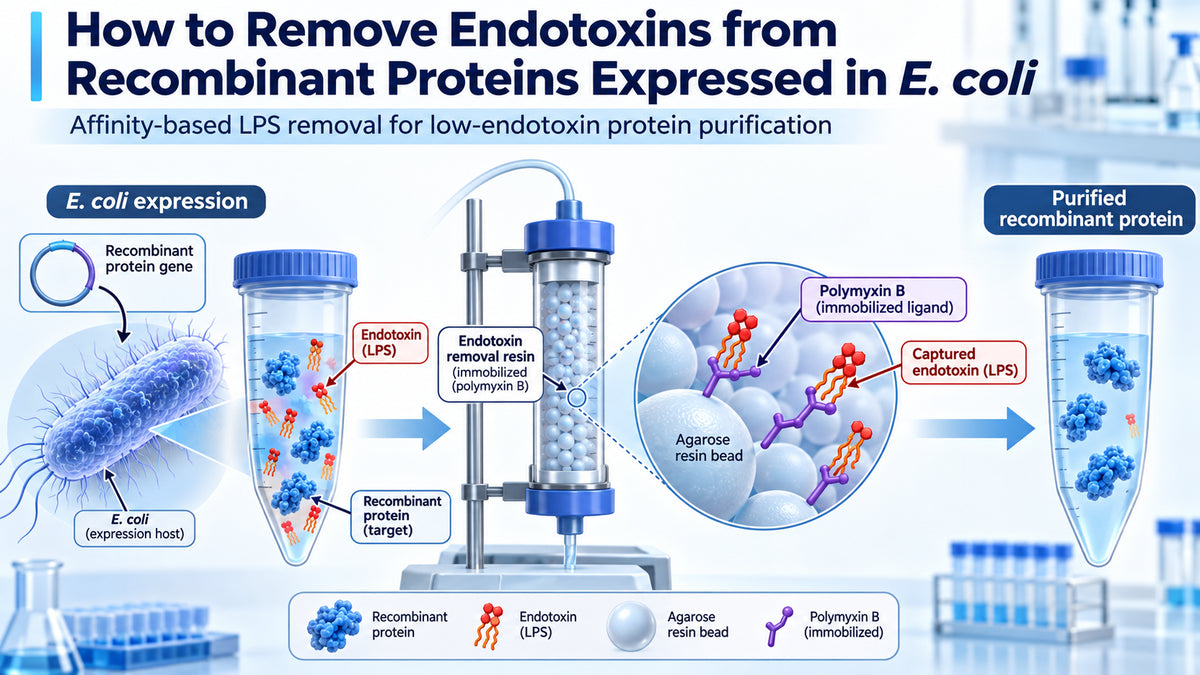
Recombinant proteins expressed in Escherichia coli frequently contain bacterial endotoxins that can interfere with downstream biological experiments. These contaminants, primarily lipopolysaccharides (LPS) from the bacterial outer membrane, may remain associated with proteins after conventional purification. Effective endotoxin removal is particularly important for recombinant proteins intended for cell culture, immune signaling studies, and other endotoxin-sensitive applications. Several techniques, including affinity adsorption, ion exchange chromatography, and detergent-based extraction, can reduce endotoxin contamination. This article examines the sources of endotoxin in E. coli-expressed proteins, compares commonly used removal strategies, and explains how endotoxin removal resin can be integrated into protein purification workflows while maintaining protein recovery and biological activity.
1. Introduction
Escherichia coli is one of the most widely used expression systems for producing recombinant proteins in biotechnology and life science research.
Its rapid growth, well-characterized genetics, and relatively economical cultivation make it suitable for producing enzymes, cytokines, growth factors, antigens, and other recombinant proteins.
However, one major challenge associated with bacterial expression systems is endotoxin contamination.
Endotoxins are lipopolysaccharides naturally present in the outer membrane of Gram-negative bacteria, including E. coli.
During bacterial cell disruption and protein extraction, LPS molecules can enter the soluble protein fraction and remain present throughout subsequent purification steps.
Even highly purified recombinant proteins may therefore contain residual endotoxins.
This contamination is particularly concerning when proteins are used in cell-based experiments, immunological research, or applications requiring tightly controlled endotoxin levels.
Consequently, endotoxin removal is often an important additional step in recombinant protein purification.
2. Why Are E. coli-Expressed Proteins Susceptible to Endotoxin Contamination?
2.1 LPS Is a Natural Component of the Bacterial Outer Membrane
The outer membrane of E. coli contains substantial amounts of lipopolysaccharide.
A typical LPS molecule consists of three structural regions:
Lipid A: The lipid-containing region responsible for much of the molecule's endotoxic activity.
Core oligosaccharide: A carbohydrate region connecting lipid A to the outer polysaccharide.
O-antigen: A variable polysaccharide component present in many LPS structures.
During recombinant protein production, endotoxins may be released through bacterial growth, cell damage, harvesting, and cell disruption.
Mechanical homogenization, sonication, or chemical lysis can expose the target protein to released LPS.
As a result, endotoxin contamination may begin early in the protein purification process.
2.2 Endotoxins Can Associate with Recombinant Proteins
Removing LPS is more complicated than removing many conventional protein impurities.
Endotoxins are amphiphilic molecules with both hydrophobic and hydrophilic structural regions.
They can form aggregates and interact with recombinant proteins through electrostatic and hydrophobic interactions.
Some proteins, particularly those with hydrophobic regions or favorable surface-charge characteristics, may associate strongly with LPS.
These interactions can make endotoxin separation difficult and may reduce the effectiveness of conventional purification methods.
2.3 Conventional Protein Purification May Not Remove All Endotoxins
Recombinant proteins are commonly purified using techniques such as:
Immobilized metal affinity chromatography (IMAC)
Ion exchange chromatography (IEX)
Size-exclusion chromatography (SEC)
Hydrophobic interaction chromatography (HIC)
Although these techniques can improve protein purity, their ability to remove endotoxins depends on the specific separation mechanism and operating conditions.
For example, Ni-NTA affinity chromatography selectively captures histidine-tagged proteins but does not inherently guarantee endotoxin removal.
Residual LPS may remain associated with the purified protein or co-purify under certain conditions.
Therefore, an additional endotoxin removal step may be necessary.
3. Why Is Endotoxin Removal Important for Recombinant Protein Research?
3.1 Preventing Unintended Immune Activation
LPS can stimulate innate immune responses through the Toll-like receptor 4 (TLR4) signaling pathway.
This activation may promote the production of inflammatory mediators, including TNF-α, IL-6, and IL-1β.
When recombinant proteins are used to study immune responses, residual endotoxin can produce biological effects unrelated to the target protein.
For example, a recombinant protein preparation may appear to stimulate macrophage activation when the observed effect is partially or primarily caused by contaminating LPS.
3.2 Improving Experimental Reproducibility
Endotoxin concentrations may vary between recombinant protein batches.
Such differences can influence cellular responses and introduce variability into experimental results.
Controlling endotoxin contamination helps researchers distinguish the biological activity of the target protein from endotoxin-induced effects.
This is especially important in cytokine research, receptor signaling experiments, and studies involving primary immune cells.
3.3 Supporting Downstream Biological Applications
Low-endotoxin recombinant protein preparations may be important for:
Cell culture and functional assays
Immune-cell activation studies
Cytokine signaling research
Receptor–ligand interaction studies
Preclinical research requiring endotoxin-controlled materials
The acceptable endotoxin concentration depends on the intended application.
There is no universal endotoxin limit that applies to every research-grade recombinant protein.
4. Common Methods for Removing Endotoxins from Recombinant Proteins
Several approaches are available for reducing LPS contamination in recombinant protein preparations.
The most appropriate technique depends on the characteristics of the target protein, the initial endotoxin concentration, and the required purity.
4.1 Affinity-Based Endotoxin Removal Resin
Affinity adsorption is a commonly used strategy for capturing endotoxins from compatible protein solutions.
These resins incorporate immobilized ligands capable of interacting with LPS molecules.
For example, Polymyxin B-based affinity resins use the endotoxin-binding properties of Polymyxin B to capture bacterial lipopolysaccharides.
The process generally involves:
Preparing the contaminated protein solution.
Equilibrating the endotoxin removal resin.
Applying the protein solution under suitable binding conditions.
Allowing endotoxins to interact with the immobilized ligand.
Recovering the endotoxin-reduced protein fraction.
Affinity resins can be evaluated as a polishing step after primary protein purification.
However, protein recovery and endotoxin clearance must be verified for the individual preparation.
4.2 Ion Exchange Chromatography
Ion exchange chromatography separates molecules according to their interactions with charged stationary phases.
Because LPS contains negatively charged groups, it may interact strongly with anion exchange materials under suitable conditions.
This property can be exploited to separate endotoxins from certain recombinant proteins.
The effectiveness of ion exchange depends on the target protein's charge characteristics, buffer pH, ionic strength, and protein–endotoxin interactions.
Anion exchange is not universally suitable for all recombinant proteins, particularly when the target and endotoxin exhibit similar binding behavior.
4.3 Detergent-Based Endotoxin Removal
Detergent-based methods use the amphiphilic characteristics of LPS to facilitate separation.
Triton X-114 phase separation is one example investigated for removing endotoxins from recombinant protein solutions.
This method can reduce endotoxin contamination in compatible systems.
However, detergent exposure may affect protein stability, and residual detergent must be adequately removed when it is incompatible with the intended downstream application.
Protein recovery and detergent clearance should therefore be assessed.
4.4 Ultrafiltration and Diafiltration
Ultrafiltration and diafiltration can assist with buffer exchange, concentration, and the removal of certain process-related impurities.
However, endotoxin removal through membrane-based separation is complicated by LPS aggregation and protein–endotoxin associations.
Depending on aggregate size and membrane characteristics, endotoxins may be retained together with the target protein.
Consequently, conventional ultrafiltration should not be assumed to provide effective endotoxin clearance without supporting experimental evidence.
5. Using Polymyxin B Agarose Resin for E. coli Recombinant Proteins
Polymyxin B affinity resin offers an adsorption-based strategy for reducing residual endotoxins after conventional protein purification.
5.1 How Polymyxin B Captures LPS
Polymyxin B is a cationic cyclic polypeptide that can interact with lipid A, a major structural region of bacterial lipopolysaccharide.
The binding mechanism involves electrostatic interactions between positively charged groups on Polymyxin B and negatively charged phosphate groups on LPS, together with hydrophobic interactions.
In an affinity resin, Polymyxin B-based ligands are immobilized onto a solid support.
When an endotoxin-containing protein solution contacts the resin, accessible LPS molecules can bind to the immobilized ligands.
Under appropriate conditions, the target recombinant protein remains primarily in the liquid phase and can be recovered.
5.2 Features of High-Efficiency Endotoxin Removal Resin
FireGene High-Efficiency Endotoxin Removal Purification Resin uses modified Polymyxin B immobilized on 4% agarose microspheres.
Its listed specifications include:
|
Parameter |
Specification |
|
Matrix |
4% agarose microspheres |
|
Affinity ligand |
Modified Polymyxin B |
|
Bead size |
45–165 μm |
|
Endotoxin-binding capacity |
>2,000,000 EU/mL resin |
|
Operating pH |
5–10 |
|
Maximum pressure |
0.1 MPa (1 bar) |
|
Storage temperature |
2–8°C |
The manufacturer reports endotoxin removal of up to 99% and protein recovery of up to 90% under suitable conditions.
These values describe reported performance and should not be interpreted as guaranteed results for every recombinant protein.
Actual outcomes depend on protein characteristics, endotoxin loading, buffer conditions, contact time, and sample compatibility.
6. Step-by-Step Workflow for Endotoxin Removal from E. coli-Expressed Proteins
A practical endotoxin removal workflow should be integrated with the existing recombinant protein purification procedure.
Step 1: Complete Primary Protein Purification
Begin with a recombinant protein preparation purified using an appropriate method, such as Ni-NTA affinity chromatography.
Remove insoluble material and assess the sample for visible precipitation or aggregation.
Measure the protein concentration and evaluate purity using suitable analytical methods.
Step 2: Measure Initial Endotoxin Contamination
Determine the starting endotoxin concentration using an appropriate bacterial endotoxins test.
Calculate the total endotoxin burden from the measured concentration and sample volume.
Where appropriate, express endotoxin content in EU/mg protein to facilitate comparisons between preparations with different protein concentrations.
Step 3: Prepare the Endotoxin Removal Resin
Prepare the affinity resin according to the manufacturer's current instructions.
Remove the storage solution and perform any required regeneration and equilibration steps.
Use compatible endotoxin-controlled buffers and suitable laboratory consumables.
Avoid introducing additional endotoxin during preparation.
Step 4: Apply the Recombinant Protein Sample
Introduce the sample to the equilibrated resin using the recommended processing format.
Maintain suitable loading conditions and sufficient contact time for endotoxin adsorption.
The resin volume and flow rate should be selected according to the sample's endotoxin burden and the manufacturer's recommendations.
Step 5: Collect the Endotoxin-Reduced Protein
Recover the product-containing fraction using appropriate low-endotoxin collection tubes.
Monitor protein recovery and evaluate whether additional processing affects protein stability.
When collecting multiple fractions, measure their protein content before pooling.
Step 6: Verify Endotoxin Removal
Measure the residual endotoxin concentration after resin treatment.
Calculate endotoxin removal efficiency using total endotoxin amounts before and after purification.
Endotoxin Removal (%) = [(Initial Total Endotoxin − Final Total Endotoxin) / Initial Total Endotoxin] × 100
Also calculate protein recovery:
Protein Recovery (%) = (Recovered Protein Mass / Initial Protein Mass) × 100
These two measurements provide complementary information about purification performance.
Note: This is a general workflow, not a substitute for the manufacturer's product-specific instructions for use.
7. Factors Affecting Endotoxin Removal Efficiency
7.1 Protein–Endotoxin Interactions
Some recombinant proteins associate strongly with LPS, which can reduce the accessibility of endotoxin molecules to affinity ligands.
Such interactions may depend on protein charge, hydrophobicity, and conformation.
When endotoxin removal is inefficient, the relationship between the protein and LPS should be considered.
7.2 Buffer pH and Ionic Strength
Buffer composition influences electrostatic and hydrophobic interactions during endotoxin removal.
Changing pH or salt concentration may improve endotoxin adsorption or reduce nonspecific protein binding.
However, such adjustments should remain compatible with the target protein and resin.
7.3 Resin Capacity and Contact Time
Insufficient resin capacity may result in endotoxin breakthrough.
Similarly, inadequate contact time can prevent sufficient interaction between LPS molecules and the affinity ligands.
Resin volume and sample flow rate should be optimized according to the purification requirements.
7.4 Protein Recovery and Stability
A successful endotoxin removal process must preserve the quality of the target recombinant protein.
Potential problems include nonspecific adsorption, aggregation, and loss of biological activity.
Protein concentration, structural integrity, and functional performance should be evaluated when relevant to the intended application.
8. How to Verify Endotoxin Removal
Reliable endotoxin testing is essential for determining whether a purification step has achieved its intended objective.
8.1 Common Endotoxin Detection Methods
Common analytical methods include:
LAL gel-clot assays
Kinetic chromogenic LAL assays
Kinetic turbidimetric LAL assays
Suitable recombinant Factor C assays
The selected method should be appropriate for the sample and its intended use.
8.2 Understanding Endotoxin Units
Endotoxin results are commonly reported as EU/mL or EU/mg protein.
EU/mL expresses endotoxin activity relative to sample volume.
EU/mg protein expresses measured endotoxin activity relative to the amount of protein.
For example, if a solution contains 0.5 EU/mL and 1 mg/mL protein, its endotoxin content is 0.5 EU/mg protein.
Both measurements can be useful for evaluating recombinant protein preparations.
8.3 Avoiding Analytical Interference
Protein samples may contain components that interfere with bacterial endotoxins tests.
Potential sources of interference include unfavorable pH, detergents, chelating agents, high ionic strength, and other matrix components.
Appropriate positive product controls and inhibition/enhancement testing help verify assay suitability.
A low measured endotoxin concentration should not be interpreted as successful removal unless analytical interference has been adequately evaluated.
9. Frequently Asked Questions
Q1. Can Ni-NTA purification remove endotoxins from E. coli proteins?
Ni-NTA chromatography can reduce certain impurities, but it is not specifically designed for endotoxin removal. Residual LPS may remain in purified protein fractions. Endotoxin testing is necessary to determine whether further treatment is required.
Q2. What is the best method for removing endotoxins from recombinant proteins?
There is no universally optimal method. Affinity adsorption, ion exchange chromatography, and detergent-based approaches have different strengths and limitations. Method selection depends on the target protein, initial endotoxin burden, required clearance, and acceptable protein recovery.
Q3. Does Polymyxin B resin affect recombinant protein activity?
The resin is designed to capture endotoxins, but some proteins may interact nonspecifically with the affinity material. Recovery, stability, and biological activity should be evaluated after purification.
Q4. Can recombinant proteins become contaminated again after endotoxin removal?
Yes. Endotoxin may be introduced through contaminated buffers, laboratory consumables, processing equipment, or sample handling. Appropriate contamination-control practices are important throughout the workflow.
Q5. How low should endotoxin levels be for recombinant protein research?
The acceptable endotoxin level depends on the experiment. Immune-cell assays and other highly sensitive applications may require particularly low endotoxin burdens. Researchers should establish application-specific acceptance criteria rather than relying on a universal threshold.
10. Conclusion
Endotoxin contamination is a major consideration when producing recombinant proteins using E. coli expression systems.
Because bacterial lipopolysaccharides can remain associated with proteins after conventional purification, additional endotoxin removal may be necessary for sensitive downstream applications.
Affinity-based endotoxin removal resin provides one strategy for reducing LPS contamination while recovering compatible recombinant proteins.
However, successful purification requires careful consideration of resin capacity, sample composition, contact time, protein–endotoxin interactions, and protein stability.
Most importantly, endotoxin removal must be verified using a suitable analytical method.
For researchers preparing recombinant proteins for cell-based experiments and other endotoxin-sensitive applications, FireGene High-Efficiency Endotoxin Removal Purification Resin offers a modified Polymyxin B-based affinity approach that can be evaluated as part of an optimized purification workflow.


