
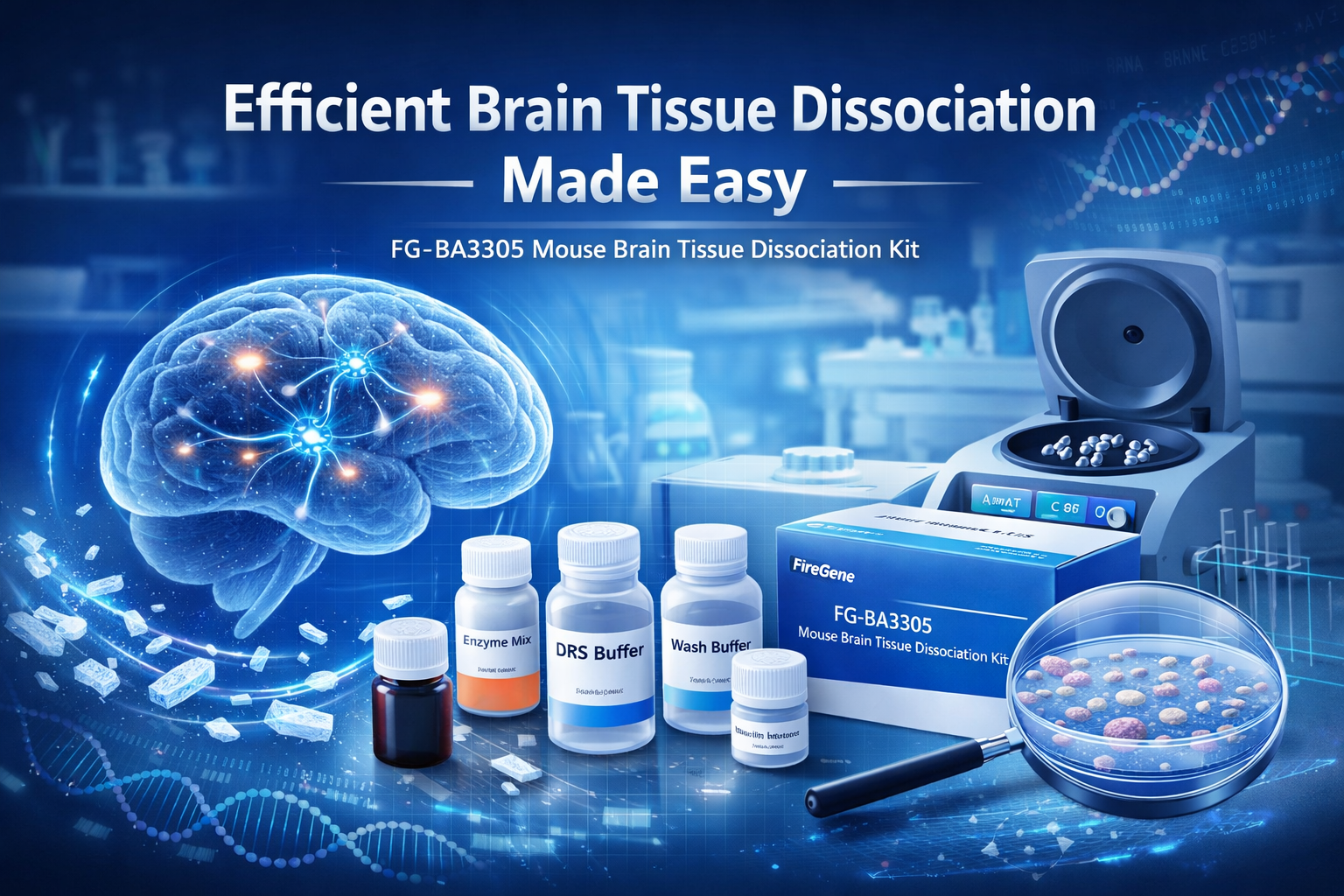
Dissociation of mouse brain tissue is often the first major challenge in neuroscience research. Neurons are highly delicate, and their myelin sheaths are easily fragmented during conventional dissociation procedures. Traditional methods frequently result in low cell viability, excessive fragmentation, and complicated workflows that compromise the quality of downstream analyses.
The FG-BA3305 Mouse Brain Tissue Dissociation Kit from FireGene is specifically designed to address these challenges. Featuring a gentle enzymatic digestion system combined with a dedicated debris removal solution, the kit enables rapid preparation of high-purity single-cell suspensions while preserving neuronal integrity and viability. The resulting cell suspensions are ideal for a wide range of downstream applications, including single-cell RNA sequencing (scRNA-seq) and other advanced neuroscience studies.
By simplifying the dissociation workflow and improving sample quality, the FG-BA3305 Mouse Brain Tissue Dissociation Kit provides a reliable and efficient solution for mouse brain tissue preparation in modern brain research. Researchers working with neural samples can benefit from the optimized protocol and consistent performance offered by FireGene products.

Addressing the Pain Points | Brain Dissection Always Fails? The Root Cause Lies Here
Brain tissue is intricate and unique, presenting significant challenges for dissection: neurons are fragile and easily damaged, becoming inactive if not properly digested with enzymes; myelin sheath dissection generates numerous fragments, interfering with downstream detection; the proportion of target cells is low, making them prone to loss using traditional methods.
Difficulty in controlling digestion time, susceptibility to errors in centrifugation parameters, and the lack of a dedicated defrauding protocol directly lead to high experimental reproducibility and inaccurate results, becoming a core obstacle in brain science research.
Breakthrough Solution | BA3305: The Ultimate Tool for Brain Dissociation
Targeting the pain points of mouse brain tissue dissociation, the BA3305 reagent kit was specifically developed and comprehensively optimized, offering five core advantages for more efficient and stable brain dissociation.
1. Gentle Enzymatic Digestion: Customized compound enzymes precisely break down the matrix without damaging live cells, resulting in highly active suspensions with minimal clumping.
2. Rapid Dissociation: Enzymatic digestion is completed in 20-30 minutes, significantly shortening experimental time and reducing in vitro cell exposure.
3. Dedicated Debriding: Equipped with DRS buffer, gradient centrifugation efficiently separates fragments, improving suspension purity.
4. Sterile and Ready to Use: All components are aseptically prepared, requiring no additional sterilization; ready to use immediately, reducing the risk of contamination.
5. Wide Applicability: The prepared suspension can be directly used for single-cell sequencing, cell culture, and other experiments, meeting all research needs in one stop.
Essential Guidelines | Components and Storage: Details Determine Success or Failure
BA3305 is a 10-reaction pack containing 4 core components. Different components require different storage conditions; strictly adhering to these conditions is crucial to ensuring reagent activity and preventing experimental failure.

Core Storage Points
• Store components at -20℃. Avoid repeated freeze-thaw cycles. It is recommended to aliquot only as needed.
• Components stored at 4℃ away from light should not be frozen. Use as soon as possible after opening.
• Mix all components thoroughly before use to ensure uniform concentration.
Pitfall Avoidance Tips | Remember These Key Points to Avoid Detours
Success in brain cell dissociation hinges on details.
Avoiding the following pitfalls will double your experimental success rate:
1. Always use a horizontal centrifuge. During the decomposition step, adjust the acceleration and deceleration to center the centrifuge; otherwise, it will disrupt the liquid layer and affect the decomposition effect.
2. Maintain aseptic technique throughout the entire process. Use a laminar flow hood, lab coat, and disposable gloves to prevent microbial contamination.
3. Handle gently. Mix reagents gently and avoid vigorous mixing. Do not vortex when using DRS to prevent cell rupture and clumping.
4. Strictly control the lysis time. Perform the lysis on ice for 5 minutes to avoid excessive lysis and damage to brain cells.
5. Prioritize fresh tissue. If immediate experimentation is not possible, use BA3301 preservation solution to ensure tissue viability.
5. Perform experiments immediately after quality control to minimize in vitro cell placement and maintain high cell suspension activity.
The core of brain dissociation lies in balancing efficient dissociation with cell protection. The FG-BA3305 mouse brain tissue dissociation kit, with its customized design, simple operation, and stable results, solves the challenges of preparing brain science samples. Firegene, adhering to the philosophy of "technology creates value and serves human health," is deeply committed to the research and development of biological reagents, using professional products to safeguard scientific research.
FireGene, light your research with passion, innovation, and profession.


