
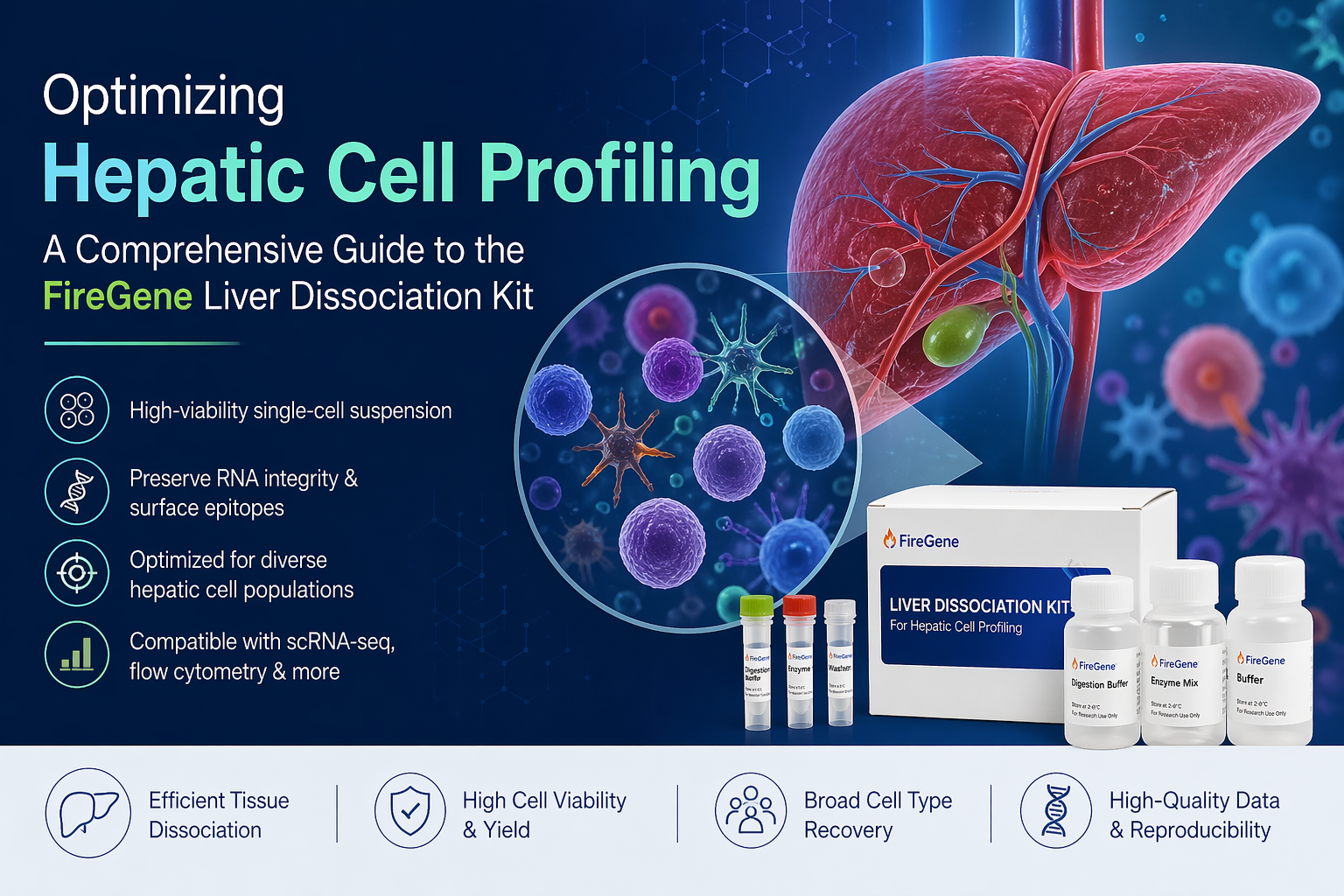
Introduction: Why Liver Tissue Dissociation Matters in Modern Hepatic Research
The liver is one of the most structurally and functionally complex organs in the human body, composed of a diverse array of parenchymal and non-parenchymal cell types, including hepatocytes, Kupffer cells, hepatic stellate cells, and liver sinusoidal endothelial cells. This cellular heterogeneity underpins the liver’s critical roles in metabolism, detoxification, and immune regulation. As a result, accurately profiling these distinct cell populations has become essential in advancing hepatic research.
In recent years, the rapid adoption of single-cell technologies, such as single-cell RNA sequencing (scRNA-seq) and high-dimensional flow cytometry, has transformed how researchers study liver biology and disease. These approaches enable high-resolution analysis of cellular diversity, functional states, and intercellular interactions. However, the success of these downstream applications is highly dependent on the quality of the initial sample preparation—particularly the ability to generate a viable, representative single-cell suspension from liver tissue.
Liver tissue dissociation presents unique challenges due to its dense extracellular matrix and intricate sinusoidal architecture. Inefficient or overly harsh dissociation methods can compromise cell viability, alter gene expression profiles, or lead to the loss of sensitive cell populations. Consequently, there is a growing need for optimized liver dissociation kits that can reliably preserve cellular integrity.
The FireGene Liver Dissociation Kit for Hepatic Cell Profiling is designed to address these challenges, offering a specialized approach to support high-quality single-cell liver analysis.
Challenges in Liver Tissue Dissociation and Their Impact on Data Quality
Liver tissue dissociation remains a technically demanding step in hepatic research due to the organ’s intricate architecture and biochemical composition. The liver is characterized by a dense extracellular matrix (ECM), tight cell–cell junctions, and a highly organized sinusoidal network. These structural features make it difficult to efficiently separate individual cells without compromising their viability or function.
One of the primary challenges is achieving a balance between sufficient tissue digestion and cell preservation. Inadequate dissociation often results in incomplete tissue breakdown, leading to cell clumping and reduced single-cell capture efficiency in downstream workflows. Conversely, overly aggressive enzymatic or mechanical processing can damage cell membranes, reduce viability, and trigger stress-induced transcriptional changes that distort biological interpretation.
Another critical issue is the selective loss of fragile or rare cell populations, such as hepatocytes and liver sinusoidal endothelial cells (LSECs). These cells are particularly sensitive to enzymatic conditions and mechanical stress, and their loss can introduce bias into datasets, ultimately affecting the accuracy of hepatic cell profiling.
These dissociation-related limitations directly impact downstream applications, including single-cell RNA sequencing, flow cytometry, and primary cell culture. Poor sample quality can lead to low sequencing depth, increased background noise, and unreliable identification of cell subtypes.
Given these challenges, the use of optimized, liver-specific dissociation strategies is essential to ensure reproducibility and high-quality data in modern hepatic research.
FireGene Liver Dissociation Kit: Mechanism and Technical Advantages
The FireGene Liver Dissociation Kit is engineered to address the specific challenges associated with hepatic tissue processing by combining a tissue-optimized enzymatic system with a controlled dissociation workflow. Unlike generic dissociation solutions, this kit is tailored to effectively degrade the liver’s extracellular matrix while preserving the integrity of diverse cell populations. The enzyme cocktail is carefully formulated to target key matrix components, enabling efficient tissue breakdown without excessive cellular damage.
A central advantage of the FireGene system lies in its ability to maintain high cell viability and yield, which are critical parameters for downstream single-cell applications. By minimizing harsh mechanical disruption and optimizing digestion kinetics, the protocol reduces the risk of membrane damage and apoptosis. This is particularly important for sensitive liver cell types, ensuring that hepatocytes, Kupffer cells, and endothelial cells remain intact and functionally representative.
In addition, the kit is designed to preserve surface epitopes and RNA quality, supporting compatibility with workflows such as single-cell RNA sequencing, flow cytometry, and cell sorting. Reduced dissociation-induced stress responses further enhance data reliability by limiting artificial transcriptional alterations during sample preparation.
Another key benefit is workflow consistency, which improves reproducibility across experiments and sample types. Standardized reagents and protocols help reduce operator-dependent variability, a common issue in manual dissociation methods.
Overall, the FireGene Liver Dissociation Kit provides a technically robust solution for generating high-quality single-cell suspensions, making it well-suited for advanced hepatic cell profiling applications.
Applications in Hepatic Cell Profiling and Disease Research
High-quality liver dissociation is foundational for accurately interrogating hepatic biology across a wide range of research areas. With the ability to generate viable and representative single-cell suspensions, tools like the FireGene Liver Dissociation Kit enable deeper insights into cellular heterogeneity and functional dynamics within the liver.
In liver cancer research, single-cell approaches are widely used to dissect the tumor microenvironment, revealing interactions between malignant hepatocytes, immune infiltrates, and stromal components. Reliable dissociation is essential for preserving these diverse populations, allowing researchers to identify tumor-specific signatures and potential therapeutic targets. Similarly, in studies of fibrosis and non-alcoholic steatohepatitis (NASH), capturing activated hepatic stellate cells and inflammatory cell subsets is critical for understanding disease progression and tissue remodeling.
The kit also supports applications in liver immunology, where profiling Kupffer cells, monocyte-derived macrophages, and lymphocyte populations can uncover mechanisms of immune regulation and inflammation. Maintaining the integrity of these immune cells is particularly important for downstream analyses such as flow cytometry and single-cell sequencing.
Beyond disease-focused studies, efficient liver dissociation facilitates biomarker discovery, drug screening, and toxicity assessment, all of which rely on accurate representation of hepatic cell types. By enabling consistent recovery of hepatocytes, endothelial cells, and other non-parenchymal cells, researchers can generate more reliable datasets for translational research.
Overall, advanced dissociation solutions play a central role in unlocking the full potential of single-cell liver research and precision medicine initiatives.
Best Practices and Future Perspectives in Liver Single-Cell Preparation
Achieving high-quality single-cell suspensions from liver tissue requires not only optimized reagents but also careful attention to experimental parameters and handling techniques. Key factors such as digestion time, enzyme concentration, and temperature must be precisely controlled to balance efficient tissue dissociation with cell preservation. Over-digestion can compromise membrane integrity and RNA quality, while insufficient digestion may lead to cell aggregation and reduced capture efficiency in single-cell workflows.
Minimizing mechanical stress during processing is equally important. Gentle pipetting, appropriate filtration, and timely neutralization of enzymatic activity help maintain cell viability and prevent the loss of fragile populations. In addition, rapid processing following tissue collection is critical to preserve transcriptomic fidelity, as prolonged handling can introduce stress-related gene expression artifacts.
Standardization is another essential consideration. Using well-validated, tissue-specific kits enhances reproducibility across experiments and operators, reducing variability that can confound downstream data analysis. This is particularly important in large-scale studies and multi-sample comparisons, where consistency in sample preparation directly impacts data reliability.
Looking ahead, liver dissociation workflows are increasingly being integrated with emerging technologies, including spatial transcriptomics and multi-omics platforms. These approaches demand even higher standards of sample integrity, as they aim to link cellular identity with spatial and functional context. As a result, advanced dissociation solutions—such as the FireGene Liver Dissociation Kit—are expected to play a pivotal role in supporting next-generation hepatic research and enabling more precise, systems-level insights into liver biology.
FireGene, light your research with passion, innovation, and profession.
FireGene Single-Cell Sample Prep
Looking for validated dissociation kits?
FireGene's tissue dissociation kits are optimized for specific organ types — brain, tumor, liver, GI, reproductive, and more. Validated for 10x Genomics Chromium and BD Rhapsody workflows.


