
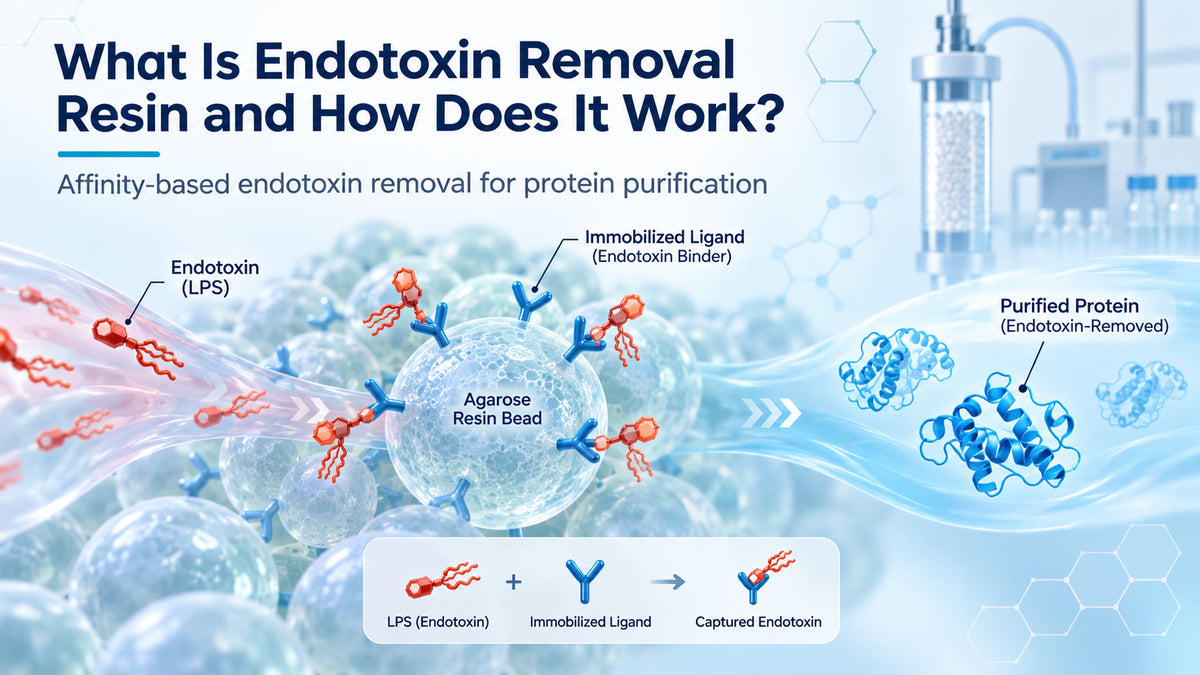
Endotoxin contamination is a common challenge in recombinant protein purification, antibody preparation, and biological research. Bacterial endotoxins, primarily lipopolysaccharides (LPS) derived from Gram-negative bacteria, can interfere with experimental results by triggering inflammatory and immune responses. Endotoxin removal resin provides an affinity-based approach for reducing LPS contamination while preserving valuable biomolecules. By immobilizing endotoxin-binding ligands, such as modified Polymyxin B, onto a solid support, these resins selectively capture endotoxins from compatible sample solutions. This article explains the fundamental principles of endotoxin removal resin, its adsorption mechanism, key performance factors, purification workflow, and applications in life science research.
1. What Is Endotoxin Removal Resin?
Endotoxin removal resin is a specialized purification material designed to capture and reduce bacterial endotoxins in biological samples.
Endotoxins are primarily lipopolysaccharides (LPS), major structural components of the outer membrane of Gram-negative bacteria. They can enter biological preparations through bacterial expression systems, contaminated water, raw materials, or laboratory equipment.
Unlike conventional protein impurities, endotoxins can remain present even after standard chromatographic purification.
This is particularly problematic when purified proteins are subsequently used in cell culture, immunological assays, or other endotoxin-sensitive experiments.
Endotoxin removal resin addresses this challenge by introducing a dedicated affinity adsorption step.
The resin typically consists of two functional components:
Solid support matrix: A porous material, such as agarose, that provides a framework for immobilizing affinity ligands.
Endotoxin-binding ligand: A functional molecule capable of interacting with bacterial LPS.
When a contaminated sample contacts the resin, endotoxin molecules bind to the immobilized ligand. Under suitable conditions, much of the target protein remains in solution and can be recovered with a lower endotoxin burden.
2. Why Is Endotoxin Removal Important?
Endotoxin contamination can significantly affect the reliability of biological experiments, even when the target protein appears highly purified.
2.1 Activation of Immune Responses
LPS is recognized by the innate immune system, particularly through signaling involving Toll-like receptor 4 (TLR4) and associated recognition proteins.
This interaction can activate intracellular signaling pathways and stimulate the production of inflammatory mediators, including TNF-α, IL-6, and IL-1β.
Consequently, endotoxin contamination may produce biological responses unrelated to the intended function of an experimental protein.
2.2 Interference with Cell-Based Assays
In cell culture experiments, endotoxin contamination may alter gene expression, cytokine secretion, cellular activation, and other biological responses.
For example, an investigator studying a recombinant cytokine might observe increased inflammatory signaling. Without endotoxin testing, it may be difficult to determine whether the response originates from the recombinant protein, contaminating LPS, or both.
Reducing endotoxin contamination can therefore improve the interpretability and reproducibility of experimental results.
2.3 Challenges in Recombinant Protein Production
Proteins expressed in Escherichia coli are particularly susceptible to endotoxin contamination because LPS is naturally associated with the bacterial outer membrane.
Cell disruption during protein extraction releases bacterial components into the preparation.
Although affinity chromatography, ion exchange, and size-exclusion chromatography can remove many protein-related impurities, they do not necessarily eliminate endotoxins to the level required for sensitive downstream applications.
An additional endotoxin removal step may therefore be necessary.
3. How Does Endotoxin Removal Resin Work?
The primary mechanism of many endotoxin removal resins is selective affinity adsorption.
Rather than separating molecules only according to their size or molecular weight, affinity-based materials exploit interactions between endotoxin molecules and immobilized binding ligands.
3.1 Understanding LPS Structure
A typical lipopolysaccharide molecule contains three major structural regions:
Lipid A: A hydrophobic, lipid-containing region responsible for much of the endotoxic activity.
Core oligosaccharide: A carbohydrate region connecting lipid A to the outer polysaccharide.
O-antigen: A variable polysaccharide region extending outward from the bacterial surface.
The amphiphilic structure of LPS contributes to its ability to associate with proteins, membranes, and other biological molecules.
LPS can also form aggregates, which complicates its purification behavior.
3.2 Polymyxin B-Based Affinity Adsorption
Polymyxin B is a cationic cyclic polypeptide that can bind to the lipid A region of many LPS molecules.
Its interaction with endotoxin involves electrostatic attraction between positively charged groups on Polymyxin B and negatively charged phosphate groups on LPS, together with hydrophobic interactions.
In endotoxin removal resin, modified Polymyxin B is immobilized onto a solid matrix.
This configuration allows the ligand to capture endotoxins while limiting the need to introduce soluble Polymyxin B into the purified sample.
The process can be summarized as follows:
Endotoxin-contaminated sample → Contact with affinity resin → LPS adsorption → Separation of resin → Recovery of endotoxin-reduced sample
The effectiveness of this process depends on the molecular characteristics of the sample and the operating conditions.
3.3 Role of the Agarose Matrix
Agarose is commonly used as a chromatographic support because of its hydrophilic characteristics, porous structure, and compatibility with many aqueous biological buffers.
Agarose microspheres provide surface area for immobilized affinity ligands and can be incorporated into packed-column or other compatible purification formats.
The matrix also permits the separation of bound endotoxins from the liquid sample.
However, the structural properties of the resin influence its allowable flow rate, pressure, and mechanical stability.
4. Key Features of High-Efficiency Endotoxin Removal Purification Resin
High-efficiency endotoxin removal resins are designed to combine substantial endotoxin-binding capacity with acceptable recovery of the target biomolecule.
An example is FireGene's High-Efficiency Endotoxin Removal Purification Resin, which incorporates modified Polymyxin B immobilized on 4% agarose microspheres.
Its listed technical characteristics include:
|
Parameter |
Specification |
|
Affinity ligand |
Modified Polymyxin B |
|
Matrix |
4% agarose microspheres |
|
Bead size |
45–165 μm |
|
Endotoxin-binding capacity |
>2,000,000 EU/mL resin matrix |
|
Operating pH range |
5–10 |
|
Maximum operating pressure |
0.1 MPa (1 bar) |
|
Storage temperature |
2–8°C |
The manufacturer reports that endotoxin levels can be reduced to as low as 0.1 EU/mL under suitable conditions, with endotoxin removal of up to 99% and protein recovery of up to 90%.
These figures describe reported product performance rather than guaranteed results for every preparation.
The achievable endotoxin reduction and recovery depend on the sample composition, endotoxin loading, protein characteristics, and purification conditions.
5. General Workflow for Endotoxin Removal Using Affinity Resin
A typical endotoxin removal workflow includes sample preparation, resin conditioning, affinity adsorption, sample recovery, and analytical verification.
5.1 Step 1: Prepare the Sample
Begin with a clarified protein solution and determine its initial endotoxin concentration using an appropriate endotoxin assay.
Record the sample volume, protein concentration, buffer composition, and pH.
When necessary, remove insoluble particles or aggregates that could interfere with resin contact or column operation.
5.2 Step 2: Prepare and Equilibrate the Resin
Prepare the resin according to the manufacturer's instructions.
Depending on the product and whether the resin is new or previously used, conditioning or regeneration may be required before the purification step.
Remove the storage solution and equilibrate the resin with a compatible endotoxin-controlled buffer.
Use suitable water, containers, and consumables to minimize additional endotoxin contamination.
5.3 Step 3: Apply the Sample
Introduce the sample to the equilibrated resin using the recommended purification format.
During contact, endotoxin molecules interact with the immobilized affinity ligand.
Appropriate flow rate and contact time are important because insufficient interaction may reduce the amount of endotoxin captured.
Resin volume should be selected according to the initial endotoxin burden, binding capacity, sample volume, and intended reduction target.
5.4 Step 4: Recover the Purified Sample
Collect the endotoxin-reduced protein solution according to the manufacturer's recommended procedure.
In many affinity-capture workflows, the desired protein is recovered primarily in the flow-through and subsequent compatible buffer fractions, while a portion of the endotoxin remains associated with the resin.
Monitor protein concentration and recovery to identify potential losses caused by nonspecific adsorption.
5.5 Step 5: Verify Endotoxin Reduction
Measure endotoxin concentrations before and after treatment using a suitable analytical method, such as a Limulus amebocyte lysate (LAL) assay.
The endotoxin removal efficiency can be calculated as:
Endotoxin Removal (%) = [(Initial Endotoxin Amount − Final Endotoxin Amount) / Initial Endotoxin Amount] × 100
When sample volumes change during processing, total endotoxin amounts should be calculated from concentration multiplied by volume.
Protein recovery should also be measured independently to evaluate the overall purification performance.
Note: This workflow is a general explanation and does not replace the product-specific instructions for use.
6. Factors Affecting Endotoxin Removal Efficiency
Several variables determine how effectively a resin removes endotoxins from a biological sample.
6.1 Sample pH
Solution pH can affect the charge properties of the target protein, endotoxin interactions, and resin performance.
Although some resins operate across a relatively broad pH range, the optimal conditions should be determined for each sample.
6.2 Ionic Strength
Salt concentration influences electrostatic interactions among endotoxin molecules, resin ligands, and proteins.
Increasing ionic strength may reduce certain nonspecific interactions and improve protein recovery, but excessive salt can also alter endotoxin adsorption.
Buffer conditions should therefore be optimized rather than adjusted without validation.
6.3 Initial Endotoxin Concentration
Samples containing high endotoxin concentrations require sufficient binding capacity.
If the resin becomes overloaded, residual endotoxin can remain in the recovered preparation.
The initial endotoxin burden should be considered when selecting resin volume.
6.4 Contact Time and Flow Rate
Affinity adsorption requires adequate interaction between the sample and immobilized ligand.
Excessively rapid flow or insufficient incubation may compromise removal efficiency.
Operating conditions should remain within the manufacturer's recommended limits.
6.5 Protein–Endotoxin Interactions
Some proteins form strong associations with LPS, making endotoxin removal more challenging.
These interactions may depend on protein charge, hydrophobicity, conformation, and buffer composition.
Therefore, a resin that performs well with one recombinant protein may require different operating conditions for another.
7. Applications of Endotoxin Removal Resin
7.1 Recombinant Protein Purification
Endotoxin removal resin can be incorporated into purification workflows for compatible recombinant proteins expressed in Gram-negative bacterial systems.
Removing residual LPS is particularly important when the proteins will be used in immune-cell assays, receptor signaling studies, or other sensitive biological experiments.
7.2 Antibody and Fc-Fusion Protein Research
Antibodies and Fc-fusion proteins may require additional endotoxin control when intended for cell-based research.
Affinity endotoxin removal can serve as a polishing operation after conventional chromatographic purification, provided the target molecule is compatible with the resin.
7.3 Peptide and Biological Reagent Preparation
Selected peptides and protein-based reagents may also benefit from endotoxin removal before their use in functional experiments.
Suitability should be evaluated individually because molecular charge and hydrophobicity may influence adsorption and sample recovery.
7.4 Biopharmaceutical Process Development
Endotoxin removal resins are also relevant to research and development of purification strategies for biological products.
In this setting, researchers must consider endotoxin clearance, product recovery, resin compatibility, ligand leaching, and process reproducibility.
Use in GMP manufacturing requires additional material qualification and process validation; suitability for laboratory research does not establish suitability for clinical manufacturing.
8. Frequently Asked Questions
Q1. Can endotoxin removal resin completely eliminate endotoxins?
No resin can be assumed to remove all endotoxin from every sample. The final concentration depends on the starting contamination level, resin capacity, sample matrix, and process conditions. Endotoxin testing is necessary to verify the result.
Q2. Does endotoxin removal resin affect protein activity?
Affinity-based removal is intended to preserve the target biomolecule, but nonspecific adsorption or changes in buffer conditions may reduce recovery or affect activity. Protein concentration and functional activity should be evaluated after treatment.
Q3. Can endotoxin removal resin be reused?
Some products support regeneration and reuse under defined conditions. However, reuse may introduce cross-contamination risks or reduce performance. Follow the manufacturer's instructions and verify suitability for each application.
Q4. Is endotoxin removal resin the same as an endotoxin detection kit?
No. Endotoxin removal resin is used to reduce contamination, whereas endotoxin detection assays measure the endotoxin content of samples. Both technologies may be used together during sample preparation and quality assessment.
Q5. Can endotoxin removal resin remove endotoxins from plasmid DNA?
Compatibility depends on the specific resin chemistry. Some endotoxin removal technologies are developed for nucleic acids, but protein-oriented affinity resins are not automatically suitable for plasmid DNA purification. Product-specific compatibility must be confirmed before use.
9. Conclusion
Endotoxin removal resin provides a practical affinity-based strategy for reducing lipopolysaccharide contamination in compatible biological preparations.
By immobilizing endotoxin-binding ligands such as modified Polymyxin B on a solid matrix, these materials allow endotoxins to be captured and separated from valuable target molecules.
Successful purification depends not only on endotoxin-binding capacity but also on sample compatibility, pH, ionic strength, contact time, and protein recovery.
For researchers preparing recombinant proteins, antibodies, and other biological reagents, selecting a suitable endotoxin removal resin and verifying treatment performance can improve sample quality and experimental reliability.
Explore FireGene High-Efficiency Endotoxin Removal Purification Resin for more information on product specifications, compatibility, and applications in protein purification research.


