
In sterile pharmaceutical manufacturing, controlling microorganisms is only one part of contamination control. Components that come into contact with injectable products must also be appropriately controlled for bacterial endotoxins. This distinction is particularly important because a process capable of killing microorganisms does not necessarily eliminate endotoxin activity.
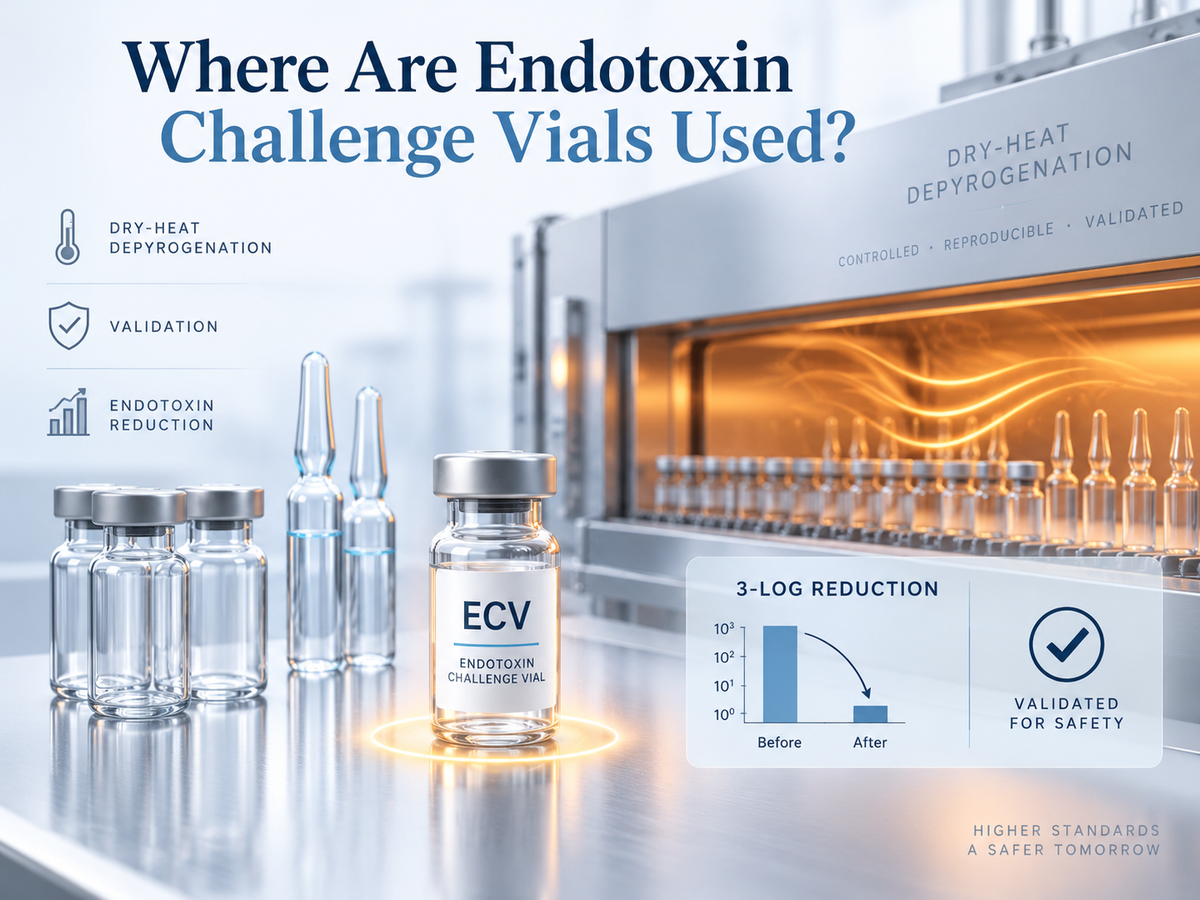
For this reason, Endotoxin Challenge Vials (ECVs) are widely used during the validation and qualification of dry-heat depyrogenation processes.
ECVs contain a defined endotoxin challenge and are exposed to a depyrogenation cycle together with the equipment or components being evaluated. By comparing endotoxin activity before and after processing, manufacturers can determine whether the cycle provides sufficient endotoxin destruction.
One of the most widely recognized targets for depyrogenation validation is a minimum 3-log reduction in endotoxin activity, representing at least a 99.9% reduction from the initial challenge. FDA guidance has historically discussed a 3-log endotoxin reduction when evaluating depyrogenation processes, while pharmaceutical industry guidance also recognizes demonstration of substantial endotoxin reduction as an important element of dry-heat process validation.
This article explains where ECVs are used, why they are important, and how they support pharmaceutical depyrogenation validation.
1. What Is an Endotoxin Challenge Vial?
An Endotoxin Challenge Vial is a validation tool containing a known quantity of bacterial endotoxin. It is designed to challenge the ability of a process to reduce or destroy endotoxin activity.
ECVs are particularly associated with dry-heat depyrogenation validation.
A simplified validation concept can be represented as:
Known Endotoxin Challenge → Dry-Heat Exposure → Endotoxin Recovery Testing → Log Reduction Calculation
Before processing, the initial endotoxin challenge is known or characterized. After exposure to the depyrogenation cycle, residual endotoxin activity is measured using an appropriate bacterial endotoxins testing approach.
The difference between the initial and recovered endotoxin levels indicates the effectiveness of the process.
For example:
Initial challenge: 10,000 EU
Residual activity: 10 EU
This represents a:
10,000 → 10 EU = 3-log reduction
The use of a defined challenge makes ECVs useful as quantitative validation tools rather than simple indicators that heating occurred.
2. Why Sterilization and Depyrogenation Are Different
One of the most important concepts in sterile manufacturing is the distinction between sterilization and depyrogenation.
Sterilization is primarily intended to destroy or remove viable microorganisms.
Depyrogenation focuses on reducing or eliminating pyrogenic substances, particularly bacterial endotoxins.
Endotoxins are lipopolysaccharide-associated materials originating from the outer membrane of Gram-negative bacteria. They can remain problematic even after the bacteria themselves are no longer viable.
Consequently:
Microbial Destruction ≠ Endotoxin Destruction

This distinction explains why conventional biological indicators used for sterilization studies cannot by themselves demonstrate effective endotoxin reduction.
For equipment intended to perform both sterilization and depyrogenation, manufacturers therefore need evidence that the process achieves the required thermal conditions and provides appropriate endotoxin reduction.
FDA materials have long emphasized that validation of endotoxin reduction should include knowledge of the endotoxin burden and an appropriate endotoxin challenge.
ECVs provide a practical way to generate this evidence.
3. Depyrogenation Validation of Glass Vials and Ampoules
One of the most important applications of ECVs is the validation of depyrogenation processes for primary packaging components.
Examples include:
pharmaceutical glass vials;
ampoules;
glass bottles;
cartridges;
heat-resistant containers;
certain stainless-steel utensils; and
other components that may contact sterile products.
Primary packaging materials can contribute microbial, particulate, or endotoxin contamination if they are not adequately controlled before filling.
Modern sterile-manufacturing principles therefore require manufacturers to consider endotoxin and pyrogen risks associated with packaging components. PDA discussions of sterile primary packaging similarly emphasize controlling endotoxin/pyrogen contamination and validating relevant processes.
Glass containers are particularly suitable for high-temperature dry-heat processing because they can tolerate conditions capable of substantially reducing endotoxin activity.
During validation, ECVs may be distributed throughout a representative load.
After the cycle:
ECV Placement → Dry-Heat Cycle → Recovery → Endotoxin Measurement → Log-Reduction Evaluation
The resulting data provide evidence that the validated process can achieve its predetermined depyrogenation acceptance criterion.
4. Validation of Dry-Heat Ovens
Dry-heat ovens are another major application area for ECVs.
These systems may be used to depyrogenate:
glassware;
laboratory utensils;
stainless-steel components;
filling-machine parts;
containers; and
other heat-resistant manufacturing materials.
Temperature alone does not fully demonstrate process effectiveness.
A temperature sensor can confirm that a particular position reached a defined temperature for a specified period. However, the sensor does not directly demonstrate how much endotoxin activity was destroyed.
This is where ECVs provide complementary information.
A comprehensive qualification study may therefore combine:
Temperature Mapping + Heat-Penetration Studies + Endotoxin Challenge Studies
Temperature measurements characterize thermal distribution, while ECV recovery data provide direct evidence of endotoxin reduction.
This combination helps connect the physical performance of the dry-heat system with its intended depyrogenation function.
5. Depyrogenation Tunnel Validation
Continuous depyrogenation tunnels are widely used in sterile pharmaceutical manufacturing to process glass containers before aseptic filling.
A typical tunnel may contain several functional zones:
Infeed → Heating Zone → High-Temperature Zone → Cooling Zone → Aseptic Filling Area

Glass containers move continuously through these zones on a conveyor.
Validation must demonstrate that containers receive sufficient heat exposure even under challenging operating conditions.
Important variables may include:
conveyor speed;
tunnel temperature;
airflow;
load density;
vial size;
container arrangement;
heating-zone residence time; and
equipment configuration.
ECVs can be placed within selected containers and passed through the tunnel under defined conditions.
After processing, the ECVs are tested for residual endotoxin activity.
The resulting data allow the validation team to determine whether the tunnel consistently provides the required level of depyrogenation.
6. Using ECVs at Cold Spots and Worst-Case Locations
ECV placement is an important component of meaningful validation.
Placing challenge vials only in easily heated areas would provide limited information about overall process capability.
Instead, validation studies commonly focus attention on cold spots or worst-case positions identified through thermal mapping and process-development studies.
A simplified sequence is:
Thermal Mapping → Identify Cold/Worst-Case Locations → Place ECVs → Run Cycle → Measure Endotoxin Reduction
For a batch oven, challenging positions may include areas with comparatively slow heating or unfavorable airflow.
For a tunnel, relevant variables may involve lateral vial position, conveyor location, container density, or operating speed.
The objective is to challenge locations that are most difficult to depyrogenate rather than simply demonstrating performance under ideal conditions.
If adequate endotoxin reduction is demonstrated at properly justified worst-case locations, the resulting study provides stronger evidence that the overall validated process is robust.
7. ECVs in IQ, OQ, and PQ
ECVs may also form part of equipment qualification programs involving Installation Qualification, Operational Qualification, and Performance Qualification.
Installation Qualification — IQ
IQ confirms that equipment has been installed according to approved specifications.
Typical checks may include:
equipment identification;
utilities;
instrumentation;
sensors;
calibration status;
construction materials;
airflow components; and
supporting documentation.
ECVs are generally more directly relevant to later functional and performance studies than to basic installation verification.
Operational Qualification — OQ
OQ evaluates whether equipment operates within defined ranges.
Studies may examine:
temperature ranges;
airflow;
alarms;
conveyor speeds;
control limits;
operating parameters; and
thermal distribution.
Challenge studies may be incorporated where appropriate to help characterize process capability.
Performance Qualification — PQ
PQ is particularly important for ECV application.
During PQ, the complete process is evaluated under defined production or representative operating conditions.
ECVs can be placed at predetermined challenge locations to demonstrate that the validated cycle consistently achieves the specified endotoxin reduction.
Therefore, ECV data become part of the documented evidence connecting equipment operation with actual depyrogenation performance.
8. Demonstrating a 3-Log Endotoxin Reduction
The concept of a 3-log reduction is central to many dry-heat depyrogenation validation programs.
A 3-log reduction means that endotoxin activity is reduced by a factor of 1,000.
For example:
|
Initial Endotoxin Activity |
After Processing |
Reduction |
|
10,000 EU |
10 EU |
3 log |
|
1,000 EU |
1 EU |
3 log |
|
100,000 EU |
100 EU |
3 log |
Mathematically:
Log Reduction = log10 (Initial Endotoxin / Residual Endotoxin)
A 3-log reduction corresponds to:
99.9% reduction
It is important to recognize that validation criteria must be defined within the manufacturer's validated process, applicable regulatory framework, product requirements, and quality system rather than treating a single numerical value as the only consideration.
Nevertheless, the 3-log endotoxin challenge has long been recognized as an important benchmark in pharmaceutical depyrogenation validation. FDA materials specifically discuss expectations for substantial endotoxin reduction, including a 3-log challenge in relevant validation contexts.
9. Routine Revalidation and Periodic Qualification
Validation does not end when equipment is initially released for use.
Dry-heat equipment performance may change over time.
Potential causes include:
heater deterioration;
changes in airflow;
conveyor wear;
fan performance changes;
gasket or seal deterioration;
sensor replacement;
equipment maintenance;
software or control modifications;
changes in load configuration; and
changes in operating parameters.
For this reason, validated equipment is typically subject to an established lifecycle qualification and revalidation strategy.
ECV challenge studies may be included during periodic requalification to confirm that the process continues to achieve its validated depyrogenation performance.
The basic principle is:
Initial Validation → Routine Operation → Periodic Requalification → Continued State of Control
If modifications could significantly influence heat distribution or heat penetration, additional validation work may also be required.
10. ECVs After Equipment or Process Changes
ECVs are especially valuable when a significant change has been made to a validated system.
Examples include:
replacement of heating elements;
major tunnel maintenance;
conveyor modifications;
airflow adjustments;
fan replacement;
changes in cycle parameters;
introduction of a new vial format;
changes in load configuration; or
major equipment upgrades.
The validation team must determine whether the change could affect the ability of the process to achieve its established depyrogenation objective.
Where the impact is considered significant, thermal studies combined with ECV challenges can provide objective evidence that the modified system remains capable of meeting its acceptance criteria.
11. Why ECVs Are Important in Pharmaceutical Quality Systems
ECVs provide a direct connection between process conditions and endotoxin destruction.
Temperature data tell the validation team what happened physically inside the equipment.
ECVs help answer the biological-chemical performance question:
Did the process actually reduce endotoxin activity to the required extent?
For this reason, ECV studies can support:
dry-heat process development;
depyrogenation validation;
equipment qualification;
performance qualification;
change control;
periodic requalification;
deviation investigation; and
continued verification of process performance.
This makes ECVs particularly valuable in pharmaceutical environments where heat-resistant components must be appropriately controlled before they contact sterile or injectable products.
Conclusion
Endotoxin Challenge Vials are essential validation tools for demonstrating the effectiveness of dry-heat depyrogenation processes.
Their most common applications include the qualification of dry-heat ovens, depyrogenation tunnels, pharmaceutical glass containers, laboratory utensils, and other heat-resistant components used in sterile manufacturing.
During validation, ECVs containing a known endotoxin challenge are placed at scientifically justified locations, including potential cold spots or worst-case positions. Following the dry-heat cycle, residual endotoxin activity is measured and compared with the initial challenge.
Demonstration of an appropriate endotoxin reduction—commonly including a minimum 3-log reduction target within validated pharmaceutical depyrogenation strategies—provides quantitative evidence that the process performs as intended.
ECVs therefore complement thermal mapping and equipment qualification by answering a critical validation question: not simply whether the equipment became hot enough, but whether the validated process actually achieved effective endotoxin destruction.


