
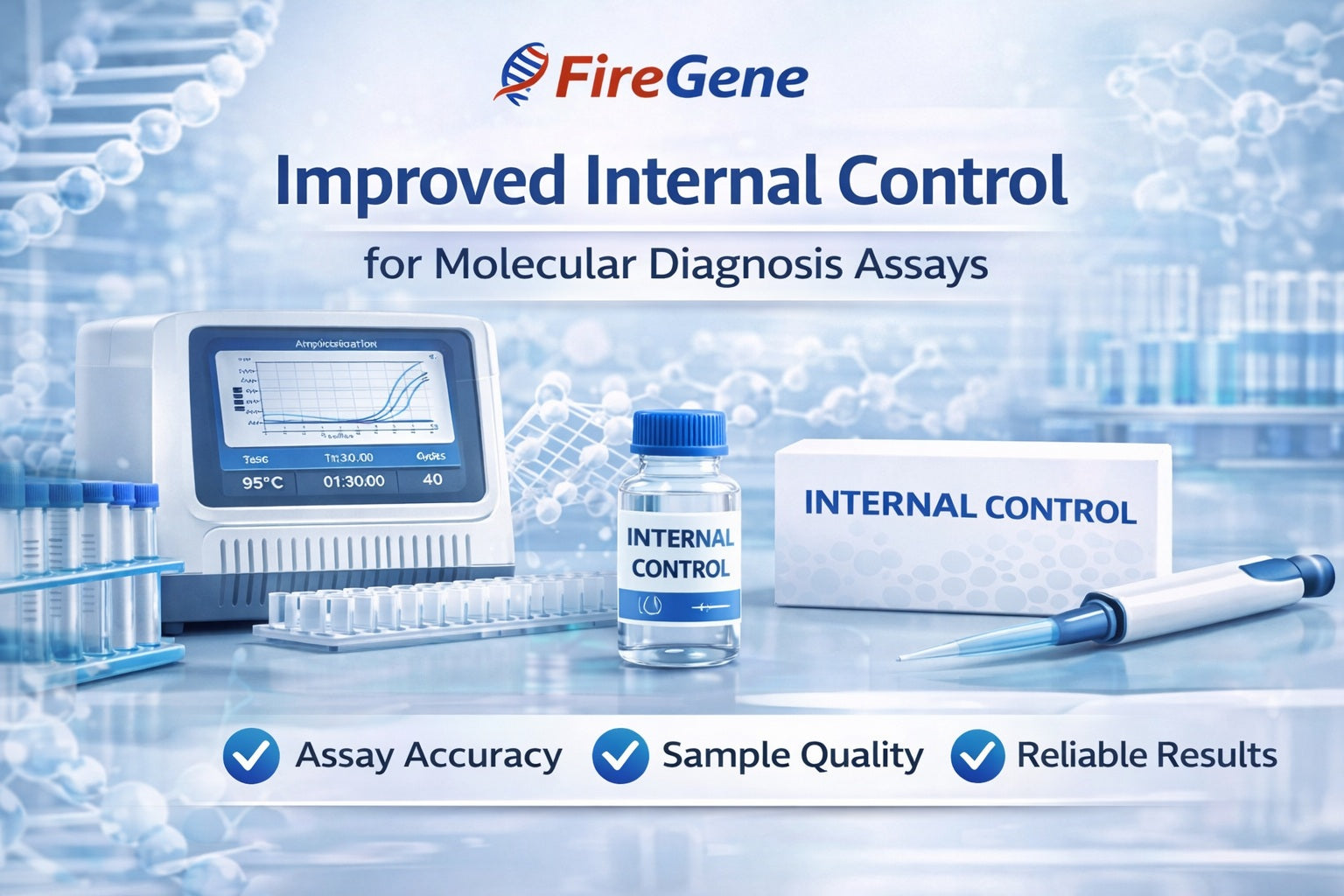
In modern Molecular Diagnosis, accuracy is everything. A result is only valuable when laboratories and healthcare providers can trust that the assay worked correctly from sample to result. That is why an effective Internal Control is such an important part of molecular testing workflows.
Whether the assay is based on Polymerase Chain Reaction or another nucleic acid method, internal controls help verify that the test process is functioning as expected. They support stronger assay confidence, help identify workflow issues, and play a key role in improving diagnostic accuracy in DNA amplification. They are also essential in answering a critical question for laboratories and manufacturers: how to avoid false negatives in molecular diagnostics.
What Is an Internal Control in Molecular Diagnosis?
An Internal Control is a known control target included within the assay workflow to confirm that the test process is working properly. It helps verify that steps such as extraction, amplification, and detection have occurred as expected. If the internal control does not perform correctly, the result may need further review. In simple terms, an internal control acts like a built-in check on assay quality.
Key Benefits of Internal Control
- Supports the result confidence
- Helps detect workflow failure
- Improves assay interpretation
- Strengthens quality assurance
- Helps reduce uncertainty in negative results
This makes internal control an essential part of reliable molecular testing.
How Internal Controls Help Avoid False Negatives
One of the most important reasons to use internal controls is to support efforts to avoid false negatives in molecular diagnostics. A false negative can occur when the target is present, but the assay fails to detect it due to technical or sample-related factors.
Common Causes of False Negatives
- Poor sample quality
- Incomplete nucleic acid extraction
- Amplification inhibitors in the sample
- Reagent degradation
- Instrument or workflow error
- Low target concentration
An internal control helps laboratories recognize when a negative result may need closer review. Instead of assuming every negative is valid, the assay can provide additional confidence that the process worked correctly.
Internal Control and Polymerase Chain Reaction Assays
In assays based on Polymerase Chain Reaction, the role of internal control is especially important. PCR depends on the successful amplification of the target nucleic acid. If something blocks the amplification process, the target may not be detected even when it is present. An internal control helps verify that the amplification environment supports successful reaction performance.
Why Internal Control Is Valuable in PCR
- Confirms amplification function
- Helps detect inhibition
- Supports the interpretation of negative samples
- Improves trust in assay performance
- Adds reliability to result reporting
This is why internal controls are often considered a core part of high-quality PCR assay design.
Improving Diagnostic Accuracy in DNA Amplification
A major goal in assay development is improving diagnostic accuracy in DNA amplification. Accuracy is not only about finding the target when it is present. It is also about confirming that the assay conditions were suitable for detection in the first place. Internal controls contribute to this by showing whether the system performed correctly.
Internal Control Supports Accuracy By:
- Confirming process integrity
- Revealing inhibition or failure conditions
- Supporting a reliable negative interpretation
- Helping maintain consistency across samples
- Strengthening assay robustness in routine use
For molecular assays, better control design often leads to better confidence in final results.
Types of Internal Control in Molecular Assays
Internal controls can be designed in different ways depending on assay goals and workflow structure.
Common Internal Control Approaches
Endogenous Internal Control
This type uses a naturally occurring target in the sample, often a housekeeping gene or another expected nucleic acid sequence. It helps confirm that the sample contains amplifiable material and that extraction was successful.
Exogenous Internal Control
This type uses a defined external control material added to the sample or reaction. It helps monitor extraction, amplification, or both, depending on its design. Both approaches can be useful. The best choice depends on the assay design and intended clinical or laboratory purpose.
What Makes an Improved Internal Control?
An improved internal control should do more than just be present in the assay. It should be well-designed, well-matched to the workflow, and easy to interpret.
Features of an Effective Internal Control
- Stable and reproducible performance
- Compatibility with assay chemistry
- Minimal interference with target detection
- Clear and consistent signal
- Appropriate concentration level
- Relevance to extraction and amplification steps
A strong internal control supports the test without competing too heavily with the main target.
The Role of Annealing Sequence in Control Design
The annealing sequence is an important design element in nucleic acid assays. It influences how primers bind during amplification and affects overall reaction performance. When designing an internal control, the annealing sequence should be carefully selected to support reliable amplification without interfering with the target assay.
Why Annealing Sequence Matters
- Supports specific primer binding
- Helps maintain amplification efficiency
- Reduces risk of unwanted cross-reactivity
- Improves consistency in control performance
A well-designed annealing sequence contributes to cleaner, more reliable assay behavior.
Internal Control, Amplicon Design, and Assay Performance
Another important factor is the amplicon. An amplicon is the DNA fragment produced during amplification. In internal control design, the amplicon should be carefully selected to behave predictably in the assay and to reflect the intended performance checkpoint.
Good Amplicon Design Should Support:
- Reliable amplification efficiency
- Clear signal detection
- Stable assay performance
- Logical interpretation of results
The size, sequence, and behavior of the control amplicon can all influence assay quality.
Common Problems When Internal Control Is Weak
A weak or poorly designed internal control may reduce the assay's value rather than improve it.
Potential Problems Include:
- Inconsistent control signal
- Competition with target amplification
- Poor detection of inhibition
- Unclear interpretation of negative results
- Reduced confidence in assay validity
This is why internal control design should be treated as a strategic part of assay development, not a small technical detail.
Real-World Example
Imagine a PCR-based assay designed to detect a low-level pathogen in clinical samples. A sample produces a negative target result. Without Internal Control, the laboratory may not know whether the sample was truly negative or whether amplification was inhibited.
If a well-designed control is present and performs as expected, the negative result becomes much more trustworthy. If the control fails, the lab knows the sample may need to be reanalyzed. This is a practical example of improving diagnostic accuracy in DNA amplification through better assay control.
Best Practices for Improved Internal Control Design
Manufacturers and assay developers can strengthen control performance through thoughtful design and validation.
Best Practices
- Match control design to assay purpose
- Validate control behavior across sample types
- Confirm compatibility with Polymerase Chain Reaction conditions
- Optimize control concentration carefully
- Design a suitable amplicon for clear interpretation
- Select an appropriate annealing sequence
- Evaluate performance under inhibition-prone conditions
- Study how the control behaves in routine workflow settings
These steps help create a more dependable and user-friendly molecular assay.
Why Better Internal Control Supports Modern Molecular Diagnosis
As Molecular Diagnosis continues to expand, assay expectations are becoming higher. Laboratories want not only sensitivity, but also reliability, repeatability, and confidence in negative results. That is where improved internal control becomes especially valuable.
It supports stronger assay performance, better workflow monitoring, and clearer result interpretation. For developers and diagnostic providers, that means a better foundation for high-quality testing. For companies working in molecular diagnostics, including FireGene, the design of internal controls is closely linked to assay trust, user confidence, and long-term product quality.
FAQ:
What is an internal control in molecular diagnosis?
An internal control is a built-in reference target used in the assay to confirm that the extraction, amplification, and detection steps are working properly.
Why is internal control important in PCR assays?
It helps verify that the Polymerase Chain Reaction worked correctly and supports the interpretation of negative results.
How does internal control help avoid false negatives in molecular diagnostics?
It helps identify workflow failures, inhibition, or poor sample processing that might otherwise lead to a negative result being misinterpreted as valid.
What is an amplicon in molecular testing?
An amplicon is the DNA fragment generated during amplification and used for detection in the assay.
Why does annealing sequence matter in internal control design?
The annealing sequence affects primer binding and amplification performance, making it important for reliable, specific control behavior.
Conclusion
An improved Internal Control is one of the most practical ways to strengthen Molecular Diagnosis assays. It supports reliable DNA amplification, enhances confidence in Polymerase Chain Reaction workflows, and directly improves diagnostic accuracy. Just as importantly, it helps address one of the most important challenges in testing: how to avoid false negatives in molecular diagnostics.
By focusing on smart control design, clear amplicon behavior, and a suitable annealing sequence, assay developers can build stronger, more reliable molecular tests. For organizations such as FireGene, educational content around internal controls also helps users better understand what makes a molecular assay more trustworthy and effective.


