
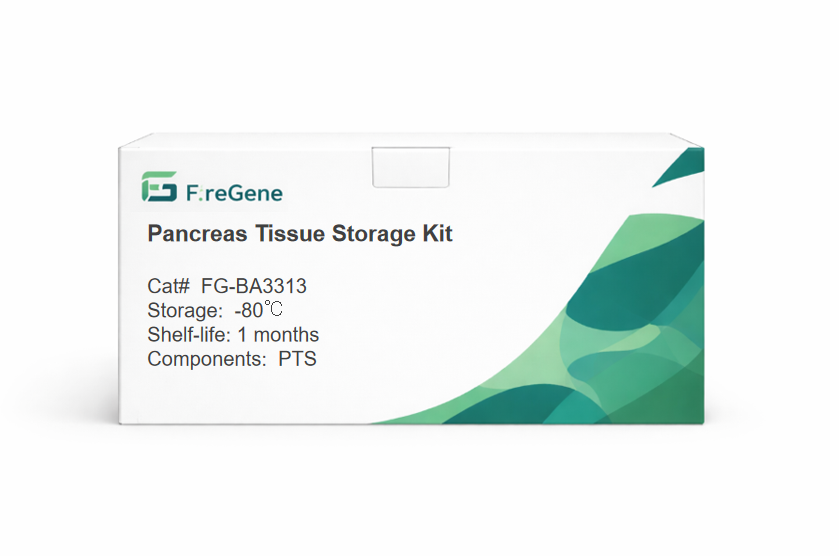

Description
Overview
FireGene Pancreas Tissue Storage Kit is engineered to preserve pancreatic tissue integrity for downstream analysis in both research and clinical applications. This advanced preservation solution ensures tissue viability by maintaining physiological balance and mitigating cellular stress, making it ideal for single-cell sequencing, biomarker analysis, and long-term storage.
Background Information
- Designed to address the need for high-quality pancreatic tissue samples in:
- Single-cell sequencing and transcriptomic profiling.
- Biomarker analysis using immunofluorescence and histology.
- Long-term biobanking for pancreatic disease research and pathology.
- Suitable for use in experimental models of diabetes, pancreatitis, and pancreatic cancer.
- Preserves cellular structure and function in fresh or frozen tissues to support reproducibility and downstream experimental success.
Detection Principle
- The kit employs a specialized buffer system that:
- Maintains osmotic and metabolic equilibrium to prevent tissue damage.
- Includes antioxidants that reduce oxidative stress and neutralize reactive oxygen species.
- Inhibits apoptotic and necrotic cell death pathways, ensuring preserved tissue integrity.
- As a result:
- Samples remain viable and structurally intact, supporting accurate molecular and cellular analyses after thawing.
Specifications
| Applications | Single-cell sequencing, cell culture or other cell-related detections |
| Compatible Sample Types | Pancreas tissue |
| Supported Instruments | / |
| Storage | -80 °C |
| Shelf-life | 1 month |
Kit Components
| Component | 8 Reactions/Kit |
| Pancreas Tissue Storage Solution | 8 × 1.8 mL |
Product FAQ
1. Q: Is this preservation solution only suitable for mammalian pancreatic tissue? Are there differences in preservation effects on different parts of the pancreas (e.g., islets, exocrine portion)? Can it be used for pancreatic tumor tissue or non-mammalian pancreatic tissue (e.g., avian pancreas)?
A: The preservation solution is only suitable for normal mammalian pancreatic tissue and is not temporarily applicable to pancreatic tumor tissue or non-mammalian pancreatic tissue. Pancreatic tumor tissue has abnormal cell structure and metabolic characteristics, and the preservation solution cannot maintain its physiological activity; the cell membrane structure and anti-damage mechanism of non-mammalian pancreatic tissue (such as avian pancreas) are significantly different from those of mammals, leading to massive cell death after preservation. There are slight differences in the preservation effects on different parts of the pancreas: islet tissue (containing sensitive endocrine cells) has stricter requirements for preservation conditions, and it is recommended to prioritize processing within the 48-hour preservation period; the exocrine portion has slightly stronger tolerance but still needs to complete experiments within the specified time. Both can maintain sensitivity to glucose stimulation through the preservation solution without significant differences in activity.
2. Q: The instruction manual recommends storing 200mg of pancreatic tissue per cryovial. Will insufficient tissue quantity (e.g., 50mg) or excessive quantity (e.g., 300mg) affect the preservation effect? How to adjust the operation?
A: Yes, it will affect the effect. ① Insufficient tissue quantity (<100mg): The preservation solution is relatively excessive, which will not directly damage cells but will increase the difficulty of tissue transfer and cleaning in subsequent experiments, and easily cause the tissue to float due to excessive liquid, affecting subsequent dissociation efficiency. It is recommended to combine multiple small-dose tissues (50-100mg each) into the same cryovial, control the total weight at 150-200mg, and fill the cryovial with the preservation solution according to the conventional dosage. ② Excessive tissue quantity (>250mg): The cryovial (2mL specification) cannot hold a sufficient amount of preservation solution, causing part of the tissue to be exposed to air and undergo dry necrosis. The tissue needs to be stored in multiple cryovials, with the tissue quantity in each vial strictly controlled at 180-220mg to ensure the tissue is completely immersed in the preservation solution.
3. Q: The preservation solution needs to be stored at -80℃ in the dark with a validity period of 1 month. Can it still be used if it exceeds the validity period but has no obvious changes in appearance (e.g., no turbidity or precipitation)? Will temporary thawing (e.g., placing at room temperature for 10 minutes when taking) during storage at -80℃ affect the effect?
A: The preservation solution that exceeds the validity period cannot be used anymore. Even if there is no change in appearance, its internal protective components (such as anti-self-digestion factors and activity stabilizers) will degrade over time, unable to prevent the self-digestion of pancreatic tissue, which may lead to massive damage to islet cells. Temporary thawing during storage at -80℃ (10 minutes at room temperature) needs to be judged according to the situation: ① Incomplete thawing (only a small amount of thawing on the tube wall): Immediately put it back at -80℃, and it can be used normally later. ② Complete thawing: It needs to be stored at 4℃ in the dark within 24 hours and used as soon as possible, and cannot be frozen again. The activity of protective components will decrease by 10%-15% after complete thawing, but it can still meet the short-term preservation needs. If it is not used within 24 hours, it should be discarded.
4. Q: Step 3 requires "gently rinsing the tissue with PBS buffer until the surface is clean". What is the operational standard for "gentle"? What consequences will occur if the rinsing force is too strong or blood and mucus are not cleaned?
A: The operational standard for "gentle" is: gently clamp the edge of the tissue with tweezers (avoid clamping the main part of the tissue), stir slowly in PBS at a frequency of once per second, with each rinsing time not exceeding 30 seconds, and repeat 3-4 times until there is no visible blood or mucus residue in the PBS. Excessive rinsing force will cause damage to pancreatic tissue, release internal digestive enzymes, and accelerate tissue self-digestion; uncleaned blood will introduce red blood cell impurities, which are easily confused with pancreatic cells during subsequent dissociation, affecting the accuracy of cell counting; mucus will wrap the tissue surface, preventing the penetration of the preservation solution, leading to necrosis of local cells due to lack of protection.
5. Q: Step 4 requires "filling the cryovial with the preservation solution to completely immerse the tissue". What impact will incomplete filling (e.g., filling only 2/3 of the cryovial) have on the preservation effect? Can PBS be used to supplement to a full cryovial?
A: Incomplete filling of the preservation solution will cause the tissue to contact with air, leading to oxidative damage. At the same time, the concentration of the preservation solution may change due to the volatilization of air above the liquid surface, unable to maintain a stable preservation environment. The cell activity may decrease by 25%-30% after 24 hours of preservation, and basically lose experimental value after 48 hours. PBS cannot be used to supplement to a full cryovial. PBS has no components for anti-self-digestion and maintaining glucose stimulation sensitivity, which will dilute the concentration of effective components in the preservation solution, destroy the protection system, lead to intensified self-digestion of pancreatic tissue, and a sharp decline in the activity of islet cells.
6. Q: The preservation temperature requires 2℃-8℃. How to stabilize the temperature if the temperature fluctuation range of the laboratory refrigerator is large (e.g., 1℃-9℃)? What problems will occur if the temperature is lower than 2℃ (e.g., 0℃) or higher than 8℃ (e.g., 10℃)?
A: When the refrigerator temperature fluctuates greatly, the cryovial can be placed in a constant-temperature incubator (adjusted to 5℃), or wrapped with thermal insulation cotton and placed in the middle layer of the refrigerator (an area with relatively stable temperature), avoiding positions with severe temperature fluctuations such as the refrigerator door and evaporator. A temperature lower than 2℃ (e.g., 0℃) will cause local freezing of the preservation solution, and ice crystals will pierce the pancreatic cell membrane. In particular, islet cells are more sensitive to low temperatures, and their activity will decrease by more than 40%; a temperature higher than 8℃ (e.g., 10℃) will accelerate the degradation of protective components in the preservation solution and promote the activity of self-digestive enzymes in pancreatic tissue. The tissue may become significantly turbid after 12 hours of preservation and cannot be used for subsequent experiments.
7. Q: Step 5 requires "the number of biological ice packs depends on the weather conditions to ensure the sample is at 2℃-8℃ without freezing". How to adjust the number of ice packs according to the weather? What impact will transportation time exceeding 24 hours have?
A: Standards for adjusting the number of ice packs: ① Normal temperature weather (15℃-25℃): Place 2 500g biological ice packs (1 on top and 1 on bottom) in a 500mL foam box. ② High-temperature weather (>25℃): Increase to 4 500g biological ice packs (1 on each side, with the sample placed in the middle), and attach thermal insulation film inside the foam box. ③ Low-temperature weather (<15℃): Place 1 500g biological ice pack, and fill the space around the sample with paper towels to avoid freezing due to too low temperature. Transportation time exceeding 24 hours will significantly increase risks: even if the temperature is stable, the sensitivity of pancreatic tissue to glucose stimulation will gradually decrease after more than 24 hours in the preservation solution. The longer the transportation time within the 48-hour preservation period, the greater the deviation of subsequent experimental data. It is recommended to control the transportation time within 12 hours and check the tissue status immediately after arrival.
8. Q: The preservation solution needs to be "completely thawed and mixed" before use. What is the specific thawing method? What consequences will occur if a 37℃ water bath is used to accelerate thawing or if it is used without complete thawing?
A: The thawing method is natural thawing at room temperature (18℃-25℃). Take the preservation solution out of -80℃, place it in a room-temperature environment, invert and mix it once every 10 minutes until the liquid is completely clear without ice crystals. A 37℃ water bath cannot be used to accelerate thawing. A 37℃ water bath will cause the local temperature of the preservation solution to be too high, destroying the activity of anti-self-digestion factors and making the preservation solution invalid; using it without complete thawing, the remaining ice crystals will melt slowly when in contact with the tissue, generating osmotic pressure shock and damaging pancreatic cells. In particular, it will lead to a significant decline in the activity of islet cells, affecting the subsequent detection of blood glucose regulation function.
9. Q: Cell suspension preparation experiments need to be carried out within 48 hours of preservation. Can the preservation time be extended to 72 hours if the operation cannot be carried out on time due to special circumstances? How to judge whether the tissue is still usable after extension?
A: Extending the preservation time to 72 hours is not recommended. After more than 48 hours, the protective effect of the preservation solution will decrease sharply, the self-digestion of pancreatic tissue will intensify, and the cell activity may be lower than 50%, which cannot meet the needs of high-precision experiments such as high-throughput single-cell sequencing. If the preservation time needs to be extended due to special circumstances, the experiment must be completed within 60 hours, and the following standards should be used to judge whether the tissue is still usable before use: ① Observe the tissue appearance: no obvious swelling, turbidity, or peculiar smell. ② Stain a small amount of tissue with trypan blue: cell viability ≥60%. ③ Detect glucose stimulation sensitivity: after treatment with low-glucose medium, the insulin secretion reaches more than 50% of that of fresh tissue. Only when the above three conditions are met can the tissue be used; otherwise, it should be discarded.
10. Q: Compared with other tissue preservation solutions of this brand (e.g., FG-BA3301 Animal Tissue Universal Preservation Solution), what are the core advantages of this pancreatic tissue-specific preservation solution? Can BA3301 be used as a substitute for this product to preserve pancreatic tissue?
A: The core advantages are reflected in two aspects: ① Aiming at the "easy self-digestion" characteristic of pancreatic tissue, anti-self-digestion factors are added to inhibit the activity of digestive enzymes such as trypsin in the pancreas and avoid tissue self-damage. ② It contains a special glucose stimulation-sensitive stabilizer, which can maintain the response ability of pancreatic tissue to changes in glucose concentration and retain its physiological activity of regulating blood glucose, which is not available in universal preservation solutions. FG-BA3301 cannot be used as a substitute. FG-BA3301 has no anti-self-digestion components. When preserving pancreatic tissue, obvious self-digestion will occur within 24 hours, a large number of islet cells will die, and the glucose stimulation sensitivity cannot be maintained, making it impossible to obtain accurate physiological function data in subsequent experiments.
Files Download Links