
Introduction
Bacterial endotoxin testing is one of the most important microbiological quality control activities in pharmaceutical manufacturing. For injectable drugs, biologics, vaccines, monoclonal antibodies, cell and gene therapies, and other parenteral products, reliable endotoxin testing is essential for protecting patients and supporting compliant batch release.
Yet endotoxin testing failures remain surprisingly common.
A failed result does not always mean that a product contains excessive endotoxin. In many cases, the underlying problem is analytical rather than manufacturing-related. Inadequate sample preparation, matrix interference, contaminated consumables, poor pipetting technique, inappropriate dilution, reagent handling errors, and instrument problems can all compromise test performance.
The regulatory environment is also becoming more sophisticated. In March 2026, the U.S. FDA issued a revised final guidance, Pyrogen and Endotoxins Testing—Questions and Answers, clarifying its current thinking on endotoxin and pyrogen testing and expanding the discussion to accommodate recombinant reagent approaches. The FDA emphasizes that manufacturers should establish testing approaches appropriate for their products and demonstrate that the selected method is suitable for its intended purpose.
At the same time, USP <85> remains a fundamental compendial reference for bacterial endotoxin testing, while USP <1085> provides additional guidance on the proper application of endotoxin testing methodologies. USP also now recognizes USP <86>, which addresses bacterial endotoxin testing using recombinant reagents.
For pharmaceutical QC laboratories, the goal should therefore be more than simply obtaining a passing result. The objective is to establish an endotoxin testing workflow that is accurate, reproducible, traceable, and scientifically justified.
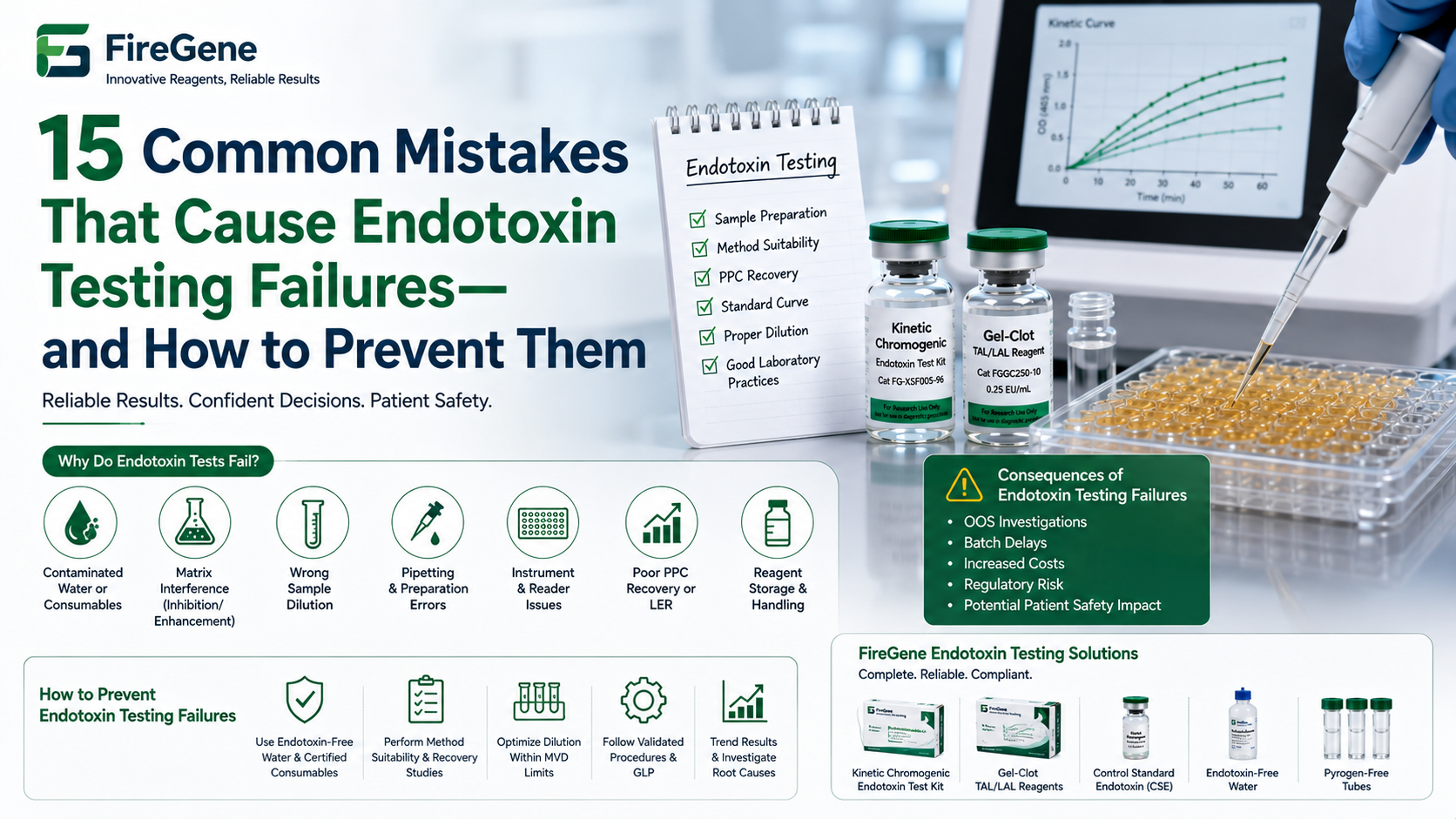
This article examines 15 common mistakes that can cause endotoxin testing failures and explains practical strategies for preventing them.
1. Using Contaminated Water or Consumables
One of the most basic—and most frequently overlooked—causes of endotoxin testing problems is contamination introduced by the laboratory itself.
Endotoxins can be present in:
- Non-pyrogen-free water
- Glassware
- Pipette tips
- Tubes
- Microplates
- Sample containers
- Reagent reservoirs
A laboratory may have a perfectly functioning TAL/LAL assay, yet still obtain elevated results because endotoxin was introduced during sample preparation.
How to prevent it
Use qualified Endotoxin-Free Water and certified pyrogen-free consumables throughout the analytical workflow.
Laboratories should also establish clear procedures for:
- Storage of endotoxin-free materials
- Handling of opened packages
- Sample preparation
- Cleaning of work areas
- Prevention of cross-contamination
The goal is to ensure that the laboratory environment does not become an uncontrolled source of endotoxin.
2. Poor Pharmaceutical Water System Control
Endotoxin testing reliability begins long before the sample reaches the laboratory.
Water used in pharmaceutical manufacturing and laboratory testing can become contaminated through:
- Biofilm formation
- Stagnant piping
- Poor sanitization
- Contaminated storage tanks
- Distribution loop problems
- Improper sampling
This is particularly important for WFI and other critical pharmaceutical water systems.
A gradual increase in endotoxin levels may be an early warning sign of developing biofilm or system deterioration even when individual results remain within specification.
How to prevent it
Manufacturers should establish comprehensive water monitoring programs that combine:
- Microbial monitoring
- Endotoxin testing
- Physical and chemical monitoring
- Trend analysis
- Preventive maintenance
- Validated sanitization
Reliable endotoxin testing depends on controlling the quality of the water used throughout the manufacturing and analytical process.
3. Skipping Method Suitability Testing
A common misconception is that a validated TAL/LAL reagent will automatically work for every pharmaceutical product.
It will not.
Different products can contain components that interfere with the endotoxin reaction. A formulation may inhibit the reaction and produce artificially low results, or enhance the reaction and produce artificially high results.
Potential sources of interference include:
- High salt concentrations
- Extreme pH
- Surfactants
- Chelating agents
- Proteins
- Peptides
- Lipids
- Complex formulation buffers
How to prevent it
Perform product-specific method suitability testing before routine testing begins.
The objective is to demonstrate that the product matrix does not prevent the assay from reliably detecting a known endotoxin spike.
This is particularly important for biologics, monoclonal antibodies, peptide drugs, and other complex formulations.
4. Choosing the Wrong Sample Dilution
Dilution is one of the most important variables in endotoxin testing.
Too little dilution may leave matrix interference unresolved. Excessive dilution, however, can reduce the endotoxin concentration below the effective sensitivity of the assay.
The Maximum Valid Dilution (MVD) provides an important framework for determining how far a product may be diluted while maintaining the ability to detect endotoxin at the applicable limit.
How to prevent it
During method development:
- Establish the applicable endotoxin limit.
- Determine assay sensitivity.
- Calculate the MVD.
- Evaluate multiple dilution levels.
- Compare spike recovery across dilutions.
- Select the dilution that provides reliable recovery and adequate sensitivity.
Do not automatically assume that the highest possible dilution is the best dilution.
5. Ignoring Inhibition and Enhancement
Inhibition and enhancement are among the most important causes of unreliable endotoxin results.
Inhibition
The sample suppresses the TAL/LAL reaction, potentially causing endotoxin concentrations to appear lower than they actually are.
Enhancement
The sample accelerates or amplifies the reaction, potentially producing falsely elevated results.
Both effects can compromise product release decisions.
How to prevent it
Use Positive Product Controls (PPCs) or appropriate spike recovery studies to demonstrate that the product matrix allows reliable endotoxin detection.
If recovery is outside the established acceptance range, investigate:
- Sample dilution
- pH
- ionic strength
- formulation components
- reagent compatibility
- sample preparation
Do not simply repeat the same failed test without investigating the underlying mechanism.
6. Failing to Investigate Low Endotoxin Recovery
Low Endotoxin Recovery (LER) deserves special attention in modern pharmaceutical endotoxin testing.
LER occurs when endotoxin becomes less detectable in a sample over time, potentially because the endotoxin interacts with components of the formulation or becomes physically or chemically masked.
This issue can be particularly relevant to complex biologic formulations containing surfactants, proteins, or other excipients.
How to prevent it
Manufacturers should consider:
- Time-course recovery studies
- Multiple sample dilutions
- Formulation-specific investigation
- Sample storage studies
- Evaluation of surfactant or protein interactions
A single acceptable spike recovery measurement at one time point may not always provide sufficient information for complex products.
7. Incorrect Reagent Storage or Preparation
TAL/LAL reagents are sensitive analytical reagents that require controlled handling.
Common mistakes include:
- Incorrect storage temperature
- Using reagents beyond their validated stability period
- Improper reconstitution
- Excessive agitation
- Repeated temperature cycling
- Using incorrectly prepared reagent solutions
These errors can lead to poor standard curves, increased variability, or unexpected assay failures.
How to prevent it
Follow the manufacturer's validated instructions for:
- Storage
- Reconstitution
- Mixing
- Equilibration
- Use within specified time limits
Laboratories should document reagent lot numbers and preparation details to support traceability during investigations.
8. Inaccurate Pipetting
A kinetic endotoxin assay is highly sensitive to volume differences.
Small pipetting errors can affect:
- Standard concentrations
- Sample dilution
- PPC recovery
- Replicate agreement
- Kinetic measurements
This becomes particularly important when working with small liquid volumes in 96-well plates.
How to prevent it
Implement routine pipette qualification and calibration.
Analysts should also receive training on:
- Proper aspiration
- Dispensing technique
- Tip immersion depth
- Avoiding bubbles
- Consistent pipetting speed
- Correct pipette selection
Automated liquid handling systems can further improve reproducibility in high-throughput laboratories.
9. Introducing Air Bubbles During Plate Preparation
Air bubbles are a relatively simple problem but can have a significant impact on photometric endotoxin assays.
Bubbles may interfere with absorbance measurements and cause abnormal kinetic curves.
How to prevent it
Analysts should inspect wells before measurement and avoid:
- Aggressive pipetting
- Excessive vortexing immediately before transfer
- Rapid dispensing
- Incorrect plate handling
When bubbles are observed, follow the laboratory's validated procedure for removing them without compromising sample integrity.
10. Using an Inappropriate Microplate Reader
Kinetic Chromogenic endotoxin testing requires an instrument capable of performing the required kinetic absorbance measurements at the appropriate wavelength and temperature conditions.
Instrument-related problems may include:
- Incorrect wavelength
- Poor temperature control
- Incorrect kinetic intervals
- Calibration problems
- Software configuration errors
- Plate positioning issues
How to prevent it
Laboratories should qualify and periodically verify microplate readers according to their quality system.
For a typical Kinetic Chromogenic assay, the instrument configuration should be compatible with the assay's validated requirements, including the specified absorbance wavelength, incubation temperature, and kinetic reading parameters.
11. Poor Standard Curve Preparation
A standard curve is the analytical foundation of a quantitative endotoxin assay.
A poor curve can result from:
- Incorrect standard preparation
- Inaccurate serial dilution
- Contaminated dilution tubes
- Insufficient mixing
- Pipetting errors
- Incorrect concentrations
If the standard curve is unreliable, sample results become questionable regardless of how well the samples themselves were prepared.
How to prevent it
Use a standardized endotoxin standard preparation procedure and carefully document:
- Standard lot
- Reconstitution volume
- Dilution factors
- Preparation time
- Analyst
- Reagent lot
Control Standard Endotoxin (CSE) can be used where appropriate to support calibration and recovery studies.
12. Testing Samples Outside Their Validated Conditions
An endotoxin method is not automatically valid for every concentration, formulation, or sample condition.
Problems can arise when laboratories test:
- New formulations
- New concentrations
- New excipients
- New sample matrices
- Changed manufacturing processes
without reassessing method suitability.
How to prevent it
Treat significant product or process changes as potential triggers for method review.
Examples include:
- Reformulation
- New excipient supplier
- Concentration changes
- New manufacturing equipment
- Process scale-up
- Changes in sample storage conditions
Analytical methods should evolve alongside the products they measure.
13. Assuming Sterility Means Endotoxin-Free
This is one of the most important conceptual mistakes in pharmaceutical microbiology.
A sterile product can still contain bacterial endotoxins.
Sterility testing addresses viable microorganisms. Endotoxin testing addresses biologically active components of Gram-negative bacterial cell walls.
Sterile filtration may remove bacteria but does not reliably eliminate endotoxins already present in the process.
How to prevent it
Maintain separate control strategies for:
- Microbial contamination
- Sterility
- Endotoxin contamination
- Pyrogenic risk
These controls complement rather than replace one another.
14. Repeating a Failed Test Without Root-Cause Investigation
When an endotoxin result fails, some laboratories immediately repeat the test.
Repeating a test can be appropriate under a validated investigation procedure, but simply generating another result does not explain why the first result failed.
Possible root causes include:
- Product contamination
- Laboratory contamination
- Matrix interference
- Reagent failure
- Pipetting error
- Instrument malfunction
- Sample degradation
- Incorrect dilution
How to prevent it
Use a structured OOS investigation process.
Review:
- Raw data
- Standard curve
- PPC recovery
- Replicate agreement
- Reagent lots
- Instrument records
- Analyst procedure
- Sample preparation
- Historical trends
The objective should be to identify the assignable cause rather than simply obtain a passing result.
15. Failing to Trend Endotoxin Data
A laboratory may pass hundreds of endotoxin tests while still developing a serious quality problem.
For example, results may gradually increase from historical baseline without exceeding the specification limit.
If the laboratory only evaluates results as "pass" or "fail," this emerging trend may remain invisible.
How to prevent it
Trend:
- Finished product endotoxin results
- Water system endotoxin levels
- PPC recovery
- Standard curve performance
- OOS and OOT events
- Method suitability results
- Analyst or instrument performance
Long-term trending provides an additional layer of quality control that can identify emerging problems before they become major deviations.
A Practical Endotoxin Testing Troubleshooting Workflow
When an endotoxin test fails, laboratories can use a structured troubleshooting sequence:
Step 1: Verify the raw data
Review the complete kinetic curve, standard curve, replicates, and instrument output.
Step 2: Check system suitability
Confirm that the standard curve and controls met the validated acceptance criteria.
Step 3: Review PPC recovery
Determine whether the product matrix interfered with endotoxin detection.
Step 4: Check reagent and consumable controls
Review reagent lot numbers, preparation records, water, tubes, plates, and other consumables.
Step 5: Review sample preparation
Verify dilution factors, mixing, pH, storage, and handling conditions.
Step 6: Check the instrument
Review calibration, temperature, wavelength, software settings, and maintenance records.
Step 7: Review historical trends
Compare the result with previous batches, water system results, and laboratory performance.
Step 8: Determine the root cause
Classify the failure as product-related, process-related, laboratory-related, reagent-related, or instrument-related.
This approach helps prevent unnecessary repeat testing and provides a more defensible basis for OOS and deviation investigations.
How FireGene Can Support Reliable Endotoxin Testing
Reliable endotoxin testing requires an integrated analytical workflow rather than a single reagent.
FireGene provides a portfolio designed to support routine bacterial endotoxin testing, method development, validation, and laboratory quality control.
The portfolio includes:
- Kinetic Chromogenic Endotoxin Test Kits for quantitative endotoxin testing
- Gel-Clot TAL/LAL Reagents for compendial endotoxin limit testing
- Control Standard Endotoxin (CSE) for standard curves and recovery studies
- Endotoxin-Free Water for reagent preparation and sample dilution
- Pyrogen-Free Tubes and Consumables to minimize laboratory contamination
Using appropriate reagents together with validated procedures, qualified equipment, and controlled laboratory practices can help laboratories improve assay consistency and reduce avoidable endotoxin testing failures.
Regulatory Perspective: What Is Changing in 2026?
Endotoxin testing is evolving beyond a single traditional methodology.
In March 2026, FDA revised its Pyrogen and Endotoxins Testing—Questions and Answers guidance. The revised document reflects broader recognition of recombinant reagent approaches and emphasizes that manufacturers using alternative or recombinant methods should establish suitability for the intended application.
USP has also established <86> Bacterial Endotoxins Test Using Recombinant Reagents, expanding the pharmacopeial framework for non-animal-derived endotoxin testing approaches. USP notes that suitability should be demonstrated for the specific material, drug substance, or drug product being tested.
This evolution does not eliminate the importance of traditional TAL/LAL testing. Instead, it reinforces a broader principle:
The selected endotoxin testing method must be demonstrated to be fit for its intended purpose.
For pharmaceutical QC laboratories, method suitability, matrix evaluation, recovery studies, appropriate controls, and documented analytical performance remain central to reliable endotoxin testing.
10 Questions Laboratories Should Ask Before Running an Endotoxin Test
Before starting a critical endotoxin assay, analysts should consider:
- Is the sample matrix known to interfere with endotoxin detection?
- Has method suitability been demonstrated for this product?
- Is the selected dilution within the validated range?
- Are all water and consumables endotoxin-free?
- Are the reagents stored and prepared correctly?
- Is the standard curve preparation procedure controlled?
- Are pipettes and instruments qualified?
- Are PPC recovery results acceptable?
- Has LER been evaluated where appropriate?
- Are results being trended over time?
If the answer to several of these questions is "no," the laboratory may be increasing its analytical risk before the test has even started.
Key Takeaways
Endotoxin testing failures are rarely caused by a single factor. More often, they result from interactions between product characteristics, laboratory practices, reagents, equipment, and environmental conditions.
The most important lessons are:
- Do not assume that a validated endotoxin reagent automatically works for every product.
- Perform product-specific method suitability testing before routine analysis.
- Control water, tubes, plates, pipette tips, and other consumables to prevent laboratory-introduced endotoxin contamination.
- Optimize sample dilution rather than automatically selecting the highest possible dilution.
- Use PPC recovery and other controls to identify inhibition or enhancement.
- Evaluate Low Endotoxin Recovery when working with complex formulations.
- Maintain qualified pipettes, microplate readers, and other analytical equipment.
- Investigate failed results systematically instead of repeatedly testing until a passing result is obtained.
- Trend analytical data to identify emerging problems before they become OOS events.
- Keep endotoxin testing methods aligned with current regulatory expectations and product-specific risk.
Conclusion
Reliable bacterial endotoxin testing is not simply a matter of choosing a sensitive TAL/LAL reagent and following a protocol. The reliability of the final result depends on the entire analytical ecosystem—from pharmaceutical water and pyrogen-free consumables to sample preparation, dilution, method suitability, reagent handling, instrumentation, data interpretation, and laboratory quality systems.
The most effective QC laboratories therefore approach endotoxin testing as a controlled analytical process rather than an isolated test.
By avoiding common mistakes, validating methods for their intended products, controlling potential contamination sources, monitoring PPC recovery, investigating matrix interference, and trending performance over time, pharmaceutical manufacturers can significantly reduce unnecessary testing failures and OOS investigations.
As regulatory expectations continue to evolve in 2026—including the FDA's updated guidance and the growing recognition of recombinant endotoxin testing approaches—method suitability and analytical fitness for purpose are becoming increasingly important.
For manufacturers of sterile injectables, biologics, vaccines, monoclonal antibodies, peptide drugs, and advanced therapies, the goal should not simply be to pass the endotoxin test.
The goal should be to build an endotoxin testing program that produces reliable, reproducible, scientifically defensible results—every time.
That is the foundation of efficient QC, consistent batch release, strong regulatory compliance, and, ultimately, patient safety.
FireGene Endotoxin Testing
Ready to run your endotoxin assay?
FireGene offers a complete endotoxin testing toolkit — from TAL reagents and CSE standards to pyrogen-free consumables and LAL reagent water. All products are aligned with USP <85>, EP 2.6.14, and JP 4.01.


