
Introduction
Bacterial endotoxin control is an essential part of pharmaceutical manufacturing, injectable drug development, medical device production, and laboratory quality control. Endotoxin testing methods such as the Limulus Amebocyte Lysate (LAL) assay and recombinant Factor C (rFC) assay rely on carefully characterized endotoxin standards and controls.
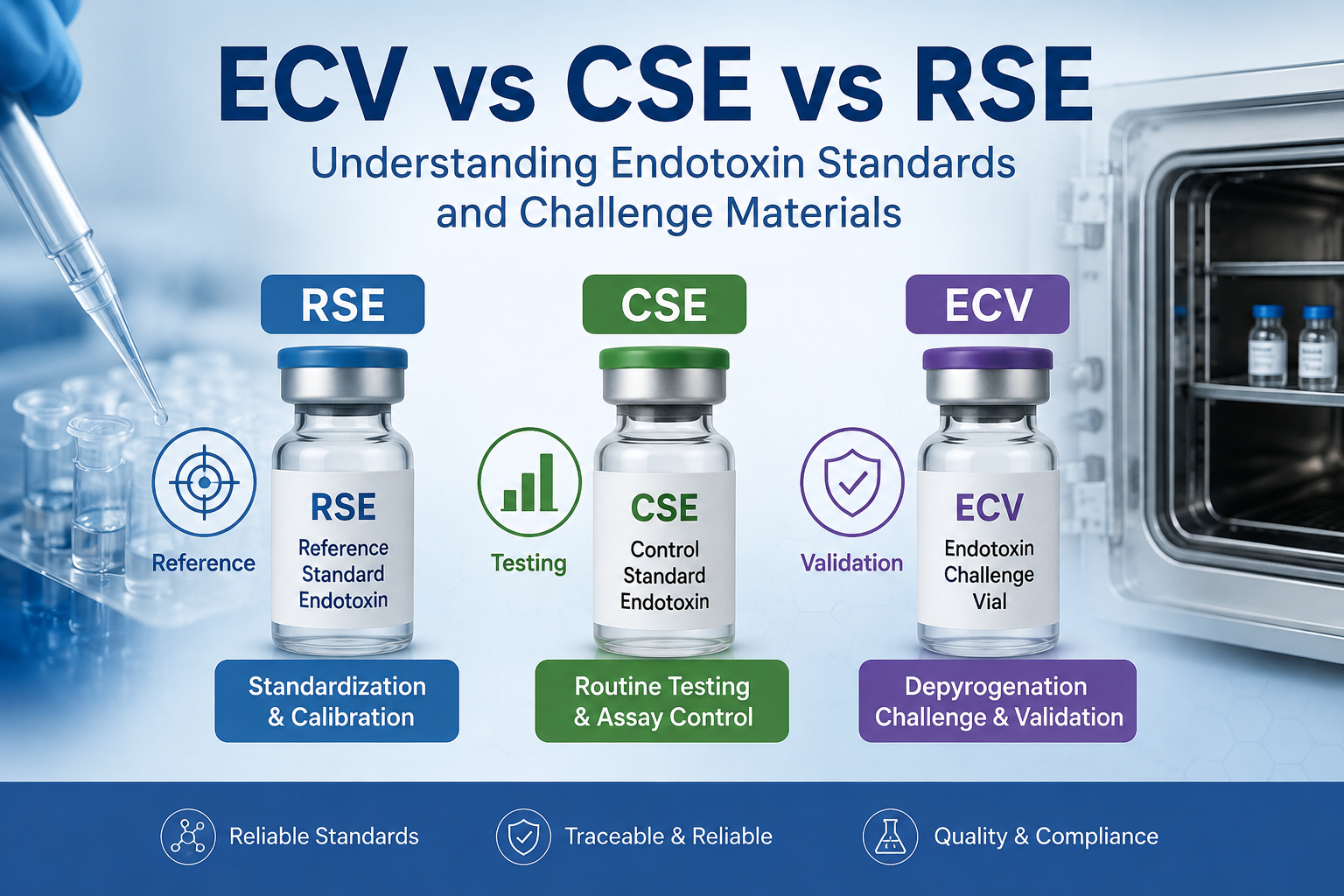
Three terms are frequently encountered in endotoxin-related applications: Endotoxin Challenge Vial (ECV), Control Standard Endotoxin (CSE), and Reference Standard Endotoxin (RSE). Although all three contain or are associated with bacterial endotoxin, they serve different purposes.
Understanding the differences between ECV, CSE, and RSE is important when selecting materials for endotoxin testing, method validation, and dry-heat depyrogenation validation.
1. What Is Reference Standard Endotoxin (RSE)?
Reference Standard Endotoxin (RSE) is a highly characterized endotoxin reference material used as a fundamental standard in bacterial endotoxin testing.
RSE is generally assigned a defined potency in Endotoxin Units (EU) and is used as a reference for establishing the potency of secondary endotoxin standards. In many compendial testing systems, a recognized reference endotoxin standard serves as the basis for calibration and standardization.
RSE can be used in applications such as:
Qualification and calibration of endotoxin standards
Bacterial endotoxin test method validation
Verification of assay performance
Preparation and qualification of Control Standard Endotoxin
Laboratory quality control
The key role of RSE is standardization. It provides a reference point that allows endotoxin measurements to be expressed consistently in Endotoxin Units.
Therefore:
RSE → Primary reference for endotoxin standardization
2. What Is Control Standard Endotoxin (CSE)?
Control Standard Endotoxin (CSE) is an endotoxin preparation used routinely for bacterial endotoxin testing. CSE is commonly calibrated against an appropriate reference standard, such as RSE, and its potency is assigned in EU per vial or according to the manufacturer's specifications.
Compared with a primary reference standard, CSE is generally more convenient for routine laboratory use.
CSE can be used for:
LAL assay standard curves
Positive controls
Inhibition/enhancement testing
Assay validation
Routine endotoxin testing
Verification of test system performance
For example, in a quantitative LAL assay, CSE can be reconstituted and diluted to prepare a series of endotoxin concentrations. These standards are then used to generate the assay's standard curve.
The basic relationship can be summarized as:
RSE → Calibration of CSE → Routine endotoxin testing
This makes CSE particularly useful for laboratories performing frequent endotoxin analysis.
3. What Is an Endotoxin Challenge Vial (ECV)?
An Endotoxin Challenge Vial (ECV) is designed for a different application.
Rather than being primarily intended to establish a routine analytical standard curve, an ECV is used as a challenge material for depyrogenation validation.
During dry-heat depyrogenation validation, manufacturers need to demonstrate that a validated process can achieve sufficient endotoxin reduction. An ECV contains a defined amount of bacterial endotoxin that can be subjected to the proposed depyrogenation process.
A typical validation workflow is:
ECV placement → Dry-heat treatment → Endotoxin recovery/testing → Endotoxin reduction calculation
The amount of endotoxin remaining after treatment is compared with the initial endotoxin challenge level.
A commonly used concept for evaluating depyrogenation performance is the endotoxin reduction value (LRV):
LRV = log10 (Initial Endotoxin Level / Final Endotoxin Level)
For example, if a process reduces endotoxin from 1,000 EU to 1 EU:
LRV = log10 (1,000 / 1) = 3
This represents a 3-log reduction in endotoxin.
Therefore, ECV is particularly relevant to:
Dry-heat depyrogenation validation
Depyrogenation tunnels
Dry-heat ovens
Glass vial depyrogenation
Pharmaceutical container validation
Process qualification
4. ECV vs CSE vs RSE: Key Differences
Although ECV, CSE, and RSE are all related to bacterial endotoxin, their intended functions are different.
|
Material |
Primary Purpose |
Typical Application |
|
RSE |
Reference and standardization |
Calibration and method validation |
|
CSE |
Routine endotoxin testing |
LAL/rFC testing and controls |
|
ECV |
Endotoxin challenge |
Depyrogenation validation |
The easiest way to remember the distinction is:
RSE = Reference
CSE = Control/Testing
ECV = Challenge/Validation
Another important difference is the context in which the endotoxin is used. RSE and CSE are closely associated with analytical endotoxin testing, whereas ECV is primarily associated with process validation.

5. How Are RSE and CSE Related?
RSE and CSE should not be considered interchangeable materials.
A reference standard provides the benchmark for endotoxin potency. A CSE is typically calibrated against the applicable reference standard and can then be used for routine laboratory testing.
This approach provides consistency while reducing the need to use the primary reference material for every routine assay.
For laboratories, the practical workflow may therefore look like:
Reference Standard Endotoxin (RSE)
↓
Calibration / Qualification
↓
Control Standard Endotoxin (CSE)
↓
Routine LAL or rFC Testing
The exact calibration and traceability requirements should always follow the applicable pharmacopoeial requirements, regulatory expectations, and manufacturer's certificate.
6. How Is ECV Different from CSE?
One of the most common misunderstandings is treating an ECV as simply a high-concentration CSE.
While both may contain characterized bacterial endotoxin, their intended applications are different.
CSE is primarily an analytical control material. It may be diluted to prepare standards or controls for endotoxin assays.
ECV, on the other hand, is specifically designed to provide an endotoxin challenge during a depyrogenation study. Its format, endotoxin load, container configuration, traceability, and recovery characteristics should be appropriate for the intended validation protocol.
Therefore, selecting an ECV for depyrogenation validation should involve more than simply choosing an endotoxin standard with a high EU value.
Important considerations include:
Endotoxin potency
Endotoxin source and characterization
Container configuration
Lot traceability
Certificate of Analysis
Recovery procedure
Compatibility with the validation protocol
Applicable regulatory or pharmacopeial requirements
7. Choosing the Right Endotoxin Material
The appropriate material depends on the objective of the study.
For routine endotoxin testing
CSE is generally the practical choice for preparing assay standards and controls, provided it is appropriately calibrated and qualified.
For reference and standardization
RSE is used as the reference material for establishing or verifying endotoxin potency and supporting method validation activities.
For depyrogenation validation
ECV is the appropriate type of material when the objective is to challenge a dry-heat process and demonstrate endotoxin reduction.
Choosing the correct material helps laboratories avoid inappropriate substitutions and improves the reliability of endotoxin-related validation work.
8. Why Endotoxin Standards Matter in Pharmaceutical Quality Control
Endotoxin is a heat-stable pyrogen produced by Gram-negative bacteria. Even when microorganisms have been eliminated, residual endotoxin may remain and create a significant quality concern for parenteral products and medical devices.
For this reason, pharmaceutical manufacturers must address endotoxin from two complementary perspectives:
1. Detection
Analytical methods such as LAL and rFC assays determine whether endotoxin is present and quantify its level when applicable.
2. Removal or inactivation
Validated processes such as dry-heat depyrogenation are used to reduce endotoxin contamination to an acceptable level.
CSE and RSE primarily support the detection and analytical side, while ECV supports process validation for endotoxin reduction.
Conclusion
ECV, CSE, and RSE are not interchangeable endotoxin materials. Each has a distinct role in endotoxin control and pharmaceutical quality systems.
RSE (Reference Standard Endotoxin) provides an important reference for endotoxin potency and standardization. CSE (Control Standard Endotoxin) is commonly used for routine endotoxin testing, assay controls, and method validation. ECV (Endotoxin Challenge Vial) is designed to challenge depyrogenation processes and evaluate endotoxin reduction during validation.
In simple terms:
RSE → Reference
CSE → Routine Testing
ECV → Depyrogenation Challenge
Understanding these differences can help laboratories and pharmaceutical manufacturers select appropriate endotoxin materials for analytical testing, validation, and quality control.


