
Introduction: Why High-Quality Gut Cell Isolation Matters
The gastrointestinal tract is one of the most complex and dynamic systems in the body, containing a diverse network of epithelial cells, immune cells, stromal cells, and microbial interactions. As interest in gut biology continues to expand, researchers increasingly rely on high-quality single-cell isolation techniques to better understand intestinal health and disease. From inflammatory bowel disease (IBD) and colorectal cancer to microbiome research and regenerative medicine, accurate gut cell analysis has become essential for modern biomedical studies.
However, preparing viable single-cell suspensions from gastrointestinal tissue remains technically challenging. The dense extracellular matrix, mucus-rich environment, and delicate epithelial structures can make traditional tissue dissociation methods inefficient or damaging to cells. Poor dissociation may result in reduced cell viability, cell clumping, or the loss of sensitive cell populations, ultimately affecting downstream experimental accuracy.
Advanced applications such as single-cell RNA sequencing (scRNA-seq), flow cytometry, and organoid culture require optimized tissue processing workflows that preserve both cellular diversity and RNA integrity. This growing demand has driven the development of specialized dissociation solutions tailored specifically for gastrointestinal tissues.
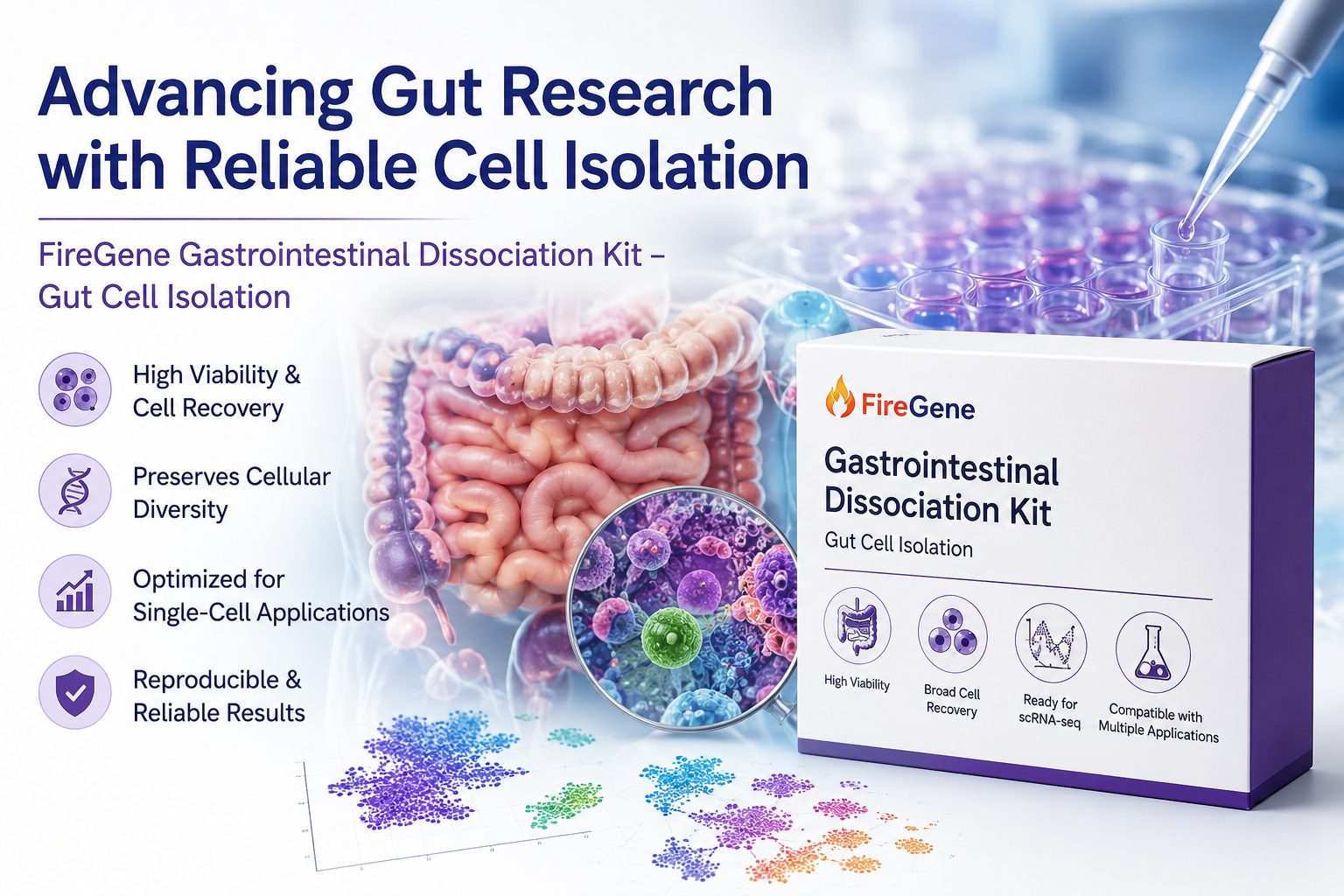
The FireGene Gastrointestinal Dissociation Kit – Gut Cell Isolation is designed to address these challenges by providing an optimized enzymatic workflow for efficient and gentle gut tissue dissociation. By supporting high cell viability and reproducible single-cell preparation, the kit helps researchers generate reliable data for a wide range of gastrointestinal and immunology studies.
Challenges in Gastrointestinal Tissue Dissociation
Gastrointestinal tissue dissociation is a critical step in many modern life science workflows, yet it remains one of the most technically demanding processes in cell isolation research. Unlike softer tissues, the gastrointestinal tract contains a dense extracellular matrix, tightly connected epithelial layers, abundant mucus, and highly diverse cell populations. These structural complexities make it difficult to generate high-quality single-cell suspensions without damaging fragile cells.
One of the most common challenges during gut tissue dissociation is maintaining high cell viability. Overly aggressive enzymatic digestion or excessive mechanical disruption can lead to cell death, membrane damage, and altered gene expression profiles. Fragile epithelial cells are particularly vulnerable during processing, often resulting in reduced recovery rates and biased experimental outcomes.
Another major issue is cell clumping caused by incomplete tissue digestion or residual mucus. Cell aggregates can interfere with downstream applications such as flow cytometry and single-cell RNA sequencing (scRNA-seq), reducing data accuracy and instrument performance. In addition, prolonged digestion times may trigger stress-response pathways, potentially affecting transcriptomic analysis and masking biologically relevant signals.
Researchers must also consider the balance between efficient tissue breakdown and preservation of cellular diversity. Inadequate dissociation can limit immune cell recovery, while excessive digestion may damage rare or sensitive populations important for gastrointestinal disease studies.
Because of these challenges, optimized gastrointestinal dissociation protocols are essential for obtaining reproducible, high-quality results. Specialized solutions such as the FireGene Gastrointestinal Dissociation Kit are designed to improve digestion efficiency while preserving cell integrity, viability, and RNA quality for advanced downstream applications.
FireGene Gastrointestinal Dissociation Kit: Features and Workflow
The FireGene Gastrointestinal Dissociation Kit – Gut Cell Isolation is designed to simplify the preparation of high-quality single-cell suspensions from complex gastrointestinal tissues. By combining optimized enzymatic digestion with a streamlined workflow, the kit helps researchers achieve efficient tissue dissociation while preserving cell viability and cellular diversity. This makes it particularly valuable for advanced applications such as single-cell RNA sequencing (scRNA-seq), flow cytometry, organoid culture, and immune profiling.
One of the key advantages of the FireGene kit is its targeted enzymatic formulation developed specifically for gut tissue. Gastrointestinal samples contain dense extracellular matrix components and tightly connected epithelial structures that are difficult to dissociate using standard methods. The kit uses a multi-step enzymatic digestion strategy to gently break down extracellular matrix proteins and cell junctions while minimizing damage to sensitive epithelial and immune cell populations. 
The workflow is designed for both efficiency and reproducibility. Typically, gastrointestinal tissue is first minced into small fragments to improve reagent penetration. The sample is then incubated with optimized digestion enzymes under controlled conditions, followed by gentle mechanical dissociation and filtration to generate a uniform single-cell suspension. This process helps reduce cell clumping and improves downstream analytical performance.
Another notable feature of the FireGene Gastrointestinal Dissociation Kit is its compatibility with a wide range of downstream applications. Researchers can use the isolated cells for scRNA-seq, fluorescence-activated cell sorting (FACS), primary cell culture, and intestinal organoid development. High cell viability and improved recovery of epithelial, stromal, and immune cells support more reliable experimental outcomes and reproducible biological insights.
Applications in Gastrointestinal and Immunology Research
The ability to isolate high-quality single cells from gastrointestinal tissues has become increasingly important in both gastrointestinal biology and immunology research. Advanced dissociation technologies now allow researchers to investigate complex cellular interactions within the gut microenvironment with greater precision and reproducibility. The FireGene Gastrointestinal Dissociation Kit – Gut Cell Isolation supports a wide range of applications by enabling efficient preparation of viable single-cell suspensions from intestinal tissues.
One major application area is inflammatory bowel disease (IBD) research. Diseases such as Crohn’s disease and ulcerative colitis involve highly dynamic interactions between epithelial cells, immune cells, and the intestinal microbiota. Reliable gut tissue dissociation allows researchers to profile immune cell populations, study inflammatory signaling pathways, and better understand disease progression at the single-cell level.
The kit is also highly valuable in colorectal cancer research. Tumor tissues contain heterogeneous populations of cancer cells, stromal cells, and infiltrating immune cells that require careful preservation during tissue processing. High-quality single-cell isolation supports tumor microenvironment analysis, cancer stem cell studies, and biomarker discovery using techniques such as flow cytometry and single-cell RNA sequencing (scRNA-seq).
In microbiome and mucosal immunology studies, researchers use dissociated gut cells to examine host–microbe interactions and intestinal barrier function. Accurate isolation of epithelial and immune populations is essential for understanding how microbial communities influence immune regulation and gastrointestinal health.
Additionally, the FireGene Gastrointestinal Dissociation Kit can support organoid research and regenerative medicine applications. Efficient recovery of viable intestinal cells enables the development of organoid models for drug screening, disease modeling, and tissue regeneration studies. By improving cell viability and preserving cellular diversity, the kit helps researchers generate more reliable and biologically meaningful experimental data across multiple gastrointestinal research fields.
Conclusion: Advancing Gut Research with Reliable Cell Isolation
Reliable gastrointestinal tissue dissociation plays a critical role in advancing modern biomedical research. As scientists continue exploring the complex cellular environment of the gut, the demand for high-quality single-cell isolation methods has grown rapidly. From inflammatory bowel disease and colorectal cancer to microbiome studies and regenerative medicine, accurate preparation of viable single-cell suspensions is essential for generating meaningful and reproducible data.
Traditional dissociation methods often struggle to balance digestion efficiency with cell preservation, leading to reduced viability, cell loss, and compromised downstream analysis. These limitations can significantly affect sensitive applications such as single-cell RNA sequencing (scRNA-seq), flow cytometry, and organoid culture. Optimized solutions are therefore necessary to improve experimental consistency and support deeper biological insights.
The FireGene Gastrointestinal Dissociation Kit – Gut Cell Isolation provides researchers with a streamlined and effective workflow for processing complex intestinal tissues. Its optimized enzymatic formulation helps preserve epithelial, stromal, and immune cell populations while maintaining high cell viability and RNA quality. By simplifying tissue dissociation and improving reproducibility, the kit supports a wide range of gastrointestinal and immunology research applications.
As gut-focused research continues to evolve, reliable cell isolation technologies like the FireGene Gastrointestinal Dissociation Kit will remain essential tools for enabling more accurate discoveries and accelerating innovation in translational and precision medicine.
FireGene, light your research with passion, innovation, and profession.
FireGene Single-Cell Sample Prep
Looking for validated dissociation kits?
FireGene's tissue dissociation kits are optimized for specific organ types — brain, tumor, liver, GI, reproductive, and more. Validated for 10x Genomics Chromium and BD Rhapsody workflows.


