
Introduction
Gastrointestinal research is advancing rapidly with the help of single-cell technologies, immune profiling, organoid models, and cell-based functional assays. From inflammatory bowel disease and colorectal cancer to gut microbiota studies and epithelial regeneration, researchers increasingly need high-quality single-cell suspensions from gastrointestinal tissues. However, preparing viable gut cells is not always straightforward. The gastrointestinal tract has a highly organized structure, strong epithelial barriers, abundant extracellular matrix components, diverse immune populations, and region-specific tissue characteristics.
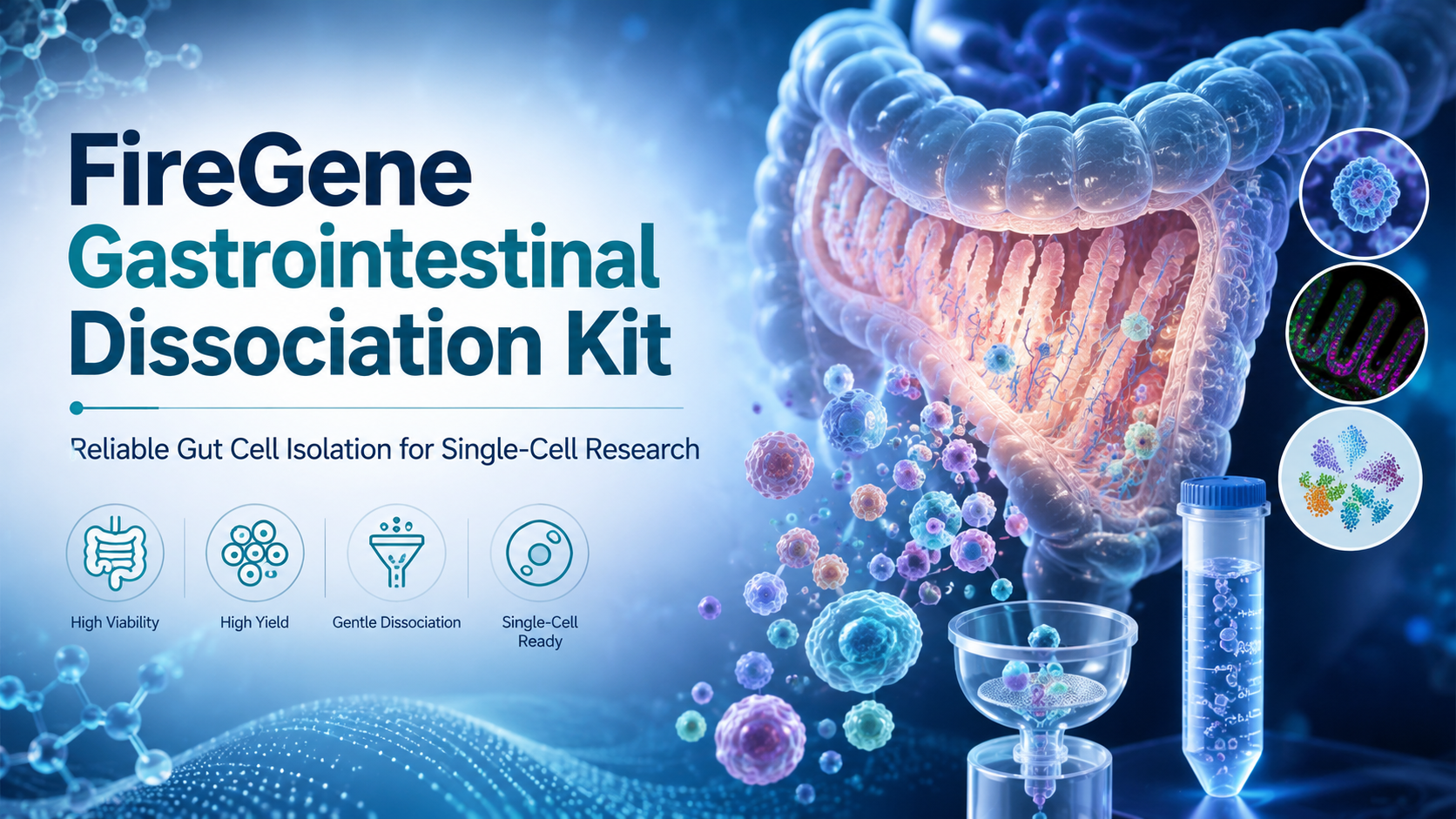
For studies that depend on accurate cellular analysis, the tissue dissociation step is critical. Poor dissociation can lead to low cell viability, biased cell recovery, excessive debris, cell clumping, or loss of fragile cell populations. The FireGene Gastrointestinal Dissociation Kit is designed to support efficient preparation of single-cell suspensions from gastrointestinal tissue, helping researchers streamline gut cell isolation for downstream applications such as single-cell RNA sequencing, flow cytometry, immune profiling, cell culture, and other cell-based assays.
Why Gastrointestinal Tissue Dissociation Is Challenging
The gastrointestinal system is one of the most complex tissue environments in the body. Unlike softer tissues that can be dissociated with relatively simple protocols, GI tissues contain multiple structural and cellular barriers. The epithelial layer is tightly connected by junctional complexes, while the lamina propria contains immune cells, fibroblasts, endothelial cells, nerves, and extracellular matrix. Depending on the tissue region, sample type, and disease state, tissue density and digestion sensitivity can vary significantly. Common challenges in GI tissue dissociation include:
· Low cell viability caused by harsh enzymatic digestion or excessive mechanical disruption.
· Incomplete dissociation due to strong epithelial and stromal structures.
· High debris levels from mucus, necrotic tissue, or damaged cells.
· Cell clumping that interferes with counting, sorting, sequencing, or culture.
· Selective cell loss, especially for fragile immune, epithelial, or stem-like populations.
· Protocol variability between operators, sample sources, or tissue conditions.
Because of these challenges, researchers often need tissue-specific dissociation reagents instead of general-purpose digestion solutions. A kit optimized for gastrointestinal samples can help reduce trial-and-error optimization and improve reproducibility across experiments.
What Is FireGene Gastrointestinal Dissociation Kit?
FireGene Gastrointestinal Dissociation Kit is an enzymatic tissue dissociation solution developed for gastrointestinal samples. It is intended to help researchers convert complex GI tissue into viable single-cell suspensions suitable for downstream cell analysis workflows.
The kit supports sample preparation for research areas such as:
· Gastrointestinal disease research
· Intestinal inflammation studies
· Colorectal cancer research
· Gut immune microenvironment analysis
· Host–microbiota interaction research
· Organoid and regenerative medicine studies
· Single-cell sequencing sample preparation
· Flow cytometry and cell-based detection
By providing a standardized enzymatic digestion system, the kit helps researchers prepare gut-derived cells in a more controlled and reproducible way. This is especially important for experiments where cell viability, RNA quality, cell-type representation, and downstream assay performance are essential.
How the Kit Supports High-Quality Gut Cell Isolation
The key goal of gastrointestinal dissociation is not simply to break tissue apart. The objective is to release viable, analyzable cells while preserving the biological information needed for downstream research. For single-cell sequencing, for example, over-digestion or excessive stress may alter gene expression profiles. For immune profiling, poor recovery of lymphocytes, macrophages, dendritic cells, or other mucosal immune populations can affect interpretation. For culture or organoid workflows, cell survival and functional integrity are particularly important.
The FireGene Gastrointestinal Dissociation Kit supports gut cell isolation by helping researchers:
1. Generate Single-Cell Suspensions
The kit is designed to digest gastrointestinal tissue into a suspension that can be filtered, counted, and processed for single-cell workflows. A high-quality single-cell suspension reduces the risk of clogging instruments and improves compatibility with flow cytometry, cell sorting, and sequencing platforms.
2. Preserve Cell Viability
Gentle but effective enzymatic digestion is important for maintaining viable cells. Excessive digestion, overheating, or harsh mechanical disruption can damage cell membranes and reduce recovery. A dedicated dissociation kit helps provide a controlled approach to cell release.
3. Improve Reproducibility
Manual preparation of enzyme mixtures can introduce variability between experiments. A kit-based workflow helps standardize the dissociation process, making it easier to compare results across samples, operators, and experimental batches.
4. Support Multiple Downstream Applications
Single-cell suspensions prepared from gastrointestinal tissue can be used in many research workflows, including scRNA-seq, flow cytometry, immune phenotyping, culture, cell sorting, viability assays, and functional studies.
Key Applications of FireGene Gastrointestinal Dissociation Kit
Single-Cell RNA Sequencing
Single-cell RNA sequencing has transformed gastrointestinal research by allowing researchers to profile cell populations at high resolution. In gut tissues, scRNA-seq can reveal epithelial subtypes, immune cell states, stromal populations, stem-like cells, inflammatory signatures, and disease-associated transcriptional programs.
However, sequencing quality begins with sample preparation. A poor dissociation process may lead to dead cells, ambient RNA contamination, biased cell recovery, or stress-induced gene expression. Using a gastrointestinal tissue dissociation kit can help researchers obtain cleaner, more viable single-cell suspensions for downstream transcriptomic analysis.
Immune Profiling and Flow Cytometry
The gut is one of the largest immune organs in the body. Mucosal immune cells play important roles in inflammation, infection, cancer, microbiota interaction, and tissue repair. Researchers studying intestinal immune responses often need to isolate immune cells from lamina propria, tumors, inflamed tissues, or disease models.
The FireGene Gastrointestinal Dissociation Kit can support immune profiling workflows by helping release viable cells from GI tissue for flow cytometry, cell sorting, and related assays. This can be useful in studies of inflammatory bowel disease, mucosal immunity, tumor immune microenvironments, and host defense mechanisms.
Colorectal Cancer Research
In colorectal cancer research, tissue dissociation is often used to analyze tumor cells, immune infiltrates, stromal components, and tumor microenvironment interactions. A high-quality single-cell suspension can support studies of tumor heterogeneity, immune evasion, cancer-associated fibroblasts, and therapy response.
Because tumor tissue may be dense, fibrotic, necrotic, or highly heterogeneous, optimized dissociation conditions are important. A tissue-specific kit can help researchers process GI tumor samples more consistently.
Gut Microbiota and Host–Microbe Interaction Studies
The gut microbiota influences epithelial function, immune regulation, inflammation, metabolism, and disease susceptibility. To study host responses to microbial changes, researchers often analyze gastrointestinal tissues at the cellular level. Dissociation of gut tissue allows researchers to examine how epithelial cells, immune cells, and stromal cells respond to microbial colonization, infection, dysbiosis, or therapeutic intervention.
Organoid and Regenerative Medicine Research
Gastrointestinal organoids are widely used to study epithelial development, stem cell biology, disease modeling, drug response, and tissue repair. Preparing viable gut-derived cells is an important upstream step in many organoid and regenerative medicine workflows. The FireGene Gastrointestinal Dissociation Kit can help support the preparation of cells for culture-based applications where viability and cell integrity are essential.
Typical Workflow for Gastrointestinal Tissue Dissociation
Although researchers should always follow the product protocol, a general GI tissue dissociation workflow often includes the following steps:
1. Sample preparation
Fresh gastrointestinal tissue is collected and washed to remove blood, mucus, or unwanted contaminants.
2. Tissue mincing
The tissue is cut into small fragments to increase the surface area for enzymatic digestion.
3. Enzymatic digestion
Tissue fragments are incubated with the dissociation reagents under recommended conditions.
4. Gentle mixing
Controlled agitation helps improve tissue digestion while minimizing cell damage.
5. Filtration
The digested sample is passed through a cell strainer to remove undigested fragments and large debris.
6. Cell washing
Cells are washed and resuspended in a suitable buffer or medium.
7. Cell counting and viability assessment
Cell concentration and viability are measured before downstream analysis.
8. Downstream application
The resulting single-cell suspension can be used for sequencing, flow cytometry, cell sorting, culture, or other assays.
Tips for Better GI Tissue Dissociation Results
To maximize cell recovery and viability, researchers should consider several practical factors:
Use Fresh, Properly Handled Tissue
Sample quality strongly affects dissociation outcome. Fresh tissue generally provides better viability than poorly stored or delayed samples. If immediate processing is not possible, appropriate tissue storage conditions should be used.
Avoid Over-Digestion
Long digestion times may increase cell yield but can reduce viability and alter cell-surface markers or gene expression. Researchers should optimize digestion time based on tissue type, sample size, and downstream application.
Minimize Mechanical Stress
Vigorous pipetting, excessive vortexing, or harsh grinding can damage cells. Gentle mechanical assistance is usually preferred, especially when preparing cells for single-cell sequencing or culture.
Remove Debris and Clumps
GI samples can contain mucus, dead cells, and tissue debris. Filtration and cleanup steps help improve suspension quality and reduce downstream complications.
Validate Before Downstream Analysis
Before sequencing or flow cytometry, researchers should check cell concentration, viability, and aggregation status. This step helps prevent sample loss and improves data reliability.
Why Choose a Tissue-Specific Gastrointestinal Dissociation Kit?
A tissue-specific kit offers several advantages over generic digestion reagents. Gastrointestinal tissue has unique structural and biochemical properties, so a general dissociation method may not provide optimal performance. A dedicated GI dissociation kit can help researchers reduce optimization time, improve workflow consistency, and obtain single-cell suspensions better suited for sensitive downstream applications.
For laboratories running multiple GI tissue experiments, standardization is especially valuable. Consistent sample preparation reduces technical variability and allows researchers to focus on biological differences rather than protocol artifacts.
Conclusion
High-quality gastrointestinal tissue dissociation is a crucial step in modern gut research. Whether the goal is single-cell RNA sequencing, immune profiling, colorectal cancer analysis, microbiota-related studies, organoid culture, or regenerative medicine research, the reliability of downstream data depends heavily on the quality of the initial single-cell suspension.
The FireGene Gastrointestinal Dissociation Kit provides a practical solution for researchers working with complex GI tissue samples. By supporting efficient enzymatic dissociation, viable cell recovery, and downstream assay compatibility, it helps streamline gut cell isolation and improves consistency in gastrointestinal research workflows.
For laboratories studying intestinal biology, inflammation, cancer, host–microbe interactions, or tissue regeneration, this kit can serve as a valuable sample preparation tool for generating high-quality single-cell suspensions from gastrointestinal tissue.
FireGene, light your research with passion, innovation, and profession.
FireGene Single-Cell Sample Prep
Looking for validated dissociation kits?
FireGene's tissue dissociation kits are optimized for specific organ types — brain, tumor, liver, GI, reproductive, and more. Validated for 10x Genomics Chromium and BD Rhapsody workflows.


