
Introduction: The Challenge of Liver Tissue Dissociation
The liver is a highly complex and heterogeneous organ composed of multiple cell types, including hepatocytes, Kupffer cells, liver sinusoidal endothelial cells (LSECs), and hepatic stellate cells. These cells are embedded within a dense extracellular matrix and organized into intricate microarchitectural units, making tissue dissociation particularly challenging. Efficiently isolating viable and representative single cells from liver tissue is a critical prerequisite for downstream cellular and molecular analyses.
Traditional liver dissociation methods often rely on harsh enzymatic digestion or mechanical disruption, which can compromise cell integrity. These approaches frequently result in reduced cell viability, disruption of fragile cell populations, and loss of important surface markers. In addition, RNA degradation during suboptimal processing can significantly affect the accuracy of transcriptomic studies, particularly in sensitive applications such as single-cell RNA sequencing.
As liver research increasingly shifts toward high-resolution techniques—such as single-cell sequencing, flow cytometry, and advanced cell culture systems—the demand for high-quality single-cell suspensions has grown substantially. Researchers require methods that not only efficiently dissociate tissue but also preserve cellular diversity, functionality, and molecular integrity.
These challenges highlight the need for optimized and standardized dissociation solutions. Advanced tools designed specifically for liver tissue can help overcome the limitations of conventional methods, enabling more reliable and reproducible insights into liver biology and disease mechanisms.
Overview of the FireGene Liver Dissociation Kit
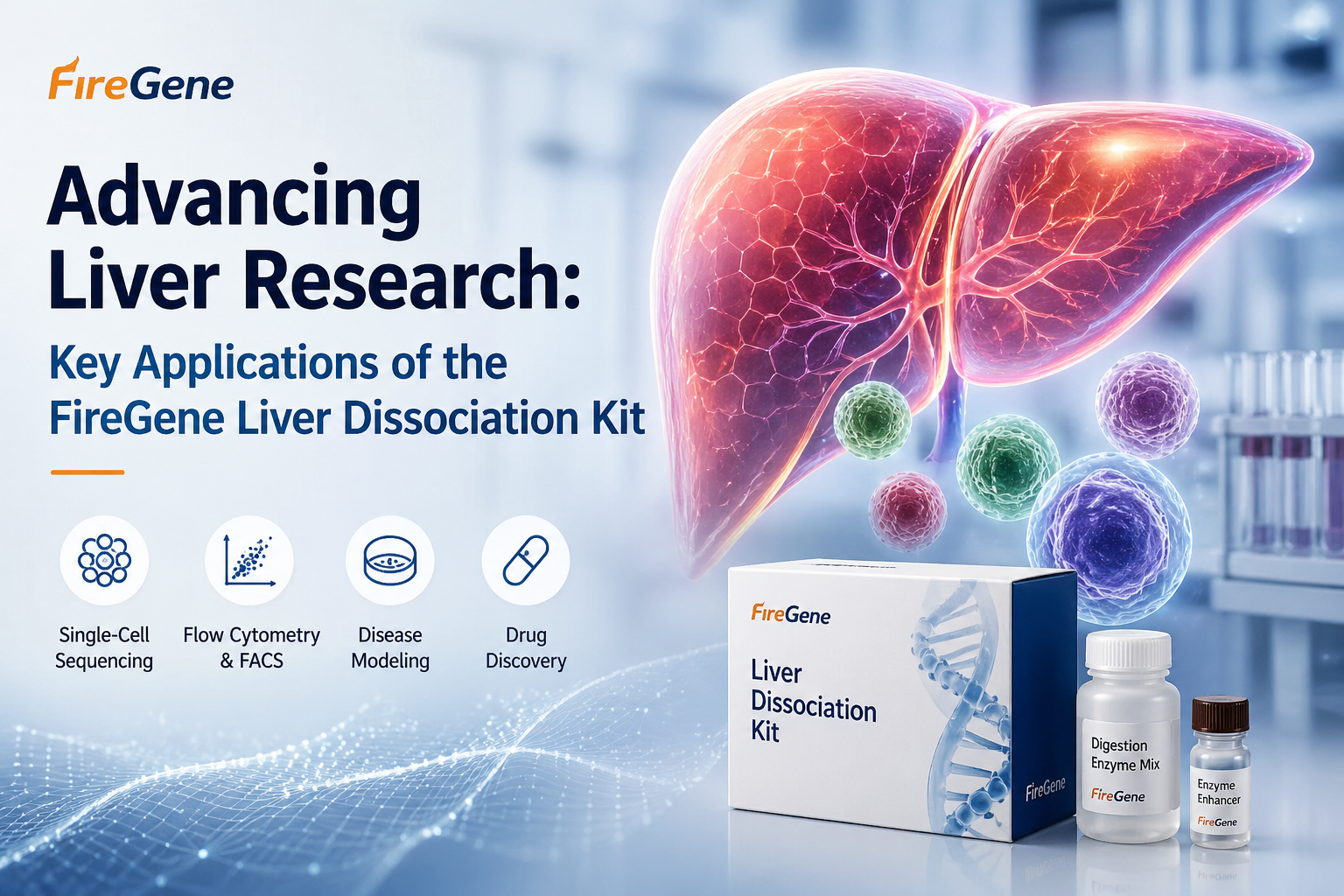
The FireGene Liver Dissociation Kit is designed to address the technical limitations associated with conventional liver tissue processing by providing a controlled and optimized enzymatic dissociation system. At its core, the kit utilizes a carefully balanced enzyme cocktail that efficiently degrades extracellular matrix components while minimizing damage to cellular structures. This enables the generation of high-quality single-cell suspensions suitable for a wide range of downstream applications.
A key advantage of this system lies in its ability to combine digestion efficiency with cellular preservation. Unlike overly aggressive protocols, the FireGene approach is optimized to maintain cell viability and reduce mechanical stress, thereby protecting fragile liver cell populations such as hepatocytes and sinusoidal endothelial cells. At the same time, it helps preserve cell surface epitopes, which are essential for accurate immunophenotyping and cell sorting workflows.
In addition to structural integrity, the kit is also engineered to support molecular fidelity. By limiting RNA degradation during the dissociation process, it ensures that isolated cells retain transcriptomic profiles that more closely reflect their in vivo state. This is particularly important for high-resolution analyses such as single-cell RNA sequencing.
The workflow is streamlined and reproducible, allowing researchers to process liver tissue samples with greater consistency across experiments. Overall, the FireGene Liver Dissociation Kit serves as a robust foundation for generating reliable single-cell inputs for advanced liver research.
Core Applications in Single-Cell and Cellular Analysis
The primary value of the FireGene Liver Dissociation Kit lies in its ability to generate high-quality single-cell suspensions that are compatible with a broad range of downstream analytical platforms. Among these, single-cell sequencing technologies—such as scRNA-seq and multi-omics approaches—represent one of the most important applications. By preserving cell viability and RNA integrity, the kit enables accurate profiling of liver cell heterogeneity, allowing researchers to identify distinct cell populations and uncover functional states that are often masked in bulk analyses.
In parallel, the kit is well-suited for flow cytometry and fluorescence-activated cell sorting (FACS). The preservation of cell surface markers during dissociation is critical for reliable immunophenotyping, particularly when studying complex immune populations within the liver. This makes it possible to isolate specific subsets, such as Kupffer cells or liver sinusoidal endothelial cells, with high precision for further analysis. Another key application is the isolation of primary liver cells for in vitro studies. High-quality dissociation facilitates the recovery of viable hepatocytes and non-parenchymal cells, which can be used in functional assays, metabolic studies, and cell-based models. These systems are essential for investigating liver physiology and cellular responses under controlled conditions.
Overall, by minimizing cell damage and bias, the kit enhances the reliability and reproducibility of cellular analyses, making it a valuable tool across diverse experimental workflows.
Applications in Disease Modeling and Drug Discovery
The FireGene Liver Dissociation Kit plays a significant role in advancing liver disease research and drug development by enabling the isolation of high-quality, representative cell populations from complex tissue samples. In disease modeling, particularly for conditions such as hepatocellular carcinoma (HCC), liver fibrosis, non-alcoholic steatohepatitis (NASH), and inflammatory liver diseases, the ability to preserve cellular diversity is essential. Accurate dissociation allows researchers to study disease-associated changes at the cellular level, including shifts in cell composition, activation states, and intercellular interactions. In oncology research, the kit supports detailed analysis of the tumor microenvironment. By maintaining the integrity of both malignant and non-malignant cell populations, it becomes possible to investigate immune infiltration, stromal contributions, and tumor heterogeneity. These insights are critical for understanding disease progression and identifying novel therapeutic targets.
The kit is also highly valuable in drug discovery workflows. High-quality primary liver cells can be used for compound screening, mechanism-of-action studies, and hepatotoxicity assessment. Since the dissociated cells more closely reflect in vivo physiology, experimental results tend to be more predictive and translationally relevant.
Additionally, the preservation of rare or sensitive cell populations enables more comprehensive biomarker discovery efforts. Overall, the FireGene Liver Dissociation Kit provides a reliable foundation for generating biologically meaningful data in both basic research and translational applications.
Advantages and Research Impact
The FireGene Liver Dissociation Kit offers several advantages that directly influence the quality and reliability of downstream research. One of its most significant benefits is the consistent generation of high cell viability and yield, which is essential for experiments that depend on intact and functional cells. By reducing mechanical and enzymatic stress during tissue processing, the kit helps maintain the physiological state of isolated cells, leading to more accurate experimental outcomes.
Another important advantage is the preservation of rare and sensitive cell populations. Liver tissue contains diverse cell types that can be easily lost or damaged during conventional dissociation. By protecting these populations, the kit enables a more comprehensive representation of the liver microenvironment, which is critical for both basic and translational studies.
Reproducibility is also enhanced through a standardized workflow. Consistent dissociation conditions minimize batch-to-batch variability, allowing researchers to generate comparable data across experiments and studies. This is particularly valuable in large-scale projects and multi-sample analyses.
Overall, the FireGene Liver Dissociation Kit supports advanced research technologies, including single-cell sequencing and precision medicine approaches. By improving the starting material quality, it contributes to more robust data generation and accelerates progress in liver biology and therapeutic development.
FireGene, light your research with passion, innovation, and profession.
FireGene Single-Cell Sample Prep
Looking for validated dissociation kits?
FireGene's tissue dissociation kits are optimized for specific organ types — brain, tumor, liver, GI, reproductive, and more. Validated for 10x Genomics Chromium and BD Rhapsody workflows.


