
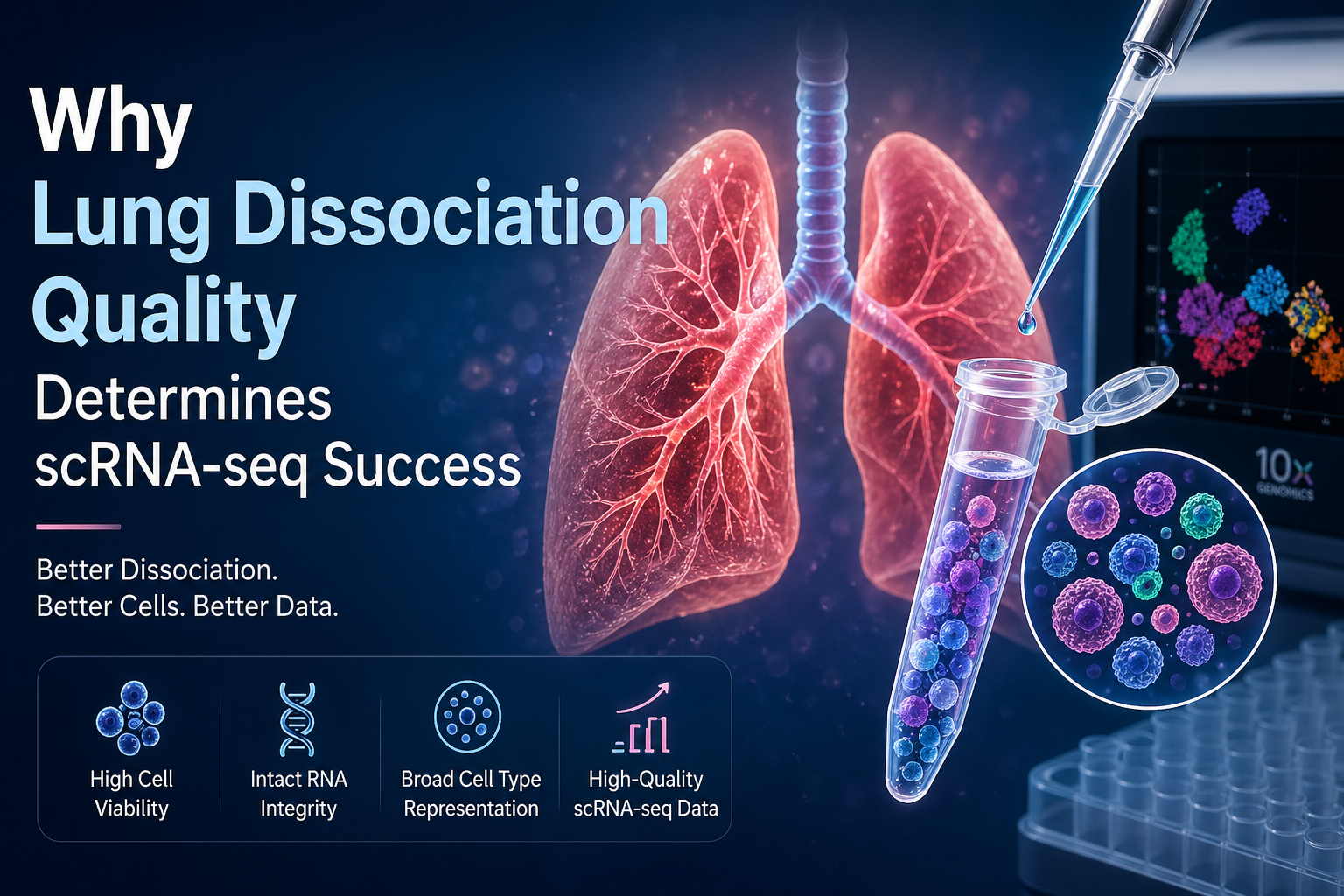
Single-cell RNA sequencing (scRNA-seq) has transformed our ability to decode the cellular complexity of lung tissue. From mapping tumor microenvironments in lung cancer to dissecting immune responses in pulmonary fibrosis and infectious diseases, scRNA-seq provides an unprecedented resolution of cellular heterogeneity.
However, one critical step often determines whether these experiments succeed or fail: lung tissue dissociation.
Poor dissociation does not just reduce yield—it fundamentally distorts biological interpretation. Understanding why dissociation quality matters, and how optimized solutions like lung-specific dissociation kits improve outcomes, is essential for generating reliable single-cell data.
The Unique Challenge of Lung Tissue
Unlike softer tissues such as spleen or blood, the lung presents a structurally complex and mechanically resilient environment. Its architecture is defined by:
· Dense extracellular matrix (ECM) rich in collagen and elastin
· Highly interconnected alveolar structures
· Diverse and fragile cell populations
· Tight epithelial-endothelial interfaces
This complexity creates a paradox:
You need sufficient enzymatic digestion to release cells, but excessive digestion damages them.
Standard dissociation protocols often fail to strike this balance. Overly aggressive conditions can destroy sensitive cell types like alveolar epithelial cells, while insufficient digestion leads to clumping and biased cell recovery.
Why Dissociation Quality Directly Impacts scRNA-seq
In scRNA-seq workflows, the input material must meet strict criteria:
· High cell viability
· Minimal debris
· Low doublet rate
· Intact RNA profiles
Dissociation is the step that determines all of these. 1. Cell Viability and Recovery
Harsh enzymatic conditions or prolonged digestion can induce apoptosis or necrosis. Dead or dying cells release RNA into the solution, increasing background noise and reducing sequencing efficiency.
Low viability also leads to underrepresentation of key populations, skewing downstream analysis.
2. Preservation of Fragile Cell Types
Certain lung cells are particularly sensitive:
· Type I alveolar epithelial cells
· Type II pneumocytes
· Endothelial cells
· Tissue-resident immune cells
These populations are often the most biologically informative. If dissociation selectively damages them, your dataset becomes inherently biased.
3. Transcriptomic Integrity
Dissociation is not a neutral process—it can actively alter gene expression.
Stress responses triggered during digestion can lead to:
· Upregulation of heat shock proteins
· Activation of inflammatory pathways
· Rapid transcriptional changes
This phenomenon, known as dissociation-induced artifacts, can obscure true biological signals and lead to misinterpretation.
4. Cell Aggregation and Doublets
Incomplete digestion results in:
· Cell clumps
· Aggregates passing through filtration
· Increased doublet rates in droplet-based sequencing systems
Doublets artificially merge transcriptomes from multiple cells, creating false cell types or misleading clusters in analysis.
The Limitations of Generic Dissociation Protocols
Many laboratories still rely on general-purpose enzymes such as collagenase or trypsin. While these can work for simpler tissues, they are often suboptimal for lung applications.
Common issues include:
· Inconsistent digestion efficiency
· Batch-to-batch variability
· Overdigestion or underdigestion
· Poor reproducibility across experiments
Without tissue-specific optimization, researchers are forced into trial-and-error workflows that waste both time and valuable samples.
The Case for Lung-Specific Dissociation Systems
To address these challenges, modern workflows increasingly rely on tissue-specific dissociation kits designed around the biological properties of lung tissue.
These systems typically incorporate:
· Optimized enzyme blends targeting lung ECM components
· Controlled digestion kinetics
· Protocols that minimize mechanical stress
· Standardized workflows for reproducibility
The result is a more controlled dissociation process that improves both cell quality and experimental consistency.
Key Features of an Effective Lung Dissociation Kit
When selecting a dissociation system for scRNA-seq, several technical factors are critical:
Balanced Enzymatic Activity
A combination of enzymes should efficiently break down ECM components without overexposing cells to proteolytic damage.
Controlled Digestion Time
Optimized protocols prevent prolonged exposure that can compromise RNA integrity.
Compatibility with Downstream Workflows
The output should be directly suitable for platforms such as:
· 10x Genomics Chromium
· Drop-seq systems
· Flow cytometry and sorting
Preservation of Cellular Diversity
The system must maintain representation across epithelial, stromal, and immune compartments.
How Optimized Kits Improve Data Quality
Using a lung-specific dissociation kit significantly enhances several aspects of scRNA-seq output:
Improved Cell Yield
Efficient digestion ensures maximal recovery from limited or precious tissue samples.
Higher Viability Rates
Gentler processing reduces cell death and improves sequencing efficiency.
Reduced Technical Noise
Minimized stress responses preserve native gene expression profiles.
Better Reproducibility
Standardized protocols reduce variability between experiments and operators.
Example: FireGene Lung Dissociation Kit (scRNA-seq Compatible)
An example of this approach is the FireGene Lung Dissociation Kit, which is specifically engineered for single-cell applications.
Its design reflects key principles required for high-quality lung dissociation:
· Enzyme formulations tailored to lung ECM composition
· Conditions optimized to preserve fragile pulmonary cell types
· Workflow compatibility with scRNA-seq platforms
· Reduced aggregation and improved single-cell suspension quality
By addressing the core bottlenecks of lung tissue processing, such systems help ensure that sequencing results accurately reflect in vivo biology rather than technical artifacts.
Best Practices for Lung Dissociation in scRNA-seq
Even with optimized kits, proper technique remains essential. The following practices can further improve outcomes:
Minimize Processing Time
Delays between tissue collection and dissociation increase cell death and RNA degradation.
Optimize Tissue Handling
Gentle mechanical disruption reduces shear stress and preserves cell integrity.
Monitor Digestion Progress
Avoid overdigestion by checking tissue dissociation periodically.
Incorporate Cleanup Steps
Post-dissociation processing may include:
· RBC lysis
· Dead cell removal
· Debris filtration
These steps improve overall sample quality before sequencing.
The Downstream Impact: Data You Can Trust
Ultimately, the goal of scRNA-seq is not just to generate data, but to generate biologically meaningful insights.
High-quality dissociation enables:
· Accurate identification of rare cell populations
· Reliable differential gene expression analysis
· Clearer clustering and cell-type annotation
· Better reproducibility across studies
Conversely, poor dissociation introduces noise, bias, and artifacts that can compromise entire datasets.
Conclusion
In lung scRNA-seq workflows, dissociation is not a routine preparatory step—it is a determinant of experimental success.
The structural complexity of lung tissue demands carefully optimized dissociation strategies that balance efficiency with preservation. Tissue-specific solutions, such as lung-targeted enzymatic kits, provide a practical way to achieve this balance while improving reproducibility and data quality.
As single-cell technologies continue to advance, the importance of upstream sample preparation will only increase. Investing in high-quality lung dissociation is not just a technical decision—it is a strategic one that directly impacts the reliability and interpretability of your research.
FireGene, light your research with passion, innovation, and profession.
FireGene Single-Cell Sample Prep
Looking for validated dissociation kits?
FireGene's tissue dissociation kits are optimized for specific organ types — brain, tumor, liver, GI, reproductive, and more. Validated for 10x Genomics Chromium and BD Rhapsody workflows.


