
Introduction
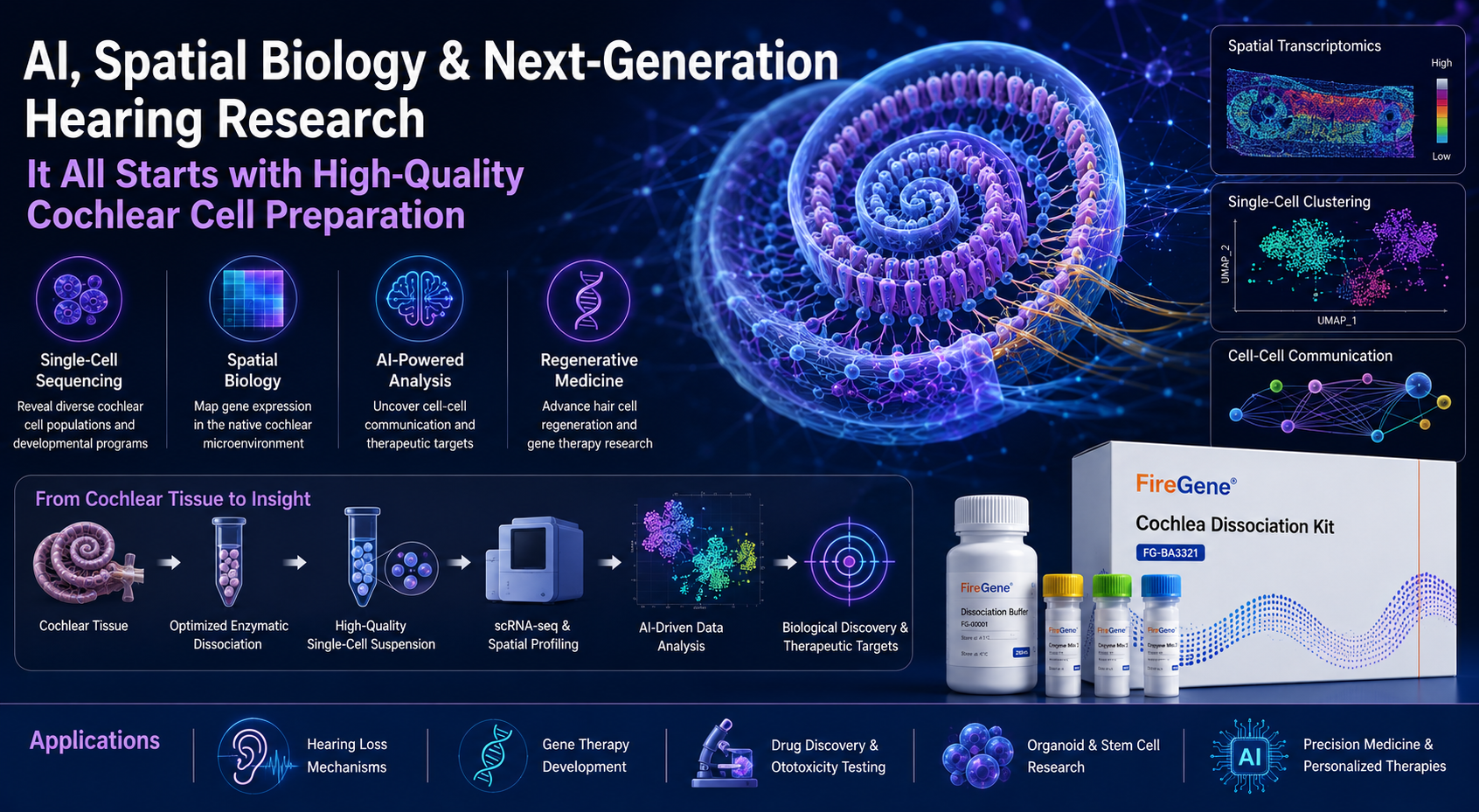
The convergence of artificial intelligence, spatial biology, single-cell sequencing, and regenerative medicine is redefining the future of hearing research.
In 2026, auditory science is no longer limited to studying bulk cochlear tissue. Researchers can now investigate:
- Individual cochlear cell populations
- Spatial gene expression patterns
- Cell-cell communication networks
- Regenerative signaling pathways
- Disease-specific transcriptional changes
These technologies are helping scientists better understand:
- Sensorineural hearing loss
- Age-related hearing degeneration
- Genetic deafness
- Noise-induced cochlear injury
- Ototoxicity
At the center of these innovations lies a deceptively simple but essential requirement: high-quality cochlear cell preparation.
The FireGene Cochlea Dissociation Kit was developed to support modern auditory research by enabling efficient isolation of viable cochlear cells suitable for advanced downstream applications.
The Era of Spatial Biology in Hearing Research
Spatial biology is one of the fastest-growing areas in biomedical science.
Unlike traditional sequencing, spatial transcriptomics preserves information about where cells are located within tissues.
This is especially important in the cochlea because:
- Cell organization is highly specialized
- Hair cells exhibit spatial gradients
- Supporting cells have region-specific functions
- Neural connectivity influences auditory processing
Researchers now use spatial biology to study:
- Hair cell degeneration
- Cochlear inflammation
- Neural circuit remodeling
- Developmental signaling
However, successful spatial workflows often depend on high-quality tissue handling before analysis begins.
Damaged cells or degraded RNA can compromise:
- Spatial mapping accuracy
- Cell annotation
- Molecular interpretation
Single-Cell Sequencing Is Becoming Standard in Auditory Research
Single-cell RNA sequencing has transformed inner ear biology.
Recent studies have constructed detailed cochlear atlases that identify:
- Hair cell subtypes
- Schwann cell populations
- Spiral ganglion neuron diversity
- Supporting cell heterogeneity
- Conserved developmental pathways
These discoveries are reshaping our understanding of:
- Hearing loss progression
- Cellular regeneration
- Therapeutic targeting
But sequencing results are highly dependent on sample preparation quality.
Poor dissociation can introduce:
- Cell death artifacts
- RNA degradation
- Stress-response signatures
- Cell loss bias
This makes cochlea-specific dissociation increasingly important.
Why Cochlear Tissue Requires Specialized Handling
The cochlea presents unique technical challenges.
Structural Fragility
Hair cells are extremely sensitive to:
- Mechanical stress
- Overdigestion
- Temperature fluctuations
Low Cell Abundance
The cochlea contains relatively few target cells compared with other tissues.
Complex Extracellular Matrix
Dense extracellular structures make efficient dissociation difficult without damaging cells.
High Sensitivity to Processing Artifacts
Even small protocol differences can affect:
- Transcriptomic profiles
- Sequencing quality
- Reproducibility
General-purpose dissociation methods often fail to preserve these delicate structures effectively.
How the FireGene Cochlea Dissociation Kit Addresses These Challenges
The FireGene Cochlea Dissociation Kit is optimized specifically for cochlear tissue applications.
According to the product overview, the kit supports:
- Hair cell isolation
- Auditory neuron recovery
- High cell viability
- Single-cell sequencing workflows
The enzymatic strategy is designed to:
- Reduce excessive digestion
- Preserve transcriptomic integrity
- Improve reproducibility
- Minimize mechanical damage
This is particularly important for next-generation sequencing applications.
AI Is Reshaping Hearing Research
Artificial intelligence is now widely used in:
- Transcriptomic clustering
- Cell-type annotation
- Drug target prediction
- Regenerative pathway analysis
- Multi-omics integration
The Hearing Restoration Project has emphasized the growing role of AI and single-cell datasets in advancing auditory regeneration research.
However, AI systems rely heavily on data quality.
If dissociation introduces artifacts, machine-learning models may:
- Misclassify cells
- Overestimate inflammatory pathways
- Miss rare cell populations
- Produce misleading conclusions
Standardized cell preparation therefore becomes essential for reliable AI-assisted biology.
Hearing Loss Therapeutics Depend on Accurate Cellular Analysis
The hearing therapeutics market is expanding rapidly.
Researchers are actively investigating:
- Hair cell regeneration
- Stem-cell therapies
- Gene replacement
- Neuroprotective compounds
- CRISPR editing
- Small-molecule therapeutics
Recent clinical updates demonstrate increasing momentum in hearing-loss gene therapy development.
To evaluate therapeutic outcomes, scientists need accurate analysis of:
- Cell survival
- Gene expression
- Regenerative signaling
- Immune activation
- Neural plasticity
High-quality dissociation workflows are critical for these analyses.
Cochlear Neural Networks and Transcriptomic Complexity
Recent transcriptomic studies reveal that cochlear function depends not only on hair-cell survival but also on broader neural competence programs involving:
- Excitability
- Synaptic plasticity
- Metabolic support
- Inflammatory regulation
This growing complexity means researchers must preserve as many native cellular states as possible during tissue processing.
Suboptimal dissociation can erase biologically important information.
Cochlear Organoids and Drug Discovery
Organoid systems are increasingly used in:
- Ototoxicity screening
- Hearing-loss modeling
- Drug testing
- Regenerative medicine
Recent reviews describe how inner ear organoids are becoming important platforms for precision drug discovery.
Successful organoid generation depends heavily on:
- Viable progenitor cells
- Healthy auditory neurons
- Preserved differentiation potential
This again highlights the importance of optimized dissociation workflows.
Best Practices for High-Quality Cochlear Cell Preparation
Use Cochlea-Specific Dissociation Protocols
Specialized protocols help preserve fragile auditory cells.
Reduce Mechanical Stress
Gentle handling minimizes cell damage.
Optimize Digestion Timing
Overdigestion may compromise:
- Viability
- RNA quality
- Cell morphology
Process Samples Quickly
Rapid processing improves transcriptomic integrity.
Validate Cell Quality Before Sequencing
Assess:
- Viability
- Cell concentration
- Debris
- Aggregation
before downstream analysis.
Future Outlook
The future of auditory research will increasingly combine:
- AI-driven analysis
- Spatial biology
- Organoid engineering
- Precision medicine
- Gene therapy
- Multi-omics integration
As these technologies become more sophisticated, sample preparation quality will become even more important.
Researchers cannot generate reliable high-resolution datasets from damaged or low-quality cochlear cells.
The FireGene Cochlea Dissociation Kit helps support modern auditory research workflows by enabling gentle and reproducible cochlear dissociation for:
- scRNA-seq
- Organoid development
- Cell culture
- Transcriptomics
- Regenerative studies
In next-generation hearing research, the path to meaningful biological insight begins with preserving the integrity of the cochlear cells themselves.
FireGene, light your research with passion, innovation, and profession.


