
Introduction
The field of hearing restoration is evolving rapidly. For decades, sensorineural hearing loss was considered largely irreversible because mammalian cochlear hair cells possess limited regenerative capacity. Today, advances in stem cell biology, organoid engineering, single-cell sequencing, and gene therapy are changing that narrative.
One of the most exciting developments is the rise of cochlear organoids.
Cochlear organoids are three-dimensional culture systems that mimic aspects of the inner ear microenvironment. These models are increasingly used to study:
- Hair cell differentiation
- Auditory neuron development
- Genetic hearing disorders
- Drug screening
- Regenerative therapies
- Personalized medicine
As the demand for inner ear organoid models grows, researchers are recognizing that one of the most critical determinants of success occurs at the very beginning of the workflow: tissue dissociation.
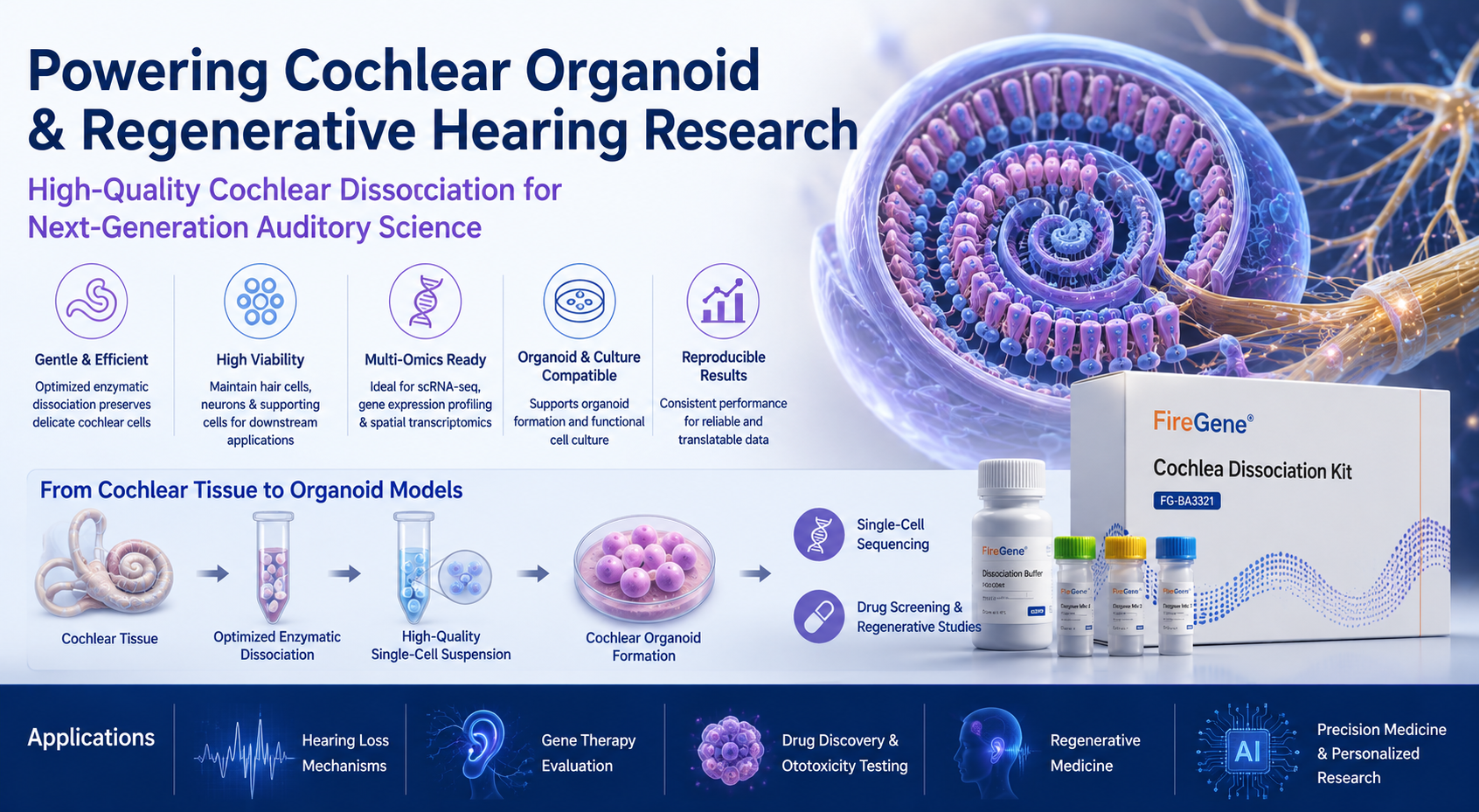
The FireGene Cochlea Dissociation Kit was designed specifically to support gentle and efficient cochlear cell isolation for advanced auditory research applications.
Why Cochlear Organoids Are Becoming a Major Trend
Traditional auditory research has relied heavily on:
- Animal models
- 2D cell cultures
- Histological analysis
While valuable, these systems have important limitations.
Animal models do not always fully replicate human hearing biology, while traditional cell cultures often fail to preserve the complex cellular interactions found in cochlear tissues.
Organoid technology offers a more physiologically relevant alternative.
Recent studies have shown that cochlear organoids can reproduce:
- Hair cell development
- Spiral ganglion neuron interactions
- Auditory signaling pathways
- Developmental transcriptional programs
Researchers are now using organoids to:
- Investigate hereditary hearing loss
- Model ototoxicity
- Screen regenerative drugs
- Evaluate gene therapies
This trend is expected to accelerate dramatically over the next several years.
The Cochlear Microenvironment Is Extremely Complex
The cochlea contains multiple specialized cell types, including:
- Inner hair cells
- Outer hair cells
- Supporting cells
- Spiral ganglion neurons
- Schwann cells
- Immune-associated populations
These cells interact through tightly regulated molecular signaling networks.
A recent cross-species single-cell atlas identified conserved transcriptional programs involved in hearing biology and hearing loss mechanisms.
To recreate this complexity in vitro, organoid systems require healthy and viable starting cell populations.
That means dissociation quality directly influences:
- Organoid formation efficiency
- Cell differentiation
- Cell survival
- Transcriptomic fidelity
- Experimental reproducibility
Why General Tissue Dissociation Methods Often Fail
The cochlea is one of the most delicate tissues in the body.
Researchers using standard dissociation methods frequently encounter:
- Low viability
- Cell clumping
- RNA degradation
- Loss of hair cells
- Excessive debris
- Poor sequencing quality
This happens because generalized enzyme formulations are usually not optimized for:
- Cochlear extracellular matrix composition
- Hair cell fragility
- Auditory neuron preservation
Mechanical dissociation can also generate excessive stress responses that alter gene expression profiles.
In single-cell sequencing workflows, this may lead to:
- Artificial inflammatory signatures
- Reduced cell diversity
- Misleading pathway analysis
As a result, auditory researchers increasingly prefer tissue-specific dissociation solutions.
How the FireGene Cochlea Dissociation Kit Supports Organoid Research
The FireGene Cochlea Dissociation Kit was developed specifically for cochlear tissue applications.
According to the product overview, the kit supports:
- Isolation of hair cells and neurons
- High cell viability
- Single-cell sequencing workflows
- Auditory regenerative studies
Key features include:
Optimized Enzymatic Digestion
The protocol is tailored to the biochemical characteristics of cochlear tissue.
Preservation of Sensitive Cell Types
Gentle digestion helps maintain:
- Hair cell integrity
- Auditory neuron viability
- Transcriptomic stability
Compatibility With Downstream Applications
The isolated cells are suitable for:
- Organoid culture
- scRNA-seq
- Cell profiling
- Functional assays
Reduced Experimental Variability
Reproducibility is especially important for:
- Multi-batch organoid studies
- Drug screening pipelines
- Comparative sequencing projects
Inner Ear Organoids and Precision Medicine
Precision medicine is becoming a central focus in hearing research.
Scientists are increasingly using patient-derived stem cells to generate personalized cochlear organoids.
These systems can help researchers:
- Model rare genetic deafness
- Predict therapeutic response
- Evaluate gene editing approaches
- Develop individualized treatments
Recent reviews highlight the growing role of organoids in personalized hearing-loss research and drug screening.
However, patient-derived organoid systems are often limited by:
- Small sample sizes
- Rare tissue availability
- High sensitivity to processing conditions
Efficient dissociation workflows are therefore essential for maximizing sample quality.
Gene Therapy Is Accelerating Auditory Research
Gene therapy has become one of the most important trends in inner ear medicine.
Several therapeutic strategies are under active investigation:
- OTOF replacement
- GJB2 correction
- CRISPR-based editing
- Hair cell regeneration
- Neuroprotective interventions
Recent clinical updates from Sensorion show growing momentum in gene therapy development for hereditary hearing loss.
To evaluate therapeutic efficacy, researchers require accurate cellular analysis of:
- Gene expression changes
- Cell survival
- Regenerative pathways
- Immune responses
This depends heavily on reliable single-cell isolation.
The Role of Single-Cell Sequencing in Cochlear Research
Single-cell sequencing has transformed auditory biology.
Researchers can now:
- Identify rare cochlear populations
- Map developmental trajectories
- Analyze intercellular communication
- Discover therapeutic targets
A major 2026 study revealed conserved regulatory networks across human and mouse cochlear tissues using single-cell analysis.
But sequencing quality depends on:
- Cell viability
- RNA integrity
- Low debris contamination
- Minimal stress-response artifacts
This is why tissue dissociation is now recognized as one of the most critical steps in the workflow.
Best Practices for Cochlear Organoid Preparation
To improve organoid success rates:
Use Tissue-Specific Dissociation Reagents
Generic enzyme systems may damage auditory cells.
Minimize Processing Time
Rapid processing helps preserve RNA quality and viability.
Avoid Excessive Mechanical Force
Gentle pipetting reduces hair cell loss.
Monitor Cell Viability Carefully
Viability assessment before culture or sequencing is essential.
Standardize Protocols
Consistent workflows improve reproducibility between experiments.
Future Directions in Auditory Regeneration
The next decade of hearing research will likely focus on:
- Hair cell regeneration
- AI-assisted transcriptomics
- Personalized medicine
- Organoid-on-chip systems
- Spatial transcriptomics
- Gene editing therapies
Several recent studies emphasize the importance of reconstructing the cochlear microenvironment in advanced organoid systems.
As technologies evolve, high-quality cochlear dissociation will remain foundational.
The success of advanced auditory workflows ultimately begins with preserving the integrity of delicate cochlear cells during isolation.
The FireGene Cochlea Dissociation Kit provides researchers with a cochlea-specific solution designed to support:
- High viability
- Reliable single-cell preparation
- Regenerative studies
- Organoid development
- Auditory transcriptomics
For researchers working at the forefront of hearing restoration science, optimized cochlear dissociation is no longer optional — it is essential.
Related Resources
- FireGene Cell Dissociation Products
- FireGene Research Solutions
- FireGene Life Science Blog
- FireGene Molecular Biology Products
FireGene, light your research with passion, innovation, and profession.


