
Introduction
Endotoxin control is an important component of biopharmaceutical manufacturing, process development, and quality assessment. Bacterial endotoxins are primarily associated with lipopolysaccharides present in the outer membrane of Gram-negative bacteria. Because these substances can enter production streams through raw materials, water systems, equipment, environmental exposure, or microbial contamination, reliable endotoxin testing is required across many stages of biological product development and manufacturing.
Biopharmaceutical samples present particular analytical challenges because they are often chemically and physically complex. Monoclonal antibodies, recombinant proteins, vaccine-related materials, peptide formulations, and nucleic acid preparations may contain proteins, salts, stabilizers, surfactants, sugars, excipients, or process-derived components that influence endotoxin assays. Consequently, an effective testing method must provide sufficient sensitivity while allowing appropriate evaluation of matrix interference.
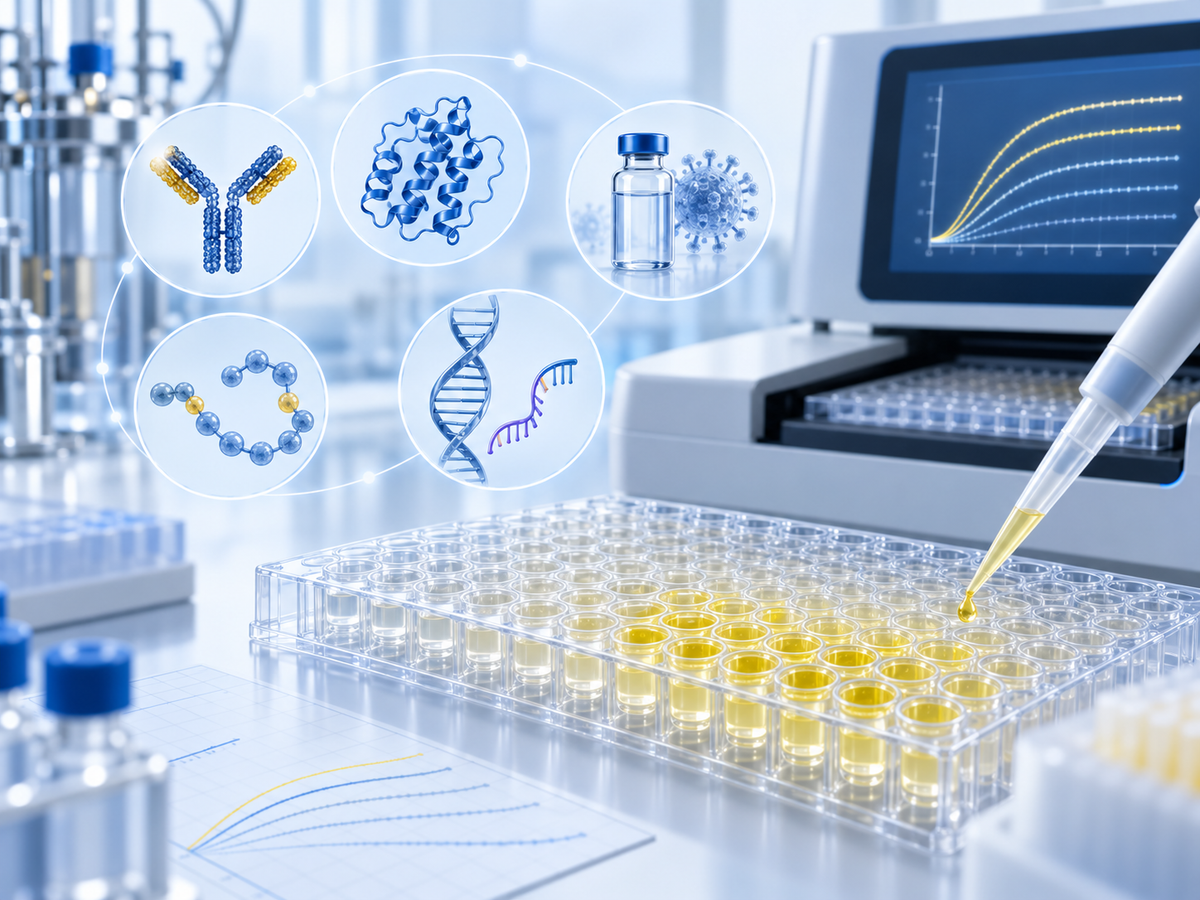
The Kinetic Chromogenic Endotoxin Test Kit is designed for quantitative endotoxin analysis based on the kinetic measurement of chromophore formation during an enzymatic reaction. Compared with endpoint approaches, kinetic chromogenic analysis continuously records the development of the reaction and calculates endotoxin concentration using a standard curve.
This analytical format can be applied to a wide range of biological samples, including monoclonal antibody solutions, recombinant proteins, vaccine intermediates, peptide preparations, DNA and RNA products, oligonucleotides, and associated process or formulation buffers.
1. Principle of the Kinetic Chromogenic Endotoxin Test
The kinetic chromogenic method is based on an endotoxin-sensitive enzymatic cascade, typically using Limulus amebocyte lysate-based reagents or an equivalent validated reaction system.
When endotoxin is present in a sample, it initiates a sequence of enzyme activation events. The activated enzyme ultimately cleaves a synthetic chromogenic substrate, releasing a colored product that can be measured spectrophotometrically.
Rather than measuring only a final absorbance value, the kinetic chromogenic method monitors the increase in absorbance over time.
The general analytical process can be summarized as:
Endotoxin Exposure → Enzymatic Cascade Activation → Chromogenic Substrate Cleavage → Color Development → Kinetic Measurement → Quantitative Calculation
The reaction time or rate of color formation is related to the amount of endotoxin present in the sample. A series of known endotoxin standards is used to generate a calibration curve, and the endotoxin concentration of unknown samples is calculated from their kinetic response.
This approach is especially useful when quantitative results are required over a broad concentration range.
2. Why Endotoxin Testing Is Important in Biopharmaceutical Manufacturing
Biological products frequently pass through multiple manufacturing stages before final formulation. Each step can potentially introduce endotoxin contamination.
Potential sources include:
purified or process water;
raw materials;
production vessels;
tubing and transfer lines;
chromatography systems;
filtration components;
formulation buffers;
excipients;
microbial contamination;
sampling containers; and
process intermediates.
Endotoxin testing may therefore be performed not only on finished products but also at critical process stages.
Routine testing can include:
Raw Materials → Process Intermediates → Purified Bulk Product → Formulated Product → Final Quality Assessment
Testing process intermediates may help researchers and manufacturing teams determine where endotoxin is introduced or removed during the production process.
The ability to quantify endotoxin at multiple stages makes kinetic chromogenic testing particularly relevant for biopharmaceutical process development and quality-control workflows.
3. Endotoxin Testing of Monoclonal Antibodies
Monoclonal antibodies represent one of the most important classes of modern biological products. Their manufacturing processes usually involve cell culture, clarification, chromatography, filtration, concentration, buffer exchange, and formulation.
Endotoxin testing may be performed on several types of monoclonal antibody samples, including:
mAb drug substance;
monoclonal antibody bulk solution;
purification intermediates;
chromatography fractions;
formulated antibody preparations;
process buffers; and
formulation buffers.
Matrix Effects in Monoclonal Antibody Samples
Monoclonal antibody solutions can present significant analytical challenges because the protein concentration may be relatively high. Formulations may also contain multiple excipients.
Typical components include:
salts;
sugars;
amino acids;
surfactants;
buffering agents;
stabilizers; and
high concentrations of protein.
These components may alter the performance of an endotoxin assay by causing either inhibition or enhancement of the reaction.
For example, a concentrated protein matrix may affect reagent accessibility or reaction kinetics, while certain buffer compositions may alter the conditions required for optimal enzyme activity.
For this reason, monoclonal antibody samples generally require product-specific interference evaluation.
A typical approach may involve:
Sample → Controlled Dilution → Positive Product Control → Kinetic Chromogenic Analysis → Recovery Evaluation → Endotoxin Calculation
Appropriate dilution can frequently reduce matrix interference while maintaining sufficient assay sensitivity.
4. Application to Recombinant Protein Samples
Recombinant proteins are another major application area for kinetic chromogenic endotoxin testing.
Relevant samples may include:
recombinant cytokines;
growth factors;
fusion proteins;
recombinant enzymes;
recombinant antigens;
receptor proteins;
purified recombinant proteins;
bulk protein solutions; and
formulation preparations.
Influence of the Expression System
The expression system used to produce a recombinant protein can influence the endotoxin risk profile.
Recombinant proteins may be expressed in:
bacterial systems;
yeast systems;
insect cells; or
mammalian cells.
Products manufactured using Gram-negative bacterial expression systems require particularly careful endotoxin monitoring because endotoxin originates from the bacterial outer membrane.
Purification processes are therefore often designed to progressively reduce endotoxin while maintaining recovery and stability of the target protein.
Endotoxin measurements at intermediate purification stages can provide useful information about the efficiency of the purification strategy.
For example:
Cell Lysate → Capture Purification → Intermediate Purification → Polishing → Bulk Protein → Formulated Product
Testing at multiple stages allows process developers to evaluate how effectively endotoxin is removed throughout the workflow.
Recombinant Protein Matrix Considerations
Important variables include:
protein concentration;
buffer composition;
ionic strength;
sample pH;
residual purification reagents;
detergents;
stabilizers; and
process additives.
Because each recombinant protein formulation has a different composition, the optimal dilution factor should be established experimentally.
5. Endotoxin Testing of Vaccine-Related Samples
Vaccine research and manufacturing may involve complex biological matrices containing proteins, peptides, polysaccharides, nucleic acids, stabilizers, salts, preservatives, or other formulation components.
Potential samples for endotoxin testing include:
vaccine bulk material;
antigen solutions;
purified antigens;
production intermediates;
formulation intermediates;
process buffers; and
selected raw materials.
The complexity of vaccine matrices means that interference evaluation is particularly important.
Components such as proteins, polysaccharides, preservatives, and high salt concentrations may influence chromogenic assay performance.
For this reason, testing usually involves determining a sample dilution that minimizes interference while remaining within the acceptable analytical range of the method.
A practical strategy can include:
Sample Characterization → Dilution Series → Spike Recovery Evaluation → Kinetic Testing → Data Review
This approach helps determine whether the sample matrix is compatible with the analytical system.
6. Endotoxin Testing of Peptide Biological Products
Peptide products have become increasingly important in biochemical research, molecular biology, pharmaceutical development, and biotechnology.
The kinetic chromogenic method can be applied to different peptide-related samples, including:
peptide bulk material;
peptide stock solutions;
peptide process intermediates;
formulated peptide solutions;
peptide-containing buffers; and
purified peptide preparations.
Analytical Challenges Associated with Peptides
Peptide samples vary considerably in their physicochemical properties.
Factors that may influence endotoxin testing include:
peptide concentration;
amino acid composition;
charge;
hydrophobicity;
aggregation;
ionic strength;
sample pH; and
formulation excipients.
Some peptides may interact with endotoxin or with components of the detection system. Highly concentrated peptide solutions may also alter the reaction environment.
As a result, direct testing of an undiluted peptide solution may not always produce reliable results.
Serial dilution is commonly used to identify a concentration at which matrix interference is minimized.
A typical workflow may include:
Peptide Sample → Dilution Series → Endotoxin Spike → Recovery Assessment → Kinetic Measurement → Final Calculation
This strategy helps distinguish true endotoxin levels from matrix-associated analytical effects.
7. Endotoxin Testing of DNA, RNA, and Oligonucleotide Products
Nucleic acid-based products represent another growing category of biological materials requiring careful contamination control.
Samples may include:
DNA preparations;
plasmid DNA;
RNA;
mRNA-related materials;
short interfering RNA;
synthetic oligonucleotides;
nucleic acid process intermediates;
formulation solutions; and
associated buffers.
Sources of Endotoxin in Nucleic Acid Production
Endotoxin can potentially enter nucleic acid production workflows through bacterial fermentation, water, reagents, equipment, or process materials.
Plasmid DNA production is particularly relevant because bacterial culture is frequently used to amplify plasmids.
Following cell harvest and lysis, purification processes are required to separate the target nucleic acid from proteins, genomic DNA, cell debris, and endotoxin.
Monitoring endotoxin during purification can therefore help assess the effectiveness of downstream processing.
Matrix Effects in Nucleic Acid Samples
Nucleic acid preparations can also produce assay interference.
Important variables may include:
high nucleic acid concentration;
viscosity;
high ionic strength;
phosphate-containing buffers;
residual purification reagents;
sample pH; and
formulation components.
Dilution is frequently useful for reducing these effects.
However, excessive dilution may lower the endotoxin concentration below the analytical sensitivity of the assay. Therefore, dilution must be selected carefully.
8. Product Interference and Spike Recovery
Matrix interference is one of the most important considerations when applying kinetic chromogenic endotoxin testing to biological products.
Interference generally falls into two categories:
Inhibition
The sample suppresses the expected endotoxin reaction, potentially producing an artificially low result.
Enhancement
The sample increases the apparent response, potentially producing a result higher than expected.
To evaluate these effects, laboratories commonly use a Positive Product Control, in which a known quantity of endotoxin is added to the sample.
The measured recovery of the added endotoxin provides information about whether the sample matrix affects the reaction.
The basic concept is:
Sample + Known Endotoxin Spike → Measurement → Recovery Calculation
If the recovery meets the acceptance criteria established for the validated method, the sample dilution can be considered suitable for testing.
If recovery falls outside the acceptable range, additional dilution or method optimization may be required.
9. Maximum Valid Dilution and Sample Preparation
Sample dilution is one of the most practical tools for controlling interference in endotoxin testing.
However, samples cannot simply be diluted indefinitely.
The Maximum Valid Dilution, or MVD, defines the maximum degree to which a sample can be diluted while still allowing detection of the applicable endotoxin limit using a method with a given sensitivity.
A general expression is:
MVD = Endotoxin Limit × Sample Concentration / Method Sensitivity
The precise calculation depends on how the endotoxin specification and sample concentration are expressed.
MVD is particularly relevant when testing complex biological products such as:
monoclonal antibodies;
recombinant proteins;
vaccines;
peptide solutions; and
nucleic acid preparations.
In practice, several sample dilutions below the MVD may be evaluated to determine which provides the most reliable recovery and repeatability.
10. Establishing a Kinetic Chromogenic Standard Curve
Quantitative analysis requires preparation of endotoxin standards at known concentrations.
The general workflow is:
Endotoxin Standard Preparation
→ Serial Dilution
→ Reaction Setup
→ Kinetic Absorbance Measurement
→ Calibration Curve Generation
→ Sample Quantification
The instrument continuously records absorbance as the chromogenic reaction develops.
Depending on the analytical system, software may determine a threshold time or reaction rate for each standard.
A relationship is then established between the kinetic response and the endotoxin concentration.
Important analytical parameters may include:
standard concentration range;
calibration curve performance;
replicate agreement;
reagent blank response;
positive product control recovery; and
sample dilution.
Consistent preparation of standards and samples is essential for reproducible kinetic analysis.
11. Typical Workflow for Biopharmaceutical Endotoxin Testing
A practical endotoxin testing workflow for biological samples may be organized as follows:
Step 1: Sample Assessment
Review the composition of the biological sample, including protein concentration, pH, salts, excipients, and other potentially interfering substances.
Step 2: Determine the Endotoxin Limit
Establish the applicable endotoxin limit based on the intended analytical or quality-control requirement.
Step 3: Calculate the Maximum Valid Dilution
Determine the allowable dilution range based on the assay sensitivity and sample characteristics.
Step 4: Prepare Sample Dilutions
Prepare one or more dilutions using appropriate endotoxin-free materials and reagents.
Step 5: Prepare Endotoxin Standards
Generate a standard series covering the validated analytical range.
Step 6: Prepare the Positive Product Control
Spike the sample with a known endotoxin concentration to evaluate inhibition or enhancement.
Step 7: Perform Kinetic Chromogenic Detection
Monitor absorbance continuously during the chromogenic reaction.
Step 8: Evaluate Assay Validity
Review the standard curve, replicate consistency, blank response, and spike recovery.
Step 9: Calculate Endotoxin Concentration
Calculate the endotoxin level in the original sample after correcting for the dilution factor.
The complete workflow can therefore be summarized as:
Sample Collection → Sample Characterization → Dilution → Interference Evaluation → Kinetic Measurement → Data Analysis → Result Review
12. Advantages of Kinetic Chromogenic Testing for Biological Products
Kinetic chromogenic endotoxin testing offers several analytical features that are particularly useful for biopharmaceutical samples.
Quantitative Measurement
The method provides numerical endotoxin concentration data rather than a simple qualitative result.
Broad Analytical Range
Multiple standards can be used to generate a calibration curve covering a useful concentration range.
Continuous Reaction Monitoring
Kinetic measurement records the progression of the chromogenic reaction rather than relying exclusively on a single endpoint measurement.
Compatibility With Sample Dilution
Complex biological matrices can often be evaluated at multiple dilutions to identify conditions that reduce interference.
Suitable for Diverse Biological Matrices
Applications can include:
monoclonal antibodies;
recombinant proteins;
cytokines;
fusion proteins;
recombinant enzymes;
vaccine-related samples;
peptide preparations;
DNA;
RNA;
oligonucleotides; and
associated process buffers.
Useful Across the Manufacturing Process
The assay can support endotoxin monitoring of raw materials, process intermediates, bulk materials, and formulated products.
Conclusion
The Kinetic Chromogenic Endotoxin Test Kit provides a quantitative approach for evaluating bacterial endotoxin in a broad range of biopharmaceutical samples. Its kinetic measurement format is well suited to laboratories requiring quantitative analysis of complex biological matrices.
Monoclonal antibodies, recombinant proteins, vaccine-related materials, peptide preparations, DNA, RNA, and oligonucleotide products each present different analytical challenges. Protein concentration, pH, ionic strength, excipients, residual process reagents, and other matrix components can influence assay performance.
For this reason, reliable endotoxin analysis requires more than simply adding a sample to the assay system. Appropriate sample dilution, Maximum Valid Dilution assessment, interference evaluation, Positive Product Control testing, standard curve validation, and careful data interpretation are essential components of a robust analytical workflow.
When properly validated for a specific product matrix, kinetic chromogenic endotoxin testing can provide a practical platform for endotoxin monitoring throughout biopharmaceutical research, process development, manufacturing, and quality-control activities.


