
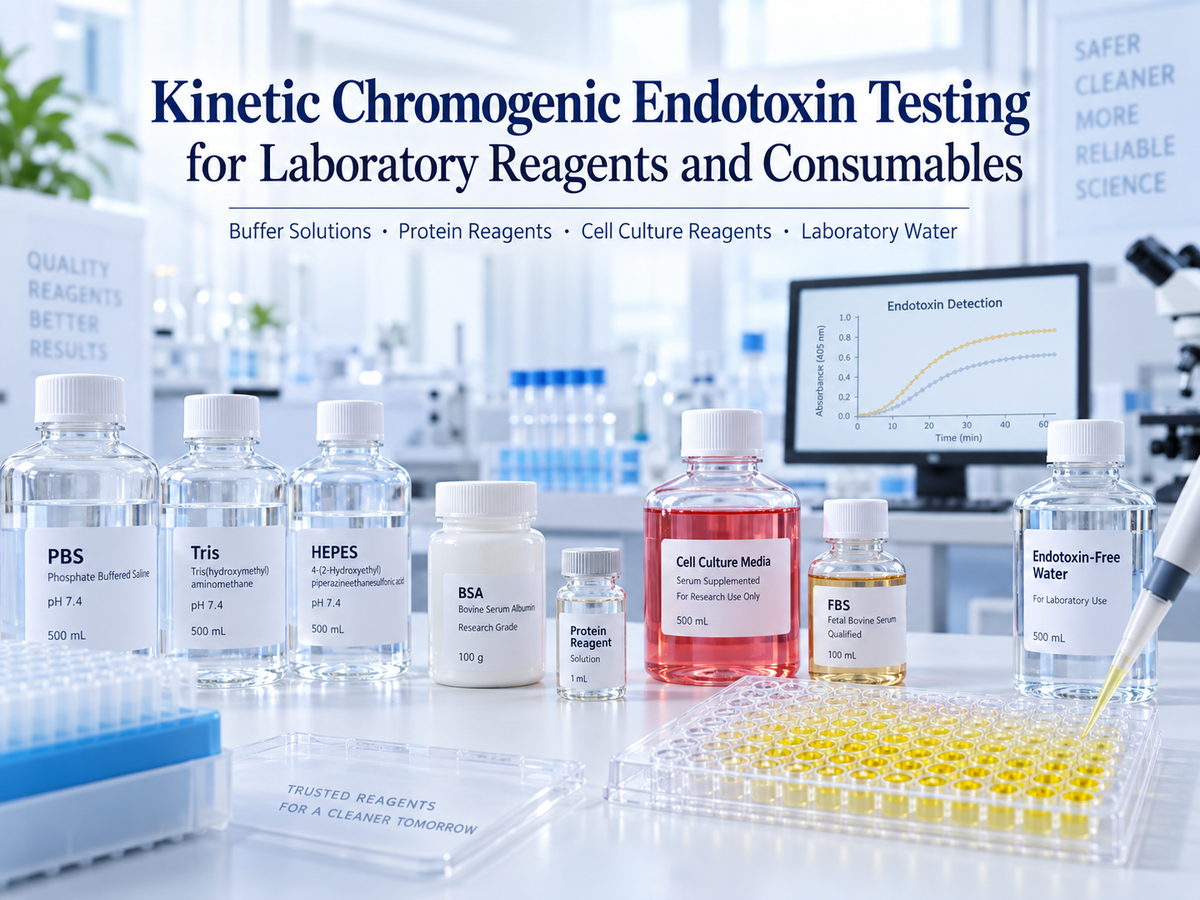
Laboratory reagents and consumables can be important sources of unintended endotoxin contamination in pharmaceutical development, biotechnology research, cell culture, protein purification, and analytical workflows. Even when a reagent appears chemically simple or microbiologically clean, trace levels of bacterial endotoxin may still be present and can affect downstream experiments, particularly those involving immune signaling, recombinant proteins, sensitive cell systems, or biologically active molecules.
The kinetic chromogenic endotoxin assay provides a quantitative approach for measuring bacterial endotoxin in a wide range of laboratory reagents. The method is based on endotoxin-mediated activation of the Limulus Amebocyte Lysate, or LAL, enzymatic cascade, followed by generation of a chromogenic signal. The rate of color development is monitored kinetically and used to calculate endotoxin concentration.
Because many laboratory reagents are water-based and relatively transparent, they are often suitable for kinetic chromogenic endotoxin testing. However, reagent composition can strongly influence assay performance. Salts, proteins, detergents, stabilizers, pH modifiers, and other components may inhibit or enhance the LAL reaction. Method suitability and appropriate sample dilution are therefore important for obtaining reliable results.
Buffer Solutions
Buffer solutions are among the most frequently used reagents in molecular biology, biochemistry, pharmaceutical research, and protein science. They are also common candidates for endotoxin testing because they may come into direct contact with proteins, peptides, cells, or other biologically sensitive materials.
Typical buffer samples include:
phosphate-buffered saline (PBS)
Tris buffers
HEPES buffers
phosphate buffers
acetate buffers
citrate buffers
protein formulation buffers
sample preparation buffers
Simple aqueous buffers are generally compatible with kinetic chromogenic testing, particularly when they are clear and contain moderate concentrations of salts.
However, high ionic strength or extreme pH may interfere with the LAL enzymatic cascade. Buffers containing additional components such as surfactants, reducing agents, chelators, or high concentrations of sugars may require dilution or additional suitability testing.
PBS, for example, is commonly used in cell-based and protein-related workflows. Although PBS itself is chemically straightforward, endotoxin contamination introduced during reagent preparation or storage can influence downstream biological assays. Testing critical buffer systems can therefore be useful when low-endotoxin conditions are required.
Protein Research Reagents
Protein-related laboratory reagents represent another important sample category for kinetic chromogenic endotoxin analysis.
Examples include:
protein storage solutions
protein purification buffers
recombinant protein preparations
enzyme solutions
antibody solutions
protein stabilization buffers
chromatography eluates
protein concentration buffers
Protein research reagents can be more difficult to test than simple buffers because high protein concentrations may affect endotoxin availability or interfere with assay components.
Proteins may bind endotoxin, alter its apparent recovery, or change the physicochemical environment of the sample. In addition, protein buffers frequently contain salts, glycerol, sugars, surfactants, amino acids, or reducing agents that may influence the chromogenic reaction.
For this reason, protein-containing samples often require carefully selected dilution conditions. The objective is to reduce matrix interference while maintaining endotoxin concentration within the measurable range of the assay.
Spike recovery studies are especially important for protein-related reagents because they help demonstrate that the matrix does not significantly suppress or enhance endotoxin detection.
Cell Culture Reagents
Cell culture systems are particularly sensitive to endotoxin contamination because many cell types respond to bacterial lipopolysaccharides at relatively low concentrations.
Common cell culture-related samples include:
basal culture media
complete culture media
cell culture supplements
serum replacements
growth supplements
nutrient additives
cell washing solutions
cell resuspension solutions
Endotoxin contamination in cell culture reagents can influence experimental outcomes by altering cytokine expression, cell activation, inflammatory signaling, proliferation, or differentiation.
This is especially relevant in experiments involving immune cells, macrophages, monocytes, dendritic cells, endothelial cells, or other endotoxin-responsive systems.
Culture media can be challenging matrices because they often contain amino acids, vitamins, salts, glucose, proteins, and other additives. More complex media formulations may require dilution or validation to confirm that the sample matrix is compatible with kinetic chromogenic detection.
Supplements and additives should also be considered individually. A reagent that is used at low concentration in the final culture system may still introduce measurable endotoxin if the stock solution contains significant contamination.
Laboratory Water
Water quality is fundamental to reliable laboratory testing because water is used to prepare buffers, reagents, standards, media, and analytical solutions.
Common laboratory water samples include:
ultrapure water
deionized water
reagent-grade water
endotoxin-free water
water used for buffer preparation
water used in cell culture workflows
water used for analytical reagent preparation
Ultrapure and endotoxin-free water are often expected to contain very low levels of bacterial endotoxin. Kinetic chromogenic analysis can be used to verify endotoxin control where stringent laboratory requirements apply.
Water is generally one of the easiest matrices to evaluate because it has low chemical complexity and minimal optical interference.
However, water system contamination can develop through microbial growth, storage conditions, contaminated containers, tubing, or insufficient system maintenance. Routine endotoxin monitoring may therefore be useful in laboratories where water quality directly affects sensitive biological or analytical procedures.
Laboratory Consumables and Contact Materials
Although liquid reagents are the most straightforward samples for kinetic chromogenic testing, laboratory consumables can also be evaluated indirectly through extraction or rinsing procedures.
Examples may include:
sample tubes
pipette tips
microplates
storage containers
filtration devices
tubing
bottle closures
plastic laboratory components
These materials are typically not tested directly. Instead, an appropriate endotoxin-free extraction or rinse solution is brought into contact with the material, and the resulting extract is analyzed.
This approach can be useful when evaluating consumables intended for sensitive cell-based assays, protein production, or low-endotoxin laboratory workflows.
Why Endotoxin Testing Matters in Research Laboratories
Endotoxin contamination can be difficult to detect visually and may not produce obvious changes in routine laboratory reagents.
Nevertheless, low concentrations of endotoxin can significantly influence experimental systems. In cell-based research, endotoxin may activate innate immune pathways and alter gene expression. In protein research, endotoxin contamination can complicate interpretation of biological activity. In pharmaceutical development, endotoxin introduced through laboratory reagents can affect quality assessments or process-development studies.
For these reasons, endotoxin testing can support:
reagent qualification
troubleshooting of unexpected biological results
verification of low-endotoxin laboratory materials
cell culture quality control
protein purification process development
research reproducibility
analytical method development
Matrix Interference and Method Suitability
Not all laboratory reagents can be tested under identical conditions.
Potential interference may arise from:
high salt concentration
extreme pH
proteins
surfactants
chelating agents
reducing agents
preservatives
sugars
viscous components
colored substances
These components may inhibit or enhance the LAL reaction or interfere with optical detection.
Method suitability testing is therefore necessary for complex reagents. A known amount of endotoxin is added to the sample, and recovery is assessed to determine whether the matrix allows reliable detection.
Dilution is one of the most widely used strategies for reducing interference. The selected dilution should decrease the concentration of interfering components without reducing endotoxin below the required detection level.
Conclusion
The kinetic chromogenic endotoxin assay can be applied to a broad range of laboratory reagents and consumables, including buffer solutions, protein research reagents, cell culture materials, laboratory water, and extracts from selected laboratory consumables.
Common samples include PBS, Tris and HEPES buffers, protein storage solutions, purification buffers, cell culture media, supplements, ultrapure water, and endotoxin-free water.
Simple aqueous reagents are generally the most straightforward to analyze, while protein-rich, highly concentrated, or chemically complex matrices may require additional dilution and method suitability verification.
By incorporating endotoxin testing into reagent qualification and laboratory quality control, researchers can reduce one potential source of experimental variability and improve confidence in sensitive biological, biochemical, and pharmaceutical workflows.


