
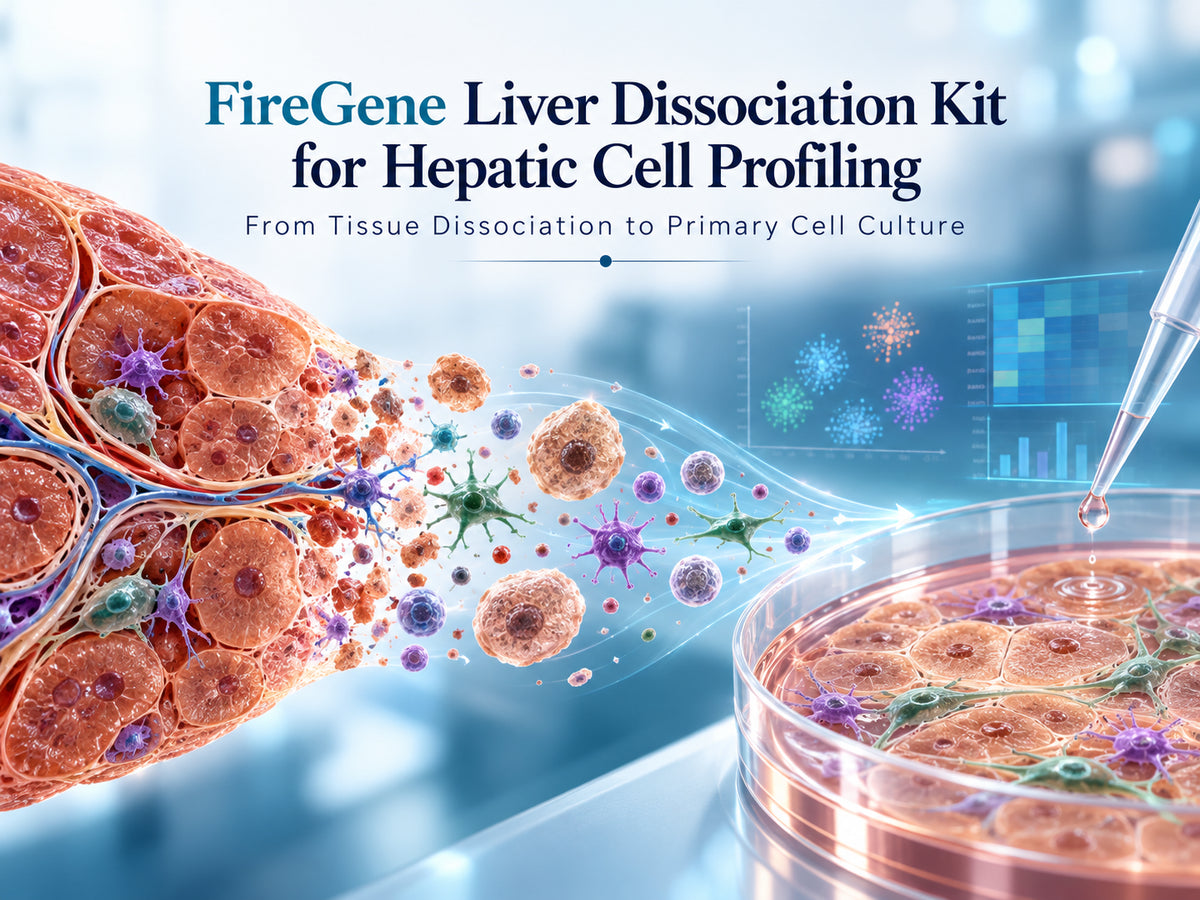
Liver tissue dissociation is essential for obtaining viable hepatic cells for cellular and molecular research. Beyond single-cell RNA sequencing and flow cytometry, isolated liver cells can support primary cell culture and functional experiments. The FireGene Liver Dissociation Kit for Hepatic Cell Profiling is designed to prepare single-cell suspensions from liver tissue, supporting downstream applications involving hepatocytes and non-parenchymal cells. This article discusses the suitability of dissociated hepatic cells for primary culture, their applications in drug metabolism, hepatotoxicity, liver inflammation, and fibrosis research, and the factors influencing cell attachment, viability, and functional stability. Understanding these considerations can help researchers optimize liver cell isolation and subsequent experimental workflows.
1. Introduction
The liver is a complex organ responsible for numerous physiological functions, including drug metabolism, protein synthesis, glucose regulation, lipid metabolism, and immune surveillance.
These functions depend on interactions among different hepatic cell populations, including hepatocytes, Kupffer cells, hepatic stellate cells, and liver sinusoidal endothelial cells.
Isolating these cells is essential for investigating liver biology under controlled experimental conditions.
However, liver tissue contains extensive cell–cell connections and extracellular matrix components that make direct cellular isolation challenging.
Tissue dissociation provides a method for separating liver tissue into individual cells while attempting to preserve their viability and biological characteristics.
The FireGene Liver Dissociation Kit for Hepatic Cell Profiling (FG-BA3323) is designed to generate single-cell suspensions from liver tissue for downstream research.
Although single-cell sequencing and flow cytometry are common applications, an important question is whether the recovered cells can also be used for primary cell culture.
The answer is yes. Cell culture is included among the manufacturer's stated applications. Nevertheless, successful cultivation depends on cell viability, attachment, appropriate culture conditions, and the physiological characteristics of the isolated cells.
2. Why Is Liver Tissue Dissociation Important for Primary Cell Culture?
Primary cell culture involves maintaining cells directly isolated from biological tissues.
Unlike immortalized cell lines, primary cells can retain selected characteristics of their tissue of origin, making them valuable for functional investigations.
Primary hepatocytes, for example, are widely used to study xenobiotic metabolism, hepatic enzyme activity, and cellular responses to experimental compounds.
However, the isolation process can significantly influence subsequent culture performance.
2.1 Preserving Cell Viability
Excessive enzymatic digestion or mechanical disruption can damage cell membranes, reduce viability, and interfere with cellular attachment.
Conversely, insufficient dissociation may result in cell aggregates that complicate recovery and experimental analysis.
A suitable dissociation workflow should balance effective tissue breakdown with the preservation of intact cells.
Researchers should evaluate cell viability immediately after isolation using established methods such as trypan blue exclusion or fluorescence-based live/dead assays.
2.2 Maintaining Functional Characteristics
High cell viability does not necessarily guarantee normal cellular function.
Hepatocytes may remain alive but exhibit altered enzyme activity, reduced protein synthesis, or impaired metabolic responses.
Therefore, cell quality should be evaluated using both viability measurements and functional assays relevant to the intended experiment.
3. Which Hepatic Cells Can Be Cultured After Dissociation?
Liver tissue contains several biologically distinct cell populations that may be recovered and maintained under suitable conditions.
3.1 Primary Hepatocytes
Hepatocytes constitute the major parenchymal cell population of the liver.
They participate in protein synthesis, drug metabolism, lipid regulation, and detoxification.
Following tissue dissociation, viable hepatocytes can be collected and seeded into appropriate culture vessels.
Primary hepatocyte cultures are commonly used for investigating:
Drug metabolism and hepatotoxicity
Cytochrome P450 enzyme activity
Lipid accumulation and metabolic dysfunction
Albumin synthesis and secretion
Oxidative stress and mitochondrial function
However, mature primary hepatocytes typically exhibit limited proliferation under conventional culture conditions.
Their differentiated functions may also decline during prolonged culture.
3.2 Kupffer Cells
Kupffer cells are specialized liver-resident macrophages involved in immune surveillance and inflammatory regulation.
After appropriate enrichment, isolated Kupffer cells may be maintained in culture for studies involving cytokine production, immune signaling, and macrophage activation.
These models are particularly useful for investigating liver inflammation and immune-related cellular responses.
3.3 Hepatic Stellate Cells
Hepatic stellate cells regulate extracellular matrix homeostasis and play important roles in liver fibrosis.
Following tissue injury, stellate cells may become activated and increase extracellular matrix production.
Cultured hepatic stellate cells provide models for studying collagen expression, fibrogenic signaling, and the molecular mechanisms underlying hepatic fibrosis.
However, standard culture conditions can independently promote stellate cell activation, making experimental controls essential.
3.4 Liver Sinusoidal Endothelial Cells
Liver sinusoidal endothelial cells contribute to hepatic vascular function, molecular exchange, and inflammatory regulation.
Following appropriate isolation and enrichment, these cells can support studies of endothelial signaling and interactions within the hepatic microenvironment.
Because they are sensitive to changes in their surrounding environment, specialized culture conditions may be necessary to preserve their characteristics.
4. Preparing Dissociated Liver Cells for Primary Culture
Successful primary culture requires careful handling throughout the isolation and seeding process.
Step 1: Tissue Preparation
Liver tissue should be collected and transported under suitable conditions to minimize cellular damage.
Prolonged processing delays or improper storage may compromise viability and reduce downstream culture performance.
Step 2: Enzymatic Dissociation
The tissue is processed using the FireGene Liver Dissociation Kit according to the manufacturer's instructions.
Controlled digestion facilitates the separation of hepatic cells from surrounding tissue structures.
Step 3: Cell Recovery and Washing
Following dissociation, the cell suspension may undergo filtration, washing, and debris removal.
Residual digestive enzymes should be adequately removed because they may interfere with cellular attachment and recovery.
Step 4: Cell Seeding
Recovered cells are transferred into culture vessels containing appropriate medium.
For primary hepatocytes, collagen-coated surfaces are commonly used to improve cell attachment.
Different hepatic cell populations may require specialized media and extracellular matrix conditions.
Step 5: Culture Evaluation
Following seeding, researchers should assess cellular morphology, attachment efficiency, viability, and relevant functional indicators.
For hepatocytes, albumin secretion, urea production, and cytochrome P450 activity are useful measurements of functional performance.
5. Downstream Research Applications
5.1 Drug Metabolism and Hepatotoxicity Studies
Primary hepatocytes are widely used in pharmaceutical research because they express enzymes responsible for drug biotransformation.
Cultured hepatocytes can help researchers evaluate cellular responses to investigational compounds.
Common experimental endpoints include cell viability, mitochondrial activity, oxidative stress, and metabolic enzyme function.
These assays provide valuable information about potential drug-induced cellular injury.
However, hepatocyte metabolic activity should be verified before conducting metabolism-dependent experiments.
5.2 Liver Fibrosis Research
Liver fibrosis involves excessive extracellular matrix accumulation following persistent hepatic injury.
Hepatic stellate cells are central regulators of this process.
Cultured stellate cells can be used to investigate fibrogenic pathways, collagen production, and cellular activation.
Experimental biomarkers frequently include alpha-smooth muscle actin (α-SMA), collagen type I, and transforming growth factor beta-associated signaling.
Researchers may also establish co-culture systems to investigate interactions between hepatocytes, macrophages, and stellate cells.
5.3 Hepatic Inflammation Research
Liver inflammation involves communication among immune cells, hepatocytes, and other resident cell populations.
Kupffer cells are particularly relevant because they regulate inflammatory responses through cytokine production and immune signaling.
Following dissociation and suitable enrichment, cultured Kupffer cells may be used to investigate inflammatory activation, cytokine expression, and NF-κB-associated pathways.
These experiments can help characterize the cellular mechanisms involved in liver injury and inflammatory disease.
5.4 Metabolic Dysfunction Research
The liver plays a central role in maintaining glucose and lipid homeostasis.
Primary hepatocyte cultures offer a platform for investigating hepatic lipid accumulation, metabolic stress, and changes in energy metabolism.
Researchers may examine triglyceride accumulation, mitochondrial function, and the expression of genes involved in lipid metabolism.
Such experiments support investigations into metabolic dysfunction-associated steatotic liver disease and related hepatic disorders.
5.5 Advanced Hepatic Cell Models
Isolated hepatic cells may also be incorporated into more complex experimental platforms.
Examples include hepatocyte–macrophage co-cultures, hepatocyte–stellate cell systems, and selected three-dimensional liver culture models.
These systems can facilitate the investigation of cell–cell communication and tissue microenvironment interactions.
However, advanced culture models require additional optimization beyond the initial tissue dissociation procedure.
6. How to Improve Cell Attachment and Culture Performance
One challenge in primary liver cell culture is achieving reliable attachment after tissue dissociation.
The FireGene product guidance discusses situations where cells exhibit acceptable viability but low attachment efficiency.
Several factors should be considered.
Removal of residual enzymes: Adequate washing helps reduce interference from remaining dissociation reagents.
Extracellular matrix coating: Collagen-coated culture surfaces can improve primary hepatocyte attachment.
Appropriate culture medium: Culture conditions should match the requirements of the specific hepatic cell population.
Controlled seeding conditions: Cell density and handling procedures should be optimized to minimize stress and support recovery.
Functional validation: Researchers should monitor attachment, morphology, viability, and relevant biological markers rather than relying on cell counts alone.
These measures can improve experimental consistency, although successful culture cannot be guaranteed for every tissue sample.
7. Can Dissociated Hepatocytes Be Maintained Long-Term?
Primary hepatocytes can be cultured following isolation, but maintaining differentiated hepatic functions over extended periods remains challenging.
Under conventional monolayer conditions, primary hepatocytes may gradually lose metabolic activity and characteristic morphology.
Specialized systems, including collagen sandwich cultures, co-cultures, and three-dimensional matrices, have been investigated to extend functional maintenance.
Nevertheless, primary hepatocyte culture should not be confused with continuous cell expansion.
Mature hepatocytes generally have limited proliferation under standard laboratory conditions.
Therefore, researchers should distinguish between short-term functional experiments, extended maintenance of differentiated cells, and long-term cell propagation.
The FireGene Liver Dissociation Kit supports the initial cell isolation stage but does not independently guarantee long-term culture stability.
8. Conclusion
Liver tissue dissociation is an essential step in obtaining viable hepatic cells for laboratory research.
The FireGene Liver Dissociation Kit for Hepatic Cell Profiling supports the preparation of single-cell suspensions that can be used not only for single-cell sequencing and cellular profiling but also for primary cell culture and downstream experimental applications.
Depending on cell quality and subsequent enrichment procedures, isolated hepatocytes and non-parenchymal cells may support drug metabolism studies, hepatotoxicity assays, hepatic inflammation investigations, liver fibrosis research, and advanced co-culture models.
Successful culture requires careful attention to tissue quality, enzymatic digestion, cell recovery, extracellular matrix selection, and cell-type-specific maintenance conditions.
By connecting liver tissue dissociation with functional cell culture, researchers can extend their investigations from cellular characterization to experimental studies of hepatic physiology and disease mechanisms.


