
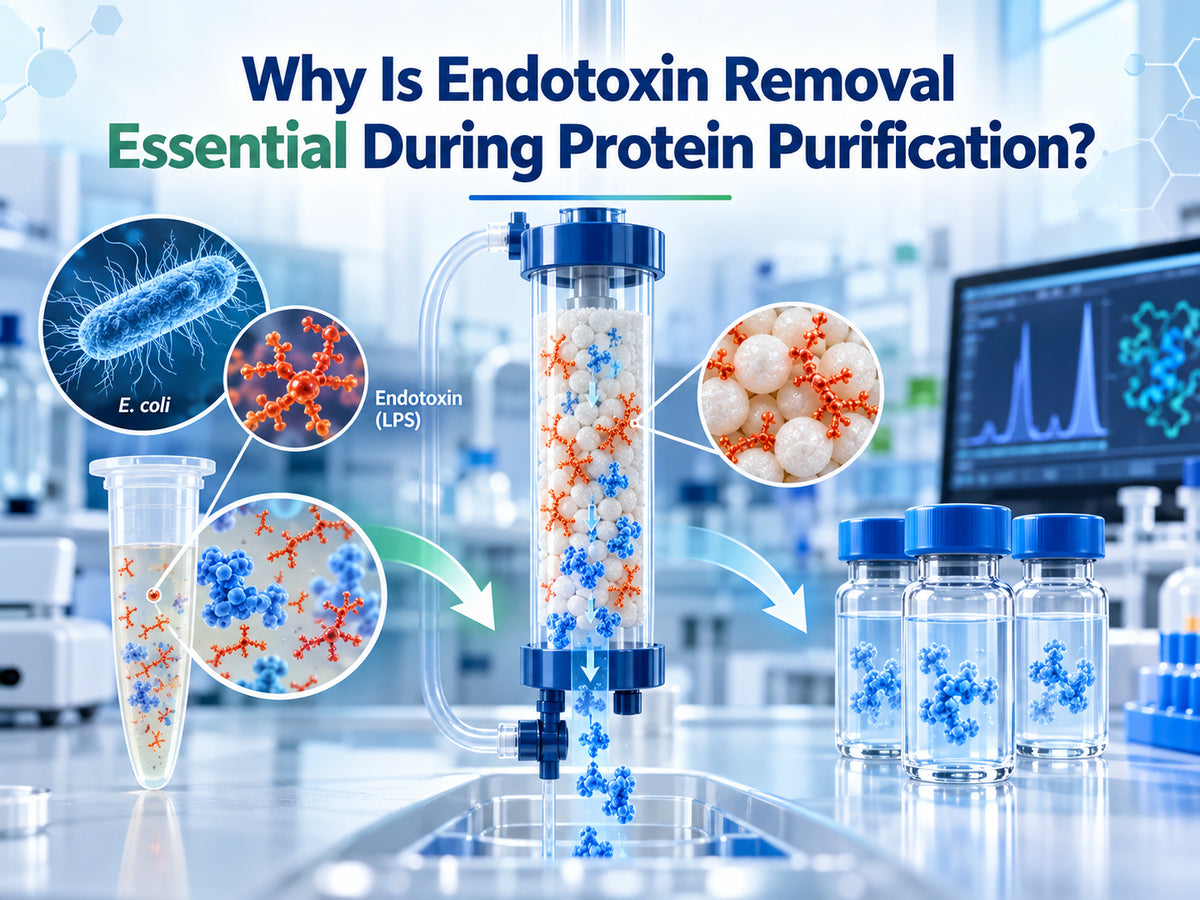
Endotoxin contamination represents a significant challenge in recombinant protein purification, particularly when proteins are expressed in Gram-negative bacteria such as Escherichia coli. Bacterial endotoxins, primarily lipopolysaccharides (LPS), can remain associated with target proteins throughout extraction and purification. These contaminants may interfere with biological assays, activate unwanted immune responses, and compromise experimental reproducibility. Because conventional purification techniques do not always eliminate endotoxins, dedicated removal strategies are often necessary. This article examines the sources and consequences of endotoxin contamination, compares common removal methods, and explains how high-efficiency endotoxin removal purification resin helps produce high-quality proteins while maintaining protein recovery, structural integrity, and biological activity.
1. What Are Endotoxins in Protein Purification?
Endotoxins are lipopolysaccharides (LPS) located in the outer membranes of Gram-negative bacteria, including Escherichia coli, Pseudomonas aeruginosa, and Salmonella species.
LPS molecules contain three major structural components: lipid A, a core oligosaccharide, and an O-antigen polysaccharide.
Lipid A is primarily responsible for the inflammatory activity associated with bacterial endotoxins.
During recombinant protein production, bacterial cell disruption releases intracellular proteins alongside membrane-associated components, including LPS.
These endotoxins can interact with proteins through hydrophobic or electrostatic interactions, making separation challenging.
Unlike living bacteria, endotoxins do not require microbial viability to produce biological effects. Therefore, sterilization or sterile filtration does not necessarily eliminate endotoxin contamination.
2. Why Is Endotoxin Removal Critical During Protein Purification?
2.1 Preventing Interference with Biological Assays
Residual endotoxins can interfere with experiments designed to investigate recombinant protein activity.
LPS is a potent activator of innate immunity, particularly through the TLR4–MD-2 signaling complex.
This activation can trigger downstream pathways involving NF-κB and promote inflammatory cytokine production.
Consequently, endotoxin-contaminated protein preparations may produce biological responses unrelated to the target protein.
For example, a recombinant protein may appear to stimulate macrophage activation when the observed response is actually caused by residual LPS.
Such contamination can lead to misleading conclusions about protein function and signaling mechanisms.
2.2 Preserving Protein Quality and Biological Activity
Protein purification aims to obtain target proteins with suitable purity, structural integrity, and functional activity.
However, endotoxin contamination can compromise the suitability of a preparation for downstream biological applications.
LPS–protein interactions may also complicate purification and analytical characterization.
In addition, aggressive endotoxin removal procedures can cause protein loss, aggregation, or loss of activity.
Therefore, an effective purification strategy should balance three objectives:
Reducing endotoxin contamination.
Maintaining protein recovery and structural integrity.
Preserving biological activity.
High-efficiency endotoxin removal purification resin may help achieve these objectives when appropriately matched to the target protein.
2.3 Improving Experimental Reproducibility
Endotoxin concentrations can vary among protein purification batches.
Even when protein purity appears comparable, differences in residual LPS levels may influence downstream biological experiments.
This variability is especially important in immunological studies, where small amounts of endotoxin can alter cellular responses.
Consistent endotoxin control helps researchers improve data reproducibility and compare experimental results across different protein batches.
3. Where Does Endotoxin Contamination Come From?
Endotoxin contamination can originate at multiple stages of protein production and purification.
3.1 Bacterial Expression Systems
E. coli is widely used for recombinant protein production because of its rapid growth, established genetic tools, and efficient protein expression.
However, its outer membrane contains substantial amounts of LPS.
During cell lysis, endotoxin-containing components are released into the crude protein extract.
Some endotoxins may remain associated with the target protein throughout downstream processing.
3.2 Buffers and Laboratory Materials
Endotoxins may also be introduced through contaminated water, purification buffers, equipment, and laboratory consumables.
Inadequate cleaning or prolonged storage of aqueous solutions can increase contamination risks.
Using appropriately qualified low-endotoxin materials helps reduce the initial endotoxin burden.
3.3 Incomplete Removal During Chromatography
Conventional protein purification methods, including affinity and ion-exchange chromatography, are primarily optimized for separating the target protein from other components.
However, protein-bound endotoxins may co-purify with the desired product.
Consequently, high protein purity does not automatically indicate low endotoxin content.
4. How Can Endotoxins Be Removed from Protein Samples?
Several strategies are available for reducing endotoxin contamination.
|
Method |
Principle |
Main Consideration |
|
Affinity-based endotoxin removal resin |
Captures endotoxin through selective interactions |
Requires protein compatibility testing |
|
Ion-exchange chromatography |
Separates components based on charge |
Protein and LPS may exhibit overlapping interactions |
|
Ultrafiltration |
Separates molecules or aggregates through membrane-based processes |
Effectiveness depends on molecular size and aggregation |
|
Detergent-assisted phase separation |
Partitions endotoxins into a detergent-rich phase |
Requires detergent removal and protein stability assessment |
|
Specialized adsorbents |
Bind endotoxin through surface chemistry |
Capacity, selectivity, and recovery vary |
The optimal method depends on protein properties, sample composition, endotoxin concentration, and downstream applications.
No single method is universally suitable for every recombinant protein.
5. How Does High-Efficiency Endotoxin Removal Purification Resin Work?
High-efficiency endotoxin removal purification resin is designed to reduce LPS contamination in compatible aqueous protein preparations.
Depending on the formulation, the resin may contain immobilized affinity ligands or functional groups capable of interacting with endotoxin molecules.
These interactions may involve electrostatic attraction, hydrophobic binding, or ligand-specific recognition.
During purification, endotoxins bind to the resin while the protein-containing solution is recovered.
The effectiveness of this approach depends on factors such as pH, ionic strength, resin capacity, contact time, and protein characteristics.
Key Benefits of Endotoxin Removal Resin
Efficient LPS reduction: Helps decrease endotoxin contamination that may persist after conventional protein purification.
Mild processing conditions: Can offer an alternative to harsh thermal or chemical treatments for temperature-sensitive proteins.
Protein recovery: Appropriately selected resins may minimize target protein loss, although recovery must be experimentally verified.
Preservation of biological activity: Compatible purification conditions may help maintain protein functionality.
Flexible workflow integration: Can potentially be incorporated into downstream recombinant protein purification procedures.
Published research has demonstrated that affinity-based and detergent-assisted approaches can substantially reduce endotoxins in recombinant protein preparations, although performance varies with the purification system.
6. How Does Endotoxin Removal Improve Downstream Research?

6.1 Cell Culture Experiments
Endotoxin contamination can alter the behavior of immune-sensitive cell populations, including macrophages, monocytes, and dendritic cells.
LPS exposure may increase cytokine production, activate inflammatory signaling, and modify gene expression.
Using low-endotoxin recombinant proteins helps reduce unwanted cellular stimulation.
6.2 Protein–Receptor Interaction Studies
Residual LPS may complicate experiments investigating interactions between recombinant proteins and cellular receptors.
This is especially relevant when studying inflammatory signaling pathways or potential TLR4-associated biological activity.
Appropriate endotoxin controls help distinguish genuine protein-mediated responses from contamination-related effects.
6.3 Biopharmaceutical Research
Recombinant proteins intended for pharmaceutical development require careful control of product-related and process-related impurities.
Endotoxin contamination represents an important safety and quality concern, particularly for parenteral applications.
According to the FDA, controlling endotoxin contamination throughout manufacturing is preferable to attempting removal from heavily contaminated finished products.
7. Conclusion
Endotoxin removal is an important component of recombinant protein purification, particularly when proteins are expressed in Gram-negative bacterial systems.
Residual LPS can interfere with biological assays, stimulate unwanted immune responses, and compromise experimental reproducibility.
Although conventional chromatography can achieve high protein purity, additional endotoxin removal may be necessary to obtain preparations suitable for endotoxin-sensitive applications.
High-efficiency endotoxin removal purification resin offers a practical approach to reducing LPS contamination while aiming to maintain protein recovery, structural integrity, and biological activity.
Combining appropriate purification methods, endotoxin testing, and protein quality assessment helps researchers produce more reliable recombinant protein preparations for downstream biological research.


