
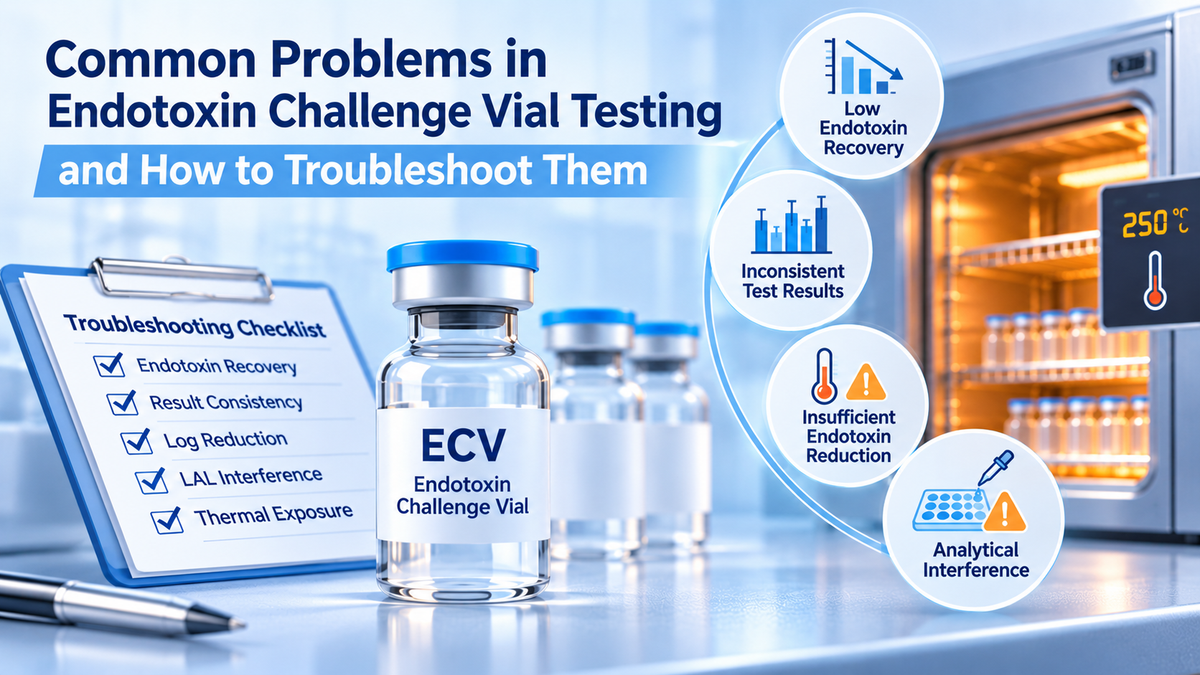
Endotoxin Challenge Vials (ECVs) are widely used to evaluate the effectiveness of dry heat depyrogenation processes in pharmaceutical manufacturing. Although ECV testing provides a measurable approach to assessing endotoxin reduction, several analytical and operational challenges can compromise the reliability of validation results. Common difficulties include inadequate endotoxin recovery, inconsistent measurements, insufficient logarithmic reduction, and interference during bacterial endotoxin testing. These issues may arise from indicator characteristics, extraction procedures, assay conditions, equipment performance, or sample handling practices. Understanding their underlying causes is essential for distinguishing analytical errors from genuine process deficiencies. This article examines common problems encountered during ECV testing and discusses systematic troubleshooting strategies to improve accuracy, reproducibility, and confidence in pharmaceutical depyrogenation validation.
1. Introduction
Bacterial endotoxin control is an essential component of pharmaceutical quality assurance, particularly in the manufacture of injectable drugs, sterile preparations, and parenteral products.
Endotoxins are primarily associated with lipopolysaccharides (LPS) present in the outer membranes of Gram-negative bacteria. Unlike viable microorganisms, endotoxins may retain biological activity after conventional sterilization procedures.
Consequently, pharmaceutical manufacturers must evaluate depyrogenation processes separately from microbial sterilization when endotoxin reduction is required.
Endotoxin Challenge Vials (ECVs) provide a practical method for assessing the effectiveness of these processes.
ECVs contain a characterized endotoxin challenge that can be exposed to defined processing conditions. By comparing recovered endotoxin activity in treated and untreated indicators, laboratories can determine the logarithmic reduction achieved during depyrogenation.
However, reliable ECV testing requires more than successful execution of a thermal cycle.
Indicator preparation, endotoxin recovery, analytical method suitability, equipment performance, and experimental design can all affect the resulting measurements.
When unexpected results occur, a systematic investigation is necessary to determine whether the problem originates from the depyrogenation process or the testing procedure itself.
2. Understanding the Importance of Reliable ECV Testing
The primary purpose of ECV testing is to demonstrate that a depyrogenation process achieves a predefined reduction in measurable bacterial endotoxin activity.
For applicable dry heat depyrogenation studies, a commonly used performance benchmark is a reduction of at least three logarithmic units.
A 3-log reduction represents a 1,000-fold decrease, equivalent to a 99.9% reduction in endotoxin activity.
The reduction is calculated as:
Log Reduction = log₁₀ (Initial Recoverable Endotoxin Activity / Residual Endotoxin Activity)
For example, if an untreated control provides 10,000 EU/vial and a treated indicator contains 10 EU/vial, the calculated reduction is 3 log.
Nevertheless, the accuracy of this calculation depends on the reliability of both measurements.
Poor endotoxin recovery, inappropriate sample dilution, analytical inhibition, or inconsistent thermal exposure may produce misleading results.
Therefore, effective troubleshooting is essential for obtaining scientifically defensible validation data.
3. Problem One: Low Endotoxin Recovery
3.1 Understanding Low Recovery
Insufficient endotoxin recovery from untreated control indicators is a significant concern during ECV validation.
Untreated controls establish the recoverable initial endotoxin challenge used to calculate process reduction.
When recovery is lower than expected, the baseline measurement may not accurately represent the intended challenge.
This can affect the interpretation of the calculated logarithmic reduction.
3.2 Common Causes
Several factors may contribute to low endotoxin recovery.
Endotoxin adsorption: Lipopolysaccharide molecules may interact with glass surfaces or other materials used during extraction.
Incomplete extraction: Inadequate agitation, extraction time, or unsuitable extraction conditions may prevent efficient endotoxin recovery.
Unsuitable extraction media: The composition or properties of the extraction solution may affect endotoxin recovery or subsequent assay performance.
Sample handling losses: Transfer procedures, container selection, and pipetting practices may introduce variability or reduce the amount of recoverable endotoxin.
Analytical inhibition: A low result may reflect interference in the measurement method rather than incomplete physical extraction.
3.3 Troubleshooting Strategies
When poor recovery is observed, laboratories should first review the indicator manufacturer's extraction instructions and the approved analytical procedure.
Extraction conditions should be evaluated to determine whether mixing, contact time, or other procedural variables contributed to the result.
Appropriate endotoxin-free consumables and extraction media should be used to minimize contamination and analytical artifacts.
Replicate untreated controls can help determine whether the problem is systematic or associated with individual samples.
Analytical method suitability should also be reviewed to distinguish genuine recovery problems from assay inhibition.
If control recovery does not meet predefined acceptance criteria, the affected validation results should be investigated before drawing conclusions about depyrogenation effectiveness.
4. Problem Two: Inconsistent ECV Test Results
4.1 Sources of Variability
Inconsistent results between replicate indicators can reduce confidence in the reproducibility of a depyrogenation study.
For example, indicators exposed during the same qualification run may produce different residual endotoxin measurements.
Such variation does not necessarily indicate equipment failure.
Instead, the difference may originate from several independent sources.
4.2 Potential Causes
Uneven thermal exposure: Indicators positioned at different locations may experience variations in heat distribution or penetration.
Indicator variability: Differences in endotoxin loading or recovery characteristics may contribute to inconsistent measurements.
Operator technique: Variations in extraction, mixing, dilution, and sample transfer may influence analytical results.
Analytical variability: Instrument performance, calibration, reagent preparation, and assay execution may affect measurement consistency.
Sample contamination: Introduction of environmental endotoxin during handling may produce unexpectedly elevated values.
4.3 Troubleshooting Strategies
A structured investigation should begin with a review of indicator placement and process records.
Temperature distribution and heat penetration data should be evaluated to determine whether the affected indicators experienced comparable thermal conditions.
Laboratories should also review the indicator lot, extraction procedure, assay controls, and sample handling records.
Using indicators from a consistent manufacturing lot and standardized analytical procedures can help minimize unnecessary variability.
Operator training and routine equipment verification further support reproducible results.
Unexpected outliers should not be excluded without documented scientific justification.
5. Problem Three: Insufficient Endotoxin Reduction
5.1 Identifying Inadequate Reduction
One of the most important outcomes of ECV validation is determining whether the depyrogenation process meets its predefined acceptance criteria.
If the measured logarithmic reduction is below the established requirement, the study may indicate inadequate process performance.
For example, a reduction of 2.4 log would not meet a predefined 3-log acceptance criterion.
However, the underlying cause must be investigated before determining whether the thermal cycle itself is inadequate.
5.2 Potential Causes
Several process-related factors can contribute to insufficient endotoxin reduction.
Inadequate thermal exposure: The actual temperature or exposure duration may be insufficient for the intended process.
Improper loading configuration: Container arrangement or excessive loading may affect heat distribution and penetration.
Conveyor speed variation: In continuous depyrogenation tunnels, changes in conveyor speed may alter residence time within the heating zone.
Equipment performance problems: Heating elements, airflow systems, temperature sensors, or control systems may not operate as intended.
Incorrect indicator placement: Indicators may have been positioned under conditions that do not match the approved study design.
Analytical errors and unexpectedly elevated residual measurements should also be considered.
5.3 Troubleshooting Strategies
The investigation should include a review of recorded temperature profiles, exposure duration, equipment status, and loading conditions.
Temperature mapping and heat penetration studies may help identify locations receiving inadequate thermal exposure.
For continuous systems, conveyor speed and residence time should be evaluated.
For batch ovens, attention should be given to loading arrangements, shelf positions, and temperature uniformity.
Before modifying process parameters, laboratories should confirm that the analytical method and untreated control recovery were acceptable.
Corrective actions should address the documented root cause, followed by appropriate verification or repeat validation.
6. Problem Four: Analytical Interference During LAL Testing
6.1 Understanding Analytical Interference
Bacterial endotoxin testing commonly relies on Limulus Amebocyte Lysate (LAL)-based methods.
These methods detect endotoxin through an enzymatic reaction that can be influenced by sample composition and assay conditions.
Interference may produce falsely low or elevated endotoxin measurements, compromising the interpretation of ECV results.
6.2 Common Sources of Interference
Reaction inhibition: Certain sample components may suppress the assay response, potentially causing underestimation of endotoxin activity.
Reaction enhancement: Some substances or matrix effects may increase the measured response, leading to artificially elevated results.
Unsuitable pH: Conditions outside the validated assay range may affect enzymatic activity.
Extraction-related interference: Materials introduced during extraction or dilution may alter assay performance.
Contamination: Endotoxin introduced through laboratory water, containers, or handling may interfere with low-level measurements.
6.3 Troubleshooting Strategies
Analytical method suitability should be established for the recovered ECV samples.
Appropriate positive product controls or equivalent method-specific controls can help identify inhibition or enhancement.
When justified, sample dilution may reduce matrix-related interference, provided the dilution remains compatible with the required analytical sensitivity.
The suitability of extraction media, sample containers, and laboratory reagents should also be evaluated.
Testing procedures should follow the applicable method requirements and manufacturer's instructions.
7. Problem Five: Poor Indicator Placement and Temperature Distribution
7.1 Why Placement Matters
The position of an ECV within depyrogenation equipment can significantly influence the thermal exposure it receives.
An indicator placed in a location with favorable heat transfer may demonstrate adequate reduction even when other parts of the equipment receive less effective treatment.
Therefore, indicator placement should be based on scientific evaluation rather than convenience.
7.2 Troubleshooting Placement Problems
Temperature mapping and heat penetration studies should be reviewed to identify representative challenging locations.
For batch dry heat ovens, relevant variables may include shelf position, chamber loading, airflow characteristics, and container arrangement.
For continuous depyrogenation tunnels, conveyor position, belt speed, loading pattern, and heating-zone temperature distribution should be considered.
The validation protocol should document the rationale for each indicator location.
If placement does not adequately represent the intended worst-case conditions, additional qualification work may be necessary.
8. A Systematic Approach to ECV Troubleshooting
A structured investigation helps distinguish analytical problems from genuine depyrogenation failures.
Step 1: Verify Untreated Control Recovery
Confirm that the untreated ECVs provide acceptable recoverable endotoxin activity.
Review extraction conditions and control results before interpreting treated indicators.
Step 2: Evaluate Analytical Method Suitability
Examine assay sensitivity, calibration performance, inhibition or enhancement, and sample dilution.
Determine whether the analytical method can reliably measure endotoxin activity within the required range.
Step 3: Review Indicator Handling
Check indicator identity, lot information, storage conditions, expiration dates, and handling procedures.
Confirm that the indicators were suitable for the intended validation study.
Step 4: Examine Processing Conditions
Review temperature records, exposure duration, equipment loading, conveyor speed, and relevant operating parameters.
Compare actual conditions with those defined in the approved validation protocol.
Step 5: Assess Study Design and Indicator Placement
Determine whether indicator locations adequately represented challenging processing conditions.
Evaluate supporting temperature distribution and heat penetration studies.
Step 6: Implement Corrective and Preventive Actions
Once the root cause has been identified, appropriate corrective actions should be documented and implemented.
Repeat testing or requalification should be performed when necessary and according to approved quality procedures.
9. Best Practices for Improving ECV Testing Reliability
Many common ECV testing problems can be minimized through appropriate study planning and laboratory controls.
Important practices include:
Select characterized Endotoxin Challenge Vials from qualified suppliers.
Review manufacturer documentation before testing.
Establish suitable endotoxin recovery procedures.
Use qualified bacterial endotoxin testing methods.
Conduct appropriate temperature mapping and heat penetration studies.
Standardize sample extraction and handling procedures.
Maintain adequate analytical controls.
Document processing conditions and deviations.
Investigate unexpected results before modifying validated parameters.
Apply scientifically justified acceptance criteria.
These practices improve reproducibility and support the integrity of pharmaceutical depyrogenation validation data.
10. Conclusion
Endotoxin Challenge Vial testing provides valuable evidence for evaluating the effectiveness of dry heat depyrogenation processes.
However, the reliability of the results depends on multiple factors, including endotoxin recovery, indicator consistency, analytical method suitability, thermal exposure, and study design.
Low endotoxin recovery, inconsistent results, insufficient logarithmic reduction, and LAL assay interference are among the most important issues encountered during validation.
Each problem requires a systematic investigation to distinguish technical or analytical variability from genuine process deficiencies.
By combining appropriate controls, qualified analytical procedures, representative indicator placement, and comprehensive documentation, laboratories can improve the accuracy and consistency of ECV validation studies.
A well-designed troubleshooting strategy not only supports successful depyrogenation qualification but also strengthens endotoxin contamination control within pharmaceutical manufacturing operations.
Frequently Asked Questions (FAQs)
1. What causes low endotoxin recovery from ECVs?
Low recovery may result from endotoxin adsorption, incomplete extraction, unsuitable recovery conditions, sample handling losses, or analytical inhibition.
2. Why do ECVs sometimes produce inconsistent results?
Variability may arise from differences in thermal exposure, indicator characteristics, extraction procedures, operator technique, or assay performance.
3. What should be done when ECV testing fails to demonstrate a 3-log reduction?
Laboratories should investigate untreated control recovery, analytical suitability, processing parameters, temperature distribution, and indicator placement before determining appropriate corrective actions.
4. Can LAL assay interference affect ECV validation?
Yes. Reaction inhibition or enhancement can produce misleading endotoxin measurements. Appropriate method suitability testing is necessary to identify such effects.
5. How can ECV validation reproducibility be improved?
Reproducibility can be improved through standardized procedures, characterized indicators, qualified recovery methods, appropriate equipment mapping, and comprehensive documentation.
6. Are ECVs suitable for both batch ovens and continuous depyrogenation tunnels?
Yes, provided the indicator design is compatible with the equipment and the validation protocol accounts for the relevant operating characteristics.
For laboratory research and applicable pharmaceutical process-validation use only. Always follow the indicator manufacturer's instructions, validated analytical methods, and approved quality procedures.


